Into the darkness d 1, p.55
Into the Darkness d-1,
p.55


Balozhu nodded to him and Smilsu. “Courage, men,” he said, though he hadn’t shown any enormous amount of it himself. “Before long, the Algarvians’ attacks must surely lose their impetus.”
“Aye, my lord count,” Talsu answered, though Balozhu hadn’t given any reason why the Algarvians should slow down. Talsu and Smilsu both bowed low; Balozhu might not have been a bold soldier, but he was a stickler for military punctilio. Satisfied, he went on his way, that mildly confused expression still spread across his bland features.
Very, very softly, Smilsu said, “Aye, he’ll lead us to victory.” In a different tone of voice, that might have been praise for Balozhu. As things were, Talsu looked around to make sure no one but him had heard his friend.
He too spoke in a whisper: “I don’t know why we bother keeping up this fight when it’s already lost.”
“Another good question,” Smilsu allowed. “Another question you’d better not ask our dear, noble colonel. The only answer he’d come up with has a dungeon in it somewhere, you mark my words.”
“I can do better than that for myself, thanks,” Talsu said. “Staying alive comes to mind. You throw down your stick and throw up your hands in front of an Algarvian, it’s not better than even money he lets you surrender. He’s about as likely to blaze you down instead.”
“Aye, the redheads are savages,” Smilsu said. “They always have been. I expect they always will be.” He spat in glum emphasis.
“That’s the truth,” Talsu said. But he recalled slitting Algarvian’s throats when sticks needed charging. Not all the savagery lay on the Algarvian side.
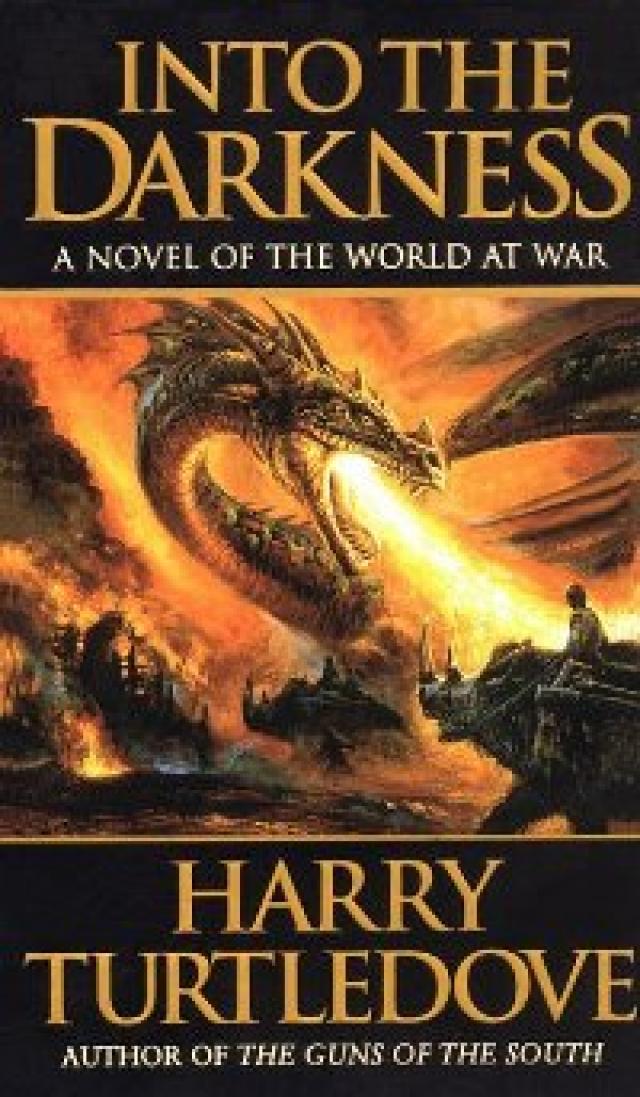
And then he stopped caring where the savagery lay, for the Algarvians started tossing eggs at his regiment’s position. Dragons appeared overhead, dropping more eggs and also swooping low to flame Jelgavans rash enough to be caught away from cover. Shouting like demons in their coarse, trilling tongue, the redheads swarmed forward.
They flitted from rock to rock like the mountain apes of the distant west. But mountain apes were not armed with sticks. Mountain apes did not bring heavy sticks and egg-tossers forward on the backs of armored behemoths. Mountain apes did not have dragons diving to their aid.
Along with the rest of the regiment, Talsu retreated. It was that or be outflanked, cut off, and altogether wrecked. Spotting Vartu not far away, a cut on his forehead sending blood dripping down the side of his face, Talsu called, “Don’t you wish you’d gone home to serve Dzirnavu’s relations?”
“Powers above, no!” the former regimental commander’s servant answered. “There, they’d be paying me to let them abuse me. Here, if these stinking Algarvians want to do me a bad turn, I can blaze back at them.” He dropped to one knee and did just that. Then he retreated again, falling back like the veteran he’d become.
Talsu was unhappily aware that his comrades and he couldn’t retreat a great deal farther, not with the Algarvians still blocking the pass through which the main line of the retreat would have to go. He wondered what Colonel Balozhu and the men above him would have them do once they were well and thoroughly trapped. Whatever it was, it would probably be some half measure that didn’t come close to solving the real problem, which was that the Algarvians had more imagination than they knew what to do with and the Jelgavans … the Jelgavans didn’t have nearly enough.
More eggs rained down on the beleaguered regiment. More Algarvians pushed forward against its crumbling front, too. Talsu began to wonder whether the officers above Balozhu would have much chance to do anything with the regiment at all. It seemed to be breaking up right here. Maybe his chances of living through an attempted surrender were better than those of living through much more fighting after all.
Dragons stooped like falcons, flaming, flaming. Not far away from Talsu, a man turned into a torch. He kept running and shrieking and setting bushes ablaze till at last, mercifully, he fell. Talsu made up his mind to yield himself up to the first Algarvian who wasn’t actively trying to kill him the instant they saw each other.
Then Smilsu shouted, “Over here! This way!” Talsu, just then, would have taken any way out of the trap in which the regiment found itself. The stink of his comrade’s charred flesh in his nostrils, he ran toward the little path leading up into the mountains that Smilsu had found.
He wasn’t the only one, either. Vartu and half a dozen others sprinted toward that path. None of them, Talsu was sure, had the least idea where it led, or if it led anywhere. None of them cared, cither; he was equally sure of that. Wherever it went could not be worse than here.
That was what he thought till another dragon painted in white and green and red swooped toward his comrades and him. On that narrow track, they had nowhere to run, nowhere to hide. He threw his stick up to his shoulder and blazed away. He gave a sort of mental shrug even as he did so. If he was going to die, he’d die fighting. Given a chance, he would have far preferred not dying at all. Soldiers didn’t always get choices like that.
Sometimes—not nearly often enough, especially not among Jelgavans these days—soldiers did get lucky. Talsu wasn’t the only one blazing at the dragon, but he always insisted his was the beam that caught the great beast in the eye and blazed out its tiny, hate-filled brain. Instead of turning him into another human torch, the dragon and its flier slammed into the ground not twenty feet from him, cutting off the mouth of the path. The dragon’s carcass began to burn then. The flier didn’t move; the fall of his dragon must have killed him.
Talsu was not about to complain. He had his life back when he’d expected to lose it in the next instant. “Let’s go!” he said. He still didn’t know where he was going. He didn’t care, either. He could go, and so he would.
“Blazed down a dragon!” Smilsu cried. “They’d give us a decoration for that, if only they knew about it.”
“Bugger the decorations,” Talsu said. He looked around. No, he had no officers, nor even any sergeants, to tell him what to do. He felt absurdly free, cut off not only from whatever was left of the rest of the regiment but also from the army and Jelgava as a whole. “Come on. Let’s see if we can get away.”
“We’ve already gotten away,” Vartu said, which also held a great deal of truth. The ex-servant turned an eye to the sky, no doubt fearing another dragon might turn that truth into a lie.
But the Algarvians had more to worry about than a few fleeting foot-soldiers. Their dragons rained death down on the Jelgavans still trying to push through their force plugging the pass. Talsu and his companions, out of the main tight, were quickly forgotten.
“Do you know,” Smilsu said after they trudged east, or as close to east as they could, for a couple of miles, “I think this track is going to let us out into the foothills on the other side of the mountains.”
“If you’re right,” Vartu said, “it sure as blazes doesn’t look like anybody in a fancy uniform knows it’s here. If the dukes and counts and what have you did know, they’d be moving men along it.”
Smilsu nodded. “Aye. If we come out the other side, we could be heroes for letting the dukes know about it.”
They walked on a while longer. Then Talsu said, “If I had my choice between being a hero and being out of the cursed war …” He took another couple of steps before realizing that might be exactly the choice he had. He spat. “What have the dukes and counts and what have you ever done for me? They’ve done plenty to me. They’ve done their cursed best to get me killed. Let them sweat.” He kept going. None of the others said a word to contradict him.
16.
Tealdo and his company tramped down a road through fields fragrant with fennel. The Jelgavans used the spice to flavor sausage. Tealdo gnawed on a hard, grayish length of the stuff he’d taken from a farmhouse a few miles back. At first, he hadn’t been sure he liked it; it gave the chopped and salted meat a slightly medicinal taste. Now that he’d grown used to it, though, it wasn’t bad.
Here and there in the fields, Jelgavan farmers stood staring at the Algarvian soldiers advancing past them. Tealdo pointed to one of them, a thickset, stooped old man leaning on a hoe. “Wonder what’s going through his head right now. He never expected to see us on this side of the Bradanos, I’ll lay.”
“I wouldn’t mind getting laid myself,” his friend Trasone answered. That wasn’t what Tealdo had meant, but it didn’t strike him as the worst idea in the world, either. Trasone went on, “I bet the Kaunian bastard is hoping he locked up his daughters well enough so we can’t find ’em or maybe”—he took another look at the farmer—“maybe his granddaughters.”
Sergeant Panfilo glared at both of them. “We don’t have the time to waste for you cockproud whoresons to pull the pants off every Jelgavan slut we find. We finish this occupation, they’ll set up brothels for us, set ’em up or more likely take over some that are already going. Till then, keep your pricks under your kilts.”
In a low voice, Tealdo said, “Panfilo’s an old man. Doesn’t matter to him if he has to wait for his fun.” Trasone laughed and nodded. Unfortunately for Tealdo, his voice hadn’t been quite low enough. Panfilo spent the next mile and a half scorching his ears.
By the time the sergeant was through, Tealdo thought he could smell the organs in question sizzling. The only thing that kept him from being sure was the smoke already drifting in the air. Behemoths and dragons had gone ahead of the main force of footsoldiers, following the same pattern in Jelgava as they had farther south in Valmiera. Here, once they’d forced their way through the passes and down on to the plain, they’d met little resistance.
Four or five Jelgavans got out of the road to let the Algarvian soldiers march past them. The Jelgavans wore dirty, tattered uniforms, but none of them was carrying a weapon. “Sir, shouldn’t we round them up and send them back to a captives’ camp?” somebody asked Captain Galafrone.
“I don’t see any point to bothering,” replied the commoner who’d risen from the ranks. “The war’s over for them. They’re heading for home, no place else but. When they get there, they’ll tell everybody who’ll listen that we’re too tough to lick. That’s what we want the Jelgavans to hear.”
He showed a hard common sense a lot of officers with bluer blood would have been better off having. Tealdo nodded approval. These Jelgavans weren’t going to do any more fighting; they looked so tired and worn, they might have been some of the handful who’d made it back from the Algarvian side of the mountains. Indeed, why waste time and detail a man to escort them off into captivity?
One of them shook his fist toward the east. “Blaze our noblemen!” he said in accented Algarvian. Then he dropped back into Jelgavan to tell his pals what he’d said. Their blond heads bobbed up and down.
“Don’t worry about it, chum,” Trasone said. “We’ll take care of it for you.”
Tealdo couldn’t tell whether the Jelgavans understood his friend or not. It mattered little, one way or the other. King Donalitu hadn’t surrendered yet, but the war was as good as over even so. Some more Jelgavans would get blazed because their king was stubborn, and a few Algarvians, too, but that also mattered little, as far as Tealdo could see. Once the mountain shell was cracked, Jelgava had proved easy meat.
“Come on, you miserable, lazy bastards,” Galafrone called to his own men. “Keep moving. The deeper we push the knife in, the less room the blonds will have to wriggle and the more they’ll bleed.” He did his best to drive his company forward with the force of his words and will, but Tealdo noted that he didn’t sound so urgent as he had in the campaign against Valmiera. Even he thought the Algarvians were on the point of wrapping things up.
As if to prove as much, an hour or so later a few Algarvian guards led a great many more Jelgavans west toward captivity. The Jelgavans were not glum or downhearted. Instead, they smiled and laughed and joked with the men who guarded them. To them, a captives’ camp looked good.
“Degenerate Kaunians,” Trasone said scornfully.
“Well, maybe,” Tealdo answered, “but maybe not, too. I don’t think it’s against the law to show you’re glad to be alive.”
“You could be right,” Trasone said, but he didn’t sound as if he believed it. “You’re more generous than I am, though, I’ll tell you that.”
Tealdo only shrugged and kept plodding east. Jelgavans weren’t worth arguing about. But he remained convinced he had it straight. If he’d been a Jelgavan soldier—especially a Jelgavan soldier east of the mountains, who wouldn’t have expected to do much fighting till just before the fighting found him—he wouldn’t have needed to be a degenerate to be happy he’d come through in one piece.
Toward evening that day, a couple of diehard Jelgavans blazed at Tealdo and his comrades from a brushy field. Galafrone turned his company loose, saying no more than, “You know what to do, boys. Hunt ’em down.”
Methodically as if they were digging a trench, the Algarvians did. The trouser-wearing foes were fine soldiers, and made them work hard. But two against a company was not betting odds, even if the two did have good cover. One of the Jelgavan soldiers indeed died hard, blazed down from the flank as he in turn kept blazing away at the Algarvians in front of him. The other threw down his stick as the Algarvians closed in on him. He stood up with his hands high, smiling and speaking good Algarvian: “All right, boys, you’ve got me now.”
He did not go west toward a captives’ camp.
“Can’t play that kind of game with us,” Trasone rumbled as he picked his way through the bushes and back toward the road.
“Oh, you can play it,” Tealdo answered, “but you’re a fool if you expect to win. It’s not like football or draughts—it’s for keeps. You don’t just up and quit when it’s not going your way.”
“Aye, by the powers above,” Trasone said. “You blaze at me and my pals, you’re going to pay.”
“This whole kingdom is going to pay,” Tealdo said. His friend nodded, then threw back his head and laughed, plainly enjoying the idea.
They camped by a village where the Jelgavans must have shown fight, for about half of it had burned. Eggs had smashed a good many houses, while others showed the scars of beams from the heavy sticks behemoths carried. Along with the sour stink of stale smoke, the sickly-sweet smell of death clogged Tealdo’s nostrils.
A few Jelgavans still slunk around the village, their postures as wary and fright-filled as those of the dogs that kept them company. They weren’t worth plundering; whatever they might have had before the first waves of Algarvians went through their village, they had nothing now. A couple of them, bolder than the rest, came up to the camp and begged for food. Some of the Algarvians fed them; others sent them away with curses.
Tealdo drew a midnight sentry turn. For one of the rare times since breaking into Jelgava, he felt like a soldier on hazardous duty. If some stubborn Kaunians like the ones the company had met that afternoon were sneaking up on him, they might give him a thin time of it. Shaken out of his blanket in the middle of the night, he should have been sleepy. He wasn’t.
Every rustle of a mouse scurrying through the grass made him start and swing his stick in that direction, lest it prove something worse than a mouse. Every time an owl hooted, he jumped. Once, something in the wrecked Jelgavan village collapsed with a crash. Tealdo threw himself flat, as if a wing of wardragons were passing overhead.
He got to his feet again a moment later, feeling foolish. But he knew he’d flatten out again at any other sudden, untoward noise. Better safe than sorry made a good maxim for any soldier who wanted to see the end of the war.
A little later, a Jelgavan did approach him, but openly, hands held up so he could see they were empty. Even so, he barked out a sharp order: “Halt!” He had no reason to trust the folk of this kingdom, and every reason not to.
The Jelgavan did stop, and said something quiet and questioning in the local language. Only then did Tealdo realize it was a woman. He still kept his stick aimed at her. You never could tell.
She spoke again. “I don’t know what you’re saying,” he answered.
She spread her hands—she didn’t understand him, either. Then she pointed to her mouth and rubbed her belly: she was hungry. He couldn’t have missed that if he tried. When he only stood there, she pointed elsewhere and twitched her hips, after which she rubbed her belly again. He didn’t need words for that, either: if you feed me, you can have me.
Afterwards, he wondered whether he might have responded differently had he not spent so much time marching and so little sleeping. Maybe—when he felt the urge, he satisfied it, even if he had to pay. But maybe not, too. Laying down silver was one thing. This was something else again. And he did feel worn down to a nub.
He took from his belt pouch a hard roll and a chunk of that fennel-flavored sausage and held them out to the woman. Nervously, she approached. Even more nervously, she took the food. Then, with the sigh of one completing an unpleasant but necessary bargain, she began to unbutton her tunic.
Tealdo shook his head. “You don’t need to do that,” he said. “Go on, get out of here. Go away and eat.” He spoke Algarvian—it was the only language he knew. To leave her in no doubt of what he meant, he made as if to push her away. She got that. She bowed very low, as if he were a duke, perhaps even a king. Then she did up her tunic again, leaned close to kiss him on the cheek, and hurried away into the night.
He didn’t tell his relief what had happened. He didn’t tell any of his friends the next morning, either. They would have laughed at him for not taking everything he could get. He would have laughed at one of them the same way.