Into the darkness d 1, p.72
Into the Darkness d-1,
p.72


“Come on, let’s go,” Galafrone said. “We want to impress Colonel Ombruno, right?” He pretended not to hear the jeers that rang through the car, continuing, “And some of the Yaninan women are supposed to be pretty cursed good-looking, too. I don’t know about you boys, but I don’t want ’em laughing at me on account of I can’t remember which is my left foot and which is my right when I’m marching.”
That put matters in a different light. Tealdo checked to make sure his tunic was perfectly straight and every pleat in his kilt knife-sharp. Trasone combed his mustache, not wanting a single hair out of place. Even Sergeant Panfilo set his hat on his head at a jauntier angle, and Tealdo would have sworn that only a blind woman, or one severely short of cash, could take the least interest in Panfilo.
“Get moving, you lousy lugs,” Panfilo rumbled as he surged to his feet. “Let’s show these foreign doxies what real men look like.”
A raw breeze blew through the streets of Patras. Tealdo was glad of the long, thick wool socks he wore, and would have been gladder had they been thicker and longer. Not far from the platform on which he was debarking, a Yaninan band played a vaguely familiar tune. After a while, he recognized it as the Algarvian royal hymn. “I’ve never heard it with bagpipes before,” he murmured to Trasone.
“I hope I never do again,” his friend whispered back.
Yaninans lined the route along which the Algarvian soldiers marched. Some of them held up signs in badly spelled, ungrammatical Algarvian. One said, WELL COME LIBERATATORS! Another proclaimed, DEETH FOR UNKERLANT! More signs and placards were in Yaninan, whose very characters were strange to Tealdo. For all he knew, they might have been advertising sausage or patent medicine or wishing that he and his countrymen might come down with a social disease.
But the Yaninans cheered too lustily to let him believe that. Set against Algarvians, they were short and wiry. The men favored mustaches that were thick and bushy rather than waxed to spiked perfection, as was the Algarvian ideal. Some of the older women had fairly respectable mustaches, too, which was much less common in Tealdo’s homeland.
He paid more attention to the young women. Like the men, they mostly had olive complexions and dark hair and eyes. Their features were sharply carved: wide foreheads; strong cheekbones and noses; narrow, pointed chins. They painted their lips red as blood.
“I’ve seen worse,” he said to Trasone, in a tone another man might have used to judge horseflesh.
“Oh, aye,” Trasone agreed. “And if we go into Unkerlant, you’ll see worse again. Think of Forthwegian women, only more so.”
Tealdo thought about it. He didn’t like what he was thinking. “Best argument for peace I’ve heard yet,” he said.
Trasone snickered, which brought Sergeant Panfilo’s wrath down on his head. “Silence in the ranks, curse you!” Panfilo growled.
Along with the rest of the brigade, Colonel Ombruno’s regiment assembled in front of King Tsavellas’s palace, a sprawling edifice whose onion domes painted in swirling patterns and bright colors loudly proclaimed what a foreign land this was. Algarvian banners—red, white, and green—flew alongside those of Yanina, which were simply red on white.
Another band struck up something vaguely resembling a tune. Tealdo supposed it was the Yaninan royal hymn, for a man in a domed crown and robes of scarlet and ermine ascended to a rostrum while the locals lining the edge of the plaza chorused, “Tsavellas! Tsavellas!”
King Tsavellas raised a hand. Had King Mezentio used such a gesture, he would have got silence. Tsavellas got more noise: Yaninans were anything but an orderly folk. The king waited. Slowly, very slowly, quiet came. Into it, Tsavellas spoke in accented but understandable Algarvian: “I welcome you brave men from the east, who will help shield my small kingdom from the madness of my other neighbor.” Then he said something—probably the same thing—in Yaninan. His subjects cheered. He waved to them and stepped down.
An Algarvian took his place. “That’s probably our minister here,” Tealdo said to Trasone, who nodded. Sure enough, the Algarvian spoke first not to the soldiers from his kingdom but to the assembled people of Patras in what sounded like fluent Yaninan. They cheered him with as much enthusiasm as they’d given their own sovereign.
Then he looked out over the ranks of Algarvian soldiers. “You are here for a reason, men,” he told them. “King Tsavellas invited you, begged King Mezentio to allow you, to enter Yanina to prove to King Swemmel of Unkerlant that we are determined to defend the small against the large. Just as the Kaunian kingdoms oppressed us when we were weak, so Unkerlant sought to oppress Yanina. But we are not weak now, and we shall not let our neighbors be molested. Men of Algarve, do I speak the truth?”
“Aye!” the Algarvian soldiers shouted. Some of them waved their hats. Some scaled their hats through the air. Tealdo waved his. However tempted he might have been to throw it, he refrained. Sergeant Panfilo’s comments would surely have been colorful, but might also have been imperfectly appreciative.
Two flagbearers went up on the rostrum. One held an Algarvian banner, the other a Yaninan. The flags blew in the breeze side by side.
“About-turn!” Colonel Ombruno called to his regiment. Along with his comrades, Tealdo spun on his heel. The regiment led the brigade out of the square. After one wrong turn—fortunately, out of sight of King Tsavellas and the Algarvian minister—they made their way to the barracks where they would spend the night.
Surrounding the barracks like toadstools were tents full of Yaninan soldiers. “Uh-oh,” Tealdo said. “I don’t much like that. We’re stealing their beds. They won’t love us for it.”
He liked it even less the next morning, when he woke up with bug bites. What the Yaninans served up for breakfast wasn’t very good. Tealdo had expected as much. Captain Galafrone had warned the whole company to expect as much. “Boys, they’re long on cabbage and they’re long on bread. You’ll be bored, but you won’t be hungry.”
Bored Tealdo certainly was, not that Algarvian army cooking was anything to send a noble connoisseur into flights of ecstasy. But Tealdo also ended up hungry, because the Yaninan cooks hadn’t done up enough to fill the bellies of their new Algarvian allies. Share and share alike was the rule. A few bites of black bread and not enough cabbage-and-beet soup made Tealdo’s stomach rumble and growl as if angry wild things dwelt there.
“I wonder what the Yaninans are eating,” he said as he finished the meager meal—not that finishing it took long. “I wonder if the poor whoresons are eating anything.”
“Aye. This isn’t good.” Trasone shook his head. Being a veteran, he knew how important questions of supply were. “If the Yaninans can’t do a proper job of feeding troops in their own capital, how will they manage out in the field.”
“We’ll find out, won’t we?” Tealdo said. “We’ll pay the price of finding out, too.”
But Sergeant Panfilo shook his head. “It won’t be as bad as that,” he said. “Our supply services come along with us. Once we’re stationed, once the fighting starts—if the fighting starts—they’ll take care of us. Those boys can find a six-course supper hiding under dead leaves.”
“Well, that’s true enough,” Tealdo said, somewhat reassured. It wasn’t quite so—Panfilo did exaggerate, but not by much. “Powers above pity the poor Yaninans, though. They haven’t got much, and they don’t know how to move what they do have.”
“Come on, boys,” Captain Galafrone called. “Lovely as this place is, we can’t hang around here any more. We’ve got to go out and see the big, wide world—or at least the little, narrow chunk of it that belongs to Yanina.”
Tealdo did more really hard marching that day than in any other he could remember. He’d marched farther a good many times, especially in the hectic fighting that led up to Valmiera’s collapse. But Valmiera, like Algarve, had a decent network of paved roads. A man or a horse or a unicorn or a behemoth could tramp over the cobblestones or gravel or slabs of slate at any season of the year.
He’d come into Patras by ley-line caravan, and hadn’t had to worry about what the roads were like. The streets of King Tsavellas’s capital were paved as well as those of any Algarvian town. The highway that led toward the west, toward the border with Unkerlant, was also well paved… for the first few miles.
About an hour after leaving the barracks behind, Tealdo and his comrades also left the cobblestones behind. His feet plunged into cold mud. The first time he lifted one up out of the roadbed, a lot of the roadbed came with it. The second time he lifted one out, even more mud came along. He cursed in disgust.
He wasn’t the only one cursing, either. A brimstone cloud might have surrounded the company, the regiment, the entire brigade. “These are our allies?” somebody not far away from Tealdo bellowed. “Powers below eat them, the Unkerlanters can have them and welcome!” He was more than usually exercised, but then, when he’d picked up a foot, his boot hadn’t come out of the muck with it.
“Shut up!” Galafrone shouted. “You fools haven’t got the faintest notion of what you’re talking about. I fought against the Unkerlanters in the last war, along with your fathers—if you know who your fathers are. You think this is bad, Unkerlant makes this look like Mad Duke Morando’s pleasure gardens outside of Cotigoro. You’ll find out.”
Algarvian soldiers obeyed orders. They kept marching, as best they could. That didn’t mean they didn’t speak their minds. The trooper who’d lost his boot spoke with great conviction: “I don’t care how lousy Unkerlant is. That still doesn’t make this stinking place any fornicating pleasure garden.”
On the Algarvians slogged. They came to their assigned campsite long after nightfall. Tealdo was amazed they came to it at all. Ever since the cobbles stopped, he’d felt as if he were marching in place.
The Yaninan cooks also seemed astonished the Algarvians reached the campsite. Again, they had something less than adequate rations for the brigade. Having gulped down what he was given, Tealdo started toward the west, toward Unkerlant. King Swemmel was responsible for the dreadful day he’d put in, and for other dreadful days that no doubt lay ahead. As far as Tealdo was concerned, that meant Swemmel’s subjects would pay. “Oh, how they’ll pay,” he muttered.
“Come on, curse you!” Leudast shouted to the ordinary troopers of his squad. He enjoyed being a corporal, sure enough. Being a corporal meant he got to do the shouting instead of having sergeants and corporals shout at him. “We have to move faster, curse it. You think the lousy redheads are going to stand around waiting for you to get your thumbs out of your arses?”
He left without the slightest twinge of regret the Forthwegian village in which his squad had been billeted. The locals hadn’t given his comrades and him any more trouble since the Unkerlanters blazed down the firstman and his wife, but the Forthwegians didn’t love his countrymen, and they never would.
Like rills and creeks and streams flowing together to form a great river, the Unkerlanter squads and companies that had been quartered on the countryside came together into regiments and brigades and divisions and flowed toward the east, toward the border with Algarvian-held Forthweg. Leudast smiled and nodded approval at every squadron of horsemen and unicorn-riders who kicked up dust on the newly dry roads. He felt like cheering at every section of behemoths he saw, and wished there were more of them to see.
In the fields between the roads, Forthwegian peasants plowed and planted as they had done for centuries since largely displacing the isolated Kaunians left behind when the Algarvians swept up from the south and wrecked the Kaunian Empire. The Forthwegian peasants did their best to ignore the Unkerlanter soldiers moving along the roads, just as, farther east, Forthwegian peasants were doubtless doing their best to ignore the Algarvian soldiers moving along the roads.
“They’ll be planting back in my village about now, too,” Leudast said to Sergeant Magnulf. He sniffed, then sighed. “Nothing like spring air, is there? It even smells green, you know what I mean?—like you ought to be able to grow crops from the smell without bothering with plowing and manuring and all that.”
“Don’t I wish!” Magnulf rolled his eyes. “Village I came out of is a lot farther south—matter of fact, it’s only a couple of days’ walk this side of the Gifhorn River, and on the other side of the Gifhorn they’re Grelzers first and Unkerlanters only when they bother remembering the Union of Crowns. Liable to be snowing down there even now—and if it’s not, people are still waiting for the mud to dry. Once it does, they’ll work their arses off, too. None of this moonshine about growing things with the air.”
“I didn’t say you really could,” Leudast protested. “I just said it smelled like you could.”
Magnulf, like any sergeant worth his pay, was constitutionally unable to recognize a figure of speech. He could recognize a crude joke, though, and did, pointing to a band of Unkerlanter unicorns riding across a field a Forthwegian farmer had just finished plowing. “Haw, haw, haw! Now that miserable whoreson’ll have to do it all over again. Haw, haw!”
Leudast chuckled, too; a Forthwegian peasant’s problems were none of his own. “I wish those unicorns were behemoths, is what I wish,” he said.
“Aye, that’d be good,” Magnulf agreed, laughing still. “Then he’d have bigger holes in the ground to worry about.”
That wasn’t why Leudast wished he saw more behemoths. All through Algarve’s victory over Forthweg, and then in her smashing wins against Valmiera and Jelgava, her behemoths had done more than their share of the damage. Everyone said so. The summer and autumn before, he’d spent a lot of time training against horses tricked out as behemoths. The more of the great beasts he saw with Unkerlanter crews atop them, the happier he’d be.
He kept looking up into the sky, and cocking his head to one side to try to catch the harsh cries of dragons overhead. As with the behemoths, he saw and heard some, but not so many as he would have liked. When he remarked on that to Magnulf, the sergeant said, “Be thankful you don’t see any flying out of the east. We’re getting too bloody close to the border now. Here’s hoping we’ve caught the redheads napping.”
“Aye, here’s hoping,” Leudast said in what he hoped wasn’t too hollow a voice. “Nobody else has managed to do that yet.”
Magnulf spat in the dirt. “They put one arm in a tunic sleeve at a time, same as we do. Remember”—he planted an elbow in Leudast’s ribs—“if they were as great as they think they are, they’d have won the Six Years’ War. Am I right or am I wrong?”
“You’re right, Sergeant. Can’t argue with that.” Leudast tramped on, feeling a little happier. His back ached. His feet ached. He wished King Swemmel’s impressers had never found his village. He’d spent a lot of time wishing that. He didn’t know why. It never did any good.
The regiment camped in the fields that night. That would give the Forthwegians who farmed them more work to do come morning—work likely to be undone when more Unkerlanter soldiers came through heading east. Leudast lost no sleep over that, or over the provenance of the chunks of mutton and chicken in the cookpots. Leudast lost no sleep over anything. As soon as he helped Magnulf make sure the squad was safely settled, he rolled himself in his blanket and plunged into slumber almost at once. He did not expect to wake till the rising sun pried his eyelids open.
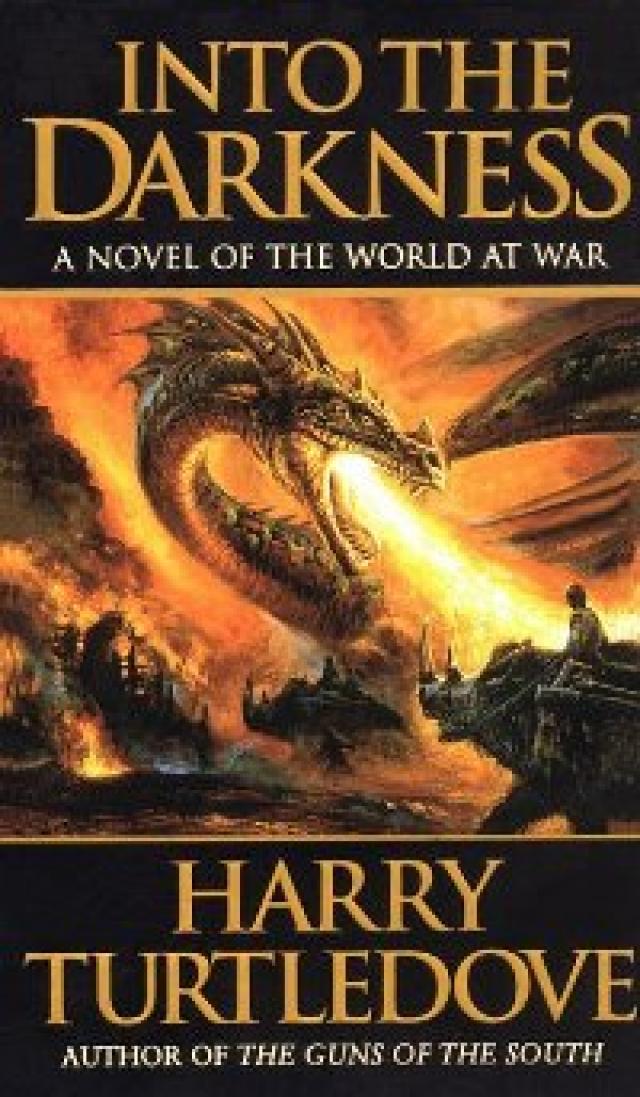
But the first eggs fell out of the sky when morning twilight was barely beginning to stain the eastern horizon with gray. Now he heard dragons’ cries, fierce and raucous. The beasts swooped low above the Unkerlanter encampment, dropping their eggs and then gaining height once more with thunderous wingbeats. Some came close enough to the ground to flame before they flew higher. More flames sprang up from tents and wagons they set afire.
Leudast seized his stick and started blazing at them, but the sky was still so dark, he had no good targets. Even with a good target, he knew a foot-soldier had to be lucky—had to be more than lucky—to bring down a dragon. He kept blazing anyhow. If he didn’t, he had no chance at all to bring one down.
An egg burst close by him, knocking him off his feet and rolling him along the ground like a pin in a game of sixteens. He knocked over a couple of other soldiers, too, just as a well-struck pin would have done, though not enough to gain a good score. They shouted and cursed, as he did. Men were screaming, too, at the top of their lungs.
Some of those screams burst from the throats of wounded men. Others were shouts of anger or, more often, horrified astonishment: “The redheads!” “The Algarvians!” “King Mezentio’s men!”
They’ve got a lot of cursed nerve, hitting us first, Leudast thought. The ground shook beneath his feet as another egg burst nearby. We were supposed to hit them first, catch them by surprise.
That hadn’t happened. It wasn’t going to happen, not now. Remembering how his officers said the Algarvians liked to fight, Leudast had a sudden nasty premonition of what was likely to happen next. “Prepare to receive attack from the east!” he shouted to his squad and anyone else who would listen. “The redheads will be hitting us with foot and cavalry and those stinking behemoths, too!”
“Aye, that’s the truth!” No one who knew Sergeant Magnulf could mistake his bellow. “That’s what those cursed Algarvians think efficient fighting’s all about. Now that the dragons have knocked us cockeyed, they’ll send in the men on the ground to try and flatten us.”
Here and there in the madness—which did not cease, for Algarvian dragons kept on pounding the encampment—officers also tried to rally their men. But some officers were killed, some were hurt, and some, with action upon them, turned out to be worthless. Leudast watched one run for the west as fast as he could go.
He had no time for more than one quick curse aimed at that captain’s back. Then more eggs started falling on the tents. These were smaller than the ones the dragons carried, which meant the Algarvians had already got tossers over the border and into the part of Forthweg Unkerlant occupied. Leudast shook his head. No—the part of Forthweg Unkerlant had occupied.