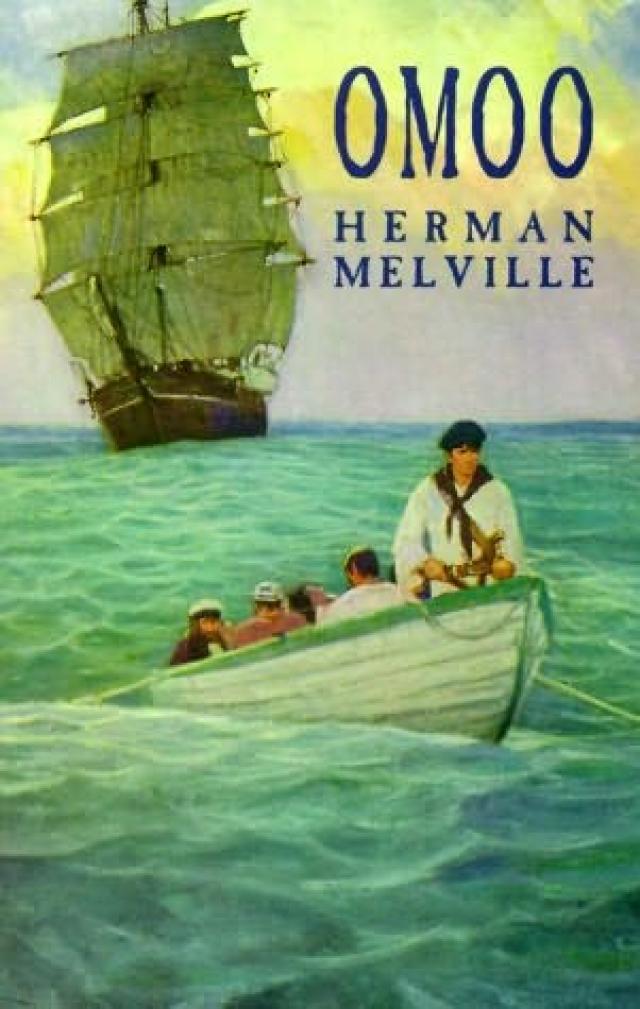
Omoo adventures in the s.., p.13
Omoo: Adventures in the South Seas,
p.13


During this period, we were the lions of the neighbourhood; and, no doubt, strangers from the distant villages were taken to see the «Karhowrees» (white men), in the same way that countrymen, in a city, are gallanted to the Zoological Gardens.
All this gave us a fine opportunity of making observations. I was painfully struck by the considerable number of sickly or deformed persons; undoubtedly made so by a virulent complaint, which, under native treatment, almost invariably affects, in the end, the muscles and bones of the body. In particular, there is a distortion of the back, most unsightly to behold, originating in a horrible form of the malady.
Although this, and other bodily afflictions, were unknown before the discovery of the islands by the whites, there are several cases found of the Pa-Fa, or Elephantiasis-a native disease, which seems to have prevailed among them from the earliest antiquity. Affecting the legs and feet alone, it swells them, in some instances, to the girth of a man's body, covering the skin with scales. It might be supposed that one, thus afflicted, would be incapable of walking; but, to all appearance, they seem to be nearly as active as anybody; apparently suffering no pain, and bearing the calamity with a degree of cheerfulness truly marvellous.
The Fa-Fa is very gradual in its approaches, and years elapse before the limb is fully swollen. Its origin is ascribed by the natives to various causes; but the general impression seems to be that it arises, in most cases, from the eating of unripe bread-fruit and Indian turnip. So far as I could find out, it is not hereditary. In no stage do they attempt a cure; the complaint being held incurable.
Speaking of the Fa-Fa reminds me of a poor fellow, a sailor, whom I afterward saw at Roorootoo, a lone island, some two days' sail from Tahiti.
The island is very small, and its inhabitants nearly extinct. We sent a boat off to see whether any yams were to be had, as, formerly, the yams of Roorootoo were as famous among the islands round about, as Sicily oranges in the Mediterranean. Going ashore, to my surprise, I was accosted, near a little shanty of a church, by a white man, who limped forth from a wretched hut. His hair and beard were unshorn, his face deadly pale and haggard, and one limb swelled with the Fa-Fa to an incredible bigness. This was the first instance of a foreigner suffering from it that I had ever seen, or heard of; and the spectacle shocked me accordingly.
He had been there for years. From the first symptoms, he could not believe his complaint to be what it really was, and trusted it would soon disappear. But when it became plain that his only chance for recovery was a speedy change of climate, no ship would receive him as a sailor: to think of being taken as a passenger was idle. This speaks little for the humanity of sea captains; but the truth is that those in the Pacific have little enough of the virtue; and, nowadays, when so many charitable appeals are made to them, they have become callous.
I pitied the poor fellow from the bottom of my heart; but nothing could I do, as our captain was inexorable. "Why," said he, "here we are-started on a six months' cruise-I can't put back; and he is better off on the island than at sea. So on Roorootoo he must die." And probably he did.
I afterwards heard of this melancholy object, from two seamen. His attempts to leave were still unavailing, and his hard fate was fast closing in.
Notwithstanding the physical degeneracy of the Tahitians as a people, among the chiefs, individuals of personable figures are still frequently met with; and, occasionally, majestic-looking men, and diminutive women as lovely as the nymphs who, nearly a century ago, swam round the ships of Wallis. In these instances, Tahitian beauty is quite as seducing as it proved to the crew of the Bounty; the young girls being just such creatures as a poet would picture in the tropics-soft, plump, and dreamy-eyed.
The natural complexion of both sexes is quite light; but the males appear much darker, from their exposure to the sun. A dark complexion, however, in a man, is highly esteemed, as indicating strength of both body and soul. Hence there is a saying, of great antiquity among them,
"If dark the cheek of the mother, The son will sound the war-conch; If strong her frame, he will give laws."
With this idea of manliness, no wonder the Tahitians regarded all pale and tepid-looking Europeans as weak and feminine; whereas, a sailor, with a cheek like the breast of a roast turkey, is held a lad of brawn: to use their own phrase, a "taata tona," or man of bones.
Speaking of bones recalls an ugly custom of theirs, now obsolete-that of making fish-hooks and gimlets out of those of their enemies. This beats the Scandinavians turning people's skulls into cups and saucers.
But to return to the Calabooza Beretanee. Immense was the interest we excited among the throngs that called there; they would stand talking about us by the hour, growing most unnecessarily excited too, and dancing up and down with all the vivacity of their race. They invariably sided with us; flying out against the consul, and denouncing him as "Ita maitai nuee," or very bad exceedingly. They must have borne him some grudge or other.
Nor were the women, sweet souls, at all backward in visiting. Indeed, they manifested even more interest than the men; gazing at us with eyes full of a thousand meanings, and conversing with marvellous rapidity. But, alas! inquisitive though they were, and, doubtless, taking some passing compassion on us, there was little real feeling in them after all, and still less sentimental sympathy. Many of them laughed outright at us, noting only what was ridiculous in our plight.
I think it was the second day of our confinement that a wild, beautiful girl burst into the Calabooza, and, throwing herself into an arch attitude, stood afar off, and gazed at us. She was a heartless one:-tickled to death with Black Dan's nursing his chafed ankle, and indulging in certain moral reflections on the consul and Captain Guy. After laughing her fill at him, she condescended to notice the rest; glancing from one to another in the most methodical and provoking manner imaginable. Whenever anything struck her comically, you saw it like a flash-her finger levelled instantaneously, and, flinging herself back, she gave loose to strange, hollow little notes of laughter, that sounded like the bass of a music-box, playing a lively air with the lid down.
Now, I knew not that there was anything in my own appearance calculated to disarm ridicule; and indeed, to have looked at all heroic, under the circumstances, would have been rather difficult. Still, I could not but feel exceedingly annoyed at the prospect of being screamed at, in turn, by this mischievous young witch, even though she were but an islander. And, to tell a secret, her beauty had something to do with this sort of feeling; and, pinioned as I was to a log, and clad most unbecomingly, I began to grow sentimental.
Ere her glance fell upon me, I had, unconsciously, thrown myself into the most graceful attitude I could assume, leaned my head upon my hand, and summoned up as abstracted an expression as possible. Though my face was averted, I soon felt it flush, and knew that the glance was on me; deeper and deeper grew the flush, and not a sound of laughter.
Delicious thought! she was moved at the sight of me. I could stand it no longer, but started up. Lo! there she was; her great hazel eyes rounding and rounding in her head, like two stars, her whole frame in a merry quiver, and an expression about the mouth that was sudden and violent death to anything like sentiment.
The next moment she spun round, and, bursting from peal to peal of laughter, went racing out of the Calabooza; and, in mercy to me, never returned.
CHAPTER XXXIV
LIFE AT THE CALABOOZA
A FEW days passed; and, at last, our docility was rewarded by some indulgence on the part of Captain Bob.
He allowed the entire party to be at large during the day; only enjoining upon us always to keep within hail. This, to be sure, was in positive disobedience to Wilson's orders; and so, care had to be taken that he should not hear of it. There was little fear of the natives telling him; but strangers travelling the Broom Road might. By way of precaution, boys were stationed as scouts along the road. At sight of a white man, they sounded the alarm! when we all made for our respective holes (the stocks being purposely left open): the beam then descended, and we were prisoners. As soon as the traveller was out of sight, of course, we were liberated.
Notwithstanding the regular supply of food which we obtained from Captain Bob and his friends, it was so small that we often felt most intolerably hungry. We could not blame them for not bringing us more, for we soon became aware that they had to pinch themselves in order to give us what they did; besides, they received nothing for their kindness but the daily bucket of bread.
Among a people like the Tahitians, what we call "hard times" can only be experienced in the scarcity of edibles; yet, so destitute are many of the common people that this most distressing consequence of civilization may be said, with them, to be ever present. To be sure, the natives about the Calabooza had abundance of limes and oranges; but what were these good for, except to impart a still keener edge to appetites which there was so little else to gratify? During the height of the bread-fruit season, they fare better; but, at other times, the demands of the shipping exhaust the uncultivated resources of the island; and the lands being mostly owned by the chiefs, the inferior orders have to suffer for their cupidity. Deprived of their nets, many of them would starve.
As Captain Bob insensibly remitted his watchfulness, and we began to stroll farther and farther from the Calabooza, we managed, by a systematic foraging upon the country round about, to make up some of our deficiencies. And fortunate it was that the houses of the wealthier natives were just as open to us as those of the most destitute; we were treated as kindly in one as the other.
Once in a while, we came in at the death of a chiefs pig; the noise of whose slaughtering was generally to be heard at a great distance. An occasion like this gathers the neighbours together, and they have a bit of a feast, where a stranger is always welcome. A good loud squeal, therefore, was music in our ears. It showed something going on in that direction.
Breaking in upon the party tumultuously, as we did, we always created a sensation. Sometimes, we found the animal still alive and struggling; in which case, it was generally dropped at our approach.
To provide for these emergencies, Flash Jack generally repaired to the scene of operations with a sheath-knife between his teeth, and a club in his hand. Others were exceedingly officious in singeing off the bristles, and disembowelling. Doctor Long Ghost and myself, however, never meddled with these preliminaries, but came to the feast itself with unimpaired energies.
Like all lank men, my long friend had an appetite of his own. Others occasionally went about seeking what they might devour, but he was always on the alert.
He had an ingenious way of obviating an inconvenience which we all experienced at times. The islanders seldom use salt with their food; so he begged Rope Yarn to bring him some from the ship; also a little pepper, if he could; which, accordingly, was done. This he placed in a small leather wallet-a "monkey bag" (so called by sailors) — usually worn as a purse about the neck.
"In my opinion," said Long Ghost, as he tucked the wallet out of sight, "it behooves a stranger, in Tahiti, to have his knife in readiness, and his castor slung."
CHAPTER XXXV
VISIT FROM AN OLD ACQUAINTANCE
WE had not been many days ashore, when Doctor Johnson was espied coming along the Broom Road.
We had heard that he meditated a visit, and suspected what he was after. Being upon the consul's hands, all our expenses were of course payable by him in his official capacity; and, therefore, as a friend of Wilson, and sure of good pay, the shore doctor had some idea of allowing us to run up a bill with him. True, it was rather awkward to ask us to take medicines which, on board the ship, he told us were not needed. However, he resolved to put a bold face on the matter, and give us a call.
His approach was announced by one of the scouts, upon which someone suggested that we should let him enter, and then put him in the stocks. But Long Ghost proposed better sport. What it was, we shall presently see.
Very bland and amiable, Doctor Johnson advanced, and, resting his cane on the stocks, glanced to right and left, as we lay before him. "Well, my lads"-he began-"how do you find yourselves to-day?"
Looking very demure, the men made some rejoinder; and he went on.
"Those poor fellows I saw the other day-the sick, I mean-how are they?" and he scrutinized the company. At last, he singled out one who was assuming a most unearthly appearance, and remarked that he looked as if he were extremely ill. "Yes," said the sailor dolefully, "I'm afeard, doctor, I'll soon be losing the number of my mess!" (a sea phrase, for departing this life) and he closed his eyes, and moaned.
"What does he say?" said Johnson, turning round eagerly.
"Why," exclaimed Flash Jack, who volunteered as interpreter, "he means he's going to croak" (die).
"Croak! and what does that mean, applied to a patient?"
"Oh! I understand," said he, when the word was explained; and he stepped over the stocks, and felt the man's pulse.
"What's his name?" he asked, turning this time to old Navy Bob.
"We calls him Jingling Joe," replied that worthy.
"Well then, men, you must take good care of poor Joseph; and I will send him a powder, which must be taken according to the directions. Some of you know how to read, I presume?"
"That ere young cove does," replied Bob, pointing toward the place where I lay, as if he were directing attention to a sail at sea.
After examining the rest-some of whom were really invalids, but convalescent, and others only pretending to be labouring under divers maladies, Johnson turned round, and addressed the party.
"Men," said he, "if any more of you are ailing, speak up, and let me know. By order of the consul, I'm to call every day; so if any of you are at all sick, it's my duty to prescribe for you. This sudden change from ship fare to shore living plays the deuce with you sailors, so be cautious about eating fruit. Good-day! I'll send you the medicines the first thing in the morning."
Now, I am inclined to suspect that with all his want of understanding, Johnson must have had some idea that we were quizzing him. Still, that was nothing, so long as it answered his purpose; and therefore, if he did see through us, he never showed it.
Sure enough, at the time appointed, along came a native lad with a small basket of cocoa-nut stalks, filled with powders, pill-boxes, and-vials, each with names and directions written in a large, round hand. The sailors, one and all, made a snatch at the collection, under the strange impression that some of the vials were seasoned with spirits. But, asserting his privilege as physician to the first reading of the labels, Doctor Long Ghost was at last permitted to take possession of the basket.
The first thing lighted upon was a large vial, labelled-"For William — rub well in."
This vial certainly had a spirituous smell; and upon handing it to the patient, he made a summary internal application of its contents. The doctor looked aghast.
There was now a mighty commotion. Powders and pills were voted mere drugs in the market, and the holders of vials were pronounced lucky dogs. Johnson must have known enough of sailors to make some of his medicines palatable-this, at least, Long Ghost suspected. Certain it was, everyone took to the vials; if at all spicy, directions were unheeded, their contents all going one road.
The largest one of all, quite a bottle indeed, and having a sort of burnt brandy odour, was labelled-"For Daniel, drink freely, and until relieved." This Black Dan proceeded to do; and would have made an end of it at once, had not the bottle, after a hard struggle, been snatched from his hands, and passed round, like a jovial decanter. The old tar had complained of the effects of an immoderate eating of fruit.
Upon calling the following morning, our physician found his precious row of patients reclining behind the stocks, and doing "as well as could be expected."
But the pills and powders were found to have been perfectly inactive: probably because none had been taken. To make them efficacious, it was suggested that, for the future, a bottle of Pisco should be sent along with them. According to Flash Jack's notions, unmitigated medical compounds were but dry stuff at the best, and needed something good to wash them down.
Thus far, our own M.D., Doctor Long Ghost, after starting the frolic, had taken no further part in it; but on the physician's third visit, he took him to one side, and had a private confabulation. What it was, exactly, we could not tell; but from certain illustrative signs and gestures, I fancied that he was describing the symptoms of some mysterious disorganization of the vitals, which must have come on within the hour. Assisted by his familiarity with medical terms, he seemed to produce a marked impression. At last, Johnson went his way, promising aloud that he would send Long Ghost what he desired.
When the medicine boy came along the following morning, the doctor was the first to accost him, walking off with a small purple vial. This time, there was little else in the basket but a case-bottle of the burnt brandy cordial, which, after much debate, was finally disposed of by someone pouring the contents, little by little, into the half of a cocoa-nut shell, and so giving all who desired a glass. No further medicinal cheer remaining, the men dispersed.
An hour or two passed, when Flash Jack directed attention to my long friend, who, since the medicine boy left, had not been noticed till now. With eyes closed, he was lying behind the stocks, and Jack was lifting his arm and letting it fall as if life were extinct. On running up with the rest, I at once connected the phenomenon with the mysterious vial. Searching his pocket, I found it, and holding it up, it proved to be laudanum. Flash Jack, snatching it from my hand in a rapture, quickly informed all present what it was; and with much glee, proposed a nap for the company. Some of them not comprehending him exactly, the apparently defunct Long Ghost-who lay so still that I a little suspected the genuineness of his sleep-was rolled about as an illustration of the virtues of the vial's contents. The idea tickled everybody mightily; and throwing themselves down, the magic draught was passed from hand to hand. Thinking that, as a matter of course, they must at once become insensible, each man, upon taking his sip, fell back, and closed his eyes.