Omoo adventures in the s.., p.20
Omoo: Adventures in the South Seas,
p.20
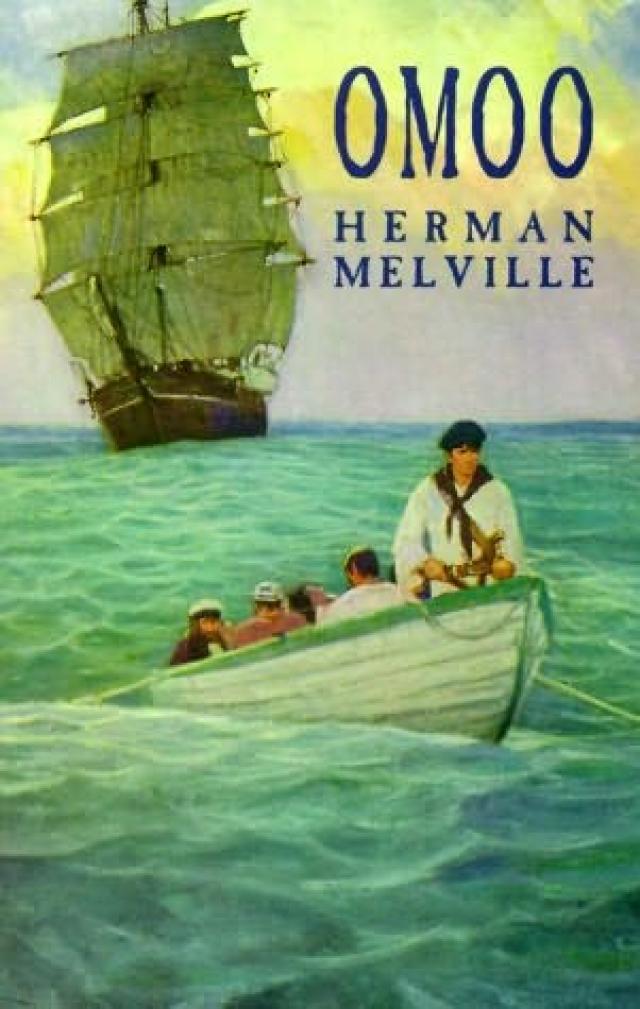


"What do you want of me, you rascals?" he cried-a greeting which provoked a retort in no measured terms. At this juncture, the natives began to crowd round, and several foreigners strolled along. Caught in the very act of speaking to such disreputable acquaintances, Wilson now fidgeted, and moved rapidly toward his office; the men following. Turning upon them incensed, he bade them be off-he would have nothing more to say to us; and then, hurriedly addressing Captain Bob in Tahitian, he hastened on, and never stopped till the postern of Pritchard's wicket was closed behind him.
Our good old keeper was now highly excited, bustling about in his huge petticoats, and conjuring us to return to the Calabooza. After a little debate, we acquiesced.
This interview was decisive. Sensible that none of the charges brought against us would stand, yet unwilling formally to withdraw them, the consul now wished to get rid of us altogether; but without being suspected of encouraging our escape. Thus only could we account for his conduct.
Some of the party, however, with a devotion to principle truly heroic, swore they would never leave him, happen what might. For my own part, I began to long for a change; and as there seemed to be no getting away in a ship, I resolved to hit upon some other expedient. But first, I cast about for a comrade; and of course the long doctor was chosen. We at once laid our heads together; and for the present, resolved to disclose nothing to the rest.
A few days previous, I had fallen in with a couple of Yankee lads, twins, who, originally deserting their ship at Tanning's Island (an uninhabited spot, but exceedingly prolific in fruit of all kinds), had, after a long residence there, roved about among the Society group. They were last from Imeeo-the island immediately adjoining-where they had been in the employ of two foreigners who had recently started a plantation there. These persons, they said, had charged them to send over from Papeetee, if they could, two white men for field-labourers.
Now, all but the prospect of digging and delving suited us exactly; but the opportunity for leaving the island was not to be slighted; and so we held ourselves in readiness to return with the planters; who, in a day or two, were expected to visit Papeetee in their boat.
At the interview which ensued, we were introduced to them as Peter and Paul; and they agreed to give Peter and Paul fifteen silver dollars a month, promising something more should we remain with them permanently. What they wanted was men who would stay. To elude the natives-many of whom, not exactly understanding our relations with the consul, might arrest us, were they to see us departing-the coming midnight was appointed for that purpose.
When the hour drew nigh, we disclosed our intention to the rest. Some upbraided us for deserting them; others applauded, and said that, on the first opportunity, they would follow our example. At last, we bade them farewell. And there would now be a serene sadness in thinking over the scene-since we never saw them again-had not all been dashed by M'Gee's picking the doctor's pocket of a jack-knife, in the very act of embracing him.
We stole down to the beach, where, under the shadow of a grove, the boat was waiting. After some delay, we shipped the oars, and pulling outside of the reef, set the sail; and with a fair wind, glided away for Imeeo.
It was a pleasant trip. The moon was up-the air, warm-the waves, musical-and all above was the tropical night, one purple vault hung round with soft, trembling stars.
The channel is some five leagues wide. On one hand, you have the three great peaks of Tahiti lording it over ranges of mountains and valleys; and on the other, the equally romantic elevations of Imeeo, high above which a lone peak, called by our companions, "the Marling-pike," shot up its verdant spire.
The planters were quite sociable. They had been sea-faring men, and this, of course, was a bond between us. To strengthen it, a flask of wine was produced, one of several which had been procured in person from the French admiral's steward; for whom the planters, when on a former visit to Papeetee, had done a good turn, by introducing the amorous Frenchman to the ladies ashore. Besides this, they had a calabash filled with wild boar's meat, baked yams, bread-fruit, and Tombez potatoes. Pipes and tobacco also were produced; and while regaling ourselves, plenty of stories were told about the neighbouring islands.
At last we heard the roar of the Imeeo reef; and gliding through a break, floated over the expanse within, which was smooth as a young girl's brow, and beached the boat.
CHAPTER LII
THE VALLEY OF MARTAIR
WE went up through groves to an open space, where we heard voices, and a light was seen glimmering from out a bamboo dwelling. It was the planters' retreat; and in their absence, several girls were keeping house, assisted by an old native, who, wrapped up in tappa, lay in the corner, smoking.
A hasty meal was prepared, and after it we essayed a nap; but, alas! a plague, little anticipated, prevented. Unknown in Tahiti, the mosquitoes here fairly eddied round us. But more of them anon.
We were up betimes, and strolled out to view the country. We were in the valley of Martair; shut in, on both sides, by lofty hills. Here and there were steep cliffs, gay with flowering shrubs, or hung with pendulous vines, swinging blossoms in the air. Of considerable width at the sea, the vale contracts as it runs inland; terminating, at the distance of several miles, in a range of the most grotesque elevations, which seem embattled with turrets and towers, grown over with verdure, and waving with trees. The valley itself is a wilderness of woodland; with links of streams flashing through, and narrow pathways fairly tunnelled through masses of foliage.
All alone, in this wild place, was the abode of the planters; the only one back from the beach-their sole neighbours, the few fishermen and their families, dwelling in a small grove of cocoa-nut trees whose roots were washed by the sea.
The cleared tract which they occupied comprised some thirty acres, level as a prairie, part of which was under cultivation; the whole being fenced in by a stout palisade of trunks and boughs of trees staked firmly in the ground. This was necessary as a defence against the wild cattle and hogs overrunning the island.
Thus far, Tombez potatoes were the principal crop raised; a ready sale for them being obtained among the shipping touching at Papeetee. There was a small patch of the taro, or Indian turnip, also; another of yams; and in one corner, a thrifty growth of the sugar-cane, just ripening.
On the side of the inclosure next the sea was the house; newly built of bamboos, in the native style. The furniture consisted of a couple of sea-chests, an old box, a few cooking utensils, and agricultural tools; together with three fowling-pieces, hanging from a rafter; and two enormous hammocks swinging in opposite corners, and composed of dried bullocks' hides, stretched out with poles.
The whole plantation was shut in by a dense forest; and, close by the house, a dwarfed "Aoa," or species of banian-tree, had purposely been left twisting over the palisade, in the most grotesque manner, and thus made a pleasant shade. The branches of this curious tree afforded low perches, upon which the natives frequently squatted, after the fashion of their race, and smoked and gossiped by the hour.
We had a good breakfast of fish-speared by the natives, before sunrise, on the reef-pudding of Indian turnip, fried bananas, and roasted bread-fruit.
During the repast, our new friends were quite sociable and communicative. It seems that, like nearly all uneducated foreigners, residing in Polynesia, they had, some time previous, deserted from a ship; and, having heard a good deal about the money to be made by raising supplies for whaling-vessels, they determined upon embarking in the business. Strolling about, with this intention, they, at last, came to Martair; and, thinking the soil would suit, set themselves to work. They began by finding out the owner of the particular spot coveted, and then making a «tayo» of him.
He turned out to be Tonoi, the chief of the fishermen: who, one day, when exhilarated with brandy, tore his meagre tappa from his loins, and gave me to know that he was allied by blood with Pomaree herself; and that his mother came from the illustrious race of pontiffs, who, in old times, swayed their bamboo crosier over all the pagans of Imeeo. A regal, and right reverend lineage! But, at the time I speak of, the dusky noble was in decayed circumstances, and, therefore, by no means unwilling to alienate a few useless acres. As an equivalent, he received from the strangers two or three rheumatic old muskets, several red woollen shirts, and a promise to be provided for in his old age: he was always to find a home with the planters.
Desirous of living on the cosy footing of a father-in-law, he frankly offered his two daughters for wives; but as such, they were politely declined; the adventurers, though not averse to courting, being unwilling to entangle themselves in a matrimonial alliance, however splendid in point of family.
Tonoi's men, the fishermen of the grove, were a sad set. Secluded, in a great measure, from the ministrations of the missionaries, they gave themselves up to all manner of lazy wickedness. Strolling among the trees of a morning, you came upon them napping on the shady side of a canoe hauled up among the bushes; lying on a tree smoking; or, more frequently still, gambling with pebbles; though, a little tobacco excepted, what they gambled for at their outlandish games, it would be hard to tell. Other idle diversions they had also, in which they seemed to take great delight. As for fishing, it employed but a small part of their time. Upon the whole, they were a merry, indigent, godless race.
Tonoi, the old sinner, leaning against the fallen trunk of a cocoa-nut tree, invariably squandered his mornings at pebbles; a gray-headed rook of a native regularly plucking him of every other stick of tobacco obtained from his friends, the planters. Toward afternoon, he strolled back to their abode; where he tarried till the next morning, smoking and snoozing, and, at times, prating about the hapless fortunes of the House of Tonoi. But like any other easy-going old dotard, he seemed for the most part perfectly content with cheerful board and lodging.
On the whole, the valley of Martair was the quietest place imaginable. Could the mosquitoes be induced to emigrate, one might spend the month of August there quite pleasantly. But this was not the case with the luckless Long Ghost and myself; as will presently be seen.
CHAPTER LIII
FARMING IN POLYNESIA
THE planters were both whole-souled fellows; but, in other respects, as unlike as possible.
One was a tall, robust Yankee, hern in the backwoods of Maine, sallow, and with a long face;-the other was a short little Cockney, who had first clapped his eyes on the Monument.
The voice of Zeke, the Yankee, had a twang like a cracked viol; and Shorty (as his comrade called him), clipped the aspirate from every word beginning with one. The latter, though not the tallest man in the world, was a good-looking young fellow of twenty-five. His cheeks were dyed with the fine Saxon red, burned deeper from his roving life: his blue eye opened well, and a profusion of fair hair curled over a well-shaped head.
But Zeke was no beauty. A strong, ugly man, he was well adapted for manual labour; and that was all. His eyes were made to see with, and not for ogling. Compared with the Cockney, he was grave, and rather taciturn; but there was a deal of good old humour bottled up in him, after all. For the rest, he was frank, good-hearted, shrewd, and resolute; and like Shorty, quite illiterate.
Though a curious conjunction, the pair got along together famously. But, as no two men were ever united in any enterprise without one getting the upper hand of the other, so in most matters Zeke had his own way. Shorty, too, had imbibed from him a spirit of invincible industry; and Heaven only knows what ideas of making a fortune on their plantation.
We were much concerned at this; for the prospect of their setting us, in their own persons, an example of downright hard labour, was anything but agreeable. But it was now too late to repent what we had done.
The first day-thank fortune-we did nothing. Having treated us as guests thus far, they no doubt thought it would be wanting in delicacy to set us to work before the compliments of the occasion were well over. The next morning, however, they both looked business-like, and we were put to.
"Wall, b'ys" (boys), said Zeke, knocking the ashes out of his pipe, after breakfast-"we must get at it. Shorty, give Peter there (the doctor), the big hoe, and Paul the other, and let's be off." Going to a corner, Shorty brought forth three of the implements; and distributing them impartially, trudged on after his partner, who took the lead with something in the shape of an axe.
For a moment left alone in the house, we looked at each other, quaking. We were each equipped with a great, clumsy piece of a tree, armed at one end with a heavy, flat mass of iron.
The cutlery part-especially adapted to a primitive soil-was an importation from Sydney; the handles must have been of domestic manufacture. "Hoes"-so called-we had heard of, and seen; but they were harmless in comparison with the tools in our hands.
"What's to be done with them?" inquired I of Peter.
"Lift them up and down," he replied; "or put them in motion some way or other. Paul, we are in a scrape-but hark! they are calling;" and shouldering the hoes, off we marched.'
Our destination was the farther side of the plantation, where the ground, cleared in part, had not yet been broken up; but they were now setting about it. Upon halting, I asked why a plough was not used; some of the young wild steers might be caught and trained for draught.
Zeke replied that, for such a purpose, no cattle, to his knowledge, had ever been used in any part of Polynesia. As for the soil of Martair, so obstructed was it with roots, crossing and recrossing each other at all points, that no kind of a plough could be used to advantage. The heavy Sydney hoes were the only thing for such land.
Our work was now before us; but, previous to commencing operations, I endeavoured to engage the Yankee in a little further friendly chat concerning the nature of virgin soils in general, and that of the valley of Martair in particular. So masterly a stratagem made Long Ghost brighten up; and he stood by ready to join in. But what our friend had to say about agriculture all referred to the particular part of his plantation upon which we stood; and having communicated enough on this head to enable us to set to work to the best advantage, he fell to, himself; and Shorty, who had been looking on, followed suit.
The surface, here and there, presented closely amputated branches of what had once been a dense thicket. They seemed purposely left projecting, as if to furnish a handle whereby to drag out the roots beneath. After loosening the hard soil, by dint of much thumping and pounding, the Yankee jerked one of the roots this way and that, twisting it round and round, and then tugging at it horizontally.
"Come! lend us a hand!" he cried, at last; and running up, we all four strained away in concert. The tough obstacle convulsed the surface with throes and spasms; but stuck fast, notwithstanding.
"Dumn it!" cried Zeke, "we'll have to get a rope; run to the house, Shorty, and fetch one."
The end of this being attached, we took plenty of room, and strained away once more.
"Give us a song, Shorty," said the doctor; who was rather sociable, on a short acquaintance. Where the work to be accomplished is any way difficult, this mode of enlivening toil is quite efficacious among sailors. So willing to make everything as cheerful as possible, Shorty struck up, "Were you ever in Dumbarton?" a marvellously inspiring, but somewhat indecorous windlass chorus.
At last, the Yankee cast a damper on his enthusiasm by exclaiming, in a pet, "Oh! dumn your singing! keep quiet, and pull away!" This we now did, in the most uninteresting silence; until, with a jerk that made every elbow hum, the root dragged out; and most inelegantly, we all landed upon the ground. The doctor, quite exhausted, stayed there; and, deluded into believing that, after so doughty a performance, we would be allowed a cessation of toil, took off his hat, and fanned himself.
"Rayther a hard customer, that, Peter," observed the Yankee, going up to him: "but it's no use for any on 'em to hang back; for I'm dumned if they hain't got to come out, whether or no. Hurrah! let's get at it agin!"
"Mercy!" ejaculated the doctor, rising slowly, and turning round. "He'll be the death of us!"
Falling to with our hoes again, we worked singly, or together, as occasion required, until "Nooning Time" came.
The period, so called by the planters, embraced about three hours in the middle of the day; during which it was so excessively hot, in this still, brooding valley, shut out from the Trades, and only open toward the leeward side of the island, that labour in the sun was out of the question. To use a hyperbolical phrase of Shorty's, "It was 'ot enough to melt the nose h'off a brass monkey."
Returning to the house, Shorty, assisted by old Tonoi, cooked the dinner; and, after we had all partaken thereof, both the Cockney and Zeke threw themselves into one of the hammocks, inviting us to occupy the other. Thinking it no bad idea, we did so; and, after skirmishing with the mosquitoes, managed to fall into a doze. As for the planters, more accustomed to "Nooning," they, at once, presented a nuptial back to each other; and were soon snoring away at a great rate. Tonoi snoozed on a mat, in one corner.
At last, we were roused by Zeke's crying out, "Up b'ys; up! rise, and shine; time to get at it agin!"
Looking at the doctor, I perceived, very plainly, that he had decided upon something.
In a languid voice, he told Zeke that he was not very well: indeed, that he had not been himself for some time past; though a little rest, no doubt, would recruit him. The Yankee thinking, from this, that our valuable services might be lost to him altogether, were he too hard upon us at the outset, at once begged us both to consult our own feelings, and not exert ourselves for the present, unless we felt like it. Then-without recognizing the fact that my comrade claimed to be actually unwell-he simply suggested that, since he was so tired, he had better, perhaps, swing in his hammock for the rest of the day. If agreeable, however, I myself might accompany him upon a little bullock-hunting excursion in the neighbouring hills. In this proposition, I gladly acquiesced; though Peter, who was a great sportsman, put on a long face. The muskets and ammunition were forthwith got from overhead; and, everything being then ready, Zeke cried out, "Tonoi! come; aramai! (get up) we want you for pilot. Shorty, my lad, look arter things, you know; and if you likes, why, there's them roots in the field yonder."