Omoo adventures in the s.., p.25
Omoo: Adventures in the South Seas,
p.25
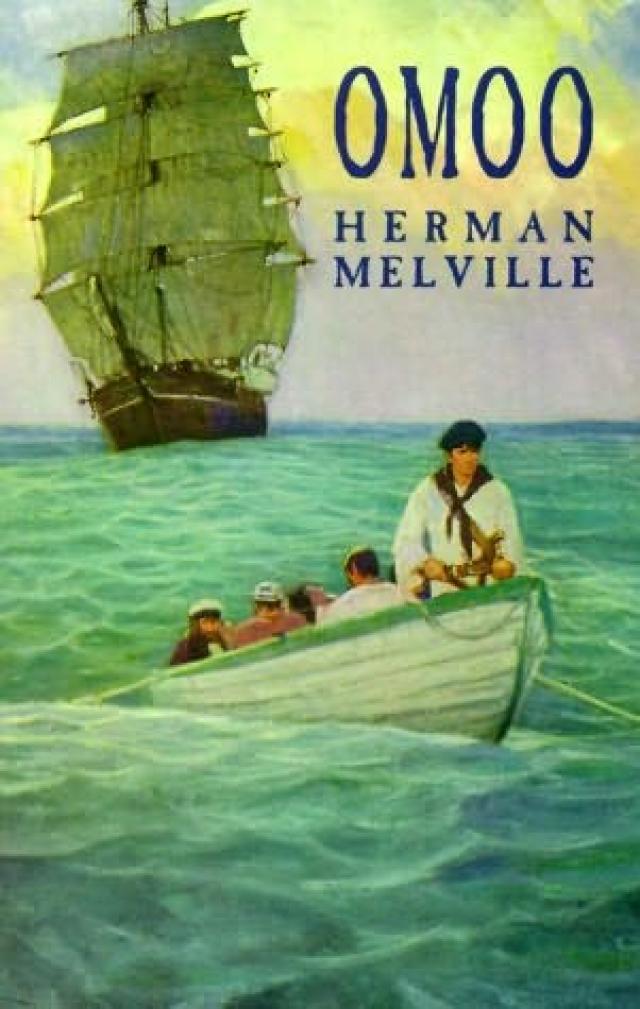


The precious paper was at last finished; and a great curiosity it was. We were much diverted with his reasons for not dating it.
"In this here dummed eliminate," he observed, "a feller can't keep the run of the months, nohow; cause there's no seasons; no summer and winter, to go by. One's etarnally thinkin' it's always July, it's so pesky hot."
A passport provided, we cast about for some means of getting to Taloo.
The island of Imeeo is very nearly surrounded by a regular breakwater of coral extending within a mile or less of the shore. The smooth canal within furnishes the best means of communication with the different settlements; all of which, with the exception of Tamai, are right upon the water. And so indolent are the Imeeose that they think nothing of going twenty or thirty miles round the island in a canoe in order to reach a place not a quarter of that distance by land. But as hinted before, the fear of the bullocks has something to do with this.
The idea of journeying in a canoe struck our fancy quite pleasantly; and we at once set about chartering one, if possible. But none could we obtain. For not only did we have nothing to pay for hiring one, but we could not expect to have it loaned; inasmuch as the good-natured owner would, in all probability, have to walk along the beach as we paddled in order to bring back his property when we had no further use for it.
At last, it was decided to commence our journey on foot; trusting that we would soon fall in with a canoe going our way, in which we might take passage.
The planters said we would find no beaten path: all we had to do was to follow the beach; and however inviting it might look inland, on no account must we stray from it. In short, the longest way round was the nearest way to Taloo. At intervals, there were little hamlets along the shore, besides lonely fishermen's huts here and there, where we could get plenty to eat without pay; so there was no necessity to lay in any store.
Intending to be off before sunrise the next morning, so as to have the benefit of the coolest part of the day, we bade our kind hosts farewell overnight; and then, repairing to the beach, we launched our floating pallet, and slept away merrily till dawn.
CHAPTER LXVII
THE JOURNEY ROUND THE BEACH
IT was on the fourth day of the first month of the Hegira, or flight from Tamai (we now reckoned our time thus), that, rising bright and early, we were up and away out of the valley of Hartair before the fishermen even were stirring.
It was the earliest dawn. The morning only showed itself along the lower edge of a bank of purple clouds pierced by the misty peaks of Tahiti. The tropical day seemed too languid to rise. Sometimes, starting fitfully, it decked the clouds with faint edgings of pink and gray, which, fading away, left all dim again. Anon, it threw out thin, pale rays, growing lighter and lighter, until at last, the golden morning sprang out of the East with a bound-darting its bright beams hither and thither, higher and higher, and sending them, broadcast, over the face of the heavens.
All balmy from the groves of Tahiti came an indolent air, cooled by its transit over the waters; and grateful underfoot was the damp and slightly yielding beach, from which the waves seemed just retired.
The doctor was in famous spirits; removing his Koora, he went splashing into the sea; and, after swimming a few yards, waded ashore, hopping, skipping, and jumping along the beach; but very careful to cut all his capers in the direction of our journey.
Say what they will of the glowing independence one feels in the saddle, give me the first morning flush of your cheery pedestrian!
Thus exhilarated, we went on, as light-hearted and care-free as we could wish.
And here I cannot refrain from lauding the very superior inducements which most intertropical countries afford, not only to mere rovers like ourselves, but to penniless people generally. In these genial regions one's wants are naturally diminished; and those which remain are easily gratified; fuel, house-shelter, and, if you please, clothing, may be entirely dispensed with.
How different our hard northern latitudes! Alas! the lot of a "poor devil," twenty degrees north of the tropic of Cancer, is indeed pitiable.
At last, the. beach contracted to hardly a yard's width, and the dense thicket almost dipped into the sea. In place of the smooth sand, too, we had sharp fragments of broken coral, which made travelling exceedingly unpleasant. "Lord! my foot!" roared the doctor, fetching it up for inspection, with a galvanic fling of the limb. A sharp splinter had thrust itself into the flesh through a hole in his boot. My sandals were worse yet; their soles taking a sort of fossil impression of everything trod upon.
Turning round a bold sweep of the beach, we came upon a piece of fine, open ground, with a fisherman's dwelling in the distance, crowning a knoll which rolled off into the water.
The hut proved to be a low, rude erection, very recently thrown up; for the bamboos were still green as grass, and the thatching fresh and fragrant as meadow hay. It was open upon three sides; so that, upon drawing near, the domestic arrangements within were in plain sight. No one was stirring; and nothing was to be seen but a clumsy old chest of native workmanship, a few calabashes, and bundles of tappa hanging against a post; and a heap of something, we knew not what, in a dark corner. Upon close inspection, the doctor discovered it to be a loving old couple, locked in each other's arms, and rolled together in a tappa mantle.
"Halloa! Darby!" he cried, shaking the one with a beard. But Darby heeded him not; though Joan, a wrinkled old body, started up in affright, and yelled aloud. Neither of us attempting to gag her, she presently became quiet; and, after staring hard and asking some unintelligible questions, she proceeded to rouse her still slumbering mate.
What ailed him we could not tell; but there was no waking him. Equally in vain were all his dear spouse's cuffs, pinches, and other endearments; he lay like a log, face up, snoring away like a cavalry trumpeter.
"Here, my good woman," said Long Ghost, "just let me try"; and, taking the patient right by his nose, he so lifted him bodily into a sitting position, and held him there until his eyes opened. When this event came to pass, Darby looked round like one stupefied; and then, springing to his feet, backed away into a corner, from which place we became the objects of his earnest and respectful attention.
"Permit me, my dear Darby, to introduce to you my esteemed friend and comrade, Paul," said the doctor, gallanting me up with all the grimace and flourish imaginable. Upon this, Darby began to recover his faculties, and surprised us not a little by talking a few words of English. So far as could be understood, they were expressive of his having been aware that there were two «karhowrees» in the neighbourhood; that he was glad to see us, and would have something for us to eat in no time.
How he came by his English was explained to us before we left. Some time previous, he had been a denizen of Papeetee, where the native language is broidered over with the most classic sailor phrases. He seemed to be quite proud of his residence there; and alluded to it in the same significant way in which a provincial informs you that in his time he has resided in the capital. The old fellow was disposed to be garrulous; but being sharp-set, we told him to get breakfast; after which we would hear his anecdotes. While employed among the calabashes, the strange, antiquated fondness between these old semi-savages was really amusing. I made no doubt that they were saying to each other, "yes, my love"-"no, my life," just in the same way that some young couples do, at home.
They gave us a hearty meal; and while we were discussing its merits, they assured us, over and over again, that they expected nothing in return for their attentions; more: we were at liberty to stay as long as we pleased; and as long as we did stay, their house and everything they had was no longer theirs, but ours; still more: they themselves were our slaves-the old lady, to a degree that was altogether superfluous. This, now, is Tahitian hospitality! Self-immolation upon one's own hearthstone for the benefit of the guest.
The Polynesians carry their hospitality to an amazing extent. Let a native of Waiurar, the westernmost part of Tahiti, make his appearance as a traveller at Partoowye, the most easterly village of Imeeo; though a perfect stranger, the inhabitants on all sides accost him at their doorways, inviting him to enter, and make himself at home. But the traveller passes on, examining every house attentively; until, at last, he pauses before one which suits him, and then exclaiming, "ah, eda maitai" (this one will do, I think), he steps in, and makes himself perfectly at ease; flinging himself upon the mats, and very probably calling for a nice young cocoa-nut, and a piece of toasted breadfruit, sliced thin, and done brown.
Curious to relate, however, should a stranger carrying it thus bravely be afterwards discovered to be without a house of his own, why, he may thenceforth go a-begging for his lodgings. The "karhowrees," or white men, are exceptions to this rule. Thus it is precisely as in civilized countries, where those who have houses and lands are incessantly bored to death with invitations to come and live in other people's houses; while many a poor gentleman who inks the seams of his coat, and to whom the like invitation would be really acceptable, may go and sue for it. But to the credit of the ancient Tahitians, it should here be observed that this blemish upon their hospitality is only of recent origin, and was wholly unknown in old times. So told me, Captain Bob.
In Polynesia it is esteemed "a great hit" if a man succeed in marrying into a family to which the best part of the community is related (Heaven knows it is otherwise with us). The reason is that, when he goes a-travelling, the greater number of houses are the more completely at his service.
Receiving a paternal benediction from old Darby and Joan, we continued our journey; resolved to stop at the very next place of attraction which offered.
Nor did we long stroll for it. A fine walk along a beach of shells, and we came to a spot where, trees here and there, the land was all meadow, sloping away to the water, which stirred a sedgy growth of reeds bordering its margin. Close by was a little cove, walled in with coral, where a fleet of canoes was dancing up and down. A few paces distant, on a natural terrace overlooking the sea, were several native dwellings, newly thatched, and peeping into view out of the foliage like summer-houses.
As we drew near, forth came a burst of voices, and, presently, three gay girls, overflowing with life, health, and youth, and full of spirits and mischief. One was arrayed in a flaunting robe of calico; and her long black hair was braided behind in two immense tresses, joined together at the ends, and wreathed with the green tendrils of a vine. From her self-possessed and forward air, I fancied she might be some young lady from Papeetee on a visit to her country relations. Her companions wore mere slips of cotton cloth; their hair was dishevelled; and though very pretty, they betrayed the reserve and embarrassment characteristic of the provinces.
The little gipsy first mentioned ran up to me with great cordiality; and, giving the Tahitian salutation, opened upon me such a fire of questions that there was no understanding, much less answering them. But our hearty welcome to Loohooloo, as she called the hamlet, was made plain enough. Meanwhile, Doctor Long Ghost gallantly presented an arm to each of the other young ladies; which, at first, they knew not what to make of; but at last, taking it for some kind of joke, accepted the civility.
The names of these three damsels were at once made known by themselves: and being so exceedingly romantic, I cannot forbear particularizing them. Upon my comrade's arms, then, were hanging Night and Morning, in the persons of Farnowar, or the Day-Born, and Earnoopoo, or the Night-Born. She with the tresses was very appropriately styled Marhar-Rarrar, the Wakeful, or Bright-Eyed.
By this time, the houses were emptied of the rest of their inmates-a few old men and women, and several strapping young fellows rubbing their eyes and yawning. All crowded round, putting questions as to whence we came. Upon being informed of our acquaintance with Zeke, they were delighted; and one of them recognized the boots worn by the doctor. "Keekee (Zeke) maitai," they cried, "nuee nuee hanna hanna portarto"-(makes plenty of potatoes).
There was now a little friendly altercation as to who should have the honour of entertaining the strangers. At last, a tall old gentleman, by name Marharvai, with a bald head and white beard, took us each by the hand, and led us into his dwelling. Once inside, Marharvai, pointing about with his staff, was so obsequious in assuring us that his house was ours that Long Ghost suggested he might as well hand over the deed.
It was drawing near noon; so after a light lunch of roasted breadfruit, a few whiffs of a pipe, and some lively chatting, our host admonished the company to lie down, and take the everlasting siesta. We complied; and had a social nap all round.
CHAPTER LXVIII
A DINNER-PARTY IN IMEEO
IT WAS just in the middle of the merry, mellow afternoon that they ushered us to dinner, underneath a green shelter of palm boughs; open all round, and so low at the eaves that we stooped to enter.
Within, the ground was strewn over with aromatic ferns-called "nahee"-freshly gathered; which, stirred underfoot, diffused the sweetest odour. On one side was a row of yellow mats, inwrought with fibres of bark stained a bright red. Here, seated after the fashion of the Turk, we looked out, over a verdant bank, upon the mild, blue, endless Pacific. So far round had we skirted the island that the view of Tahiti was now intercepted.
Upon the ferns before us were laid several layers of broad, thick «pooroo» leaves; lapping over, one upon the other. And upon these were placed, side by side, newly-plucked banana leaves, at least two yards in length, and very wide; the stalks were withdrawn so as to make them lie flat. This green cloth was set out and garnished in the manner following:-
First, a number of «pooroo» leaves, by way of plates, were ranged along on one side; and by each was a rustic nut-bowl, half-filled with sea-water, and a Tahitian roll, or small bread-fruit, roasted brown. An immense flat calabash, placed in the centre, was heaped up with numberless small packages of moist, steaming leaves: in each was a small fish, baked in the earth, and done to a turn. This pyramid of a dish was flanked on either side by an ornamental calabash. One was brimming with the golden-hued "poee," or pudding, made from the red plantain of the mountains: the other was stacked up with cakes of the Indian turnip, previously macerated in a mortar, kneaded with the milk of the cocoa-nut, and then baked. In the spaces between the three dishes were piled young cocoa-nuts, stripped of their husks. Their eyes had been opened and enlarged; so that each was a ready-charged goblet.
There was a sort of side-cloth in one corner, upon which, in bright, buff jackets, lay the fattest of bananas; "avees," red-ripe: guavas with the shadows of their crimson pulp flushing through a transparent skin, and almost coming and going there like blushes; oranges, tinged, here and there, berry-brown; and great, jolly melons, which rolled about in very portliness. Such a heap! All ruddy, ripe, and round-bursting with the good cheer of the tropical soil from which they sprang!
"A land of orchards!" cried the doctor, in a rapture; and he snatched a morsel from a sort of fruit of which gentlemen of the sanguine temperament are remarkably fond; namely, the ripe cherry lips of Misa Day-Born, who stood looking on.
Marharvai allotted seats to his guests; and the meal began. Thinking that his hospitality needed some acknowledgment, I rose, and pledged him in the vegetable wine of the cocoa-nut; merely repeating the ordinary salutation, "Yar onor boyoee." Sensible that some compliment, after the fashion of white men, was paid him, with a smile, and a courteous flourish of the hand, he bade me be seated. No people, however refined, are more easy and graceful in their manners than the Imeeose.
The doctor, sitting next our host, now came under his special protection. Laying before his guest one of the packages of fish, Marharvai opened it; and commended its contents to his particular regards. But my comrade was one of those who, on convivial occasions, can always take care of themselves. He ate an indefinite number of "Pee-hee Lee Lees" (small fish), his own and next neighbour's bread-fruit; and helped himself, to right and left, with all the ease of an accomplished diner-out.
"Paul," said he, at last, "you don't seem to be getting along; why don't you try the pepper sauce?" and, by way of example, he steeped a morsel of food into his nutful of sea-water. On following suit, I found it quite piquant, though rather bitter; but, on the whole, a capital substitute for salt. The Imeeose invariably use sea-water in this way, deeming it quite a treat; and considering that their country is surrounded by an ocean of catsup, the luxury cannot be deemed an expensive one.
The fish were delicious; the manner of cooking them in the ground preserving all the juices, and rendering them exceedingly sweet and tender. The plantain pudding was almost cloying; the cakes of Indian turnip, quite palatable; and the roasted bread-fruit, crisp as toast.
During the meal, a native lad walked round and round the party, carrying a long staff of bamboo. This he occasionally tapped upon the cloth, before each guest; when a white clotted substance dropped forth, with a savour not unlike that of a curd. This proved to be "Lownee," an excellent relish, prepared from the grated meat of ripe cocoa-nuts, moistened with cocoa-nut milk and salt water, and kept perfectly tight until a little past the saccharine stage of fermentation.
Throughout the repast there was much lively chatting among the islanders, in which their conversational powers quite exceeded ours. The young ladies, too, showed themselves very expert in the use of their tongues, and contributed much to the gaiety which prevailed.