Omoo adventures in the s.., p.29
Omoo: Adventures in the South Seas,
p.29
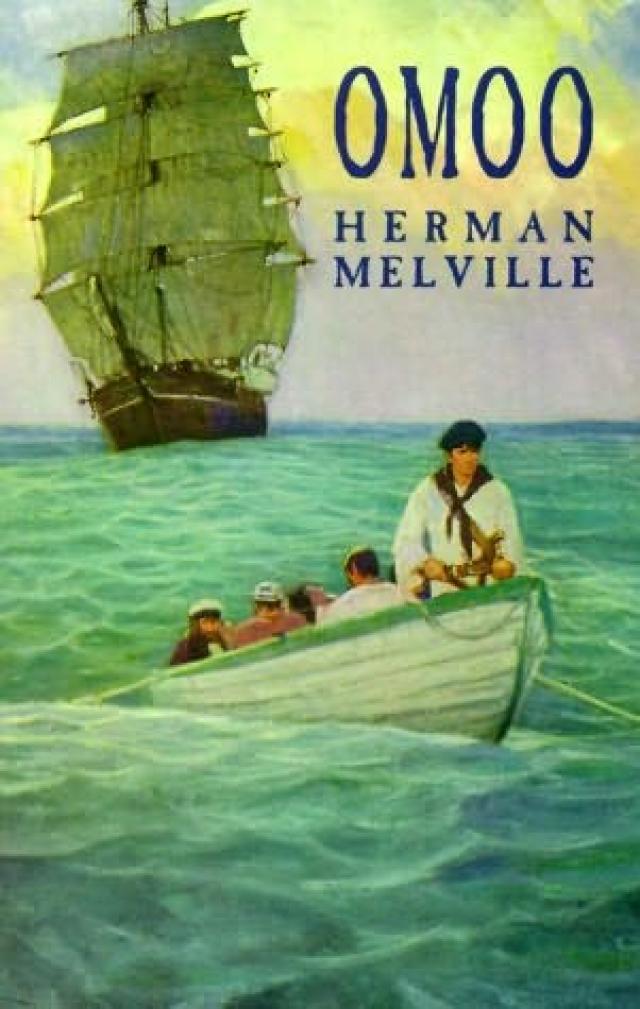


We asked where the rest of the ship's company were; a gruff old fellow made answer, "One boat's crew of 'em is gone to Davy Jones's locker:-went off after a whale, last cruise, and never come back agin. All the starboard watch ran away last night, and the skipper's ashore kitching 'em."
"And it's shipping yer after, my jewels, is it?" cried a curly-pated little Belfast sailor, coming up to us, "thin arrah! my livelies, jist be after sailing ashore in a jiffy:-the divil of a skipper will carry yees both to sea, whether or no. Be off wid ye thin, darlints, and steer clear of the likes of this ballyhoo of blazes as long as ye live. They murther us here every day, and starve us into the bargain. Here, Dick, lad, har! the poor divil's canow alongside; and paddle away wid yees for dear life."
But we loitered awhile, listening to more inducements to ship; and at last concluded to stay to supper. My sheath-knife never cut into better sea-beef than that which we found lying in the kid in the forecastle. The bread, too, was hard, dry, and brittle as glass; and there was plenty of both.
While we were below, the mate of the vessel called out for someone to come on deck. I liked his voice. Hearing it was as good as a look at his face. It betokened a true sailor, and no taskmaster.
The appearance of the Leviathan herself was quite pleasing. Like all large, comfortable old whalers, she had a sort of motherly look:-broad in the beam, flush decks, and four chubby boats hanging at the breast. Her sails were furled loosely upon the yards, as if they had been worn long, and fitted easy; her shrouds swung negligently slack; and as for the "running rigging," it never worked hard as it does in some of your "dandy ships," jamming in the sheaves of blocks, like Chinese slippers, too small to be useful: on the contrary, the ropes ran glibly through, as if they had many a time travelled the same road, and were used to it.
When evening came, we dropped into our canoe, and paddled ashore; fully convinced that the good ship never deserved the name which they gave her.
CHAPTER LXXVII
A PARTY OF ROVERS-LITTLE LOO AND THE DOCTOR
WHILE IN Partoowye, we fell in with a band of six veteran rovers, prowling about the village and harbour, who had just come overland from another part of the island.
A few weeks previous, they had been paid off, at Papeetee, from a whaling vessel, on board of which they had, six months before, shipped for a single cruise; that is to say, to be discharged at the next port. Their cruise was a famous one; and each man stepped upon the beach at Tahiti jingling his dollars in a sock.
Weary at last of the shore, and having some money left, they clubbed, and purchased a sail-boat; proposing a visit to a certain uninhabited island, concerning which they had heard strange and golden stories. Of course, they never could think of going to sea without a medicine-chest filled with flasks of spirits, and a small cask of the same in the hold in case the chest should give out.
Away they sailed; hoisted a flag of their own, and gave three times three, as they staggered out of the bay of Papeetee with a strong breeze, and under all the «muslin» they could carry.
Evening coming on, and feeling in high spirits and no ways disposed to sleep, they concluded to make a night of it; which they did; all hands getting tipsy, and the two masts going over the side about midnight, to the tune of
"Sailing down, sailing down, On the coast of Barbaree."
Fortunately, one worthy could stand by holding on to the tiller; and the rest managed to crawl about, and hack away the lanyards of the rigging, so as to break clear from the fallen spars. While thus employed, two sailors got tranquilly over the side, and went plumb to the bottom, under the erroneous impression that they were stepping upon an imaginary wharf to get at their work better.
After this, it blew quite a gale; and the commodore, at the helm, instinctively kept the boat before the wind; and by so doing, ran over for the opposite island of Imeeo. Crossing the channel, by almost a miracle they went straight through an opening in the reef, and shot upon a ledge of coral, where the waters were tolerably smooth. Here they lay until morning, when the natives came off to them in their canoes. By the help of the islanders, the schooner was hove over on her beam-ends; when, finding the bottom knocked to pieces, the adventurers sold the boat for a trifle to the chief of the district, and went ashore, rolling before them their precious cask of spirits. Its contents soon evaporated, and they came to Partoowye.
The day after encountering these fellows, we were strolling among the groves in the neighbourhood, when we came across several parties of natives armed with clumsy muskets, rusty cutlasses, and outlandish clubs. They were beating the bushes, shouting aloud, and apparently trying to scare somebody. They were in pursuit of the strangers, who, having in a single night set at nought all the laws of the place, had thought best to decamp.
In the daytime, Po-Po's house was as pleasant a lounge as one could wish. So, after strolling about, and seeing all there was to be seen, we spent the greater part of our mornings there; breakfasting late, and dining about two hours after noon. Sometimes we lounged on the floor of ferns, smoking, and telling stories; of which the doctor had as many as a half-pay captain in the army. Sometimes we chatted, as well as we could, with the natives; and, one day-joy to us! — Po-Po brought in three volumes of Smollett's novels, which had been found in the chest of a sailor, who some time previous had died on the island.
Amelia! — Peregrine! — you hero of rogues, Count Fathom! — what a debt do we owe you!
I know not whether it was the reading of these romances, or the want of some sentimental pastime, which led the doctor, about this period, to lay siege to the heart of the little Loo.
Now, as I have said before, the daughter of Po-Po was most cruelly reserved, and never deigned to notice us. Frequently I addressed her with a long face and an air of the profoundest and most distant respect-but in vain; she wouldn't even turn up her pretty olive nose. Ah! it's quite plain, thought I; she knows very well what graceless dogs sailors are, and won't have anything to do with us.
But thus thought not my comrade. Bent he was upon firing the cold glitter of Loo's passionless eyes.
He opened the campaign with admirable tact: making cautious approaches, and content, for three days, with ogling the nymph for about five minutes after every meal. On the fourth day, he asked her a question; on the fifth, she dropped a nut of ointment, and he picked it up and gave it to her; on the sixth, he went over and sat down within three yards of the couch where she lay; and, on the memorable morn of the seventh, he proceeded to open his batteries in form.
The damsel was reclining on the ferns; one hand supporting her cheek, and the other listlessly turning over the leaves of a Tahitian Bible. The doctor approached.
Now the chief disadvantage under which he laboured was his almost complete ignorance of the love vocabulary of the island. But French counts, they say, make love delightfully in broken English; and what hindered the doctor from doing the same in dulcet Tahitian. So at it he went.
"Ah!" said he, smiling bewitchingly, "oee mickonaree; oee ready Biblee?"
No answer; not even a look.
"Ah I matai! very goody ready Biblee mickonaree."
Loo, without stirring, began reading, in a low tone, to herself.
"Mickonaree Biblee ready goody maitai," once more observed the doctor, ingeniously transposing his words for the third time.
But all to no purpose; Loo gave no sign.
He paused, despairingly; but it would never do to give up; so he threw himself at full length beside her, and audaciously commenced turning over the leaves.
Loo gave a start, just one little start, barely perceptible, and then, fumbling something in her hand, lay perfectly motionless; the doctor rather frightened at his own temerity, and knowing not what to do next. At last, he placed one arm cautiously about her waist; almost in the same instant he bounded to his feet, with a cry; the little witch had pierced him with a thorn. But there she lay, just as quietly as ever, turning over the leaves, and reading to herself.
My long friend raised the siege incontinently, and made a disorderly retreat to the place where I reclined, looking on.
I am pretty sure that Loo must have related this occurrence to her father, who came in shortly afterward; for he looked queerly at the doctor. But he said nothing; and, in ten minutes, was quite as affable as ever. As for Loo, there was not the slightest change in her; and the doctor, of course, for ever afterwards held his peace.
CHAPTER LXXVIII
MRS. BELL
ONE DAY, taking a pensive afternoon stroll along one of the many bridle-paths which wind among the shady groves in the neighbourhood of Taloo, I was startled by a sunny apparition. It was that of a beautiful young Englishwoman, charmingly dressed, and mounted upon a spirited little white pony. Switching a green branch, she came cantering toward me.
I looked round to see whether I could possibly be in Polynesia. There were the palm-trees; but how to account for the lady?
Stepping to one side as the apparition drew near, I made a polite obeisance. It gave me a bold, rosy look; and then, with a gay air, patted its palfrey, crying out, "Fly away, Willie!" and galloped among the trees.
I would have followed; but Willie's heels were making such a pattering among the dry leaves that pursuit would have been useless.
So I went straight home to Po-Po's, and related my adventure to the doctor.
The next day, our inquiries resulted in finding out that the stranger had been on the island about two years; that she came from Sydney; and was the wife of Mr. Bell (happy dog!), the proprietor of the sugar plantation to which I have previously referred.
To the sugar plantation we went, the same day.
The country round about was very beautiful: a level basin of verdure, surrounded by sloping hillsides. The sugar-cane-of which there was about one hundred acres, in various stages of cultivation-looked thrifty. A considerable tract of land, however, which seemed to have been formerly tilled, was now abandoned.
The place where they extracted the saccharine matter was under an immense shed of bamboos. Here we saw several clumsy pieces of machinery for breaking the cane; also great kettles for boiling the sugar. But, at present, nothing was going on. Two or three natives were lounging in one of the kettles, smoking; the other was occupied by three sailors from the Leviathan, playing cards.
While we were conversing with these worthies, a stranger approached. He was a sun-burnt, romantic-looking European, dressed in a loose suit of nankeen; his fine throat and chest were exposed, and he sported a Guayaquil hat with a brim like a Chinese umbrella. This was Mr. Bell. He was very civil; showed us the grounds, and, taking us into a sort of arbour, to our surprise, offered to treat us to some wine. People often do the like; but Mr. Bell did more: he produced the bottle. It was spicy sherry; and we drank out of the halves of fresh citron melons. Delectable goblets!
The wine was a purchase from, the French in Tahiti.
Now all this was extremely polite in Mr. Bell; still, we came to see Mrs. Bell. But she proved to be a phantom, indeed; having left the same morning for Papeetee, on a visit to one of the missionaries' wives there.
I went home, much chagrined.
To be frank, my curiosity had been wonderfully piqued concerning the lady. In the first place, she was the most beautiful white woman I ever saw in Polynesia. But this is saying nothing. She had such eyes, such moss-roses in her cheeks, such a divine air in the saddle, that, to my dying day, I shall never forget Mrs. Bell.
The sugar-planter himself was young, robust, and handsome. So, merrily may the little Bells increase, and multiply, and make music in the Land of Imeeo.
CHAPTER LXXIX
TALOO CHAPEL-HOLDING COURT IN POLYNESIA
IN Partoowye is to be seen one of the best-constructed and handsomest chapels in the South Seas. Like the buildings of the palace, it stands upon an artificial pier, presenting a semicircular sweep to the bay. The chapel is built of hewn blocks of coral; a substance which, although extremely friable, is said to harden by exposure to the atmosphere. To a stranger, these blocks look extremely curious. Their surface is covered with strange fossil-like impressions, the seal of which must have been set before the flood. Very nearly white when hewn from the reefs, the coral darkens with age; so that several churches in Polynesia now look almost as sooty and venerable as famed St. Paul's.
In shape, the chapel is an octagon, with galleries all round. It will seat, perhaps, four hundred people. Everything within is stained a tawny red; and there being but few windows, or rather embrasures, the dusky benches and galleries, and the tall spectre of a pulpit look anything but cheerful.
On Sundays we always went to worship here. Going in the family suite of Po-Po, we, of course, maintained a most decorous exterior; and hence, by all the elderly people of the village, were doubtless regarded as pattern young men.
Po-Po's seat was in a snug corner; and it being particularly snug, in the immediate vicinity of one of the Palm pillars supporting the gallery, I invariably leaned against it: Po-Po and his lady on one side, the doctor and the dandy on the other, and the children and poor relations seated behind.
As for Loo, instead of sitting (as she ought to have done) by her good father and mother, she must needs run up into the gallery, and sit with a parcel of giddy creatures of her own age; who, all through the sermon, did nothing but look down on the congregation; pointing out, and giggling at the queer-looking old ladies in dowdy bonnets and scant tunics. But Loo, herself, was never guilty of these improprieties.
Occasionally during the week they have afternoon service in the chapel, when the natives themselves have something to say; although their auditors are but few. An introductory prayer being offered by the missionary, and a hymn sung, communicants rise in their places, and exhort in pure Tahitian, and with wonderful tone and gesture. And among them all, Deacon Po-Po, though he talked most, was the one whom you would have liked best to hear. Much would I have given to have understood some of his impassioned bursts; when he tossed his arms overhead, stamped, scowled, and glared, till he looked like the very Angel of Vengeance.
"Deluded man!" sighed the doctor, on one of these occasions, "I fear he takes the fanatical view of the subject." One thing was certain: when Po-Po spoke, all listened; a great deal more than could be said for the rest; for under the discipline of two or three I could mention, some of the audience napped; others fidgeted; a few yawned; and one irritable old gentleman, in a nightcap of cocoa-nut leaves, used to clutch his long staff in a state of excessive nervousness, and stride out of the church, making all the noise he could, to emphasize his disgust.
Right adjoining the chapel is an immense, rickety building, with windows and shutters, and a half-decayed board flooring laid upon trunks of palm-trees. They called it a school-house; but as such we never saw it occupied. It was often used as a court-room, however; and here we attended several trials; among others, that of a decayed naval officer, and a young girl of fourteen; the latter charged with having been very naughty on a particular occasion set forth in the pleadings; and the former with having aided and abetted her in her naughtiness, and with other misdemeanours.
The foreigner was a tall, military-looking fellow, with a dark cheek and black whiskers. According to his own account, he had lost a colonial armed brig on the coast of New Zealand; and since then, had been leading the life of a man about town among the islands of the Pacific.
The doctor wanted to know why he did not go home and report the loss of his brig; but Captain Crash, as they called him, had some incomprehensible reasons for not doing so, about which he could talk by the hour, and no one be any the wiser. Probably he was a discreet man, and thought it best to waive an interview with the lords of the admiralty.
For some time past, this extremely suspicious character had been carrying on the illicit trade in French wines and brandies, smuggled over from the men-of-war lately touching at Tahiti. In a grove near the anchorage he had a rustic shanty and arbour, where, in quiet times, when no ships were in Taloo, a stray native once in a while got boozy, and staggered home, catching at the cocoa-nut trees as he went. The captain himself lounged under a tree during the warm afternoons, pipe in mouth; thinking, perhaps, over old times, and occasionally feeling his shoulders for his lost epaulets.
But, sail ho! a ship is descried coming into the bay. Soon she drops her anchor in its waters; and the next day Captain Crash entertains the sailors in his grove. And rare times they have of it:-drinking and quarrelling together as sociably as you please.
Upon one of these occasions, the crew of the Leviathan made so prodigious a tumult that the natives, indignant at the insult offered their laws, plucked up a heart, and made a dash at the rioters, one hundred strong. The sailors fought like tigers; but were at last overcome, and carried before a native tribunal; which, after a mighty clamour, dismissed everybody but Captain Crash, who was asserted to be the author of the disorders.
Upon this charge, then, he had been placed in confinement against the coming on of the assizes; the judge being expected to lounge along in the course of the afternoon. While waiting his Honour's arrival, numerous additional offences were preferred against the culprit (mostly by the old women); among others was the bit of a slip in which he stood implicated along with the young lady. Thus, in Polynesia as elsewhere;-charge a man with one misdemeanour, and all his peccadilloes are raked up and assorted before him.
Going to the school-house for the purpose of witnessing the trial, the din of it assailed our ears a long way off; and upon entering the building, we were almost stunned. About five hundred natives were present; each apparently having something to say and determined to say it. His Honour-a handsome, benevolent-looking old man-sat cross-legged on a little platform, seemingly resigned, with all Christian submission, to the uproar. He was an hereditary chief in this quarter of the island, and judge for life in the district of Partoowye.