Omoo adventures in the s.., p.7
Omoo: Adventures in the South Seas,
p.7
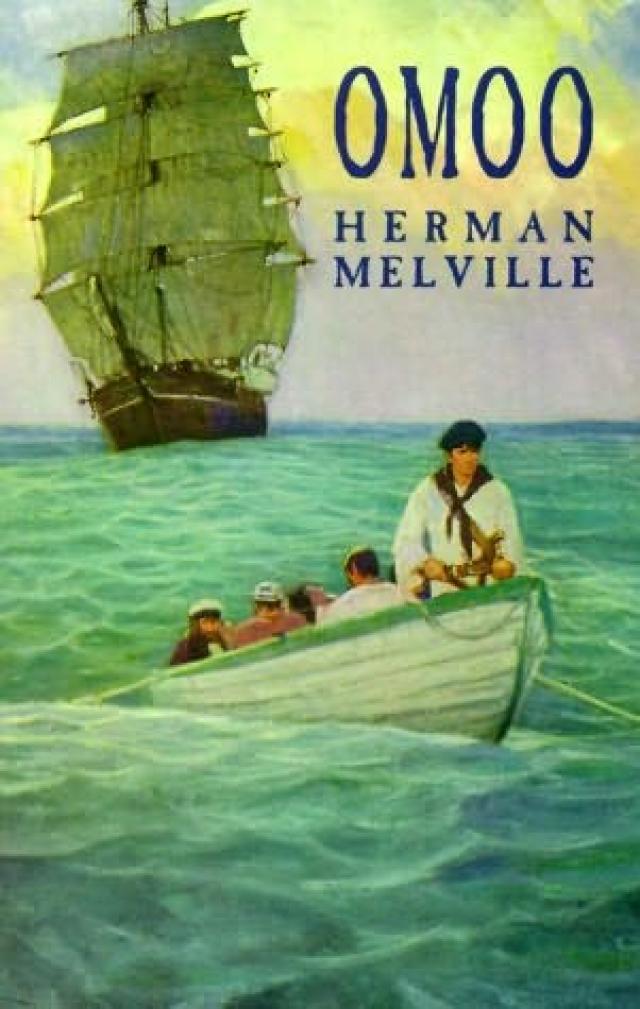


Tahiti is by far the most famous island in the South Seas; indeed, a variety of causes has made it almost classic. Its natural features alone distinguish it from the surrounding groups. Two round and lofty promontories, whose mountains rise nine thousand feet above the level of the ocean, are connected by a low, narrow isthmus; the whole being some one hundred miles in circuit. From the great central peaks of the larger peninsula-Orohena, Aorai, and Pirohitee-the land radiates on all sides to the sea in sloping green ridges. Between these are broad and shadowy valleys-in aspect, each a Tempe-watered with fine streams, and thickly wooded. Unlike many of the other islands, there extends nearly all round Tahiti a belt of low, alluvial soil, teeming with the richest vegetation. Here, chiefly, the natives dwell.
Seen from the sea, the prospect is magnificent. It is one mass of shaded tints of green, from beach to mountain top; endlessly diversified with valleys, ridges, glens, and cascades. Over the ridges, here and there, the loftier peaks fling their shadows, and far down the valleys. At the head of these, the waterfalls flash out into the sunlight, as if pouring through vertical bowers of verdure. Such enchantment, too, breathes over the whole, that it seems a fairy world, all fresh and blooming from the hand of the Creator.
Upon a near approach, the picture loses not its attractions. It is no exaggeration to say that, to a European of any sensibility, who, for the first time, wanders back into these valleys-away from the haunts of the natives-the ineffable repose and beauty of the landscape is such, that every object strikes him like something seen in a dream; and for a time he almost refuses to believe that scenes like these should have a commonplace existence. No wonder that the French bestowed upon the island the appellation of the New Cytherea. "Often," says De Bourgainville, "I thought I was walking in the Garden of Eden."
Nor, when first discovered, did the inhabitants of this charming country at all diminish the wonder and admiration of the voyager. Their physical beauty and amiable dispositions harmonized completely with the softness of their clime. In truth, everything about them was calculated to awaken the liveliest interest. Glance at their civil and religious institutions. To their king, divine rights were paid; while for poetry, their mythology rivalled that of ancient Greece.
Of Tahiti, earlier and more full accounts were given, than of any other island in Polynesia; and this is the reason why it still retains so strong a hold on the sympathies of all readers of South Sea voyages. The journals of its first visitors, containing, as they did, such romantic descriptions of a country and people before unheard of, produced a marked sensation throughout Europe; and when the first Tahitiana were carried thither, Omai in London, and Aotooroo in Paris, were caressed by nobles, scholars, and ladies.
In addition to all this, several eventful occurrences, more or less connected with Tahiti, have tended to increase its celebrity. Over two centuries ago, Quiros, the Spaniard, is supposed to have touched at the island; and at intervals, Wallis, Byron, Cook, De Bourgainville, Vancouver, Le Perouse, and other illustrious navigators refitted their vessels in its harbours. Here the famous Transit of Venus was observed, in 1769. Here the memorable mutiny of the Bounty afterwards had its origin. It was to the pagans of Tahiti that the first regularly constituted Protestant missionaries were sent; and from their shores also, have sailed successive missions to the neighbouring islands.
These, with other events which might be mentioned, have united in keeping up the first interest which the place awakened; and the recent proceedings of the French have more than ever called forth the sympathies of the public.
CHAPTER XIX
A SURPRISE-MORE ABOUT BEMBO
THE sight of the island was right welcome. Going into harbour after a cruise is always joyous enough, and the sailor is apt to indulge in all sorts of pleasant anticipations. But to us, the occasion was heightened by many things peculiar to our situation.
Since steering for the land, our prospects had been much talked over. By many it was supposed that, should the captain leave the ship, the crew were no longer bound by her articles. This was the opinion of our forecastle Cokes; though, probably, it would not have been sanctioned by the Marine Courts of Law. At any rate, such was the state of both vessel and crew that, whatever might be the event, a long stay, and many holidays in Tahiti, were confidently predicted.
Everybody was in high spirits. The sick, who had been improving day by day since the change in our destination, were on deck, and leaning over the bulwarks; some all animation, and others silently admiring an object unrivalled for its stately beauty-Tahiti from the sea.
The quarter-deck, however, furnished a marked contrast to what was going on at the other end of the ship. The Mowree was there, as usual, scowling by himself; and Jermin walked to and fro in deep thought, every now and then looking to windward, or darting into the cabin and quickly returning.
With all our light sails wooingly spread, we held on our way, until, with the doctor's glass, Papeetee, the village metropolis of Tahiti, came into view. Several ships were descried lying in the harbour, and among them, one which loomed up black and large; her two rows of teeth proclaiming a frigate. This was the Reine Blanche, last from the Marquesas, and carrying at the fore the flag of Rear-Admiral Du Petit Thouars. Hardly had we made her out, when the booming of her guns came over the water. She was firing a salute, which afterwards turned out to be in honour of a treaty; or rather-as far as the natives were concerned-a forced cession of Tahiti to the French, that morning concluded.
The cannonading had hardly died away, when Jermin's voice was heard giving an order so unexpected that everyone started. "Stand by to haul back the main-yard!"
"What's that mean?" shouted the men, "are we not going into port?"
"Tumble after here, and no words!" cried the mate; and in a moment the main-yard swung round, when, with her jib-boom pointing out to sea, the Julia lay as quiet as a duck. We all looked blank-what was to come next?
Presently the steward made his appearance, carrying a mattress, which he spread out in the stern-sheets of the captain's boat; two or three chests, and other things belonging to his master, were similarly disposed of.
This was enough. A slight hint suffices for a sailor.
Still adhering to his resolution to keep the ship at sea in spite of everything, the captain, doubtless, intended to set himself ashore, leaving the vessel, under the mate, to resume her voyage at once; but after a certain period agreed upon, to touch at the island, and take him off. All this, of course, could easily be done without approaching any nearer the land with the Julia than we now were. Invalid whaling captains often adopt a plan like this; but, in the present instance, it was wholly unwarranted; and, everything considered, at war with the commonest principles of prudence and humanity. And, although, on Guy's part, this resolution showed more hardihood than he had ever been given credit for, it, at the same time, argued an unaccountable simplicity, in supposing that such a crew would, in any way, submit to the outrage.
It was soon made plain that we were right in our suspicions; and the men became furious. The cooper and carpenter volunteered to head a mutiny forthwith; and while Jermin was below, four or five rushed aft to fasten down the cabin scuttle; others, throwing down the main-braces, called out to the rest to lend a hand, and fill away for the land. All this was done in an instant; and things were looking critical, when Doctor Long Ghost and myself prevailed upon them to wait a while, and do nothing hastily; there was plenty of time, and the ship was completely in our power.
While the preparations were still going on in the cabin, we mustered the men together, and went into counsel upon the forecastle.
It was with much difficulty that we could bring these rash spirits to a calm consideration of the case. But the doctor's influence at last began to tell; and, with a few exceptions, they agreed to be guided by him; assured that, if they did so, the ship would eventually be brought to her anchors without anyone getting into trouble. Still they told us, up and down, that if peaceable means failed, they would seize Little Jule, and carry her into Papeetee, if they all swung for it; but, for the present, the captain should have his own way.
By this time everything was ready; the boat was lowered and brought to the gangway; and the captain was helped on deck by the mate and steward. It was the first time we had seen him in more than two weeks, and he was greatly altered. As if anxious to elude every eye, a broad-brimmed Payata hat was pulled down over his brow; so that his face was only visible when the brim flapped aside. By a sling, rigged from the main-yard, the cook and Bembo now assisted in lowering him into the boat. As he went moaning over the side, he must have heard the whispered maledictions of his crew.
While the steward was busy adjusting matters in the boat, the mate, after a private interview with the Mowree, turned round abruptly, and told us that he was going ashore with the captain, to return as soon as possible. In his absence, Bembo, as next in rank, would command; there being nothing to do but keep the ship at a safe distance from the land. He then sprang into the boat, and, with only the cook and steward as oarsmen, steered for the shore.
Guy's thus leaving the ship in the men's hands, contrary to the mate's advice, was another evidence of his simplicity; for at this particular juncture, had neither the doctor nor myself been aboard, there is no telling what they might have done.
For the nonce, Bembo was captain; and, so far as mere seamanship was concerned, he was as competent to command as anyone. In truth, a better seaman never swore. This accomplishment, by the bye, together with a surprising familiarity with most nautical names and phrases, comprised about all the English he knew.
Being a harpooner, and, as such, having access to the cabin, this man, though not yet civilized, was, according to sea usages, which know no exceptions, held superior to the sailors; and therefore nothing was said against his being left in charge of the ship; nor did it occasion any surprise.
Some additional account must be given of Bembo. In the first place, he was far from being liked. A dark, moody savage, everybody but the mate more or less distrusted or feared him. Nor were these feelings unreciprocated. Unless duty called, he seldom went among the crew. Hard stories too were told about him; something, in particular, concerning an hereditary propensity to kill men and eat them. True, he came from a race of cannibals; but that was all that was known to a certainty.
Whatever unpleasant ideas were connected with the Mowree, his personal appearance no way lessened them. Unlike most of his countrymen, he was, if anything, below the ordinary height; but then, he was all compact, and under his swart, tattooed skin, the muscles worked like steel rods. Hair, crisp and coal-black, curled over shaggy brows, and ambushed small, intense eyes, always on the glare. In short, he was none of your effeminate barbarians.
Previous to this, he had been two or three voyages in Sydney whalemen; always, however, as in the present instance, shipping at the Bay of Islands, and receiving his discharge there on the homeward-bound passage. In this way, his countrymen frequently enter on board the colonial whaling vessels.
There was a man among us who had sailed with the Mowree on his first voyage, and he told me that he had not changed a particle since then.
Some queer things this fellow told me. The following is one of his stories. I give it for what it is worth; premising, however, that from what I know of Bembo, and the foolhardy, dare-devil feats sometimes performed in the sperm-whale fishery, I believe in its substantial truth.
As may be believed, Bembo was a wild one after a fish; indeed, all New Zealanders engaged in this business are; it seems to harmonize sweetly with their blood-thirsty propensities. At sea, the best English they speak is the South Seaman's slogan in lowering away, "A dead whale, or a stove boat!" Game to the marrow, these fellows are generally selected for harpooners; a post in which a nervous, timid man would be rather out of his element.
In darting, the harpooner, of course, stands erect in the head of the boat, one knee braced against a support. But Bembo disdained this; and was always pulled up to his fish, balancing himself right on the gunwale.
But to my story. One morning, at daybreak, they brought him up to a large, long whale. He darted his harpoon, and missed; and the fish sounded. After a while, the monster rose again, about a mile off, and they made after him. But he was frightened, or "gallied," as they call it; and noon came, and the boat was still chasing him. In whaling, as long as the fish is in sight, and no matter what may have been previously undergone, there is no giving up, except when night comes; and nowadays, when whales are so hard to be got, frequently not even then. At last, Bembo's whale was alongside for the second time. He darted both harpoons; but, as sometimes happens to the best men, by some unaccountable chance, once more missed. Though it is well known that such failures will happen at times, they, nevertheless, occasion the bitterest disappointment to a boat's crew, generally expressed in curses both loud and deep. And no wonder. Let any man pull with might and main for hours and hours together, under a burning sun; and if it do not make him a little peevish, he is no sailor.
The taunts of the seamen may have maddened the Mowree; however it was, no sooner was he brought up again, than, harpoon in hand, he bounded upon the whale's back, and for one dizzy second was seen there. The next, all was foam and fury, and both were out of sight. The men sheered off, flinging overboard the line as fast as they could; while ahead, nothing was seen but a red whirlpool of blood and brine.
Presently, a dark object swam out; the line began to straighten; then smoked round the loggerhead, and, quick as thought, the boat sped like an arrow through the water. They were "fast," and the whale was running.
Where was the Mowree? His brown hand was on the boat's gunwale; and he was hauled aboard in the very midst of the mad bubbles that burst under the bows.
Such a man, or devil, if you will, was Bembo.
CHAPTER XX
THE ROUND ROBIN-VISITORS FROM SHORE
AFTER the captain left, the land-breeze died away; and, as is usual about these islands, toward noon it fell a dead calm. There was nothing to do but haul up the courses, run down the jib, and lay and roll upon the swells. The repose of the elements seemed to communicate itself to the men; and for a time there was a lull.
Early in the afternoon, the mate, having left the captain at Papeetee, returned to the ship. According to the steward, they were to go ashore again right after dinner with the remainder of Guy's effects.
On gaining the deck, Jermin purposely avoided us and went below without saying a word. Meanwhile, Long Ghost and I laboured hard to diffuse the right spirit among the crew; impressing upon them that a little patience and management would, in the end, accomplish all that their violence could; and that, too, without making a serious matter of it.
For my own part, I felt that I was under a foreign flag; that an English consul was close at hand, and that sailors seldom obtain justice. It was best to be prudent. Still, so much did I sympathize with the men, so far, at least, as their real grievances were concerned; and so convinced was I of the cruelty and injustice of what Captain Guy seemed bent upon, that if need were, I stood ready to raise a hand.
In spite of all we could do, some of them again became most refractory, breathing nothing but downright mutiny. When we went below to dinner these fellows stirred up such a prodigious tumult that the old hull fairly echoed. Many, and fierce too, were the speeches delivered, and uproarious the comments of the sailors. Among others Long Jim, or-as the doctor afterwards called him-Lacedaemonian Jim, rose in his place, and addressed the forecastle parliament in the following strain:
"Look ye, Britons! if after what's happened, this here craft goes to sea with us, we are no men; and that's the way to say it. Speak the word, my livelies, and I'll pilot her in. I've been to Tahiti before and I can do it." Whereupon, he sat down amid a universal pounding of chest-lids, and cymbaling of tin pans; the few invalids, who, as yet, had not been actively engaged with the rest, now taking part in the applause, creaking their bunk-boards and swinging their hammocks. Cries also were heard, of "Handspikes and a shindy!" "Out stun-sails!" "Hurrah!"
Several now ran on deck, and, for the moment, I thought it was all over with us; but we finally succeeded in restoring some degree of quiet.
At last, by way of diverting their thoughts, I proposed that a "Round Robin" should be prepared and sent ashore to the consul by Baltimore, the cook. The idea took mightily, and I was told to set about it at once. On turning to the doctor for the requisite materials, he told me he had none; there was not a fly-leaf, even in any of his books. So, after great search, a damp, musty volume, entitled "A History of the most Atrocious and Bloody Piracies," was produced, and its two remaining blank leaves being torn out, were by help of a little pitch lengthened into one sheet. For ink, some of the soot over the lamp was then mixed with water, by a fellow of a literary turn; and an immense quill, plucked from a distended albatross' wing, which, nailed against the bowsprit bitts, had long formed an ornament of the forecastle, supplied a pen.
Making use of the stationery thus provided, I indited, upon a chest-lid, a concise statement of our grievances; concluding with the earnest hope that the consul would at once come off, and see how matters stood for himself. Eight beneath the note was described the circle about which the names were to be written; the great object of a Round Robin being to arrange the signatures in such a way that, although they are all found in a ring, no man can be picked out as the leader of it.
Few among them had any regular names; many answering to some familiar title, expressive of a personal trait; or oftener still, to the name of the place from which they hailed; and in one or two cases were known by a handy syllable or two, significant of nothing in particular but the men who bore them. Some, to be sure, had, for the sake of formality, shipped under a feigned cognomen, or "Purser's name"; these, however, were almost forgotten by themselves; and so, to give the document an air of genuineness, it was decided that every man's name should be put down as it went among the crew.