

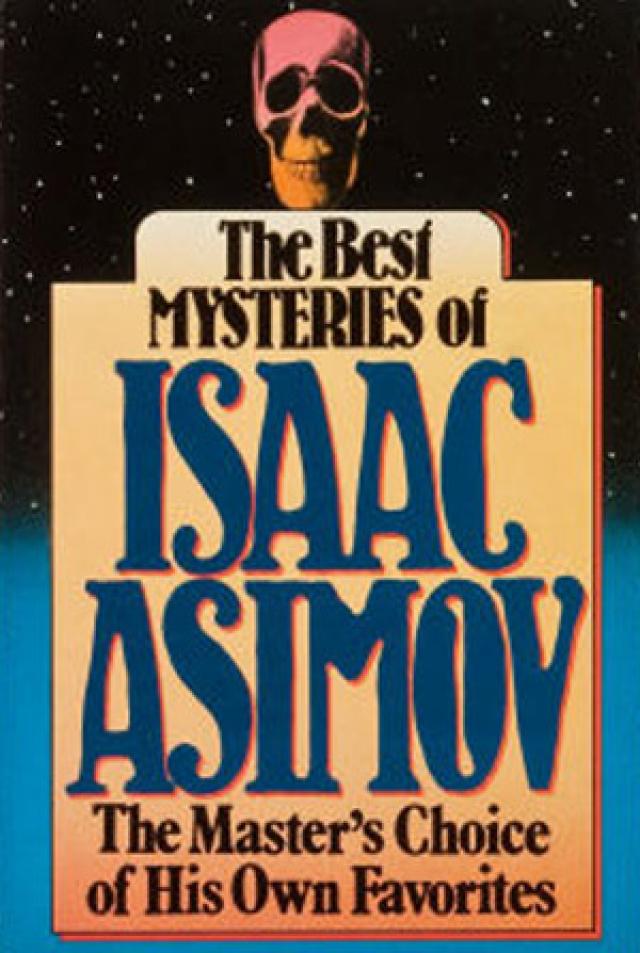
The best mysteries of is.., p.15
The Best Mysteries of Isaac Asimov,
p.15


“More likely to say ‘eastern,’” muttered Halsted.
“Either way, sir, there would not be a one and only east, but—”
Gonzalo exploded in sudden excitement. “Wait a minute, Henry. I think I see what you’re driving at. If we have the state of West Virginia—the one and only west—then we can consider Virginia to be East Virginia—the one and only east.”
“No, you can’t,” said Trumbull, with a look of disgust on his face. “Virginia has been Virginia for three and a half centuries. Calling it East Virginia doesn’t make it so.”
“It would not matter if one did, Mr. Trumbull,” said Henry, “since there is no Virginian city on the list.—But before abandoning that line of thought, however, I remembered that Mr. Murdock’s uncle lived in New Jersey and that his ancestors had lived there since colonial times. Memories of my grade school education stirred, for half a century ago we were much more careful about studying colonial history than we are today.
“It seems to me, and I’m sure Mr. Rubin will correct me if I’m wrong, that at one time in its early history New Jersey was divided into two parts—East Jersey and West Jersey, the two being separately governed. This did not last a long time, a generation perhaps, and then the single state of New Jersey was reconstituted. East Jersey, however, is the only section of what are now the United States that had ‘east’ as a part of its official name as colony or state.”
Murdock looked interested. His lips lifted in what was almost a smile. “The one and only east. It could be.”
“There is more to it than that,” said Henry. “Perth Amboy was, in its time, the capital of East Jersey.”
Murdock’s eyes opened wide. “Are you serious, Henry?”
“I am quite certain of this and I think it is the compelling factor. It was the capital of the one and only east in the list of colonies and states. I do not think you will lose the inheritance if you offer that name on Monday; nor do I think you will be gambling.” Rubin said, scowling, “I said Perth Amboy.”
“For a non-compelling reason,” said Drake. “How do you do it, Henry?”
Henry smiled slightly. “By abandoning reason for something more certain as Mr. Murdock suggested at the start.”
“What are you talking about, Henry?” said Avalon. “You worked it out very nicely by a line of neat argument.”
“After the fact, sir,” said Henry. “While all of you were applying reason, I took the liberty of seeking authority and turned to the reference shelf we use to settle arguments. I looked up each city in Webster’s Geographical Dictionary. Under Perth Amboy, it is clearly stated that it was once the capital of East Jersey.”
He held out the book and Rubin snatched it from his hands, to check the matter for himself.
“It is easy to argue backward, gentlemen,” said Henry.
8
The Cross of Lorraine
I’ve never considered myself as very adept at telling a love story, but in this case Eleanor Sullivan, then managing editor (now editor) of EQMM (Ellery Queen’s Mystery Magazine), was fond of the romantic aspect of the story. This was flattering to me and at once elevated the story in my esteem.
Then, too, there are some things that are quite obvious once pointed out, and are absolutely opaque until then. The point of this story is one of those things. I happened to notice the peculiarity because I was actively looking for something to use in a story, but Eleanor said that an associate failed to see the object even when it stared him in the face. As a result, I think of this as perhaps the best of all the Black Widower stories.
Emmanuel Rubin did not, as a general rule, ever allow a look of relief to cross his face. Had one done so, it would have argued a prior feeling of uncertainty or apprehension, sensations he might feel but would certainly never admit to.
This time, however, the relief was unmistakable. It was monthly banquet time for the Black Widowers; Rubin was the host, and it was he who was supplying the guest; and here it was about twenty minutes after seven and only now—with but ten minutes left before the banquet was to start—only now did his guest arrive.
Rubin bounded toward him, careful, however, not to spill a drop of his second drink.
“Gentlemen,” he said, clutching the arm of the newcomer, “my guest, the Amazing Larri—spelled L-A-R-R-I.” And in a lowered voice, over the hum of pleased-to-meet-yous, “Where the hell were you?”
Larri muttered, “The subway train stalled.” Then returned smiles and greetings.
“Pardon me,” said Henry, the perennial—and nonpareil—waiter at the Black Widower banquets, “but there is not much time for the guest to have his drink before dinner begins. Would you state your preference, sir?”
“A good notion, that,” said Larri, gratefully. “Thank you, waiter, and let me have a dry martini, but not too darned dry—a little damp, so to speak.”
“Certainly, sir,” said Henry.
Rubin said, “I’ve told you, Larri, that we members all have our ex officio doctorates, so now let me introduce them in nauseating detail. This tall gentleman with the neat mustache, black eyebrows, and straight back is Dr. Geoffrey Avalon. He’s a lawyer and he never smiles. The last time he tried, he was fined for contempt of court.”
Avalon smiled as broadly as he could and said, “You undoubtedly know Manny well enough, sir, not to take him seriously.”
“Undoubtedly,” said Larri. As he and Rubin stood together, they looked remarkably alike. Both were of a height—about five feet, five—both had active, inquisitive faces, both had straggly beards, though Larri’s was longer and was accompanied by a fringe of hair down either side of his face as well.
Rubin said, “And here, dressed fit to kill anyone with a real taste for clothing, is our scribble expert, Dr. Mario Gonzalo, who will insist on producing a caricature of you in which he will claim to see a resemblance. Dr. Roger Halsted inflicts pain on junior-high students under the guise of teaching them what little he knows of mathematics. Dr. James Drake is a superannuated chemist who once conned someone into granting him a Ph.D. And finally, Dr. Thomas Trumbull, who works for the government in an unnamed job as code expert and who spends most of his time hoping Congress doesn’t find out.”
“Manny,” said Trumbull wearily, “if it were possible to cast a retroactive blackball, I think you could count on five.”
And Henry said, “Gentlemen, dinner is served.”
It was one of those rare Black Widower occasions when the entrée was lobster, rarer now than ever because of the increase in prices.
Rubin, who as host bore the cost, shrugged it off. “I made a good paperback sale last month and we can call this a celebration.”
“We can celebrate,” said Avalon, “but lobster tends to kill conversation. The cracking of claws and shells, the extraction of meat, the dipping in melted butter, takes one’s full concentration.” And he grimaced with the effort he was putting into the compression of the nutcracker.
“In that case,” said the Amazing Larri, “I shall have a monopoly on the conversation,” and he grinned with satisfaction as a large platter of prime-rib roast was dexterously placed before him by Henry.
“Larri is allergic to seafood,” said Rubin.
Conversation was indeed subdued as Avalon had predicted until the various lobsters had been clearly worsted in culinary battle, and then, finally, Halsted asked, “What makes you Amazing, Larri?”
“Stage name,” said Larri. “I am a prestidigitator, an escapist extraordinaire, and the greatest living exposeur.”
Trumbull, who was sitting to Larri’s right, formed ridges on his bronzed forehead. “What the devil do you mean by exposeur?”
Rubin beat a tattoo on his water glass at this point and said, “No grilling till we’ve had our coffee.”
“For God’s sake,” said Trumbull, “I’m just asking the definition of a word.”
“Host’s decision is final,” said Rubin.
Trumbull scowled blackly in Rubin’s direction. “Then I’ll guess the answer. An exposeur is one who exposes fakes; people who, using trickery of one sort or another, pretend to produce effects they attribute to supernatural or paranatural forces.”
Larri thrust out his lower lip, raised his eyebrows, and nodded his head. “Pretty good for a guess. I couldn’t have put it better.”
Gonzalo said, “You mean that whatever someone did by what he claimed was real magic, you could do by stage magic.”
“Exactly,” said Larri. “For instance, suppose that some mystic claimed he had the capacity to bend spoons by means of unknown forces. I can do the same by using natural force, this way.” He lifted his spoon and, holding it by its two ends, he bent it half an inch out of true.
Trumbull said, “That scarcely counts. Anyone can do it that way.”
“Ah,” said Larri, “but this spoon you saw me bend is not the amazing effect at all. That spoon you were watching merely served to trap and focus the ethereal rays that did the real work. Those rays acted to bend your spoon, Dr. Trumbull.”
Trumbull looked down and picked up his spoon, which was bent nearly at right angles. “How did you do this?”
Larri shrugged. “Would you believe ethereal forces?”
Drake laughed and, pushing his dismantled lobster toward the center of the table, lit a cigarette. He said, “Larri did it a few minutes ago, with his hands, when you weren’t looking.”
Larri seemed unperturbed by exposure. “When Manny banged his glass, Dr. Trumbull, you looked away. I had rather hoped you all would.”
Drake said, “I know better than to pay attention to Manny.”
“But,” said Larri, “if no one had seen me do it, would you have accepted the ethereal forces?”
“Not a chance,” said Trumbull.
“Even if there had been no way in which you could explain the effect? Here, let me show you something. Suppose you wanted to flip a coin…”
He fell silent for a moment while Henry passed out the strawberry shortcake, pushed his own out of the way, and said, “Suppose you wanted to flip a coin, without actually lifting it and turning it—this penny, for instance. There are a number of ways it could be done. The simplest would be simply to touch it quickly, because, as you all know, a finger is always slightly sticky, especially so at mealtime, so that the coin lifts up slightly as the finger is removed and can be made to flip over. It is tails now, you see. Touch it again and it is heads.”
Gonzalo said, “No prestidigitation there, though. We see it flip.”
“Exactly,” said Larri, “and that’s why I won’t do it that way. Let’s put something over it so that it can’t be touched or flipped. Suppose we use a…” He looked about the table for a moment and seized a salt shaker. “Suppose we use this.”
He placed the salt shaker over the coin and said, “Now it is showing heads?…”
“Hold on,” said Gonzalo. “How do we know it’s showing heads? It could be tails and then, when you reveal it later, you’ll say it flipped, when it was tails all along.”
“You’re perfectly right,” said Larri, “and I’m glad you raised the point. Dr. Drake, you’ve got eyes that caught me before. Would you check this on behalf of the assembled company? I’ll lift the salt shaker and you tell me what the coin shows.”
Drake looked and said, “Heads!” in his softly hoarse voice.
“You’ll all take Dr. Drake’s word, I hope, gentlemen? Please, watch me place the salt shaker back on the coin and make sure it doesn’t flip in the process…”
“It didn’t,” said Drake.
“Now to keep my fingers from slipping while performing this trick, I will put this paper napkin over the salt shaker.”
Larri molded the paper napkin neatly and carefully over the salt shaker, then said, “But, in manipulating this napkin, I caused you all to divert your attention from the penny and you may think I have flipped it in the process.” He lifted the salt shaker with the paper about it and said, “Dr. Drake, will you check the coin again?”
Drake leaned toward it. “Still heads,” he said.
Very carefully and gently, Larri put back the salt shaker, the paper napkin still molded about it, and said, “The coin remained as is?”
“Still heads,” said Drake.
“In that case, I now perform the magic.” Larri pushed down on the salt shaker, and the paper collapsed. There was nothing inside.
There was a moment of shock, and then Gonzalo said, “Where’s the salt shaker?”
“In another plane of existence,” said Larri airily.
“But you said you were going to flip the coin.”
“I lied.”
Avalon said, “There’s no mystery. He had us all concentrating on the coin as a diversion tactic. When he picked up the salt shaker with the napkin around it to let Jim look at the coin, he just dropped the salt shaker into his hand and placed the empty, molded napkin over the coin.”
“Did you see me do that, Dr. Avalon?” asked Larri. “No. I was looking at the coin, too.”
“Then you’re just guessing,” said Larri.
Rubin, who had not participated in the demonstration at all, but who had eaten his strawberry shortcake instead and now waited for the others to catch up, said, “The tendency is to argue these things out logically and that’s impossible. Scientists and other rationalists are used to dealing with the universe, which fights fair. Faced with a mystic who does not, they find themselves maneuvered into believing nonsense and, in the end, making fools of themselves.
“Magicians, on the other hand,” Rubin went on, “know what to watch for, are experienced enough not to be misdirected, and are not impressed by the apparently supernatural. That’s why mystics generally won’t perform if they know magicians are in the audience.”
Coffee had been served and was being sipped at, and Henry was quietly preparing the brandy, when Rubin sounded the water glass and said, “Gentlemen, it is time for the official grilling, assuming you idiots have left anything to grill. Geoff, will you do the honors today?”
Avalon cleared his throat portentously and frowned down upon the Amazing Larri from under his dark and luxuriant eyebrows. Using his voice in the deepest of its naturally deep register, Avalon said, “It is customary to ask our guests to justify their existences, but if today’s guest exposes phony mystics even now and then, I, for one, consider his existence justified and will pass on.
“The temptation is to ask you how you performed your little disappearing trick of a moment ago, but I quite understand that the ethics of your profession preclude your telling us. Even though everything said here is considered under the rose, and though nothing has ever leaked, I will refrain from such questions.
“Let me instead, then, ask after your failures. Sir, you describe yourself as an exposeur. Have there been any supposedly mystical demonstrations you have not been able to duplicate in prestidigitous manner and have not been able to account for by natural means?”
Larri said, “I have not attempted to explain all the effects I have ever encountered or heard of, but where I have studied an effect and made an attempt to duplicate it, I have succeeded in every case.”
“No failures?”
“None!”
Avalon considered that, but as he prepared for the next question, Gonzalo broke in. His head was leaning on one palm, but the fingers of that hand were carefully disposed in such a way as not to disarray his hair. He said, “Now, wait, Larri, would it be right to suggest that you tackled only easy cases? The really puzzling cases you might have made no attempts on.”
“You mean,” said Larri, “that I shied away from anything that might spoil my perfect record or that might upset my belief in the rational order of the universe? If so, you’re quite wrong, Dr. Gonzalo. Most reports of apparent mystical powers are dull and unimportant, are crude and patently false. I ignore those. The cases I do take on are precisely the puzzling ones that have attracted attention because of their unusual nature and their apparent divorce from the rational. So you see, the ones I take on are precisely those you suspect I avoid.”
Gonzalo subsided and Avalon said, “Larri, the mere fact that you can duplicate a trick by prestidigitation doesn’t mean that it couldn’t have been performed by the mystic through supernatural means. The fact that human beings can build machines that fly doesn’t mean that birds are man-made machines.”
“Quite right,” said Larri, “but mystics lay their claims to supernatural powers on the notion, either expressed or implicit, that there is no other way of producing the effect. If I show that the same effect can be produced by natural means, the burden of proof then shifts to them to show that the effect can be produced after the natural means I have used are made impossible. I don’t know of any mystic who has accepted the conditions set by professional magicians to guard against trickery and who then succeeded.”
“And nothing has ever puzzled you? Not even the tricks other magicians have developed?”
“Oh yes, there are effects produced by some magicians that puzzle me in the sense that I don’t know quite how they do it. I might duplicate it but perhaps using a different method. In any case, that’s not the point. As long as an effect is produced by natural means, it doesn’t matter whether I can reproduce it or not. I am not the best magician in the world. I am just a better magician than any mystic is.”
Halsted, his high forehead flushed with anxiety, and stuttering slightly in his eagerness to speak, said, “But then nothing would startle you? No disappearance like that you carried through on the salt shaker?…”
“You mean that one?” asked Larri, pointing. There was a salt shaker in the middle of the table, but no one had seen it placed there.
Halsted, thrown off a moment, recovered and said, “Have you ever been startled by any disappearance? I heard once that magicians have made elephants disappear.”
“Actually, making elephants disappear is childishly simple. I assure you there’s nothing puzzling about disappearances in a magic act.” And then a peculiar look crossed Larri’s face, a flash of sadness and frustration. “Not in a magic act. Just…”


