

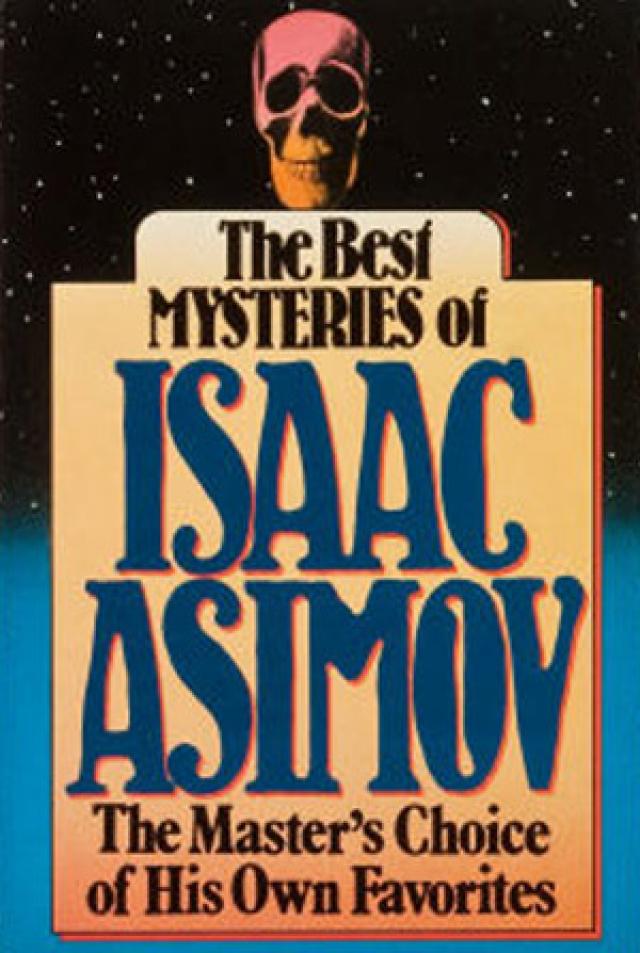
The best mysteries of is.., p.5
The Best Mysteries of Isaac Asimov,
p.5


Avalon said, “Ah! You mean ‘Is it so nominated in the bond?’ The bond is a legal contract, and the question was whether something was a requirement of the contract.”
Drake said, “Wait a bit. Didn’t that bond involve a sum of three thousand ducats?”
“By Heaven, so it did,” said Avalon.
Gonzalo’s grin split his head from ear to ear. “I think I’ve got something there: bonds involving three thousand units of money. That’s the play to look into.”
Henry interrupted softly. “I scarcely think so, gentlemen. The play in question is The Merchant of Venice and the person asking whether something was nominated in the bond was the Jew, Shylock, intent on a cruel revenge. Surely the old man would not enjoy this play.”
Levy said, “That’s right. Shylock was a dirty word to him—and not so clean to me, either.”
Rubin said, “What about the passage that goes: ‘Hath not a Jew eyes? hath not a Jew hands, organs, dimensions, senses, affections, passions…’?”
“It wouldn’t appeal to my grandfather,” said Levy. “It pleads the obvious and cries out for an equality my grandfather would not, in his heart, be willing to grant, since I’m sure he felt superior in that he was a member of God’s uniquely chosen.”
Gonzalo looked disappointed. “It seems we’re not getting anywhere.”
Levy said, “No, I don’t think we are. I went through the entire book. I read all the speeches carefully; all the passages you mentioned. None of them meant anything to me.”
Avalon said, “Granted they don’t, but you may be missing something subtle—”
“Come on, Jeff, you’re the one who said it couldn’t be subtle. My grandfather was thinking of something tailored for the mind of myself and my wife. It was something we would get, and probably get at once; and we didn’t.”
Drake said, “Maybe you’re right. Maybe some in-joke is involved.”
“I’ve just said that.”
“Then why don’t you try it backward? Can you think of something, some gag, some phrase?…Is there some expression he used every time?”
“Yes. When he disapproved of someone he would say, ‘Eighteen black years on him.’”
“What kind of an expression is that?” asked Trumbull.
“In Yiddish it’s common enough,” said Levy. “Another one was ‘It will help him like a dead man cups.’”
“What does that mean?” asked Gonzalo.
“It refers to cupping. You place a lighted piece of paper in a small round glass cup and then put the open edge against the skin. The paper goes out but leaves a partial vacuum in the cup and circulation is sucked into the superficial layers. Naturally, cupping can’t improve the circulation of a corpse.”
“All right,” said Drake, “is there anything about eighteen black years, or about cupping dead men, that reminds you of something in Shakespeare?”
There was a painful silence and finally Avalon said, “I can’t think of anything.”
“And even if you did,” said Levy, “what good would it do? What would it mean? Listen, I’ve been at this for two months. You’re not going to solve it for me in two hours.”
Drake turned to Henry again and said, “Why are you just standing there, Henry? Can’t you help us?”
“I’m sorry, Dr. Drake, but I now believe that the whole question of Shakespeare is a false lead.”
“No,” said Levy. “You can’t say that. The old man pointed to The Collected Works without any question. His fingertip was within an inch of it. It couldn’t have been any other book.”
Drake said suddenly, “Say, Levy, you’re not diddling us, are you? You’re not telling us a pack of lies to make jackasses out of us?”
“What?” said Levy in amazement.
“Nothing, nothing,” said Avalon hastily. “He’s just thinking of another occasion. Shut up, Jim.”
“Listen,” said Levy. “I’m telling you exactly what happened. He was pointing exactly at Shakespeare.”
There was a short silence and then Henry sighed and said, “In mystery stories—”
Rubin broke in with a “Hear! Hear!”
“In mystery stories,” Henry repeated, “the dying hint is a common device, but I have never been able to take it seriously. A dying man, anxious to give last-minute information, is always pictured as presenting the most complex hints. His dying brain, with two minutes’ grace, works out a pattern that would puzzle a healthy brain with hours to think. In this particular case, we have an old man dying of a paralyzing stroke who is supposed to have quickly invented a clue that a group of intelligent men have failed to work out; and with one of them having worked at it for two months. I can only conclude there is no such clue.”
“Then why should he have pointed to Shakespeare, Henry?” asked Levy. “Was it all just the vague delusions of a dying man?”
“If your story is correct,” said Henry, “then I think he was indeed trying to do something. He cannot, however, have been inventing a clue. He was doing the only thing his dying mind could manage. He was pointing to the bonds.”
“I beg your pardon,” said Levy huffily. “I was there. He was pointing to Shakespeare.”
Henry shook his head. He said, “Mr. Levy, would you point to Fifth Avenue?”
Levy thought a while, obviously orienting himself, and then pointed. “Are you pointing to Fifth Avenue?” asked Henry. “Well, the restaurant’s entrance is on Fifth Avenue, so I’m pointing to it.”
“It seems to me, sir,” said Henry, “that you are pointing to a picture of the Arch of Titus on the western wall of this room.”
“Well, I am, but Fifth Avenue is beyond it.”
“Exactly, sir. So I only know that you are pointing to Fifth Avenue because you tell me so. You might be pointing to the picture or to some point in the air before the picture, or to the Hudson River, or to Chicago, or to the planet Jupiter. If you point, and nothing more, giving no hint, verbal or otherwise, as to what you’re pointing at, you are only indicating a direction and nothing more.”
Levy rubbed his chin. “You mean my grandfather was only indicating a direction?”
“It must be so. He didn’t say he was pointing to Shakespeare. He merely pointed.”
“All right, then, what was he pointing at? The—the—” He closed his eyes and fingered his mustache gently, as he oriented the room in his house. “The Verrazano Bridge?”
“Probably not, sir,” said Henry. “He was pointing in the direction of The Collected Works. His finger was an inch from it, you said, so it is doubtful that he could be pointing at anything in front of it. What was behind the book, Mr. Levy?”
“The bookcase. The wood of the bookcase. And when you took the book out, there was nothing behind it. There was nothing pushed up against the wood, if that’s what you have in mind. We would have seen it at once if anything at all had been there.”
“And behind the bookcase, sir?”
“The wall.”
“And between the bookcase and the wall, sir?” Now Levy fell silent. He thought a while, and no one interrupted those thoughts. He said, “Is there a phone I can use, Henry?”
“I’ll bring you one, sir.”
The phone was placed in front of Levy and plugged in. Levy dialed a number.
“Hello, Julia? What are you doing up so late?…Never mind the TV and get to bed. But first call Mamma, dear…Hello, Caroline, it’s Simon…Yes, I’m having a good time, but listen, Caroline, listen. You know the bookcase with the Shakespeare in it?…Yes, that Shakespeare. Of course. Move it away from the wall…The bookcase…Look, you can take the books out of it, can’t you? Take them all out, if you have to, and dump them on the floor…No, no, just move the end of the bookcase near the door a few inches; just enough to look behind and tell me if you see anything…Look about where the Shakespeare book would be…I’ll wait, yes.”
They were all frozen in attitudes. Levy was distinctly pale. Some five minutes passed. Then, “Caroline?…Okay, take it easy. Did you move…? Okay, okay, I’ll be home soon.”
He hung up and said, “If that doesn’t beat everything. The old guy had them taped to the back of the bookcase. He must have moved that thing sometime when we were out. It’s a wonder he didn’t have a stroke then and there.”
“You did it again, Henry,” said Gonzalo.
Levy said, “Agent’s fee is three hundred dollars, Henry.”
Henry said, “I am well paid by the club, and the banquets are my pleasure, sir. There is no need for more.”
Levy reddened slightly and changed the subject. “But how did you get the trick of it? When the rest of us—”
“It was not difficult,” said Henry. “The rest of you happened to track down all the wrong paths, and I simply suggested what was left.”
3
Out of Sight
The Black Widowers, as a club, is modeled after a real-life club of which I am a member. What’s more, each of the Black Widowers (except Henry, who is an invention out of thin air) is modeled—as far as physical appearance is concerned—on members of the real-life club. (They all know this and don’t mind, so I’m putting myself in no danger in saying this.)
I am often asked which of the Black Widowers is me, and the answer is “None of them.” However, I sometimes make my appearance as a guest or as a character in the story within the story. In this tale, for instance, I am the character “Smith.” He is not described in very complimentary fashion, but then I never describe myself in very complimentary fashion. More to the point, Mrs. Smith is modeled on my dear wife, Janet, and the incident with the hot chocolate described in the story happened in real life in that precise fashion.
Because Janet and I are both in it, I can’t help but have a warm spot in my heart for this story.
The monthly banquet of the Black Widowers had reached the point where little was left of the mixed grill save for an occasional sausage and a markedly untouched piece of liver on the plate of Emmanuel Rubin—and it was then that voices rose in Homeric combat.
Rubin, undoubtedly infuriated by the presence of liver at all, was saying, even more flatly than was usual for him, “Poetry is sound. You don’t look at poetry. I don’t care whether a culture emphasizes rhyme, alliteration, repetition, balance, or cadence, it all comes down to sound.”
Roger Halsted never raised his voice, but one could always tell the state of his emotions by the color of his high forehead. Right now, it was a deep pink, the color extending past the line that had once marked hair.
He said, “What’s the use of making generalizations, Manny? No generalization can hold generally without an airtight system of axiomatics to begin with. Literature—”
“If you’re going to tell me about figurative verse,” said Rubin hotly, “save your breath. That’s Victorian nonsense.”
“What’s figurative verse?” asked Mario Gonzalo lazily. “Is he making that up, Jeff?” He added a touch to the tousled hair in his careful caricature of the banquet guest, Waldemar Long, who, since the dinner had begun, had eaten in a somber silence, but was obviously following every word.
“No,” said Geoffrey Avalon judiciously, “though I wouldn’t put it past Manny to make something up if that were the only way he could win an argument. Figurative verse is verse in which the words or lines are arranged typographically in such a way as to produce a visual image that reinforces the sense. ‘The Mouse’s Tail’ in Alice in Wonderland is the best-known example.”
Halsted’s soft voice was unequal to the free-for-all and he methodically beat his spoon against the water goblet till the decibels had simmered down.
He said, “Let’s be reasonable. The subject under discussion is not poetry in general, but the limerick as a verse form. My point is this—I’ll repeat it, Manny—that the worth of a limerick is not dictated by its subject matter. It’s a mistake to think that a limerick has to be dirty to be good. It’s easier—”
James Drake stubbed out his cigarette, twitched his small grizzled mustache, and said in his hoarse voice, “Why do you call a dirty limerick dirty? The Supreme Court will get you.”
Halsted said, “Because it’s a two-syllable word with a meaning you all understand. What do you want me to say? Sexual-excretory-blasphemous-and-miscellaneous-generally-irreverent?”
Avalon said, “Go on, Roger. Go on. Make your point and don’t let them needle you.” And, from under his luxuriant eyebrows, he frowned austerely at the table generally. “Let him talk.”
“Why?” said Rubin. “He has nothing to…Okay, Jeff. Talk, Roger.”
“Thank you all,” said Halsted, in the wounded tone of one who has finally succeeded in having his wrongs recognized. “The worth of a limerick rests in the unpredictability of the last line and in the cleverness of the final rhyme. In fact, irreverent content may seem to have value in itself and require less cleverness—and produce a less worthwhile limerick, as limerick. Now it is possible to have the rhyme masked by the orthographical conventions.”
“What?” said Gonzalo.
“Spelling,” said Avalon.
“And then,” said Halsted, “in seeing the spelling and having that instant of delay in getting the sound, you intensify the enjoyment. But under those conditions you have to see the limerick. If you just recite it, the excellence is lost.”
“Suppose you give us an example,” said Drake.
“I know what he means,” said Rubin loudly. “He’s going to rhyme M.A. and CD.—Master of Arts and Caster of Darts.”
“That’s an example that’s been used,” admitted Halsted, “but it’s extreme. It takes too long to catch on and amusement is drowned in irritation. As it happens, I’ve made up a limerick while we were having the argument—”
And now, for the first time, Thomas Trumbull entered this part of the discussion. His tanned and wrinkled face twisted into a dark scowl and he said, “The hell you did. You made it up yesterday and you engineered this whole silly nonsense so you could recite it. If it’s one of your Iliad things, I’ll personally kick you out of here.”
“It’s not the Iliad,” said Halsted. “I haven’t been working on that recently. It’s no use my reciting this one, of course. I’ll write it down and pass it around.”
He wrote in dark block letters on an unused napkin:
YOU CAN’T CALL THE BRITISH QUEEN MS. TAINT AS NICE AS ELIZABETH IS. BUT I THINK THAT THE QUEEN WOULD BE EVEN LESS KEEN TO HAVE HERSELF MENTIONED AS LS.
Gonzalo laughed aloud when it came to him. He said, “Sure, if you know that MS is pronounced Miz, then you pronounce LS as Liz.”
“To me,” said Drake scornfully, “LS would have to stand for ‘lanuscript’ if it’s going to rhyme with MS.”
Avalon pursed his lips and shook his head. “Using TAINT is a flaw. You ought to lose a syllable some other way. And to be perfectly consistent, shouldn’t the rhyme word IS be spelled simply S?”
Halsted nodded eagerly. “You’re quite right, and I thought of doing that, but it wouldn’t be transparent enough and the reader wouldn’t get it fast enough to laugh. Secondly, it would be the cleverest part of the limerick and would make the LS anticlimactic.”
“Do you really have to waste all that fancy reasoning on a piece of crap like this?” asked Trumbull.
“I think I’ve made my point,” said Halsted. “The humor can be visual.”
Trumbull said, “Well, then, drop the subject. Since I’m host this session, that’s an order…Henry, where’s the damned dessert?”
“It’s here, sir,” said Henry softly. Unmoved by Trumbull’s tone, he deftly cleared the table and dealt out the blueberry shortcake.
The coffee had already been poured and Trumbull’s guest said in a low voice, “May I have tea, please?”
The guest had a long upper lip and an equally long chin. The hair on his head was shaggy but there was none on his face and he had walked with a somewhat bearlike stoop. When he was first introduced, only Rubin had registered any recognition.
He had said, “Aren’t you with NASA?”
Waldemar Long had answered with a startled “Yes” as though he had been disturbed out of a half-resentful resignation to anonymity. He had then frowned. He was frowning now again as Henry poured the tea and melted unobtrusively into the background.
Trumbull said, “I think the time has come for our guest to enter the discussion and perhaps add some portion of sense to what has been an unusually foolish evening.”
“No, that’s all right, Tom,” said Long. “I don’t mind frivolity.” He had a deep and rather beautiful voice that had a definite note of sadness in it. He went on, “I have no aptitude for badinage myself, but I enjoy listening to it.”
Halsted, still brooding over the matter of the limericks, said, with sudden forcefulness, “I suggest Manny not be the grill master on this occasion.”
“No?” said Rubin, his sparse beard lifting belligerently.
“No. I put it to you, Tom. If Manny questions our guest, he will surely bring up the space program since there’s a NASA connection. Then we will go through the same darned argument we’ve had a hundred times. I’m sick of the whole subject of space and whether we ought to be on the moon.”
“Not half as sick as I am,” said Long, rather unexpectedly, “I’d just as soon not discuss any aspect of space exploration.”
The heavy flatness of the remark seemed to dampen spirits all around.
Even Halsted seemed momentarily at a loss for any other subject to introduce to someone connected with NASA.
Then Rubin stirred in his seat and said, “I take it, Dr. Long, that this is a recently developed attitude of yours.”
Long’s head turned suddenly toward Rubin. His eyes narrowed. “Why do you say that, Mr. Rubin?”
Rubin’s small face came as close to a simper as it ever did. “Elementary, my dear Dr. Long. You were on the cruise that went down to see the Apollo shot last winter. I’d been invited as a literary representative of the intellectual community, but I couldn’t go. However, I got the promotional literature and noticed you were along. You were going to lecture on some aspect of the space program, I forget which, and that was voluntary. So your disenchantment with the subject must have arisen in the six months since the cruise.”


