

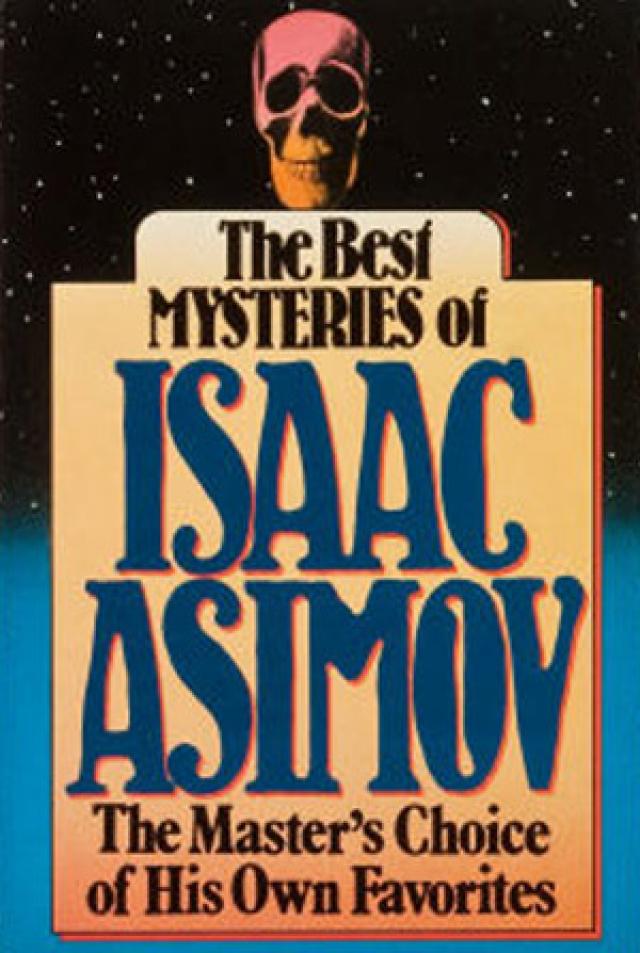
The best mysteries of is.., p.40
The Best Mysteries of Isaac Asimov,
p.40


“Well, then—The name of the German Jesuit I have been speaking of is Christoph Klau—pronounced ‘klow.’ Don’t you see the pun? Klau—clue?”
Ashley’s entire body seemed to grow flabby with disappointment. “Farfetched,” he muttered.
Davenport said anxiously, “Dr. Urth, there is no feature on the Moon named Klau as far as I know.”
“Of course not,” said Urth excitedly. “That is the whole point. At this period of history, the last half of the sixteenth century, European scholars were Latinizing their names. Klau did so. In place of the German ‘u’, he made use of the equivalent letter, the Latin ‘v’. He then added an ‘ius’ ending typical of Latin names and Christoph Klau became Christopher Clavius, and I suppose you are all aware of the giant crater we call Clavius.”
“But—” began Davenport.
“Don’t ‘but’ me,” said Urth. “Just let me point out that the Latin word ‘clavis’ means ‘key.’ Now do you see the double and bilingual pun? Klau—clue, Clavius—clavis—key. In his whole life, Jennings could never have made a double, bilingual pun, without the Device. Now he could, and I wonder if death might not have been almost triumphant under the circumstances. And he directed you to me because he knew I would remember his penchant for puns and because he knew I loved them too.”
The two men of the Bureau were looking at him wide-eyed.
Urth said solemnly, “I would suggest you search the shaded rim of Clavius, at that point where the Earth is nearest the zenith.”
Ashley rose. “Where is your videophone?”
“In the next room.”
Ashley dashed. Davenport lingered behind. “Are you sure, Dr. Urth?”
“Quite sure. But even if I am wrong, I suspect it doesn’t matter.”
“What doesn’t matter?”
“Whether you find it or not. For if the Ultras find the Device, they will probably be unable to use it.”
“Why do you say that?”
“You asked me if Jennings had ever been a student of mine, but you never asked me about Strauss, who was also a geologist. He was a student of mine a year or so after Jennings. I remember him well.”
“Oh?”
“An unpleasant man. Very cold. It is the hallmark of the Ultras, I think. They are all very cold, very rigid, very sure of themselves. They can’t empathize, or they wouldn’t speak of killing off billions of human beings. What emotions they possess are icy ones, self-absorbed ones, feelings incapable of spanning the distance between two human beings.”
“I think I see.”
“I’m sure you do. The conversation reconstructed from Strauss’s ravings showed us he could not manipulate the Device. He lacked the emotional intensity, or the type of necessary emotion. I imagine all Ultras would. Jennings, who was not an Ultra, could manipulate it. Anyone who could use the Device would, I suspect, be incapable of deliberate cold-blooded cruelty. He might strike out of panic fear as Jennings struck at Strauss, but never out of calculation, as Strauss tried to strike at Jennings. In short, to put it tritely, I think the Device can be actuated by love, but never by hate, and the Ultras are nothing if not haters.”
Davenport nodded. “I hope you’re right. But then—why were you so suspicious of the government’s motives if you felt the wrong men could not manipulate the Device?”
Urth shrugged. “I wanted to make sure you could bluff and rationalize on your feet and make yourself convincingly persuasive at a moment’s notice. After all, you may have to face my niece.”
26
A Problem of Numbers
This is the first mystery story I ever sold to EQMM. I had received one or two rejections from the magazine, but I had shrugged them off. After all, I was a science fiction writer, not a mystery writer. However, by 1969, I had written enough mysteries of one sort or another to feel like a mystery writer, too.
In November of that year, I was going through the magazine and read one of their “First Stories.” EQMM routinely had one or two stories representing the first sale of a particular author and they were usually pretty good, too.
And I said in exasperation, “Well, if they can sell a story to EQMM, then I can, too, or what’s the use of being Asimov?” So I sat down without delay and wrote a story and had it in the mail within an hour of having walked to the typewriter.
The story was accepted and a year after it appeared the magazine asked me for another one and I wrote my first Black Widower and was off and running.
Professor Neddring looked mildly at his graduate student. The young man sat there at ease; his hair was a little on the reddish side, his eyes were keen but calm, and his hands rested in the pockets of his lab coat. Altogether a promising specimen, the professor thought.
He had known for some time that the boy was interested in his daughter. What was more to the point, he had known for some time his daughter was interested in the boy.
The professor said, “Let’s get this straight, Hal. You’ve come to me for my approval before you propose to my daughter?”
Hal Kemp said, “That’s right, sir.”
“Granted that I’m not up on the latest fads of youth—but surely this can’t be the new ‘in’ thing.” The professor thrust his hands into his lab coat pockets and leaned back in his chair. “Surely, young people aren’t taking to asking permission these days? Don’t tell me you’ll give up my daughter if I turn you down?”
“No, not if she’ll still have me, and I think she will. But it would be pleasant—”
“—if you had my approval. Why?”
Hal said, “For very practical reasons. I don’t have my doctor’s degree yet and I don’t want it said that I’m dating your daughter to help me get it. If you think I am, say so, and maybe I’ll wait till after I get my degree. Or maybe I won’t and take my chances that your disapproval will make it that much harder for me to get my degree.”
“So, for the sake of your doctorate, you think it would be nice if we were friends about your marriage to Janice.”
“To be honest, yes, Professor.”
There was silence between them. Professor Neddring thought about the matter with a certain creakiness. His research work for some years now had dealt with the coordination complexes of chromium and there was a definite difficulty in thinking with some precision about anything as imprecise as affection and marriage.
He rubbed his smooth cheek—at the age of fifty he was too old for the various beard styles affected by the younger members of the department—and said, “Well, Hal, if you want a decision from me I’ll have to base it on something, and the only way I know how to judge people is by their reasoning powers. My daughter judges you in her way, but I’ll have to judge you in mine.”
“Certainly,” said Hal.
“Then let me put it this way.” The professor leaned forward, scribbled something on a piece of paper, and said, “Tell me what this says, and you will have my blessing.”
Hal picked up the paper. What was written on it was a series of numbers:
69663717263376833047
He said, “A cryptogram?”
“You can call it that.”
Hal frowned slightly. “You mean you want me to solve a cryptogram and if I do, then you’ll approve the marriage?”
“Yes.”
“And if I don’t, then you won’t approve the marriage?”
“It may sound trivial, I admit, but this is my criterion. You can always marry without my approval. Janice is of age.”
Hal shook his head. “I’d still rather have your approval. How much time do I have?”
“None. Tell me what it says now. Reason it out.”
“Now?”
The professor nodded.
Hal Kemp shifted in his chair and stared at the row of numbers in his hand. “Do I figure it out in my head? Or can I use pencil and paper?”
“Just do it. Talk. Let me hear how you think. Who knows? If I like the way you think, I may give my approval even if you don’t solve it.”
Hal said, “Well, all right. It’s a challenge. In the first place, I’ll make an assumption. I’ll assume you’re an honorable man and would not set me a problem that you knew in advance I couldn’t solve. Therefore this is a cryptogram which, to the best of your judgment, is one I can solve sitting in this chair and almost on the spur of the moment. Which in turn means that it involves something I know well.”
“That sounds reasonable,” agreed the professor.
But Hal wasn’t listening. He continued, deliberately, “I know the alphabet well, of course, so this could be an ordinary substitution cipher—numbers for letters. Presumably, it would have to have some subtlety if it were, or it would be too easy. But I’m an amateur at that sort of thing and unless I can see at once some peculiar pattern in the numbers that gives the whole thing meaning, I’d be lost. I notice there are five 6’s and five 3’s and not a single 5—but that means nothing to me. So I’ll abandon the possibility of a generalized cipher and move on to our own specialized field.”
He thought again and went on, “Your specialized field, Professor, is inorganic chemistry and that, certainly, is what mine is going to be. And to any chemist, numbers immediately suggest atomic numbers. Every chemical element has its own number and there are one hundred and four elements known today; so the numbers involved would be 1 to 104.
“You haven’t indicated how the numbers are divided up. There are the one-digit atomic numbers from 1 to 9; the two-digit ones from 10 to 99; and the three-digit ones from 100 to 104. This is all obvious, Professor, but you wanted to hear my reasoning, so I’m giving it to you in full.
“We can forget the three-digit atomic numbers, since in them a 1 is always followed by a 0 and the single 1 in your cryptogram is followed by a 7. Since you’ve given me twenty digits altogether, it is at least possible that only two-digit atomic numbers are involved—ten of them. There might be nine two-digit ones and two one-digit ones, but I doubt it. Even the presence of two one-digit atomic numbers could result in hundreds of different combinations of places in this list and that would surely make things too difficult for an instant or even a quick solution. It seems certain to me, then, that I am dealing with ten two-digit numbers, and we can therefore turn the message into: 69, 66, 37, 17, 26, 33, 76, 83, 30, 47.
“These numbers seem to mean nothing in themselves, but if they are atomic numbers then why not convert all of them into the names of the elements they represent? The names might be meaningful. That’s not so easy offhand because I haven’t memorized the list of elements in order of their atomic numbers. May I look them up in a table?”
The professor was listening with interest. “I didn’t look up anything when I prepared the cryptogram.”
“All right, then. Let’s see,” said Hal slowly. “Some are obvious. I know that 17 is chlorine, 26 is iron, 83 is bismuth, 30 is zinc. As for 76, that’s somewhere near gold, which is 79; that would mean platinum, osmium, iridium. I’d say it means osmium. The other two are rare earth elements and I can never get those straight. Let’s see—let’s see—All right. I think I have them.”
He wrote rapidly and said, “The list of the ten elements in your list is thulium, dysprosium, rubidium, chlorine, iron, arsenic, osmium, bismuth, zinc, and silver. Is that right?—No, don’t answer.”
He studied the list intently. “I see no connections among those elements, nothing that seems to give me any hint. Let’s pass on then and ask if there is anything besides the atomic number that is so characteristic of elements that it would spring to any chemist’s mind at once. Obviously, it would be the chemical symbol—the one-letter or two-letter abbreviation for each element that becomes second nature to any chemist. In this case the list of chemical symbols is”—he wrote again—“Tm, Dy, Rb, CI, Fe, As, Os, Bi, Zn, Ag.
“These might form a word or sentence, but they don’t, do they? So it would have to be a little more subtle than that. If you make an acrostic out of it and read just the first letters, that doesn’t help, either. So if we try the next most obvious step and read the second letters of each symbol in order, we come out with ‘my blessing.’ I presume that’s the solution, Professor.”
“It is,” said Professor Neddring gravely. “You reasoned it out with precision and you have my permission, for what that’s worth, to propose to my daughter.”
Hal rose, turned to leave, hesitated, then turned back. He said, “On the other hand, I don’t like to take credit that’s not mine. The reasoning I used may have been precise, but I offered it to you only because I wanted you to hear me reason logically. Actually, I knew the answer before I began, so in a way I cheated and I’ve got to admit that.”
“Oh? How so?”
“Well, I know you think well of me and I guessed you would want me to come up with a solution and that you wouldn’t be above giving me a hint. When you handed the cryptogram to me, you said, Tell me what this says, and you will have my blessing.’ I guessed that you might mean that literally. ‘My blessing’ has ten letters and you handed me twenty digits. So I broke it down into ten pairs at once.
“Then, too, I told you I hadn’t memorized the list of elements. The few elements I did remember were enough to show me that the second letters of the symbols were spelling out ‘my blessing,’ so I worked out the others from among those few that had the proper second letters in their symbols. Do I still make it?”
Professor Neddring finally smiled. He said, “Now, my boy, you really make it. Any competent scientist can think logically. The great ones use intuition.”
27
The Little Things
The New York Times asked me for a short mystery for an experimental page they were planning to start in their Magazine section. I wrote the following story and they rejected it. I was astonished. I thought it was a sure sale and, as it happened, EQMM took it at once when I sent it to them.
It would have made more of a splash in the New York Times if it had appeared there, but I’m philosophical about such things. There’s no accounting for tastes. Besides, if I don’t get a rejection every year or so, I’m liable to become conceited and I wouldn’t want that to happen to a wonderful fellow like me.
Mrs. Clara Bernstein was somewhat past fifty and the temperature outside was somewhat past ninety. The air-conditioning was working, but though it removed the fact of heat it didn’t remove the idea of heat.
Mrs. Hester Gold, who was visiting the twenty-first floor from her own place in 4-C, said, “It’s cooler down on my floor.” She was over fifty, too, and had blond hair that didn’t remove a single year from her age.
Clara said, “It’s the little things, really. I can stand the heat. It’s the dripping I can’t stand. Don’t you hear it?”
“No,” said Hester, “but I know what you mean. My boy, Joe, has a button off his blazer. Seventy-two dollars, and without the button it’s nothing. A fancy brass button on the sleeve and he doesn’t have it to sew back on.”
“So what’s the problem? Take one off the other sleeve also.”
“Not the same. The blazer just won’t look good. If a button is loose, don’t wait, get it sewed. Twenty-two years old and he still doesn’t understand. He goes off, he doesn’t tell me when he’ll be back—”
Clara said impatiently. “Listen. How can you say you don’t hear the dripping? Come with me to the bathroom. If I tell you it’s dripping, it’s dripping.”
Hester followed and assumed an attitude of listening. In the silence it could be heard:—drip—drip—drip—
Clara said, “Like water torture. You hear it all night. Three nights now.”
Hester adjusted her large faintly tinted glasses, as though that would make her hear better, and cocked her head. She said, “Probably the shower dripping upstairs in 22-G. It’s Mrs. Maclaren’s place. I know her. Listen, she’s a good-hearted person. Knock on her door and tell her. She won’t bite your head off.”
Clara said, “I’m not afraid of her. I banged on her door five times already. No one answers. I phoned her. No one answers.”
“So she’s away,” said Hester. “It’s summertime. People go away.”
“And if she’s away for the whole summer, do I have to listen to the dripping a whole summer?”
“Tell the super.”
“That idiot. He doesn’t have the key to her special lock and he won’t break in for a drip. Besides, she’s not away. I know her automobile and it’s downstairs in the garage right now.”
Hester said uneasily. “She could go away in someone else’s car.”
Clara sniffed. “That I’m sure of. Mrs. Maclaren.”
Hester frowned, “So she’s divorced. It’s not so terrible. And she’s still maybe thirty—thirty-five—and she dresses fancy. Also not so terrible.”
“If you want my opinion, Hester,” said Clara, “what she’s doing up there I wouldn’t like to say. I hear things.”
“What do you hear?”
“Footsteps. Sounds. Listen, she’s right above and I know where her bedroom is.”
Hester said tartly, “Don’t be so old-fashioned. What she does is her business.”
“All right. But she uses the bathroom a lot, so why does she leave it dripping? I wish she would answer the door. I’ll bet anything she’s got a decor in her apartment like a French I-don’t-know-what.”
“You’re wrong if you want to know. You’re plain wrong. She’s got regular furniture and lots of houseplants.”
“And how do you know that?”
Hester looked uncomfortable. “I water the plants when she’s not home. She’s a single woman. She goes on trips, so I help her out.”
“Oh? Then you would know if she was out of town. Did she tell you she’d be out of town?”
“No, she didn’t.”
Clara leaned back and folded her arms. “And you have the keys to her place, then?”
Hester said, “Yes, but I can’t just go in.”
“Why not? She could be away. So you have to water her plants.”


