

The best mysteries of is.., p.36
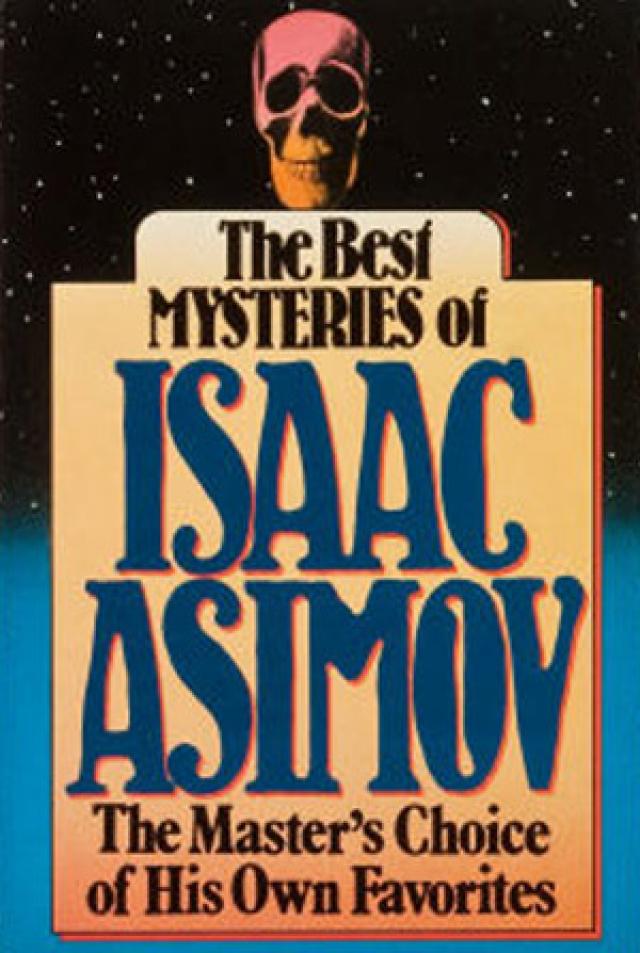
The Best Mysteries of Isaac Asimov,
p.36


It dates back to the year after World War II, when in the first flush of enthusiasm, the victorious Allies were trying to find various people who had been involved in the slaughter of the innocents. Not all the villains were Germans, as it happened, and not all the victims were Jews. With a stretch of the imagination and allowance for ingrained bitterness, one could even understand the motivation for the villainy, in some cases.
The British had on their list, for instance, someone who had brought about the deaths of several dozen British prisoners of war. That villain had been smuggled into the camp as a French prisoner with the rank of lieutenant, a part he apparently played to perfection. He initiated the plan for escape, and played a leading part in it all the way through while keeping the Germans completely informed. The escape was entirely unsuccessful and the supposed Frenchman actually shot a few of the British himself. The Nazis had what they wanted. So spectacular was the failure that there were no further attempts at escape from that particular camp for the remainder of the war.
Identifying the villain, this Lieutenant Nobody, as he was called, was not easy. He had been removed from the camp after the aborted escape. Descriptions were vague and he had been, in any case, disguised. The records uncovered at the camp were incomplete, naturally, between the ravages of war and the deliberate destruction by those in charge who wanted no trouble with vengeful victors.
About all that could be found out, as it happened, was that the supposed Frenchman was not a Frenchman, but a Canadian—a French-Canadian, of course—who had lived most of his life in Montreal. There was no more than that. We had no record of his actual name, no photograph—not even a blurred snapshot—of his face, no details of any kind.
It made sense, you see. As a Montrealer, it was quite possible he was thoroughly bilingual. He could pass as a Frenchman, who could speak enough English to communicate; and he could also speak English well enough to pass as an American. There was some evidence, of a rather feeble nature, that he had indeed served the Nazis in the role of an American among American prisoners of war.
What’s more, as a French-Canadian, it was quite possible that he had resented the ruling Anglo majority (who, in those days, controlled the Quebec economy totally) to the point of casting his lot in with the Germans.
The Americans were rather in a quandary, then, when an American noncom of superlatively innocent appearance was identified as Lieutenant Nobody.
It was not much of an identification. The accuser was a British soldier who had been a prisoner at the camp in question and who had been one of the very few who had survived the attempted escape. Two years had elapsed since he had last seen the man and all he could say in support of his contention was, essentially, “I tell you that’s the face, that’s the face.”
It could have been the face, of course, since it’s not uncommon for one person to resemble another, but it was not anything one could sensibly use. The American was questioned, of course. He, too, had been a prisoner of war, so that the accuser might possibly have seen him quite innocently at one time or another. People were occasionally shifted from one camp to another to break up any groupings that might be troublesome.
The American had his dog tags, had a history, both military and premilitary, which he could reel off. It checked with army records, as far as they went, but it was always possible that Lieutenant Nobody had been fitted out with the personality and records of a real American non-com who had died in combat—just enough of a possibility to make some people uneasy.
In the ordinary course of affairs, the noncom was sent back Stateside. Yet though the accusation was insufficient to warrant his being detained overseas, it was enough to worry the Department here in the United States.
They called me in. I was a young fellow then, and a civilian, but I already had a reputation for being able to see the horizon on a clear day, which made me rather a phenomenon among the usual cloudy-eyed individuals that filled the Army then—as they do now.
I was called before a colonel who, generally speaking, had no use for me—which didn’t bother me, since I had no use for him.
He said, “See here, Griswold, you speak to this guy and tell us whether he’s an American or a Canadian.”
I had been told the story, so I said, “Why not just take him back to the hometown and check with his relatives?”
The colonel said, “He doesn’t have any close relatives. He was brought up by an uncle who was a recluse and who is dead now. He claims he doesn’t know anyone out there very closely and vice versa. We checked and that’s so. Of course, it’s possible that he had met a look-alike some years ago, found out that the background was sufficiently obscure, and then took it over.”
“Take him back to the hometown and see if he knows his way around. He’d know where the town drugstore was, wouldn’t he?”
The colonel looked impatient. “That takes time and money, and I need both for better things than this—unless you can give me reason to believe there’s something to this accusation.”
I said, with just a touch of sarcasm, “Does he know who won the World Series in 1941?”
The colonel said, “Listen, Griswold, I don’t know who won the World Series in 1941, so don’t waste my time. You just do what I say. Talk to him and look for a speck, just one speck of Canadian in him. If you come back with that, we’ll see to it that he’s turned inside out and emptied—but we need that speck to justify the trouble. You understand?”
I understood. “Yes, sir,” I said. I knew how those things worked. If I found out something useful, the colonel would use it and take the credit. Still, I had no choice but to go ahead.
The noncom was a Sergeant Drisack. He had the kind of beaten, anxious look you would expect in a longtime prisoner who suddenly found himself under suspicion after his release for something he couldn’t understand. Yet it seemed to me that underneath that there was a vein of hard shrewdness, which didn’t really show. I knew very well it might be my imagination.
There was nothing to do but engage him in conversation. I said, “Do you remember your address in Iowa, sergeant?”
“Ohio, sir.”
“Sorry. Do you remember the address?”
“Yes, sir.”
“You know how to write, of course.”
“Yes, sir.”
I placed a piece of paper before him, then handed him a pencil, putting it near his left hand, but he reached over with his right hand and took it. “Just write it for me, will you?”
He did, and I took the paper from him and looked at it. It was the kind of writing one would expect of someone with a sixth-grade education, which was all that Drisack had had—if he were Drisack.
I said, “Can you write ‘Des Moines’?”
He looked puzzled. “How do you spell it?”
“Oh yes,” I said. “You’re not from Iowa.” (It seemed to me he looked amused, though I could see no clear sign of it.)
“Have you traveled much?”
He shook his head. “Only while I was in the Army. They took me to France. Then I got captured and the krauts took me to Germany.”
“Can you speak German?”
“I can say ‘halt’ or ‘marschieren.’ Like that.”
“Can you speak French?”
“Polly-voo, that’s all.”
“Ever been to Mexico?”
“No, sir.”
I shoved the paper at him. “Write ‘Guadalajara.’”
“What?” He looked completely blank, but his eyes seemed to glitter, or so it seemed to me.
“Well—write ‘Mexico.’”
He did, quite quickly. He was not stupid—only uneducated, or appearing so.
“Ever been to Canada?”
“No, sir.”
“You sure now? You never lived in Canada?” He looked startled and shook his head. “You never lived in Montreal?” He shook his head. “No, sir.”
“You’ve heard of it, haven’t you?”
“Yes, sir. It’s in Canada, isn’t it?”
“You never lived at 721 Sherwood Street in Montreal?” He hesitated, “No, sir.”
“Well, is there a Sherwood Street in Montreal?”
“I don’t know, sir,” he said humbly.
I shoved a new piece of paper at him. “Write ‘721 Sherwood Street, Montreal.’ Go ahead!”
He looked utterly confused, but did so. As soon as he had finished, I took the paper and pencil from him and nodded to the guard, who took him away.
I then went to colonel and said, in a leisurely way, “I found the speck, Colonel, and I explained. Our so-called American noncom was Lieutenant Nobody, of course, as a thoroughgoing investigation eventually proved, and the British hung him about six months later.”
I said suspiciously, “What gave him away—if anything?”
“You ought to be able to figure that out,” said Griswold austerely. “I had him write ‘Montreal,’ didn’t I?”
“So?”
“So it has two pronunciations, totally different, with respect to all three vowels. The o is short to English-speaking Canadians, long to French-speaking Canadians. The e is a long e to the English, a long a to the French. The a is pronounced like aw to the English but is short to the French.”
“Yes, but he wrote the word. He didn’t pronounce it.”
“Well, I acted like such a jackass in the interrogation; I was so bumbling and transparent in my questions that he couldn’t help but relax, so he lost that fine grip on himself and wrote as though he were a French-Canadian. When an e in French is pronounced ay it has an acute accent above it, a straight line moving from lower left to upper right, so that you have ‘Montreal.’ The supposed noncom couldn’t keep himself from making a speck over the e in ‘Montreal,’ and that speck gave him away. No uneducated American could have done it.”
PART III
MISCELLANEOUS MYSTERIES
25
The Key
In the 1960s, I was deeply involved in nonfiction, and wrote very little fiction. However, The Magazine of Fantasy and Science Fiction (F&SF) was planning a special “Isaac Asimov issue” and they wanted to include a new original story by me. I was not proof against flattery, and so I wrote the fourth and last of the Wendell Urth stories, and the most elaborate of them. (In fact, it is the longest story in this book.)
I was very pleased (and more than a little relieved) that I could still write fiction and I am celebrating that great discovery by including the story here.
Karl Jennings knew he was going to die. He had a matter of hours to live and much to do.
There was no reprieve from the death sentence, not here on the Moon, not with no communications in operation.
Even on Earth there were a few fugitive patches where, without radio handy, a man might die without the hand of his fellow man to help him, without the heart of his fellow man to pity him, without even the eye of his fellow man to discover the corpse. Here on the Moon, there were few spots that were otherwise.
Earthmen knew he was on the Moon, of course. He had been part of a geological expedition—no, selenological expedition! Odd, how his Earth-centered mind insisted on the “geo-.”
Wearily he drove himself to think, even as he worked. Dying though he was, he still felt that artificially imposed clarity of thought. Anxiously he looked about. There was nothing to see. He was in the dark of the eternal shadow of the northern interior of the wall of the crater, a blackness relieved only by the intermittent blink of his flash. He kept that intermittent, partly because he dared not consume its power source before he was through and partly because he dared not take more than the minimum chance that it be seen.
On his left hand, toward the south along the nearby horizon of the Moon, was a crescent of bright white Sunlight. Beyond the horizon, and invisible, was the opposite lip of the crater. The Sun never peered high enough over the lip of his own edge of the crater to illuminate the floor immediately beneath his feet. He was safe from radiation—from that at least.
He dug carefully but clumsily, swathed as he was in his spacesuit. His side ached abominably.
The dust and broken rock did not take up the “fairy castle” appearance characteristic of those portions of the Moon’s surface exposed to the alternation of light and dark, heat and cold. Here, in eternal cold, the slow crumbling of the crater wall had simply piled fine rubble in a heterogeneous mass. It would not be easy to tell there had been digging going on.
He misjudged the unevenness of the dark surface for a moment and spilled a cupped handful of dusty fragments. The particles dropped with the slowness characteristic of the Moon and yet with the appearance of a blinding speed, for there was no air resistance to slow them further still and spread them out into a dusty haze.
Jennings’ flash brightened for a moment, and he kicked a jagged rock out of the way.
He hadn’t much time. He dug deeper into the dust.
A little deeper and he could push the Device into the depression and begin covering it. Strauss must not find it.
Strauss!
The other member of the team. Half-share in the discovery. Half-share in the renown.
If it were merely the whole share of the credit that Strauss had wanted, Jennings might have allowed it. The discovery was more important than any individual credit that might go with it. But what Strauss wanted was something far more, something Jennings would fight to prevent.
One of the few things Jennings was willing to die to prevent.
And he was dying.
They had found it together. Actually, Strauss had found the ship; or, better, the remains of the ship; or, better still, what just conceivably might have been the remains of something analogous to a ship.
“Metal,” said Strauss, as he picked up something ragged and nearly amorphous. His eyes and face could just barely be seen through the thick lead glass of the visor, but his rather harsh voice sounded clearly enough through the suit radio.
Jennings came drifting over from his own position half a mile away. He said, “Odd! There is no free metal on the Moon.”
“There shouldn’t be. But you know well enough they haven’t explored more than one per cent of the Moon’s surface. Who knows what can be found on it?”
Jennings grunted assent and reached out his gauntlet to take the object.
It was true enough that almost anything might be found on the Moon for all anyone really knew. Theirs was the first privately financed selenographic expedition ever to land on the Moon. Till then, there had been only government-conducted shotgun affairs, with half a dozen ends in view. It was a sign of the advancing space age that the Geological Society could afford to send two men to the Moon for selenological studies only.
Strauss said, “It looks as though it once had a polished surface.”
“You’re right,” said Jennings. “Maybe there’s more about.”
They found three more pieces, two of trifling size and one a jagged object that showed traces of a seam.
“Let’s take them to the ship,” said Strauss.
They took the small skim boat back to the mother ship. They shucked their suits once on board, something Jennings at least was always glad to do. He scratched vigorously at his ribs and rubbed his cheeks till his light skin reddened into welts.
Strauss eschewed such weakness and got to work. The laser beam pock-marked the metal and the vapor recorded itself on the spectrograph. Titanium-steel, essentially, with a hint of cobalt and molybdenum.
“That’s artificial, all right,” said Strauss. His broad-boned face was as dour and as hard as ever. He showed no elation, although Jennings could feel his own heart begin to race.
It may have been the excitement that trapped Jennings into beginning, “This is a development against which we must steel ourselves—” with a faint stress on “steel” to indicate the play on words.
Strauss, however, looked at Jennings with an icy distaste, and the attempted set of puns was choked off.
Jennings sighed. He could never swing it, somehow. Never could! He remembered at the University—Well, never mind. The discovery they had made was worth a far better pun than any he could construct for all Strauss’s calmness.
Jennings wondered if Strauss could possibly miss the significance.
He knew very little about Strauss, as a matter of fact, except by selenological reputation. That is, he had read Strauss’s papers and he presumed Strauss had read his. Although their ships might well have passed by night in their University days, they had never happened to meet until after both had volunteered for this expedition and had been accepted.
In the week’s voyage, Jennings had grown uncomfortably aware of the other’s stocky figure, his sandy hair and china-blue eyes and the way the muscles over his prominent jawbones worked when he ate. Jennings, himself, much slighter in build, also blue-eyed, but with darker hair, tended to withdraw automatically from the heavy exudation of the other’s power and drive.
Jennings said, “There’s no record of any ship ever having landed on this part of the Moon. Certainly none has crashed.”
“If it were part of a ship,” said Strauss, “it should be smooth and polished. This is eroded and, without an atmosphere here, that means exposure to micrometeor bombardment over many years.”
Then he did see the significance. Jennings said, with an almost savage jubilation, “It’s a non-human artifact. Creatures not of Earth once visited the Moon. Who knows how long ago?”
“Who knows?” agreed Strauss dryly.
“In the report—”
“Wait,” said Strauss imperiously. “Time enough to report when we have something to report. If it was a ship, there will be more to it than what we now have.”
But there was no point in looking further just then. They had been at it for hours, and the next meal and sleep were overdue. Better to tackle the whole job fresh and spend hours at it. They seemed to agree on that without speaking.
The Earth was low on the eastern horizon, almost full in phase, bright and blue-streaked. Jennings looked at it while they ate and experienced, as he always did, a sharp homesickness.


