

The best mysteries of is.., p.42
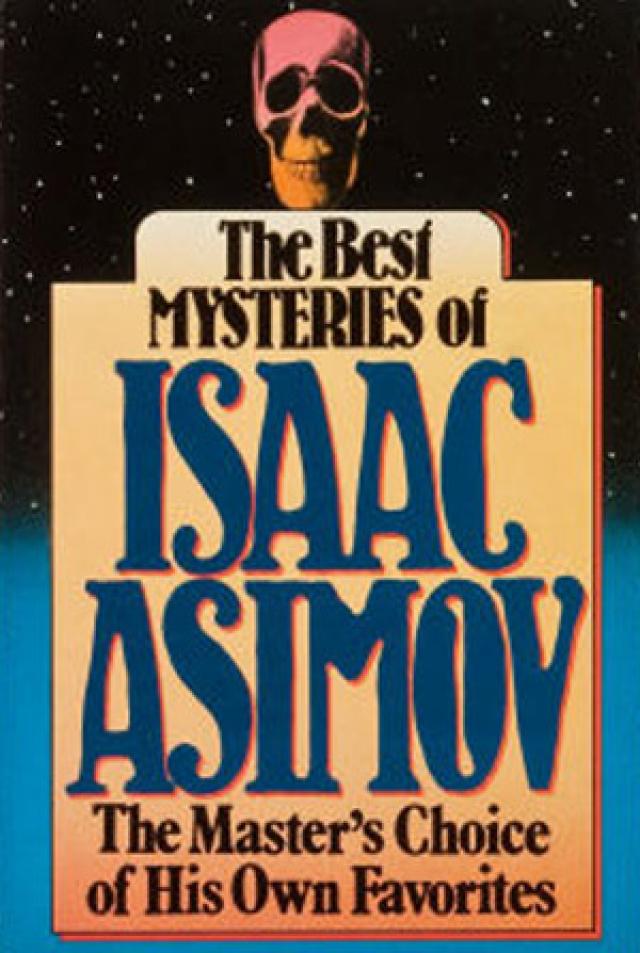
The Best Mysteries of Isaac Asimov,
p.42


I sure didn’t stay out of his way this time. He swooped down on me, all red in the face, and snatched the New York Times right out from under my hand. “What do you think you’re doing?” he said. “Don’t you have any brains?”
I just stood there with my pencil in my hand. I wasn’t doing anything.
I said, “What’s the matter, Dad?” I was just plain astonished.
Mom was hurrying over, too. I guess she wanted to make sure her one and only son wasn’t smashed beyond repair.
“What’s the matter?” she asked. “What’s he done?”
Dad stood there, getting even redder. It was as if he couldn’t think what I had done. Then he said, “Doesn’t he know better than to touch the paper? That’s not our paper.”
By that time I sort of got indignant. “Well, how am I supposed to know that, Dad?”
And Mom said, “How is he supposed to know? If that’s something important, dear, you might have said so. You needn’t have left it on the dining room table.”
Dad looked as if he wanted to back down, but didn’t know how. He said to me, “You didn’t tear anything, throw anything away…”
I guess he had become so angry when he saw me at the Times that he didn’t see what I was doing. “It’s in perfect shape,” I said.
He walked back and forth in the room, breathing hard, and we just watched him. I figured he must be on a hard case, and when a detective is on a difficult case, you can’t blame him for breathing hard.
Then he stopped. He had worked it all out of his system and he was himself again when he turned to me. “I’m sorry, Larry,” he said. “I was wrong. It wasn’t important. We have the paper microfilmed anyway…I just can’t make anything out of it.”
Mom sat down and didn’t say anything, because Dad isn’t really supposed to talk about his cases at home. I knew that, but I just put a blank look on my face and said, “Out of what, Dad?” And I sat down, too.
Dad looked at us and he sat down and threw the paper back on the table. “Out of that. The paper.”
I could tell he wanted to talk, so I kept quiet and let him.
After a while, he said, “There’s a…Well, never mind what there is, but it’s pretty worrisome, and there’s a code involved and we can’t break it.”
“That’s not really your job, is it?” Mom asked. “You don’t know anything about codes.”
“There’s something I might do.”
I said, “All codes can be broken, can’t they?”
“Some not as easily as others, Larry,” he said. “Sometimes a code is based on a key word that changes every once in a while, maybe every day. That makes it hard, unless we can find what the key word is, or, better yet, what system they use to change the key word.”
“How do you do that?” said Mom.
With a grim look on his face, Dad said, “One way is to pick up somebody’s notebook.”
“Surely, no one would put it in a notebook for people to find,” she said.
I butted in. “They would, Mom. You can’t rely on remembering a complicated system, and you can’t take chances on forgetting. Right, Dad?”
“Right,” he said. “But no one has found a notebook or anything else, and that’s it.” The tone of his voice told me that was the end of the discussion. “Have you done your homework, Larry?”
“All except some of the geography.” Then, to keep from being chased out of the room, I said, “What’s the New York Times got to do with it?”
That took Dad’s mind off the homework. “One of the men we had our eyes on was mugged last night. He managed to fight off the mugger, but he was hurt and we brought him to the hospital. That made it easy to search him very carefully without getting anyone suspicious and scaring them into changing their system or lying low. We got nowhere. No notebook.”
“Maybe the mugger got away with…” I said.
Dad shook his head. “We had a good man following him. He saw the whole thing. But the man being mugged had a New York Times on him and he held onto it while he was fighting. I thought that was suspicious, so I had the paper microfilmed and brought it home. I thought there might be some system of picking out one of the words—in a headline on some particular page—last word in some particular column—who knows? Anyone can carry the Times. It’s not like a notebook. There’s nothing suspicious about it.”
“How could you tell from the paper what the system was?” I said.
Dad shrugged. “I thought there might be a mark on it. He might look at the key word and just automatically, without even thinking, check it off. No use. There’s not a word in the paper that’s marked in any way.”
I got excited, “Yes, there are!”
Dad gave me that look I always get when he thinks I don’t know what I’m talking about. “What do you mean?”
“That’s what I was doing when you yelled and grabbed the paper,” I said, showing him the pencil I was still holding. “I was doing the crossword puzzle. Don’t you see, Dad, it was partly worked out. That’s why I started on it, to finish it off.”
Dad rubbed his nose. “We noticed that, but what makes you think that has any meaning? Lots of people work on crossword puzzles. It’s natural enough.”
“Sure, that’s why it’s a safe system. This one was worked out in the middle, Dad, just a little patch in the middle. No one just does a part in the middle. They start at the upper left corner, with number one.”
“If it’s a hard puzzle, you might not get a start till you reach the middle.”
“It was an easy puzzle, Dad. One across was a three-letter word meaning ‘presidential nickname’ and that’s got to be Ike or Abe, and one down…Anyway, this guy just went straight to that part and didn’t bother with anything else. Twenty-seven across was one of the words he worked out and the paper is for yesterday, which is the twenty-seventh of the month.”
Dad waited a long while before answering. Then he said, “Coincidence.”
“Maybe not,” I said. “The Times crossword puzzle always has at least sixty numbers every day, twice as many on Sunday. Every day of the month has a number and for that day the key word is the one in that number in the crossword puzzle. If there are two words, across and down, maybe you always take the across.”
“Hmm,” said Dad.
“How much simpler can it be? Anyone can remember that, and all you have to do is be able to work out crossword puzzles. You can get all kinds of words, long or short, even phrases, even foreign words.”
Mom said, “What if a crossword puzzle happens to be too hard to work out just in the crucial spot?”
Now Dad got excited. “They could use each day’s puzzle for the day after, and check with the solution to make sure.” He had his coat on. “Except Sunday, for which the solution comes the next Sunday…I hope the pencil you used made a different mark from his, Larry.”
“He used a pen,” I said.
…That wasn’t all there was to the case, but they did break the code. Dad got a bonus and he put it in the bank toward my college education. He said it was only fair.
31
Nothing Might Happen
Sometimes a mystery story isn’t a mystery story in the literal sense of the word. There is no puzzle, merely the outline of some criminal or near-criminal course of behavior. You might call it simply a “crime story.”
Alfred Hitchcock’s Mystery Magazine (AHMM) is very strong on that sort of story and it occurred to me to write a story for them because, for one thing, the editor, Cathleen Jordan, is one of my favorite people. Naturally, I had to write a crime story, which is atypical for me, but I’m sort of pleased with the way it turned out, and here it is.
Samuel Gelderman had been working quite diligently for five years toward the goal of becoming a millionaire. Many people do so with varying degrees of hope, some in one way, some in another. Sam’s hope was high, but his method of achieving his goal was exceptionally tedious, for he served as secretary and odd-jobs man to his uncle, the well-known writer of espionage-suspense novels, Ralph Gelderman.
Ralph was not a flashy bestselling writer. His books did not explode onto the scene in sprays of obvious money-making. He might even be considered rather obscure. This did not displease Sam, however, for Ralph was something better than a bestselling writer: He was a prolific one whose books were smooth and reliable. Each one sold moderately steadily, remaining in print for a long time, and gathering paperback editions, foreign sales, and movie options along the way.
If Ralph had been more obviously successful, he might have slowly collected a large staff about himself and he might then have developed numerous ways of spending a large percentage of his money before he passed from this earthly scene.
As it was, his professional advance had been so gradual that it had never occurred to Ralph to be anything but a one-man production machine. Nor did it occur to him to alter his generally frugal way of life. The result was that each year the number of his books in print accumulated, and each year he made a little more than the year before, and each year his investments and assets increased appreciably. He remained a bachelor, too, showing no signs of any impatience with his marital status as his years advanced.
And Sam, the orphaned son of Ralph’s older brother, was Ralph’s only close relative and his obvious sole heir.
Five years ago, Ralph had finally been persuaded by his accountant to form a small corporation, with himself as president and treasurer. He needed a second officer and it was then that he asked Sam to become, officially, what he had been on and off in an informal way for quite a while—his secretary. That became Sam’s corporation title.
The duties were tedious, for Sam had to take care of accounts, of publishing records, of correspondence, of routine dealings with publishers, editors, and agents, and also with a certain querulousness on the part of his uncle.
On the brighter side, he received a moderately decent salary, which, with the small inheritance he had received from his father, enabled him to live with his wife and teenage daughter in modest comfort, if not in splendor. Much more to the point, his position enabled Sam to know the exact nature of his uncle’s income, investments, and assets and he was astonished. It was far greater than he had imagined—and it enabled him to bear with his uncle’s occasionally unreasonable whims with the patience of a saint.
It was, moreover, a source of gratifying reassurance to Sam to know that, as the only other officer of the corporation, he would at once have its assets available to him on his uncle’s decease—as well as inheriting, in more tedious fashion, the precorporation earnings.
What was a source of deep chagrin to Sam, however, was that the happy denouement was not imminent. Ralph Gelderman was sixty, but in robust health. He might well live on for another quarter century. Sam himself was forty-two and was, he had to admit, not in robust health. Even if he survived his uncle, he might well be an old and sickly survivor, unable to get much use out of his inheritance. To be sure, the older Ralph grew, the larger the estate would be, but what if, as senility approached, he grew suddenly enamored of some charming young lady who found his wealth and his shortening life expectancy irresistible? Sam would find himself cut off with a small legacy.
Under such circumstances, Sam could not help but meditate on how convenient it would be if a kindly Providence were to carry Ralph off in the very near future; if a building cornice were to fall on him, or an automobile were to collide with him, or some virus were to attack him with unaccustomed ferocity.
It might have seemed logical for Sam to ruminate on the possibility of helping Providence along by some action of his own, but he did not like to think of such things. He was not a vicious man, he told himself, but above and beyond that, as sole heir, he himself would be the immediate and obvious suspect if anything untoward happened to Ralph. He could not possibly withstand that. Nor could he avoid it by faking a faultless alibi, or by working out a murder method that would look like suicide or accident. He just didn’t have that kind of mind.
He couldn’t even go through the unthinkable process of hiring a paid killer to do the job for him. Aside from lacking the funds for it, or the knowledge of how and where to find such a person, he did not wish to put his life into the hands of a potential blackmailer.
He sighed and realized he would simply have to content himself with hoping that Providence would do the job for him, and to watch, wistfully, as the years slipped away.
And then, much to his own astonishment, he thought of a perfect method for murder, the perfect murder—not a flaw in it, not a danger, not a care.
It happened this way…
The intercom signal had sounded one day, two years ago, and Sam had picked up the receiver and said, “Yes, Uncle.”
“Sam, come up here.”
The voice in Sam’s ear was testy, but Sam felt no cause for alarm. He had just skillfully managed to cancel a potential photography session and Ralph had grumped his thanks for it. Ralph detested photographers and cameras, and never yielded to the necessity of having his picture taken except under conditions of overwhelming force.
To Sam’s gentle suggestion that this sort of personal publicity might help sales of his books, Ralph growled impatiently and said, “I don’t want that kind of sale. I want my books to be successful on their own. I want them well known, not me.”
It was for that reason that Ralph Gelderman never became a household face, so to speak, and that his photographs on book jackets tended to be old ones, taken before middle age and continued success had hardened his stubbornness.
So Sam, following instructions, as he always did, had quashed the photography matter, and was surely in favor now.
He climbed the flight of stairs to Ralph’s neat and well-organized writing room (always referred to as his office), and said, “Yes, Uncle?”
Ralph thrust a letter at him with a discontented air. “Why am I plagued with this?”
Sam tightened his lips slightly in chagrin. It was well understood that fan mail (except for those unusually intelligent and complimentary items that Ralph rather enjoyed reading) was to be kept away from him. Sam, by long practice, could take care of it himself, knowing which should be answered and which not. Those he answered, he knew exactly how to answer, and then he would take those answers to Ralph for his signature. Nor did Ralph bother to read them. He merely signed.
It was not really a safe procedure, and Sam had at one time made the careful observation that it was not good practice to sign anything without reading it.
Ralph had put down his pen. “If I can’t trust you, I’ll have to fire you. Can I trust you?”
“Of course, Uncle. I was merely making a general statement.” But for a while, it had scared him out of making such general statements.
And now he had accidentally allowed a fan letter to reach his uncle, and it was one of the “crackpot” items; a careless oversight.
“Here’s a man,” said Ralph, peering at the signature, “named Lawrence K. Leghorn, who seems to be convinced that there is an active Communist conspiracy affecting the grade schools in his town out in Long Island somewhere, and he wants me to join him in squelching it. Apparently he confuses me with my fictional characters and wants to meet me for dinner, which, by the way, he doesn’t offer to pay for. Am I getting many letters like this?”
“One or two, Uncle. Not many.”
“Well, I don’t want to see the letters. And I certainly don’t want to see the writers of such letters. Just send them a polite squelch. Make sure it’s polite, but make sure it’s a squelch.”
“That’s exactly what I try to do, Uncle. This won’t happen again.”
“Good. See to that!”
Sam nodded and turned. As always, Ralph looked depressingly vigorous and a good ten years younger than his age. His full head of hair was dark and unfrosted, as Sam’s was, and the distinct family resemblance was all in the older man’s favor.
Sam sighed, went to his own office on the lower floor of the duplex apartment on Manhattan’s Upper East Side, and read the letter again.
It was clearly the work of a paranoid personality. A surprising number of them wrote letters to Ralph Gelderman. Perhaps it was the spy-suspense that drew them out of the woodwork; there was no question but that espionage tales fostered paranoia.
The proper reaction to letters by such people was inaction. There was no point in replying to a paranoid personality. Any reply was a provocation.
Occasionally, though, they would write again—and even again. They would complain that their letters were being stolen by post office employees, or rerouted by malign influences working through long-range radio beams. It then became necessary to send a very brief note to the effect that their letters had been received.
And in the case of this Mr. Leghorn, Ralph had specifically ordered an answer to be sent, and he would expect to sign it.
Sam sighed again, and set himself to the job of thinking out an answer. A polite one: “Dear so-and-so—heavily overextended—deadlines—no time whatever—deeply regret cannot meet with you—not a matter in which I can concern myself—”
It had to be done very delicately, for there was no telling what a paranoid personality might do, once affronted. If they thought you were part of the conspiracy…
It was at that moment that Sam achieved his blinding insight.
Of course! No telling what they might do. They might, unbribed and of their own accord, impelled by their own madness, serve the role of the falling cornice or of any of the other convenient accidents Sam dreamed of.
Why, then, be polite to this Leghorn? Why not be provocative—without being blatantly so, of course?
Excitedly, he scribbled out a note in longhand. “Dear Sir: Any meeting between ourselves is quite out of the question. Please do not waste your time in repeating this request, as it is clear to me that your suspicions with regard to conspiratorial activity are quite without foundation.”


