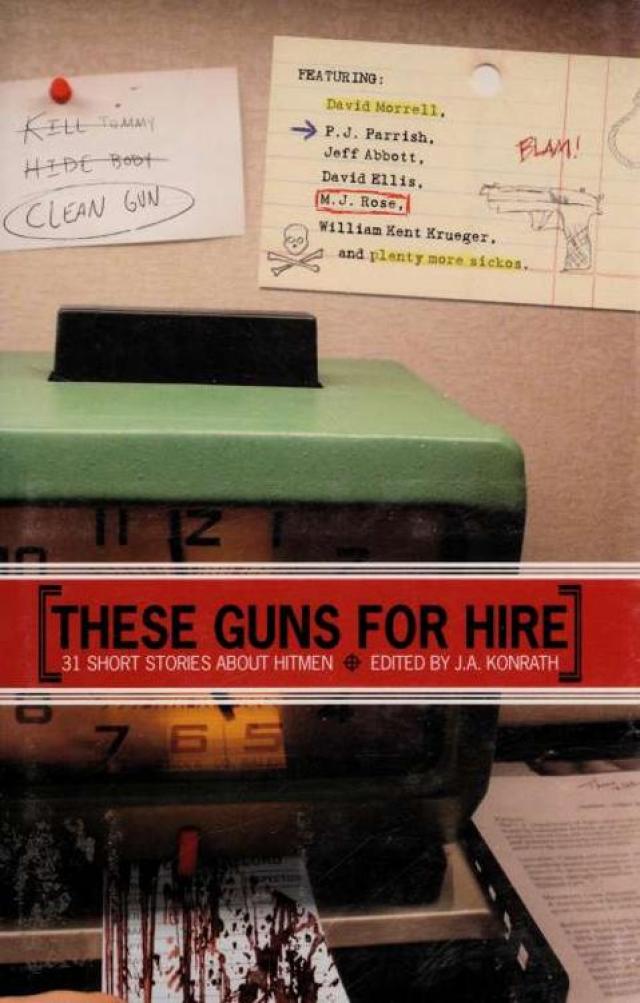
These guns for hire 2006.., p.1
These Guns for Hire (2006) Anthology,
p.1


Published by Bleak House Books, an imprint of Big Earth Publishing 923 Williamson St.
Madison, WI 53703
Compilation copyright © 2006 by J.A. Konrath Introduction copyright © 2006 by J.A. Konrath All stories copyright © 2006, by their authors, with the exception of:
“Guest Services” by Max Allan Collins, copyright © 1995, originally appeared in Murder is My Business “Beauty” by Ed Gorman, copyright © 2006, originally appeared on www.HardLuckStories.com “Keller’s Designated Hitter” by Lawrence Block, copyright © 2001, originally appeared in Murderer’s Row “Punk” by Ken Bruen, copyright © 2006, originally appeared on www.HardLuckStories.com
All rights reserved. No part of this publication may be reproduced or transmitted in any form or by any means, electronic or mechanical, including photocopy, recording, or any information storage and retrieval system, without permission in writing from the publisher.
This is a work of fiction. Any similarities to people or places, living or dead, is purely coincidental.
First Edition: September 2006
Library of Congress Cataloging-in-Publication Data
These guns for hire : a killer anthology / edited by J.A. Konrath.
p. cm.
“A collection of thirty hitman stories from David Morrell, Jeremiah Healy, William Kent Krueger, P.J. Parrish, Max Allan Collins, M.J. Rose, Jeff Abbott, Raymond Benson, David Ellis, Robert W. Walker, and more. . .”
Includes bibliographical references and index.
ISBN 1-932557-20-2 (alk. paper) 1. Murder for hire—Fiction. 2. Assassins-Fiction. 3. American fiction—21st century. I. Konrath, Joe, 1970-II. Morrell, David.
PS648.C7T45 2006
813′.7087208—dc22
2006024995
Cover photo copyright © 2006 by Kevin Glidden Design by Kevin Glidden
Printed in the USA
For Mickey Spillane and Ed McBain—
you will be missed, but your work will never be forgotten.
CONTENTS
Cover
Title Page
Copyright
Dedication
Introduction
VICTOR GISCHLER
They Always Get You
RAYMOND BENSON
Another Rock ‘N’ Roll Hit
JEREMIAH HEALY
The Confessional
JULIE HYZY
Strictly Business
JAY BONANSINGA
There’s Somebody Here Wants to Talk to You
SEAN DOOLITTLE
The Professional
MAX ALLAN COLLINS
Guest Services
P.J. PARRISH
Gutter Snipes
ED GORMAN
Beauty
MICHAEL A. BLACK
The Black Rose
LIBBY FISCHER HELLMANN
Detour
DAVID MORRELL
The Attitude Adjuster
BRIAN M. WIPRUD
When You’re Right, You’re Right
ROB KANTNER
Dead Last
J.A. KONRATH
Bereaved
M.J. ROSE
Not Shy, Not Retiring
JEFF ABBOTT
Seize Your Future
REED FARREL COLEMAN
Bat-Head Speed
LISA MANNETTI
Everybody Wins
LAWRENCE BLOCK
Keller’s Designated Hitter
ROBERT W. WALKER
Pet Project
JOHN GALLIGAN
Man Hit
WILLIAM KENT KRUEGER
Absolution
PAUL A. TOTH
Nice Kids Carry Guns
JEFF STRAND
Poor Career Choice
KEN BRUEN
Punk
MONICA J. O’ROURKE
Bloodshed Fred
MITCHELL GRAHAM
The Louvre Cafe
BENJAMIN M. LEROY
Letters From Home
MARCUS SAKEY
As Breathing
DAVID ELLIS
The Shining Knight
Back Cover
Introduction
J.A. Konrath
“Murder didn’t mean much to Raven. It was just a new job.”
So begins the 1936 novel THIS GUN FOR HIRE by Graham Greene. Raven, a hit man, was one of the first anti-heroes in crime fiction. But he was far from the last.
Since Greene’s groundbreaking creation, assassins have been a mainstay in mysteries and thrillers. They’re the dark reflection of the cops and private eyes that populate the genre. Mobsters. Snipers. Sociopaths. Bounty hunters. Spec-Ops soldiers who ruthlessly dispatch the enemy. Aging mafia loners troubled by conscience.
Sometimes the villain, sometimes the hero, always compelling.
They’re also more popular than ever.
Perhaps this is because conventional genre protagonists have constraints built into their character. Heroes are expected to adhere to a code of ethics. They seek to do good, solve the crime, catch the bad guy, rescue the victim, all while keeping within the boundaries of morality. Through the hero, the reader can witness the day being saved by those who evoke the best traits humanity has to offer: Courage, compassion, and firm sense of right and wrong.
But this also hinders a main character’s actions, and restricts a hero’s motivation. A genre protagonist must conform to reader expectations, or lose reader sympathy.
Enter the hitman. No morals or ethics. No compassion. Some may have rules, or a code of behavior, but the bottom line is that they murder people for money. Assassins don’t suffer from the same constraints as a homicide cop, a private eye, or an amateur sleuth. They can be as bad as the writer wants them to be. Which, for the writer, is very liberating.
It’s also a lot of fun.
Amoral characters allow writers to explore the darker side of human nature. To kill for cash is as cold-blooded as a human being can get. What kind of character would do something like that? What would it be like to bounce around in that person’s skull for a few dozen pages?
Hitman stories offer writers the rare opportunity to thumb their noses at conventional genre ethics, to write without limits. They appeal to that childhood sense of right and wrong, without risking the actual punishment for wrong-doing. Forbidden fruit is the tastiest, and when children gather in groups to play cops and robbers, the robbers invariably outnumber the cops.
It’s like dressing in a monster costume for Halloween. No one would actually like to meet a real monster, but it’s good fun to pretend.
This anthology is packed with monsters. Monsters who wear human masks.
THESE GUNS FOR HIRE offers readers a unique opportunity, to vicariously experience some very bad people, courtesy of the best writers in the mystery thriller genre. They’re all here. Cold blooded mobsters (Rob Kantner, Victor Gischler,) series characters from novels (David Morrell, Lawrence Block, Max Allan Collins,) humorous killers (Brian Wiprud, Jeff Strand,) hitwomen (Libby Fischer Hellmann, MJ Rose,) and even some forays into the supernatural (Jay Bonansinga, Robert W. Walker.)
So without further ado, let the assassinations begin. . .
VICTOR GISCHLER
VICTOR Gischler’s debut novel GUN MONKEYS was nominated for the Edgar Award. His current novel is SHOTGUN OPERA. Victor’s work has been translated into French and Japanese. He lives in Skiatook, Oklahoma with his wife Jackie and his son Emery.
When asked about his affinity for hitmen stories, Victor replied: “I like it when the bad guy is the good guy. Makes a nice change of pace from the squeaky clean hero doing all the usual good guy things. If a reader finds himself/herself cheering for the protagonist to commit an act we’d normally consider wrong, then the author has really accomplished something.”
Visit Victor at www.VictorGischler.com.
THEY ALWAYS GET YOU
Victor Gischler
I WATCHED THE fire march up the hill. Just the smoke actually. The flames were still a mile off, maybe two, across the valley. Then the call came.
“You recognize this voice?” asked the guy on the other end of the phone.
It took me a second. Rusty parts of my brain creaked into motion, reached back twenty years. Yeah, I recognized the voice. I told him so. No emotion in my tone. Let’s see what this long lost voice wanted before I got too worried.
“You were hard to find,” the voice said. “But I know some people.”
“I’ll bet you do.”
“Whispering Lenny is sending some boys. He knows where you are, so I thought you’d want a heads up.”
“His personal boys?”
“No,” said the voice. “It’s an open contract, so you’ll be getting a mixed bag. Anyway, I thought you’d want to know. See ya.”
“Wait.”
He waited.
“Why the phone call?”
“You took a bullet for me. I owe you.”
Oh, yeah. Funny how I’d forgotten. I looked down at my right hand, the bird finger and the ring finger gone at the first knuckle. Strange, they’d been gone so long it was almost like I’d never had them. “Okay then. We’re square.”
“I figured.” A long pause. “Good luck, Blake.” He hung up.
I sat there a long time, wondering what to do next, if I should do anything at all, and smelled the fire in the valley creep closer.
ON THE BACK deck, I watched the fire through a pair of good binoculars. I hoped the wind would shift but knew it w
ouldn’t, and through the binoculars I could actually see the flames now, not just the smoke.
Part of my brain considered the fire, assessed risk. It was early in spring, plenty of green. The fire wouldn’t catch much. Anyway it wasn’t climbing the trees, just sweeping through the underbrush, clearing out the dead limbs and leaves. Hell, the Oklahoma Parks Service often let those kinds of fires burn on purpose. Spring cleaning. The fire would most likely climb the hill, hit my freshly mown lawn and circle around. A hell of a lot of smoke, but I didn’t think the house would catch.
Still, I thought I might hook up the hoses, park the sprinklers at the south and east sides of the lawn, wet everything down, encourage the fire to go around. I’d have to watch the sun shed. It was set off in a patch of dry trees, lots of dry, loose stuff around the fire would like to eat up and crap out as ash, and I didn’t spend three weeks building the thing just to see it torched.
Even as I made these plans, watched the fire and the smoke and the direction of the wind, the other part of my brain wondered how Whispering Lenny Diamond had found me. Had someone told him? Had an old acquaintance seen me in town? How long had he known?
I glanced at the double-barrel shotgun leaning against the railing next to me. It was a short coachman’s gun, a trigger for each barrel. Squeeze both triggers at once and you got a nice spray of buckshot. Hard to miss. I’d practiced long and hard after losing the fingers, waiting for Lenny or one of his goons to come after me. I could fire off both barrels, break the breach, eject the old shells and thumb in new ones in two seconds flat. But Lenny’d never come. Nobody had. And I was out of practice.
The .38 police special on the hall table was good within a dozen feet. Beyond that I might as well be spitting watermelon seeds. I was never worth much with my left hand.
I walked back through the house to the front porch, scanned my property and the driveway. I hadn’t thought much about defending the place in recent years. Better think about it. I was fifty-six years old which meant Whispering Lenny must be almost eighty. A long time to hold a grudge.
I’d need to go into town. Pick up a few things.
But first the fire. I estimated the flames would be getting close to the headstone down in the valley. I hadn’t been down there in six months. The winter was always bad on my knees; I could get down the hill okay, but coming back up was hell. There’d be a lot of branches and leaves around the grave, and I hated the thought of the headstone all scorched up with soot and black streaks. Nothing to be done about it now.
I stuck the police special in the back of my pants, went outside, and started arranging the hoses and sprinklers. The smoke was already thick coming up the hill, even though the flames were still a long way off. The wind picked up.
“How’s it going, Blake?”
I spun quick, drew the pistol. My own speed surprised me. I hadn’t drawn on anyone in more than a dozen years. My heart beat fast. I had a steady, left-handed aim at the guy’s chest. Took me a split-second to realize it was my neighbor.
“Whoa!” Roy Jenkins held his hands up, palms toward me. A weak smile. “Didn’t mean to sneak up on you. You didn’t hear my truck?”
“No.” I lowered the pistol. “Sorry about that.”
Roy smiled bigger now, walked toward me, his hands down. He eyed the revolver. “You gonna shoot the fire?”
“I thought I saw a coyote.”
He nodded, pretended to believe me even though nobody had seen a coyote around here in about a hundred years. “Anyway, I thought I’d check on you. You fixed okay for hoses and sprinklers?”
I showed him what I’d done.
“That’s about all you can do, I guess. It won’t burn anything green. Too early in the season. We’d be bad off if it was along into August.”
I told him I’d figured the same thing.
“All the same,” Roy said, “you give me a holler if it gets bad. It’ll circle around your place first before it gets to me. Gimme a ring you need some help.”
I thanked him, and he left.
Roy was my “neighbor,” but his house was still far enough away that we had plenty of privacy. He lived across the valley on the other side, atop the next hill. From my yard, I could just stretch my neck and see his house. His hill was higher, and Roy said he could see me grilling or mowing my lawn from his upstairs window. It was good of him to check up on me, but I’d nearly shit myself when he caught me by surprise. I was more nervous than I thought. I checked the sprinklers again and went inside.
My upstairs office happened to have a window facing out back, so I could keep tabs on the fire. I pulled an old strong box out of the closet, sat at my desk, and opened it. Old papers, photographs. The picture of me at Scallywag’s Alley on Bourbon Street was a shock. I don’t remember ever being so young. It was a candid shot, me looking at old Ronny Doyle, reaching for a beer, and I was laughing. Probably at one of Doyle’s dirty jokes. I don’t even remember that night or what the occasion might have been, but there I was with black hair and a smooth face, looking like I owned the world. Stuck there in time in the faded color of the photo, eternally cock of the walk with my compadres, and nobody looked at us crossways because we were Whispering Lenny’s boys. It couldn’t have been too long after that when it all went to shit.
New Orleans, 1975
“You wanted to see me, boss?”
“Sit down, Blake.”
Lenny looked worried, dark circles under his eyes, clothes all out of whack. He probably hadn’t slept.
He said, “I need you, Blake. This is a big one. Important.” As always, the words came out like a hoarse croak. Back in the day, he’d taken a bullet in the throat and got the nickname Whispering Lenny.
“Tell me who you want killed, boss.” I was Lenny Diamond’s trigger-man. Feared and hard. I didn’t blink or flinch.
“This is more important.” He poured a tumbler half full of Cutty Sark, tossed back nearly all of it in one gulp. “You know we’re in the middle of a turf war.”
I knew.
“The other side is starting to play rough. They’re pushing hard.”
“You want me to push back?”
Lenny shook his head. “I told you. It’s not that kind of job.” A long pause. “My daughter’s back in town. She just graduated LSU.”
I’d forgotten he had a kid. I’d never seen her, never heard Lenny talk about her.