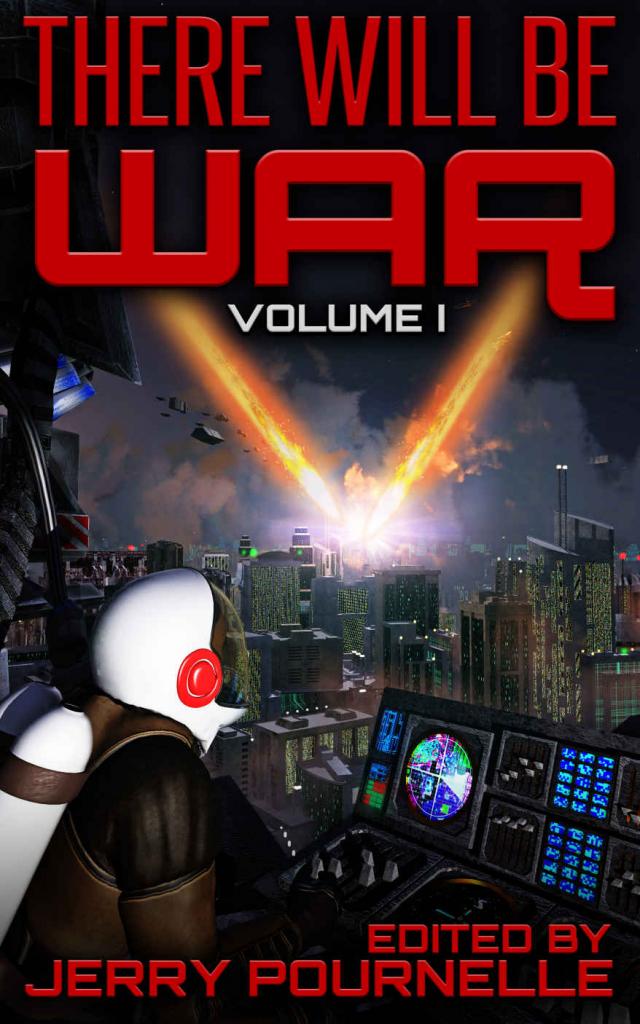
There will be war volume.., p.13
There Will Be War Volume I,
p.13


Doctor Strangelove, though, that was the one that really did it.
He had liked the old movies and programs, but he had always known they weren’t really real. After all, Errol Flynn marched all the way through Burma and came out looking great, when Cooper only went camping once and caught such a collection of poison ivy rashes and bug bites and inflamed bramble-bush scratches that his mother had pulled him out of the Scouts. And he knew he could never drive a jeep through North Africa; hell, he couldn’t stand getting sand in his shorts at the beach and he burned like a lobster.
But then in Doctor Strangelove, in the scenes on board Slim Pickens’ bomber, he knew what he was seeing was real. He knew that was what the inside of a B-52 looked like; he knew that that was what it would be like to evade a SAM missile. He didn’t even mind that bullshit about Pickens riding the H-bomb down, that was just the director being cute. And it was the first movie he’d ever seen where the actors and models didn’t have that tacky blue line around them in the projection shots.
Cooper’s hands flew to his board and armed the two fire-and-forget missiles in his battery. From that point on the target programming system in the Poignard battery itself took over, and the missiles leaped flaming from their brackets to intercept the two most dangerous incoming targets. More pale light blossomed on his screen as those missiles and others detonated between the two clusters of ships. When it faded there were still three tiny missile-bogeys, pressing on stubbornly. Cooper paid those no more attention; they were in too close for counter-missilery now and would have to be dealt with by the Oerlikon and minigun crews. Far away through several thicknesses of metal, he could hear/feel the staccato stuttering as the 20mms and quad 7.62s opened up on deck, but he paid them no attention, either. They weren’t part of his game.
He wasn’t really going to the same college as everybody else. He would sometimes stop and watch the demonstrations on his way to and from classes, and once he even signed a petition a girl thrust at him, because he thought it would be the quickest way to get past her without being rude.
Then he went back to his dorm and watched Walter Cronkite riding as an observer in a Stratofortress, whooping with glee at the way the plane lurched upwards as its bomb load was released on the landscape below.
* * *
There was a thin red circle on Cooper’s screen on short-range scan: it marked the outermost limit of engagement for his missiles. As he watched, the blips of the Russian ships drew nearer, and nearer—and touched. He immediately salvoed two more fire-and-forget missiles and then a third, laser-guided from his own console, holding his last LG missile in reserve while his battery recycled. Both system-aimed missiles plowed into a solid wall of counter-missiles and gunfire and vanished in incandescent fireballs, in silent splotches of pale green-white light. Cooper took his in on a long, predictable curve, then cut over sharply and sent the missile plunging into the ship vertically. He was rewarded with a great blot of light that continued to pulsate and expand long after the initial explosion. He immediately touched off two more fire-and-forgets.
Then they built a new amusement arcade in Penn Station. “Station-Break”, it was called, and it had everything, pinball machines, film-chain games, video games. Cooper was never very good at the film-chain games like Gunship or Shootout; he could never handle the spatial relationships properly, his helicopter would always slew off to the side or he’d aim too high with the nickel-plated plastic six-gun and miss the man on the water tower. But the video games he loved. Starforce—what a great name, almost as good as ‘Stratofortress’—in particular; you sat in this little cockpit-cubicle and controlled a set of crosshairs with the wheel, and once you were lined up on a target it locked in and all you had to do was pull the trigger. His real favorite though, was a ripoff of the last scene in Star Wars, going down the shaft, where every time you hit an enemy ship it flew apart in a spray of stick-figure wreckage—he could beat anyone at that one; he never even missed the ‘phantom raider’ ship, the one that shot back and could take away half your points if it got you. He was in the arcade constantly, on his way to and from school, and so it was that when he boarded Quincannon, having chosen the Navy after he flunked the Air Force physicals, he performed what was very probably the one imaginative act of his life, and taped a quarter to the top of his Decca-built R50/90A naval radar unit…
The two flotillas were within visual range of each other now. The men on deck could watch the gouts of flame blooming on the opposing ships as the missiles leaped out at them; the rapid-fire three-inch gun at Quincannon’s bow opened fire; the Oerlikon and minigun crews were firing constantly. At that range no motor could swivel a missile battery to track an incoming rocket faster than a frightened man could swing a gun around—the machine guns were now the main line of defense on both sides.
The two little fleets corkscrewed wildly around each other, each commander trying to place his force broadside or to the bow or stern of his enemy, to bring the full weight of his firepower to bear on those weak points. Quincannon, like all warships her size, was of a very narrow beam for her length. While this was to her advantage in terms of speed and maneuverability, it also made her very tender. As she cut and weaved across the sea, taking the steep gale waves on her quarter or even full abeam, she sent huge gouts of green water cascading across her decks. Cooper noticed none of this at his post save the ship’s erratic movement. He was used to that. He seldom went up on deck anymore, as a constant view of unbroken water bored him. His shipboard life rotated mainly between bunk and mess and the staring green eye of his console.
Now he was lining up another LG missile as his battery automatically launched brace after brace of fire-and-forgets. The air between the two fleets was thick with flame and shattered metal; aboard Quincannon an Oerlikon gunner sagged in his harness as a fiery shard tore away the side of his head; shrapnel spattered on the decks like steel and aluminum rain. Cooper saw nothing of this, only occasionally hearing the muted thunder of a particularly close explosion. He triggered his missile and sent it in on a long, weaving S-curve, watching with mounting excitement as it drew nearer and nearer its target—and vanished in a puff of light. Even as he muttered a disappointed curse he was firing his next missile, working the details to sneak it through and score. This one went all the way, a phosphorescent white dot twisting across glowing green glass to intersect another dot and vanish in a slow, spreading flash. High score. Overtime play—
More blood mixed with seawater on Quincannon’s deck. Where electronics and state-of-the-art missilery clashed and largely cancelled each other out, older and more practiced means told. A 115mm shell slammed into Quincannon’s forward minigun battery and four men died. A hole was opened in Quincannon’s defensive envelope.
His next missile was intercepted. Cooper immediately launched another, eyes fixed on his screen, fingers working the dials.
A Soviet frigate, torn and burning from two direct hits, launched a last salvo from its one remaining operational battery. One missile erupted in flames and tumbled into the sea as the guns found it. Another detonated violently, taking out a third through concussion. The fourth found the gap in Quincannon’s defense as other guns strained uselessly to make the impossible deflection shot that would stop it.
Cooper whooped with glee as his missile found its target. Then the bulkhead erupted inward and the game was over.
Quincannon limped back into Plymouth harbor. It took the engineers nearly half an hour to cut away enough wreckage to let the graves unit extricate the shattered body from the maze of twisted structural members and electronic scrap. Cooper’s body had been so firmly embedded in the ruin that it almost seemed deliberate, as though the reality of war at sea had reclaimed him with such force that a steel fist had been clenched to anchor him in place. As the stretcher team carried the body across the planking leading from the gaping wound onto the dock, a careless foot brushed a tiny bit of metal and sent it tumbling over the side. The battered, deformed quarter fell into the water with the tiniest of splashes, unnoticed.
Editor's Introduction to:
OVERDOSE
by Spider Robinson
Few question the enormous and beneficial influence that John W. Campbell had on the science fiction field. One of his greatest contributions was the discovery and training of new writers. Thus it seemed appropriate that there be a John W. Campbell, Jr. Memorial Award, and that it go to the best new writer in the science fiction field.
I had the honor to be the first winner of that award, which pleased me greatly, because I was Mr. Campbell’s last discovery.
Spider Robinson was the second winner, largely because of his fascinating “Crosstime Saloon” stories. He has since become a major talent in the field. Spider has a positive genius for combining the realistic and, uh, something else, as you’ll see in this tale of how a private soldier saved the world…
OVERDOSE
by Spider Robinson
Join the navy and see the phosphor dots.
Moonlight shattered on the leaves overhead and lay in shards on the ground. The night whispered dementedly to itself, like a Zappa minuet for paintbrush and teakettle, and in the distance a toad farted ominously.
I was really stoned.
I’d never have gotten stoned on sentry duty in a real war, but there hadn’t been much real fighting to speak of lately (this was just before we got out), and you have to pass the time somehow. And it just so happened that as I was getting ready to leave for the bush, a circle of the boys was Shotgunning.
Shotgunning? Oh, we do a lot of that. It works like so: the C.O. (…“or whomever he shall appoint…”) fills a pipe from the platoon duffle bag, fires it up, takes a few hits to get it established, and then breaks open a shotgun and inserts the pipe in one of the barrels. He raises it to his lips and blows a mighty blast down the bore, and someone on the other end takes an enormous hit from the barrel.
The C.O. then passes the Shotgun…
So as I say, I was more ruined than somewhat as I contemplated the jungle and waited for my relief. Relief? Say, you can take your medication and your yoga and your za-zen—there’s nothing on earth for straightening your head like a night in the jungles of Vietnam. Such calm, such peace, such utter tranquility.
Something crackled in the bush behind me, and my M-32 went off with a Gotterdammerung crash two inches from my left ear. As I whirled desperately about, Corporal Zeke Busby, acting C.O. and speed-freak extraordinaire, levitated a graceful foot above the surrounding vegetation and came down rapping.
“Yas indeed private yas indeed alert and conscientious as ever yas and a good thing too a good thing but if I may make so bold and without wishing to appear unduly censorious would you for Chrissake point that fuckin’ thing somewhere else?” Corporal Zeke had once been a friend of Neal Cassidy’s for perhaps just a bit too long.
“Sure thing, Corp,” I mumbled, shifting the rifle. My eardrum felt like Keith Moon’s tom-tom.
“Yas and a signal honor a signal honor my man your gratitude will no doubt be quite touching but I assure you before you protest that I consider you utterly worthy worthy worthy to the tips of your boogety-boogety shoes.”
A signal honor? He could only mean…
“I have selected you from a field of a dozen aspirants to make the run to Saigon and cop the Platoon Pound.”
I was overwhelmed. The last man so honored (a guy named Milligram Mulligan) had burned us for two bricks of Vietnamese cowshit and split for the States—this was indeed a mark of great trust. I tried to stammer my thanks, but Corporal Zeke was off again. “… situation of course most serious and grave without at the same time being in any sense of the word heavy as I’m sure you dig considering the ramifications of the logistical picture and the inherently inescapable discombobulation manifest in the necessary… what I mean… that is to say, we’ve only got five bucks to work with.” His left eye began to tic perceptibly, almost semaphorically.
“No problem, Corporal Zeke. I’ve seen action before.” Five was barely enough for a few ounces at Vietnamese prices, but the solution was simple enough—rip off a Gook. “What did you have eyes to score?”
“Yas well based on past performance and an extrapolated estimate of required added increment to offset inflation which some of these lousy bastards they smoke ‘til their noses bleed, it seems that something on the close order of five bricks would not be inordinate.”
I nodded. “You’re faded, Corp. Get me a relief and I’ll crank right now.” He didn’t hear me; he was totally engrossed in his left foot, crooning to it softly. I put the M-32 near him gently and split. When the Old Man says “Cop!” you cop, and ask how soon on the way back.
Deep in the jungle something stirred. Trees moved ungraciously aside; wildlife changed neighborhoods. A space was cleared. In this clearing grew a shimmering ball of force, a throbbing nexus of molecular disruption. It reached a diameter of some thirty feet, absorbing all that it touched, and then stopped growing abruptly. It turned a pale green, flared briefly, and stablized, emitting a noise like a short in a fifty megavolt circuit.
With something analogous to a gasp, Yteic-Os the Voracious materialized within the sphere, and fell with a horrendous crash to the jungle floor a foot below. Heshe winced—well, not exactly—and momentarily lost conscious control of the pale green bubble, which snapped out of existence at once.
Yteic-Os roared hisher fury (although there was nothing a human would have recognized as sound) and tried to block the green sphere’s dissolution by a means indescribable in human speech, something like sticking one’s foot in a slamming door. It worked just about as well; the Voracious One nearly lost a pseudopod for hisher trouble.
This was serious.
Yteic-Os was ridiculously ancient—heshe had been repairing hisher third sun on the day when fire was discovered on earth. Entropy is, however, the same for everybody. Yteic-Os had long since passed over into catabolism; hisher energy reserves dwindled by the decade.
This jumping in and out of gravity wells was a hellishly exhausting business; for centuries Yteic-Os had sidestepped the problem by using the tame space-warp over which heshe had so laboriously established control. Now the warp was gone, galaxies away by this time, and Yteic-Os had grave doubts as to hisher ability to jump free unassisted.
This world would simply have to serve. Somewhere on this planet must exist a life-form of sufficient vitality to fill Yteic-Os’s reserve cells with The Force, and heshe was not called The Voracious for nothing. Heshe extended pseudopods gingerly, questing for data on cerebration-levels, indices of disjunctive thought and the like. Insignificant but potentially useful data such as atmosphere-mix, temperature, radiation-levels and gravity were meanwhile being absorbed below the conscious level by the sensor-modules which studded Yteic-Os’s epidermis (giving himher, incidentally, the external appearance of a slightly underdone poached egg with pimples).
A pseudopod like a mutant hotdog twitched, began to quiver. Yteic-Os integrated all available data and decided ocular vision was called for. Hastily heshe grew an eye, or something very like one, and looked in the direction pointed by the trembling pseudopod.
Yes, no doubt of it, a sentient life-form, just brimming with The Force! Yteic-Os sent a guarded probe, yelped with joy (well, not precisely) as heshe learned that this planet was crawling with sentient beings. What a bountiful harvest!
Yteic-Os cannily withdrew without the other so much as suspecting hisher existence, and began patiently constructing hisher attack.
Well, the plan was simplicity itself: meet Phstuc My in a bar, demand to see the goods before paying, pull my gun and depart with the bag. Instead, I left without my pants. How the hell was I supposed to know the bartender had me covered?
So there I crouched, flat broke and sans culottes, between two G.I. cans of reeking refuse in a honky-tonk alleyway, strung out and dodging The Man. It made me homesick for Brooklyn. At least the problem was clear-cut: all I had to do was scare up a pair of pants, five bricks of acceptable smoke, a hot meal and transportation back to my outfit before dawn. Any longer and Corporal Zeke would assume I had burned him, at which point, Temporary Cease-Fire or not, Southeast Asia would become decidedly too warm for me to inhabit. I was not prepared to emulate Milligram Mulligan—ocean-going desertion requires special preparation and a certain minimum of cash, and I had neither.
The possibilities were, as I saw it, dismal. I couldn’t rip off a pedestrian without at least a token weapon, and I was morally certain the two garbage cans contained nothing more lethal than free hydrogen sulfide. I couldn’t burgle a house without more of the above-mentioned preparation, and I couldn’t even borrow money without a pair of pants.
I sure wished I had a pair of pants.
A giggle rippled down the alleyway, and I felt my spine turn into a tube of ice-cold jello. I peered over a mound of coffee-grounds and there, by the beard of Owsley, stood an absolutely dynamite chick. Red hair, crazy blue eyes, and a protoplasmic distribution that made me think of a brick latrine. At the mere sight of this girl, certain physiological reactions overcame embarrassment and mortal terror.
I sure wished I had a pair of pants.
“What’s happening?” she inquired around another giggle. My God, I thought, she’s from Long Island! I decided to trust her.
“Well, see baby, I was makin’ this run for my platoon, little smoke to sweeten the jungle, right? And, ah… I’ve gone a wee bit awry.”
“Heavy.” She jiggled sympathetically, and moved closer.
“Well, yeah, particularly since my C.O. don’t like gettin’ burned. Liable to amputate my ears is where it’s at.”
She smiled, and my eyes glazed. “No sweat. I can set you up.”
“Right.”