There will be war volume.., p.36
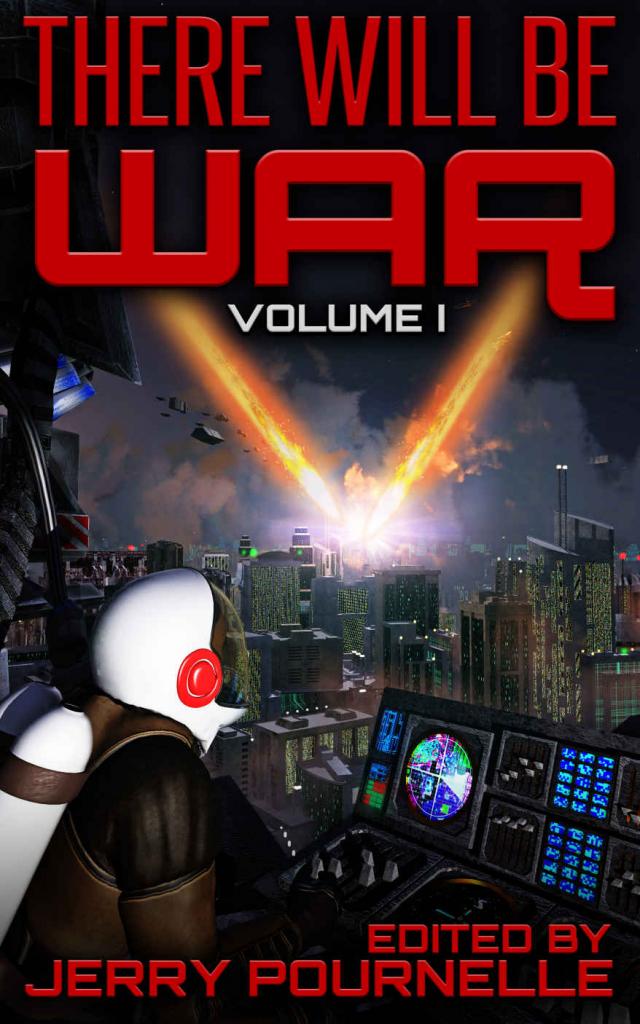
There Will Be War Volume I,
p.36


He walked painfully after his partners. “Dig in and spot them,” he said. “Wait till I get there to formulate.”
They nodded—as senior Eagle he was expected to be responsible in every strategic decision. Let the rats hole up and wait; it would only dull their nerves and drive them closer to panic. Arne and Lem slung their bows and trotted off after the five now-distant rats who were still running, aware their trap had failed and aware of the irretrievable loss of their last stronghold. There were no places of safety to which they could flee, no communities where they could pass for refugees or derelict streeters.
They could have no hope of escape, yet still they ran. And after them, like loping angels of death, came Arne and Lem. The rat they had killed in the grass had not carried a needier; nor had he worn a streetsuit.
More slowly and farther behind, a hype from his aid kit easing the pain and congestion in his leg, Bern followed. His smooth stride kept the muscle from cramping, and he had only a mile to go when he heard three spaced clicks from his handy. He touched it at his belt, clicking the carrier once. Then a voice spoke quickly.
“They’re down and covered.”
Bern brought the unit to his lips. “Ten minutes,” he said, and clicked the pattern requesting navigational data.
When the Scouts were together below the crest of the round hill where the Ruins stood, Lem outlined the situation.
“They’re pulled in behind that first row of columns. They probably don’t know how to get down to the parking levels. We can surround them on the main floor area.”
Bern nodded, and the three of them started silently up the rubbly slope towards the great level stone floor, its warps and buckles concealed by wind-drifted adobe-clay. Here and there walls stood—thick, braced walls with fine patterns carved deep in their still-gleaming surfaces, uncorrupted by the centuries. Rain-soaked soot still lingered in the stones, in cracks where lichens did not reach; a great arc of dull white carving lay like a rocker sixty feet long, both ends jagged and weathered, with no matching curves as of a broken circle remained to indicate how it had stood. Locally it was called Chandler’s Chair, and it was said that a sufficient force of men had rocked it.
As the Scouts crept past the line of columns and fallen pillars, the true size of the place began to open around them. The village of Sereno would have fit, with stables, corrals, orchards and gardens, into one quarter of that great level mesa where fallen monuments to the past lay crumbling. And from the midst of that silenced splendor, a blaster bolt flashed among them and seared some square feet of stone clean of lichen.
Lem took off to the left; by understanding, as Bern’s junior he took over responsibility of movement. Bern wasted one bolt to keep the rats pinned down while Lem tried to spot their exact location. A minute later his handy clicked.
“Wall. Ten degrees right. Under this end of the Chair. Arne go right. Three minutes.”
Bern clicked acknowledgment as Arne moved off. He shifted position closer and wasted another bolt when the flash of an incautiously extended head presented itself momentarily—this battle was not likely to be settled by blaster bolts, but hand to hand. And for that the range must be closed.
The rats had gone to ground behind a row of angled slabs which thrust from the floor almost forty degrees off perpendicular, lying partly supported by a section of solid wall. Under this slotted, slanted roof they huddled, desperate and deadly. Bern saw this as he moved, and clicked his handy.
“Come from above,” he said, and his partner clicked back.
By climbing the inner face of the Chair, Lem could come out twenty feet above and behind the rats and fire down on them. Arne would be concealed forty feet in his direction from them waiting for either Eagle to open the attack. Seconds passed.
Then a bolt spat from the far end of the sheltered space and splashed against a fallen pillar behind him. Bern rose to his feet and fired. Flame licked around one end of the slanted wall and a cry told him of a glancing hit, or near miss, as he ducked down again, his ear cocked to the sound of his blaster recharging. The blaster, salvaged from the rat they’d killed on the road, stuck from his pocket, still charged; it could serve as a backup.
Lem’s crossbow snapped from above and behind the cluster of rats, and a half-charged flash of energy dissipated in the air. Then Arne fired from cover and moved. A quarrel should penetrate a streetsuit at moderate range, and only one of the rats was so protected. Bern took advantage of the distraction to move closer, angling for a shot through one six-inch crack in the bastion.
He knelt, his leg nearly numb and clumsy, and braced the bow across the lip of a dust-filled fountain. In the deep shade behind the gap he saw indistinct shapes moving too swiftly to waste a shot. Back and forth; he waited patiently; fingertip light against the trigger. As a shadow paused blocking the slit, he stroked the release and felt the bow jump against his shoulder like a captive rabbit. The bolt passed directly into the narrow opening, vanishing without a sound, and the shadow fell away leaving the space clear again. No further targets presented themselves.
The rats’ blaster would be charged up by this time. Even though the crossbow fire must have attenuated their numbers they held positional advantage, and the Scouts hesitated to press the attack.
Silence returned to the ruins—a tense, waiting silence. A gull flashed white overhead, and warm wind whispered around the fallen columns. Bern gauged the distance to another block of white marble and estimated his chances. The rat with the blaster could only be looking one way at a time, and the needier was a short-range weapon. Five seconds in the open would be too long, but Lem could distract them. He secured his weapons and clicked a question on his handy.
“Four left, one wounded,” it answered.
“Good. Count five and cover.”
On the click of acknowledgment Bern rose to a crouch and started counting silently with measured cadence. One—two—three—four—five… The snap of Lem’s bow sent him on a clumsy four-legged scramble across a bare twenty-five feet of sparse stunted grass which grew unhealthily among the cracked marble slabs. He barked his knuckles across a jutting corner and his hand slipped. His shoulder hunched as he twisted reflexively to land rolling, and a lance of flame turned a long oval of crumbling stone to steaming white lava which seethed for a few seconds before the bursting bubbles froze in brittle froth. By then he was under cover.
Arne had taken the opportunity to advance seconds after Bern. The ring tightened.
The group of villagers with Chad in the lead should arrive within a quarter hour. A containing action would be adequate at this point. But professional pride preferred that not a rat be left alive when reinforcements did arrive. He clicked for Lem.
“Three left, one wounded. Try bounce shot—left end.”
The indicated end of the rats’ shelter was warded by a four-foot wall of stone, faint abstracts etched in it, angled partly across the opening. From his new position he could fire a bolt which would splatter rock and enough heat to cause some damage in the protected area. He cocked his bow, slung it ready and gave the sharp, rising attack whistle and fired his blaster into the wall.
Second blaster in hand, he scrambled forward to the smoking, half-slagged wall, fell flat to the stone and fired into the rats’ hole. Crossbows snapped above and ahead, and one more flicker of intolerable brilliance lanced just over his head and warmed his back like the sun for an instant as the wall behind him puffed steam. In a single swift movement he brought his bow into position with a quarrel in its slot and fired into the one figure left standing, a discharged blaster in his hand and a streetsuit helmet around his head.
Another quarrel from the opposite direction struck the figure almost simultaneously, spinning him around and ripping through the tough nyloid. The rat flopped to the ground, kicking for only a moment, across the burned body of another, and as echoes of unheard shouts died the only sound in the stillness was the harmonic lifting chord of recharging blasters.
Bern rose to his feet and limped forward, bowie ready in his fist. Arne came toward him through the settling dust, prodding cautiously at the bodies with his toe.
Lem’s head appeared above them on the lip of Chandler’s Chair. “That’s it,” he said.
“Streetsuit’s wrecked,” said Arne critically.
“Merit point for the kill,” said Bern. “It may be repairable.”
He bent awkwardly and picked up the blaster from a limp hand just as the whine cut off. He switched the circuit to safety and spent several seconds examining it before he nodded.
Lem came around the curve of graven stone as Arne found the spring needler and held it up. “I wondered why this wasn’t being used,” he said. “Now I think it may have been.”
The flat magazine opened to show the “needles”—instead of gleaming perfect lines of steeloy, it was half filled with strands of bright copper, salvaged from ancient wiring, cut to length and painstakingly worked to near-microscopic straightness. Lem winced. “Rough on the barrel! Half price for salvage.”
“They’ll be here soon for the accounting,” Bern said. “I don’t think they’ll feel cheated.” A line of dust, distant and white behind a wagonload of villagers, rose along the road from Sereno, coming to carry them back.
>THE STRATEGY OF TECHNOLOGY
by Jerry Pournelle
Astute readers will recognize that this article’s title comes from the 1970 book by Stefan T. Possony and Jerry Pournelle. STRATEGY OF TECHNOLOGY has been used as a text by both the United States Air Force Academy and the Air War College; it is, alas, out of print, although Steve and I hope to revise it soon.
Before we get into the topic proper, some good news.
The First L-5 Convention, held in Spring of 1982, was a rousing success. Fan Guest of Honor Robert A. Heinlein said it was the best weekend he’s had in years. I heartily agree; it may have been the most interesting convention I’ve ever been to. Attendance was nearly a thousand, with an excellent mixture of professionals, such as Guest of Honor Fred Haise, Buzz Aldrin, Hans Mark, Arthur Kantrowitz, my colleague G. Harry Stine, Stefan Possony, Danny Graham, etc; and space enthusiasts like Larry Niven, Ben Bova, BJO Trimble… I have a problem in choosing names; there were so many friends there. The ones above are quite literally chosen at random, and I hope I’ve offended none by leaving them out. I couldn’t possibly list all the guests we had.
There was an important session on design of a Lunar Colony, conducted by Count Renaldo Petrini, PhD., a well-known Houston architect. Everyone at the convention was invited to help out, and the results have been impressive. Dr. Petrini and his associates are planning two more (invitational) sessions. What they’ve got so far is both aesthetic and practical; they’ll do an article on it soon.
Although I was in theory Convention Co-Chairman, I don’t hesitate to brag about how well run it was, for in reality I had nothing to do with convention operations. I went about entertaining guests; the real work was done by Co-Chairman Milt Stevens, many members of the Los Angeles Science Fantasy Society, and Deputy Chairman James Ransom of the Aerospace Corporation.
I won’t make this a convention report but I will give a few anecdotes. Overheard in the operations center:
Speaker (an important aerospace executive): “This is the best managed convention I’ve ever gone to. They show you where to go, things start on time, and they have those continuation rooms for people who want to ask questions. It’s great!”
Operations Assistant (veteran of many SF Cons): “This is the easiest convention I’ve ever worked. The speakers show up on time, they’re prepared, and they’re sober!”
One high point: watching Mr. Heinlein watch Fred Haise listening as Frank Gasperik sang “The Ballad of Apollo 13.”
The L-5 Conventions are planned annually; the second, in 1983, will be in Houston. I hope there will be many more, for they give an excellent opportunity for the public to meet the space professionals.
I’m writing this in 1982. There have been a number of news items I can’t get out of my mind.
Item: the sinking of HMS Sheffield and the renamed cruiser Phoenix. A number of news magazines have written of the Falklands naval battles as “the battle of the computers,” and in a real sense I suppose that’s true. The Argentine cruiser was sunk by modern “smart” torpedoes that can be fired from many miles away and are nearly indetectible; Sheffield succumbed to a French Exocet missile, which can be launched from well over the horizon at nearly any altitude after which it flies at nearly supersonic speed about ten feet above the water.
There have been any number of articles on what all this means. Some conclude that the era of the big carriers is over, and that the U.S. Navy ought to scrap its plans for more Enterprise class ships in favor of several smaller carriers equipped with helicopters and vertical takeoff and landing (VTOL) planes. Other analysts draw precisely the opposite conclusion: that the big ships with their “full capability” aircraft can better defend themselves, and if hit are more survivable.
Item: In today’s Wall Street Journal there is an article about the US Army in Germany. It’s a good army, the article concludes; but it’s greatly outnumbered. We have a variety of new antitank missiles and equipment, but not enough money to let the troops fire the things in training—and there are a lot of Soviet tanks just across the border. One captain speaks for all when he says “There may just be more tanks than we can kill.”
Item: the Israeli advance into Lebanon. Israeli flyers, using highly sophisticated equipment and tactics, were able to overcome some of the Soviet Union’s very best air defense missiles and anti-tank weapons.
Item: Any number of demonstrations for a “nuclear freeze.” Since enhanced radiation weapons are one of the high-tech items the Army is counting on to stop Soviet tanks, this interacts with the above—and a number of powerful Senators, including Kennedy, have joined the “freeze” movement.
Item: we still have a Strategic Arms Limitation Treaty that forbids us to build any missile defense system that would protect our population. (Under SALT I we are allowed to but have not built a system to defend a single missile site; but no defenses of population centers as such are permitted. The Soviets have chosen to build their defense system to protect the missile site close by Moscow…)
A final item, one that didn’t get much publicity: early in 1982, a Czech grocery clerk was sentenced to five years at hard labor for “possession of an unlicensed mimeograph machine.”
One of the featured speakers at the L-5 Convention was Lt. Gen. Daniel O. Graham, US Army (Ret.). General Graham is Director of Project High Frontier. The basic High Frontier report can be obtained from PROJECT HIGH FRONTIER, 1010 Vermont Ave. NW Suite 1000, Washington DC 20005 for $15; and I urge anyone interested in the military future to get a copy and study it. Fair warning: some of the analysis in the High Frontier report comes directly from the Citizen’s Advisory Council on National Space Policy, of which group I am Chairman; so I am hardly unbiased.
My copy of High Frontier comes with a letter of endorsement signed by Buzz Aldrin, who met General Graham at the L-5 Convention; one thing the L-5 Con accomplished.
The basic thesis of High Frontier echoes what Possony and I wrote in STRATEGY OF TECHNOLOGY: that the decisive war need not be fought with blood and treasure—and in fact must not be. There is a way to defend Western Civilization—warts and all—without destroying the planet.
Major premise: it’s bloody expensive to try to match the Soviets tank for tank, gun for gun, ship for ship. They can keep a lot more of their population under arms than we can; certainly they can build large armies cheaper than we can.
If we continue with “the incremental approach” to defense; buying more of this and that, buy more airplanes, more guns, more tanks, more bombs; we will do nothing decisive, and we may well go bankrupt trying it. We also accumulate the means for killing the lot of us.
Instead, let us take a bold new approach; let us sidestep the enemy, and take the high ground of space.
Our present strategic doctrine is Mutual Assured Destruction, often abbreviated (by its enemies, of whom I am one) as MAD. MAD says that wars cannot be won; they can only be deterred; and therefore to prevent war all nuclear powers must mutually have the ability to destroy each other. MAD adherents oppose civil defense, not on the grounds that it won’t work, but that it might work. If we could truly defend some of our population, then we would not be hostage to the Soviets; assured destruction would not be mutual.
Those who support General Graham’s strategic thesis would restore defense to its proper role: would opt for Assured Survival as the proper strategic doctrine, and see that the arms race concentrated on defensive weapons that would protect the US population.
Defensive systems are inherently stabilizing. They deal handsomely with the “mad general” scenario (unauthorized launch of a single nuclear missile). For technical reasons one can never be certain of one’s defenses, especially against a determined and sophisticated enemy; but defensive systems can very likely deal with any power other than the Soviet Union, and that in itself is desirable. Finally, by complicating the other side’s strategic war plan, defense systems make it very difficult to predict the outcome of a strategic nuclear exchange—which makes it very unlikely that anyone would launch a strike in the first place. You don’t start a big war unless you’re fairly certain you can win it.
The point is that the High Frontier strategy does not seem incompatible with a nuclear freeze: certainly is not incompatible with a freeze on offensive nuclear weapons.
I don’t know the optimum mix of big and little carriers for the future. As a maritime nation the United States has always required naval forces to keep our sea lanes open, and Marines to project our power beyond our borders—indeed, the Constitution makes an important distinction between armies and navies. Certainly we need ships.