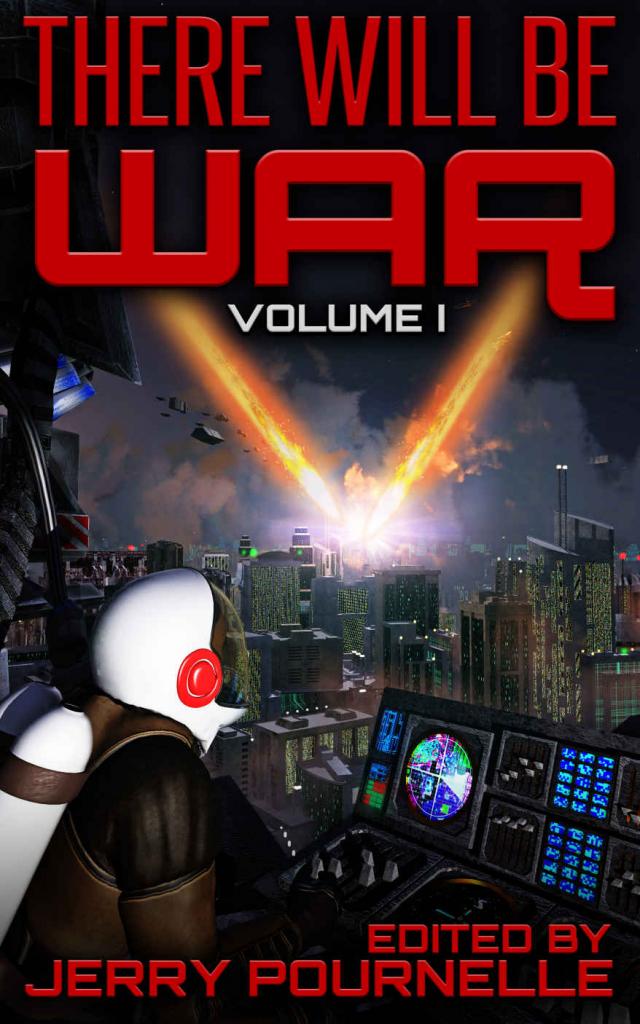
There will be war volume.., p.3
There Will Be War Volume I,
p.3


“Bridge, this is damage control.”
“Yeah, Greg.”
“Hulled in main memory bank area. I’m getting replacement elements in, but you better go to secondary computer for a while.”
“Already done.”
“Good. Got a couple other problems, but I can handle them.”
“Have at it.” Screens were coming back on line. More sensor clusters were being poked through the Langston Field on stalks. Colvin touched buttons in his chair arm. “Communications. Get number three boat in closer.”
“Acknowledged.”
The Imperial ship took evasive action. She would cut acceleration for a moment, turn slightly, then accelerate again, with constantly changing drive power. Colvin shook his head. “He’s got an iron crew,” he muttered to Halleck. “They must be getting the guts shook out of them.”
Another blast rocked Defiant. A torpedo had penetrated her defensive fire to explode somewhere near the hull. The Langston Field, opaque to radiant energy, was able to absorb and redistribute the energy evenly throughout the Field; but at cost. There had been an overload at the place nearest the bomb: energy flaring inward. The Langston Field was a spaceship’s true hull. Its skin was only metal, designed only to hold pressure. Breech it and—
“Hulled again aft of number two torpedo room,” Halleck reported. “Spare parts, and the messroom brain. We’ll eat basic protocarb for a while.”
“If we eat at all.” Why the hell weren’t they getting more hits on the enemy? He could see the Imperial ship on his screens, in the view from number two boat. Her field glowed orange, wavering to yellow, and there were two deep purple spots, probably burnthroughs. No way to tell what lay under those areas. Colvin hoped it was something vital.
His own Field was yellow tinged with green. Pastel lines jumped between the two ships. After this was over, there would be time to remember just how pretty a space battle was. The screens flared, and his odds for success dropped again, but he couldn’t trust the computer anyway. He’d lost number three boat, and number one had ceased reporting.
The enemy ship flared again as Defiant scored a hit, then another. The Imperial’s screens turned yellow, then green; as they cooled back toward red another hit sent them through green to blue. “Torps!” Colvin shouted, but the master computer had already done it. A stream of tiny shapes flashed toward the blinded enemy.
“Pour it on!” Colvin screamed. “Everything we’ve got!” If they could keep the enemy blind, keep him from finding Defiant while they poured energy into his Field, they could keep his screens hot enough until torpedoes could get through. Enough torpedoes would finish the job. “Pour it on!”
The Imperial ship was almost beyond the blue, creeping toward the violet. “By God we may have him!” Colvin shouted.
The enemy maneuvered again, but the bright rays of Defiant’s lasers followed, pinning the glowing ship against the star background. Then the screens went blank.
Colvin frantically pounded buttons. Nothing happened. Defiant was blind. “Eyes! How’d he hit us?” he demanded.
“Don’t know.” Susack’s voice was edged with fear. “Skipper, we’ve got problems with the detectors. I sent a party out but they haven’t reported—”
Halleck came on. “Imperial boat got close and hit us with torps.”
Blind. Colvin watched his screen color indicators. Bright orange and yellow, with a green tint already visible. Acceleration warnings hooted through the ship as Colvin ordered random evasive action. The enemy would be blind too. Now it was a question of who could see first. “Get me some eyes.” he said. He was surprised at how calm his voice was.
“Working on it,” Halleck said. “I’ve got minimal sight back here. Maybe I can locate him.”
“Take over gun direction,” Colvin said. “What’s with the computer?”
“I’m not getting damage reports from that area,” Halleck said. “I have men out trying to restore internal communications, and another party’s putting out antennas—only nobody really wants to go out to the hull edge and work, you know.”
“Wants!” Colvin controlled blind rage. Who cared what the crew wanted? His ship was in danger!
Acceleration and jolt warnings sounded continuously as Defiant continued evasive maneuvers. Jolt, acceleration, stop, turn, jolt—
“He’s hitting us again.” Susack sounded scared.
“Greg?” Colvin demanded.
“I’m losing him. Take over, skipper.”
Defiant writhed like a beetle on a pin as the deadly fire followed her through maneuvers. The damage reports came as a deadly litany. “Partial collapse, after auxiliary engine room destroyed. Hulled in three places in number five tankage area, hydrogen leaking to space. Hulled in the after recreation room.”
The screens were electric blue when the computer cut the drives. Defiant was dead in space. She was moving at more than a hundred kilometers per second, but she couldn’t accelerate.
“See anything yet?” Colvin asked.
“In a second,” Halleck replied. “There. Wups. Antenna didn’t last half a second. He’s yellow. Out there on our port quarter and pouring it on. Want me to swing the main drive in that direction? We might hit him with that.”
Colvin examined his screens. “No. We can’t spare the power.” He watched a moment more, then swept his hand across a line of buttons.
All through Defiant nonessential systems died. It took power to maintain the Langston Field, and the more energy the Field had to contain the more internal power was needed to keep the Field from radiating inward. Local overloads produced burnthroughs, partial collapses sending bursts of energetic photons to punch holes through the hull. The Field moved toward full collapse, and when that happened, the energies it contained would vaporize Defiant. Total defeat in space is a clean death.
The screens were indigo and Defiant couldn’t spare power to fire her guns or use her engines. Every erg was needed simply to survive.
“We’ll have to surrender,” Colvin said. “Get the message out.”
“I forbid it!”
For a moment Colvin had forgotten the political officer.
“I forbid it!” Gerry shouted again. “Captain, you are relieved from command. Commander Halleck, engage the enemy! We cannot allow him to penetrate to our homeland!”
“Can’t do that, sir,” Halleck said carefully. The recorded conversation made the executive officer a traitor, as Colvin was the instant he’d given the surrender order.
“Engage the enemy, Captain.” Gerry spoke quietly. “Look at me, Colvin.”
Herb Colvin turned to see a pistol in Gerry’s hands. It wasn’t a sonic gun, not even a chemical dart weapon as used by prison guards. Combat armor would stop those. This was a slugthrower—no. A small rocket launcher, but it looked like a slugthrower. Just the weapon to take to space.
“Surrender the ship,” Colvin repeated. He motioned with one hand. Gerry looked around, too late, as the quartermaster pinned his arms to his sides. A captain’s bridge runner launched himself across the cabin to seize the pistol.
“I’ll have you shot for this!” Gerry shouted. “You’ve betrayed everything. Our homes, our families—”
“I’d as soon be shot as surrender,” Colvin said. “Besides, the Imperials will probably do for both of us. Treason, you know. Still, I’ve a right to save the crew.”
Gerry said nothing.
“We’re dead, Mister. The only reason they haven’t finished us off is we’re so bloody helpless the Imperial commander’s held off firing the last wave of torpedoes to give us a chance to quit. He can finish us off any time.”
“You might damage him. Take him with us, or make it easier for the fleet to deal with him—”
“If I could, I’d do that. I already launched all our torpedoes. They either got through or they didn’t. Either way, they didn’t kill him, since he’s still pouring it on us. He has all the time in the world—look, damn it! We can’t shoot at him, we don’t have power for the engines, and look at the screens! Violet! Don’t you understand, you blithering fool, there’s no further place for it to go! A little more, a miscalculation by the Imperial, some little failure here, and that field collapses.”
Gerry stared in rage. “Maybe you’re right.”
“I know I’m right. Any progress, Susack?”
“Message went out,” the communications officer said. “And they haven’t finished us.”
“Right.” There was nothing else to say.
A ship in Defiant’s situation, her screens overloaded, bombarded by torpedoes and fired on by an enemy she cannot locate, is utterly helpless; but she has been damaged hardly at all. Given time she can radiate the screen energies to space. She can erect antennas to find her enemy. When the screens cool, she can move and she can shoot. Even when she has been damaged by partial collapses, her enemy cannot know that.
Thus, surrender is difficult and requires a precise ritual. Like all of mankind’s surrender signals it is artificial, for man has no surrender reflex, no unambiguous species-wide signal to save him from death after defeat is inevitable. Of the higher animals, man is alone in this.
Stags do not fight to the death. When one is beaten, he submits, and the other allows him to leave the field. The three spine stickleback, a fish of the carp family, fights for its mates but recognizes the surrender of its enemies. Siamese fighting fish will not pursue an enemy after he ceases to spread his gills.
But man has evolved as a weapon-using animal. Unlike other animals, man’s evolution is intimately bound with weapons and tools; and weapons can kill farther than man can reach. Weapons in the hand of a defeated enemy are still dangerous. Indeed, the Scottish skean dhu is said to be carried in the stocking so that it may be reached as its owner kneels in supplication….
Defiant erected a simple antenna suitable only for radio signals. Any other form of sensor would have been a hostile act and would earn instant destruction. The Imperial captain observed and sent instructions.
Meanwhile, torpedoes were being maneuvered alongside Defiant. Colvin couldn’t see them. He knew they must be in place when the next signal came through. The Imperial ship was sending an officer to take command.
Colvin felt some of the tension go out of him. If no one had volunteered for the job, Defiant would have been destroyed.
Something massive thumped against the hull. A port had already been opened for the Imperial. He entered carrying a bulky object: a bomb.
“Midshipman Horst Staley, Imperial Battlecruiser MacArthur,” the officer announced as he was conducted to the bridge. Colvin could see blue eyes and blonde hair, a young face frozen into a mask of calm because its owner did not trust himself to show any expression at all. “I am to take command of this ship, sir.”
Captain Colvin nodded. “I give her to you. You’ll want this,” he added, handing the boy the microphone. “Thank you for coming.”
“Yes, sir.” Staley gulped noticeably, then stood at attention as if his captain could see him. “Midshipman Staley reporting, sir. I am on the bridge and the enemy has surrendered.” He listened for a few seconds, then turned to Colvin. “I am to ask you to leave me alone on the bridge except for yourself, sir. And to tell you that if anyone else comes on the bridge before our Marines have secured this ship, I will detonate the bomb I carry. Will you comply?”
Colvin nodded again. “Take Mr. Gerry out, quartermaster. You others can go, too. Clear the bridge.”
The quartermaster led Gerry toward the door. Suddenly the political officer broke free and sprang at Staley. He wrapped the midshipman’s arms against his body and shouted, “Quick, grab the bomb! Move! Captain, fight your ship, I’ve got him!”
Staley struggled with the political officer. His hand groped for the trigger, but he couldn’t reach it. The mike had also been ripped from his hands. He shouted at the dead microphone.
Colvin gently took the bomb from Horst’s imprisoned hands. “You won’t need this, son,” he said. “Quartermaster, you can take your prisoner off this bridge.” His smile was fixed, frozen in place, in sharp contrast to the midshipman’s shocked rage and Gerry’s look of triumph.
The spacers reached out and Horst Staley tried to escape, but there was no place to go as he floated in free space. Suddenly he realized that the spacers had seized his attacker, and Gerry was screaming.
“We’ve surrendered, Mister Staley,” Colvin said carefully. “Now we’ll leave you in command here. You can have your bomb, but you won’t be needing it.”
Editor's Introduction to:
SPANISH MAN'S GRAVE
by James Warner Bellah
This story is not science fiction; but it has its place in this anthology, for this is one of the stories that inspired Robert Heinlein to write STARSHIP TROOPERS.
When I met Colonel James Warner Bellah, he was a crusty retired military officer. He was quite famous; Bellah’s stories inspired more than half of the best Duke Wayne movies directed by John Ford. “She Wore A Yellow Ribbon,” “Red River,” “Rio Grande,” “Thunder of Drums,” all those and more were his, and indeed shared the characters: Lt. Pennell, Captain Brittles who couldn’t be promoted, Sergeant Tyree (that was Tyree’s department…), Trooper Smith who had been a Major General in the Army of the Confederate States—those and many more.
His own biography reads:
“I was born three months before the Century of Wars began to unfold itself. The faded, drink-wrecked blue shirts of El Caney and San Juan Hill cut our laws in Westchester County when I was a boy, for my father had raised a company of infantry in the Spanish-American War and was soft, ever after, to anyone who called him Captain.”
“During my growing-up, a flamboyant cousin in cavalry yellow-and-blue was perennially in the house from chasing Aguinaldo in the Philippines—and, as late as 1916—from chasing Pancho Villa deep into the Sierra Tarahumare in Mexico.
“In my mother’s closet, there were the epaulettes and sabres of her infantry captain father, wounded seven times from Cold Harbor to Appomattox—which he reached in an ambulance, still doing duty, —because he had had a bellyful of field hospitals.
“On the inertia of all this, a fugitive from school at seventeen, I was in France with the Army Transport Service. At eighteen I was a De Haviland 9 pilot in the 117th squadron. Royal Air Force, which had, when I joined it, been still the old, original Royal Flying Corps.
“The years between, I wrote for a living, but in 1939, the bugles screamed again, and being too old to fly but still young enough to walk, I was a lieutenant in F Company, 16th Infantry, First Infantry Division, ending up in the Burma War, variously under Stillwell, Wingate, and Phil Cochran.
“None of which is to be construed as vainglory, but merely as an explanation of the fact that a great deal of my writing has had the background of war. With some pardonable reason.
“The experience of war never quite leaves a young man or woman. A great many are utterly destroyed by it. All are indelibly and subtly marked by it, because, for good or evil, the memory never quite leaves any of us.”
Col. Bellah wasn’t an easy man to get to know, and I was a bit awed by him anyway. We were both members of the Order of St. Lazarus of Jerusalem, as well as St. Nicholas Church. I last saw him at his funeral which was conducted jointly by the Knights of Lazarus, the US Army, and a personal piper. Since then his son and I have become friends.
I have never read a story that tells more about why one might be a soldier.
SPANISH MAN'S GRAVE
by James Warner Bellah
The fears of man are many. He fears the shadow of death and the closed doors of the future. He is afraid for his friends and for his sons and of the specter of tomorrow. All his life’s journey he walks in the lonely corridors of his controlled fears, if he is a man. For only fools will strut, and only cowards dare cringe.
The Barrels Patrol wound on down across the far corner of the West, riding easily for the long haul, the long swing around. Day after deadly day. Week after weary week. Never the same route, for fear of forming military habits hostiles could depend upon.
There was that smudge of smoke ahead, straight up on the horizon, like coarse and thinning hair swept across yellow linen. And nothing else. Nothing but the empty miles that echoed in from the rim of the world, from the northern wastes of the Dakota country, from south of the Rio Grande, from Kansas back in the States. And in the center of this utter loneliness, like a fly caught in amber, Ross Pennell writhed inwardly in loathing of it.
For there are no soft-handed girls on the lone plains; only the echo of their laughter in dreams. And a plains uniform is a poor badge of glory. Worn leather, reeking of horse sweat and body sweat. Shirts bleached to the blue of distant rain, the armpits white with salt rime. Battered gray beaver felt, threadbare on the head, with the sweatband stinking when you ease up the brim. And no violins. No flowers. No band music. Only the dreariness and the loneliness and the final knowledge that you have flung down your youth into this empty void and that there your youth will die, far from the lights of cities, wasted forevermore.
“I don’t like that smoke too much, Mr. Pennell,” Sergeant Tyree spat sideways, and the brown ribbon of tobacco, flat and gleaming in the sunlight, twisted over once and struck into the dust with the muffled slap of dropped playing cards. “Ain’t prairie fire; it’s focalized.”
It is odd how you come to understand things. Tyree wanted an opinion. He had a faint doubt, but that wasn’t enough for Tyree. From years of habit, he needed an opinion to ease that doubt and to rationalize it. And the opinion had to have shoulder straps on it, no matter how new the straps were.
Lieutenant Pennell glanced down the column. Corporal Bartenett and seven men. Sergeant Tyree, the captain and himself. Taking it on the downslope at a walk. Twisting in and out in single file, broadside on to the trail, head on to it, picking the best footholds, riding carefully. Thinned down to bone and muscle they were, after five weeks of this. Griped silent. Their faces were drawn with monotony, their minds were seared raw with it. The pack animals creaked along in the rear. Pennell said, “Homestead chimney smoke, probably.” For a moment, as he said it, Ross Pennell saw the broad sweep of Claymont Street in his memory. The sunlight in the green arch of the ancient elms. The smell of bonfire smoke and the broad white verandas. The cold throat bite of well water. Ginger cookies in the crockery jar. Fresh bread in the oven. His mother in lavender silk, and the snap of his father’s hunting-case watch. And a great and silent scream tore through him, for there was no going back to that now. No one there, waiting, any longer. It was almost as if cold hands pressed that silent scream up from his diaphragm, forced it up his throat, until it died in silence behind his clenched teeth.