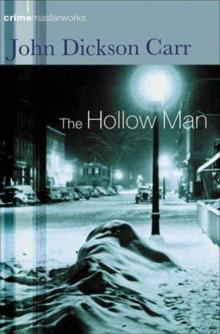
The hollow man dr gideon.., p.13
The Hollow Man (Dr Gideon Fell),
p.13


‘You must excuse me, gentlemen, for intruding so early,’ he said. ‘But I had to get it off my mind, and couldn’t feel easy until I did. I understand you were – um – looking for me last night. And I had an unpleasant night of it, I can tell you.’ He smiled. ‘My one criminal adventure was when I forgot to renew a dog license, and my guilty conscience was all over me. Every time I went out with that confounded dog I thought every policeman in London was eyeing me in a sinister way. I began to slink. So in this case I thought I’d better hunt you out. They gave me this address at Scotland Yard.’
Dr Fell was already stripping off his guest’s overcoat, with a gesture that nearly upset Mr Pettis, and hurling him into a chair. Mr Pettis grinned. He was a small, neat, starched man with a shiny bald head and a startlingly booming voice. He had prominent eyes, looking more shrewd with a wrinkle of concentration between them, a humorous mouth and a square cleft chin. It was a bony face – imaginative, ascetic, rather nervous. When he spoke he had a trick of sitting forward in his chair, clasping his hands, and frowning at the floor.
‘It’s a bad business about Grimaud,’ he said, and hesitated. ‘Naturally I’ll follow the formula of saying I wish to do everything I can to help. In this case it happens to be true.’ He smiled again. ‘Er – do you want me sitting with my face to the light, or what? Outside novels, this is my first experience with the police.’
‘Nonsense,’ said Dr Fell, introducing everybody. ‘I’ve been wanting to meet you for some time; we’ve written a few things on the same lines. What’ll you drink? Whisky? Brandy and soda?’
‘It’s rather early,’ said Pettis, doubtfully. ‘Still, if you insist – thanks! I’m very familiar with your book on the supernatural in English fiction, Doctor; you’re a great deal more popular than I shall ever be. And it’s sound.’ He frowned. ‘It’s very sound. But I don’t entirely agree with you (or Dr James) that a ghost in a story should always be malignant . . .’
‘Of course it should always be malignant. The more malignant,’ thundered Dr Fell, screwing his own face up into a tolerably hideous leer, ‘then the better. I want no sighing of gentle airs around my couch. I want no sweet whispers o’er Eden. I want BLOOD!’ He looked at Pettis in a way which seemed to give the latter an uncomfortable idea that it was his blood. ‘Harrumph. Ha. I will give you rules, sir. The ghost should be malignant. It should never speak. It should never be transparent, but solid. It should never hold the stage for long, but appear in brief vivid flashes like the poking of a face round a corner. It should never appear in too much light. It should have an old, an academic or ecclesiastical background; a flavour of cloisters or Latin manuscripts. There is an unfortunate tendency nowadays to sneer at old libraries or ancient ruins; to say that the really horrible phantom would appear in a confectioner’s shop or at a lemonade stand. This is what they call applying the “modern test.” Very well; apply the test of real life. Now, people in real life honestly have been frightened out of their five wits in old ruins or churchyards. Nobody would deny that. But, until somebody in actual life really does scream out and faint at the sight of something at a lemonade stand (other, of course, than that beverage itself), then there is nothing to be said for this theory except that it is rubbish.’
‘Some people would say,’ observed Pettis, cocking one eyebrow, ‘that the old ruins were rubbish. Don’t you believe that good ghost stories can be written nowadays?’
‘Of course they can be written nowadays, and there are more brilliant people to write ’em . . . if they would. The point is, they are afraid of the thing called Melodrama. So, if they can’t elminate the melodrama, they try to hide it by writing in such an oblique, upside-down way that nobody under heaven can understand what they are talking about. Instead of saying flat out that the character saw or heard, they try to give Impressions. It’s as though a butler, in announcing guests at a ball, were to throw open the drawing-room doors and cry: “Flicker of a top-hat, vacantly seen, or is it my complex fixed on the umbrella stand faintly gleaming?” Now, his employer might not find this satisfactory. He might want to know who in blazes was calling on him. Terror ceases to be terror if it has to be worked out like an algebra problem. It may be deplorable if a man is told a joke on Saturday night and suddenly bursts out laughing in church next morning. But it is much more deplorable if a man reads a terrifying ghost story on Saturday night, and two weeks later suddenly snaps his fingers and realizes that he ought to have been scared. Sir, I say now—’
For some time an irritated superintendent of the CID had been fuming and clearing his throat in the background. Now Hadley settled matters by slamming his fist down on the table.
‘Easy on, will you?’ he demanded. ‘We don’t want to hear any lecture now. And it’s Mr Pettis who wants to do the talking. So—’ When he saw Dr Fell’s puffings subside into a grin, he went on, smoothly, ‘As a matter of fact, it is a Saturday night I want to talk about; last night.’
‘And about a ghost?’ Pettis inquired, whimsically. Dr Fell’s outburst had put him entirely at his ease. ‘The ghost who called on poor Grimaud?’
‘Yes . . . First, just as a matter of form, I must ask you to give an account of your movements last night. Especially between, say, nine-thirty and ten-thirty?’
Pettis put down his glass. His face had grown troubled again. ‘Then you mean, Mr Hadley – after all, I am under suspicion?’
‘The ghost said he was you. Didn’t you know that?’
‘Said he was . . . Good God, no!’ cried Pettis, springing up like a bald-headed jack-in-the-box. ‘Said he was me? I mean – er – said he was – hang the grammar! I want to know what you’re talking about? What do you mean?’ He sat down quietly and stared as Hadley explained. But he fussed with his cuffs, fussed with his tie, and several times nearly interrupted.
‘Therefore, if you’ll disprove it by giving an account of your movements last night . . .’ Hadley took out his notebook.
‘Nobody told me about this last night. I was at Grimaud’s after he was shot, but nobody told me,’ said Pettis, troubled. ‘As for last night, I went to the theatre: to His Majesty’s Theatre.’
‘You can establish that, of course.’
Pettis frowned. ‘I don’t know. I sincerely hope so. I can tell you about the play, although I don’t suppose that’s much good. Oh yes; and I think I’ve still got my ticket stub somewhere, or my programme. But you’ll want to know if I met anybody I knew. Eh? No, I’m afraid not – unless I could find somebody who remembered me. I went alone. You see, every one of the few friends I have runs in a set groove. We know exactly where he is at most times, especially Saturday evenings, and we don’t try to change the orbit.’ There was a wry twinkle in his eye. ‘It’s – it’s a kind of respectable Bohemianism, not to say stodgy Bohemianism.’
‘That,’ said Hadley, ‘would interest the murderer. What are these orbits?’
‘Grimaud always works . . . excuse me; I can’t get used to the idea that he’s dead . . . always works until eleven. Afterwards you could disturb him as much as you liked; he’s a night owl; but not before. Burnaby always plays poker at his club. Mangan, who’s a sort of acolyte, is with Grimaud’s daughter. He’s with her most evenings, for that matter. I go to the theatre or the films, but not always. I’m the exception.’
‘I see. And after the theatre last night? What time did you get out?’
‘Near enough to eleven or a little past. I was restless. I thought I might drop in on Grimaud and have a drink with him. And – well, you know what happened. Mills told me. I asked to see you, or whoever was in charge. After I had waited downstairs for a long time, without anybody paying any attention to me,’ – he spoke rather snappishly – ‘I went across to the nursing-home to see how Grimaud was getting on. I got there just as he died. Now, Mr Hadley, I know this is a terrible business, but I will swear to you—’
‘Why did you ask to see me?’
‘I was at the public house when this man Fley uttered his threat, and I thought I might be of some help. Of course I supposed at the time it was Fley who had shot him; but this morning I see in the paper—’
‘Just a minute! Before we go on to that, I understand that whoever imitated you used all your tricks of address, and so on, correctly? Good! Then who in your circle (or out of it) would you suspect of being able to do that?’
‘Or wanting to do it,’ the other said, sharply.
He sat back, being careful about the knife-crease of his trousers. His nervousness was clearly giving way before the twistings of a dry, curious, insatiable brain; an abstract problem intrigued him. Putting his fingertips together, he stared out of the long windows.
‘Don’t think I’m trying to evade your question, Mr Hadley,’ he said, with an abrupt little cough. ‘Frankly, I can’t think of anybody. But this puzzle bothers me apart from the danger, in a way, to myself. If you think my ideas suffer from too much subtlety, or from too much plain damned nonsense, I’ll put it up to Dr Fell. Let’s suppose, for the sake of argument, that I am the murderer.’
He looked mockingly at Hadley, who had straightened up.
‘Hold on! I am not the murderer, but let’s suppose it. I go to kill Grimaud in some outlandish disguise (which, by the way, I would rather commit a murder than be seen wearing). Hum! I indulge in all the rest of the tomfoolery. Is it likely that, after all these things, I would blatantly sing out my real name to those young people?’
He paused, tapping his fingers.
‘That’s the first view, the short-sighted view. But the very shrewd investigator would answer: “Yes, a clever murderer might do just that. It would be the most effective way of bamboozling all the people who had jumped to the first conclusion. He changed his voice a very little, just enough so that people would remember it afterwards. He spoke as Pettis because he wanted people to think it wasn’t Pettis.” Had you thought of that?’
‘Oh yes,’ said Dr Fell, beaming broadly. ‘It was the first thing I did think of.’
Pettis nodded. ‘Then you will have thought of the answer to that, which clears me either way. If I were to do a thing like that, it isn’t my voice I should have altered slightly. If the hearers accepted it to begin with, they might not later have the doubts I wanted them to have. But,’ he said, pointing, ‘what I should have done was to make one slip in my speech. I should have said something unusual, something wrong and obviously not like myself, which later they would have remembered. And this the visitor didn’t do. His imitation was too thorough, which seems to excuse me. Whether you take the forthright view or the subtle one, I can plead not guilty either because I’m not a fool or because I am.’
Hadley laughed. His amused gaze travelled from Pettis to Dr Fell, and he could keep his worried expression no longer.
‘You two are birds of a feather,’ he said. ‘I like these gyrations. But I’ll tell you from practical experience, Mr Pettis, that a criminal who tried anything like that would find himself in the soup. The police wouldn’t stop to consider whether he was a fool or whether he wasn’t. The police would take the forthright view – and hang him.’
‘As you would hang me,’ said Pettis, ‘if you could find contributory evidence?’
‘Exactly.’
‘Well – er – that’s frank, anyhow,’ said Pettis, though he seemed acutely uneasy and startled at the reply. ‘Er – shall I go on? You’ve rather taken the wind out of my sails.’
‘Go on, certainly,’ urged the superintendent, with an affable gesture. ‘We can get ideas even from a clever man. What else have you to suggest?’
Whether or not that was a deliberate sting, it had a result nobody had expected. Pettis smiled, but his eyes had a fixed quality and his face seemed to become more bony.
‘Yes, I think you can,’ he agreed. ‘Even ideas you should have had yourselves. Let me take one instance. You – or somebody – got himself quoted at some length in all the papers this morning, about Grimaud’s murder. You showed how the murderer was careful to ensure unbroken snow for his vanishing-trick, whatever it was. He could be sure that it would snow last night, lay all his plans accordingly, and gamble on waiting until the snow stopped for the working of his scheme. In any event, he could reasonably depend on there being some snow. Is that correct?’
‘I said something of the sort, yes. What of it?’
‘Then I think you should have remembered,’ Pettis answered, evenly, ‘that the weather forecast said he could do nothing of the kind. Yesterday’s weather forecast announced that there would be no snow at all.’
‘Oh, Bacchus!’ boomed Dr Fell, and brought his fist down on the table after a pause in which he blinked at Pettis. ‘Well done! I never thought of it. Hadley, this changes things altogether! This—’
Pettis relaxed. He took out a cigarette-case and opened it. ‘Of course, there is an objection. I mean, you can make the obvious retort that the murderer knew it was bound to snow because the weather forecast said it wouldn’t. But in that case you’d be the one who took subtlety to the edge of comedy. I can’t follow it so far. Fact is, I think the weather forecast comes in for as many untrue jeers as the telephone service. It dropped a brick in this instance, yes . . . but that doesn’t matter. Don’t you believe me? Look up last night’s papers and see.’
Hadley swore, and then grinned.
‘Sorry,’ he said. ‘I didn’t mean to touch you on the raw, but I’m glad I did. Yes, it does seem to alter matters. Blast it, if a man intended to commit a crime that depended on snow, he’d certainly treat the forecast with some sort of consideration.’ Hadley drummed on the table. ‘Never mind; we’ll come back to that. I seriously ask for ideas now.’
‘That’s all, I’m afraid. Criminology is more in Burnaby’s line than in mine. I only happened to notice,’ Pettis admitted, with a jeering look at his own clothes, ‘so as to decide whether I ought to wear overshoes. Habit! . . . As to the person who imitated my voice, why try to implicate me? I’m a harmless enough old codger, I assure you. I don’t fit into the rôle of gigantic nemesis. The only reason I can think of is that I’m the only one of the group who has no definite orbit on Saturday night and might not be able to prove an alibi. But as to who could have done it . . . Any good mimic could have pulled it off; still, who knew just how I addressed those people?’
‘What about the circle at the Warwick Tavern? There were others besides the ones we’ve heard about, weren’t there?’
‘Oh yes. There were two other irregulars. But I can’t see either as a candidate. There’s old Mornington, who has had a post at the Museum for over fifty years; he’s got a cracked tenor that would never pass for me. There’s Swayle, but I believe he was speaking on the wireless last night, about ant life or something, and should have an alibi . . .’
‘Speaking at what time?’
‘Nine forty-five or thereabouts, I believe, although I wouldn’t swear to it. Besides, neither of them ever visited Grimaud’s house. – And casual drifters at the pub? Well, some may have listened or sat down at the back of the room, though nobody ever joined the conversation. I suppose that’s your best lead, even if it’s a very thin one.’ Pettis took out a cigarette and closed the case with a snap. ‘Yes. We’d better decide it was an unknown quantity, or we shall be in all kinds of quicksand, eh? Burnaby and I were Grimaud’s only close friends. But I didn’t do it, and Burnaby was playing cards.’
Hadley looked at him. ‘I suppose Mr Burnaby really was playing cards?’
‘I don’t know,’ the other admitted, with flat candour. ‘But I’ll give you odds he was, all the same. Burnaby’s no fool. And a man would have to be rather an outstanding fathead to commit a murder on the one night when his absence from a certain group would be certain to be noticed.’
Clearly this impressed the superintendent more than anything Pettis had yet said. He continued to drum on the table, scowling. Dr Fell was occupied with some obscure, cross-eyed meditation of his own. Pettis looked curiously from one to the other of them.
‘If I have given you food for thought, gentlemen—?’ he suggested, and Hadley became brisk.
‘Yes, yes! No end! Now, about Burnaby: you know he painted the picture which Dr Grimaud bought to defend himself?’
‘To defend himself? How? From what?’
‘We don’t know. I was hoping you might be able to explain it.’ Hadley studied him. ‘The taste for making cryptic remarks seems to run in his family. Do you know anything about his family, by the way?’
Pettis was evidently puzzled. ‘Well, Rosette is a very charming girl. Er – though I shouldn’t say she had a taste for making cryptic remarks. Quite the contrary. She’s a little too modern for my taste.’ His forehead wrinkled. ‘I never knew Grimaud’s wife; she’s been dead some years. But I still don’t see—’
‘Never mind. What do you think of Drayman?’
Pettis chuckled. ‘Old Hubert Drayman is the most unsuspicious man I ever met. So unsuspicious that some people think it hides a deep and devilish cunning. Excuse me, but have you got him on the carpet? If you have, I should forget it.’
‘We’ll go back to Burnaby, then. Do you know how he came to paint that picture, or when he did it, or anything about it?’
‘I think he did it a year or two ago. I remember it particularly, because it was the biggest canvas at his studio; he used it as a screen or a partition, turned up endways, whenever he needed one. I asked him once what it was intended to represent. He said, “An imaginative conception of something I never saw.” It had some French name, Dans l’Ombre des Montagnes du Sel, or something of the sort.’ He stopped tapping the still unlighted cigarette on the case. His curious, restless brain was probing again. ‘Hullo! Now that I remember it, Burnaby said, “Don’t you like it? It gave Grimaud a hell of a turn when he saw it.”’
‘Why?’