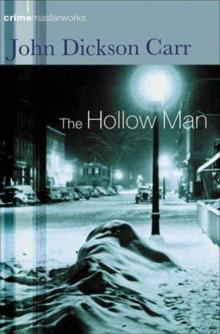
The hollow man dr gideon.., p.19
The Hollow Man (Dr Gideon Fell),
p.19


‘I will now lecture,’ announced the doctor, with amiable firmness, ‘on the general mechanics and development of that situation which is known in detective fiction as the “hermetically sealed chamber.”’
Hadley groaned. ‘Some other time,’ he suggested. ‘We don’t want to hear any lecture after this excellent lunch, and especially when there’s work to be done. Now, as I was saying a moment ago—’
‘I will now lecture,’ said Dr Fell, inexorably, ‘on the general mechanics and development of the situation which is known in detective fiction as the “hermetically sealed chamber.” Harrumph. All those opposing can skip this chapter. Harrumph. To begin with, gentlemen! Having been improving my mind with sensational fiction for the last forty years, I can say—’
‘But, if you’re going to analyze impossible situations,’ interrupted Pettis, ‘why discuss detective fiction?’
‘Because,’ said the doctor, frankly, ‘we’re in a detective story, and we don’t fool the reader by pretending we’re not. Let’s not invent elaborate excuses to drag in a discussion of detective stories. Let’s candidly glory in the noblest pursuits possible to characters in a book.
‘But to continue: In discussing ’em, gentlemen, I am not going to start an argument by attempting to lay down rules. I mean to speak solely of personal tastes and preferences. We can tamper with Kipling thus: “There are nine and sixty ways to construct a murder maze, and every single one of them is right.” Now, if I said that to me every single one of them was equally interesting, then I should be – to put the matter as civilly as possible – a cockeyed liar. But that is not the point. When I say that a story about a hermetically sealed chamber is more interesting than anything else in detective fiction, that’s merely a prejudice. I like my murders to be frequent, gory, and grotesque. I like some vividness of colour and imagination flashing out of my plot, since I cannot find a story enthralling solely on the grounds that it sounds as though it might really have happened. All these things, I admit, are happy, cheerful, rational prejudices, and entail no criticism of more tepid (or more able) work.
‘But this point must be made, because a few people who do not like the slightly lurid insist on treating their preferences as rules. They use, as a stamp of condemnation, the word “improbable.” And thereby they gull the unwary into their own belief that “improbable” simply means “bad.”
‘Now, it seems reasonable to point out that the word “improbable” is the very last which should ever be used to curse detective fiction in any case. A great part of our liking for detective fiction is based on a liking for improbability. When A is murdered, and B and C are under strong suspicion, it is improbable that the innocent-looking D can be guilty. But he is. If G has a perfect alibi, sworn to at every point by every other letter in the alphabet, it is improbable that G can have committed the crime. But he has. When the detective picks up a fleck of coal dust at the seashore, it is improbable that such an insignificant thing can have any importance. But it will. In short, you come to a point where the word “improbable” grows meaningless as a jeer. There can be no such thing as any probability until the end of the story. And then, if you wish the murder to be fastened on an unlikely person (as some of us old fogies do), you can hardly complain because he acted from motives less likely or necessarily less apparent than those of the person first suspected.
‘When the cry of “This-sort-of-thing-wouldn’t-happen!” goes up, when you complain about half-faced fiends and hooded phantoms and blond hypnotic sirens, you are merely saying, “I don’t like this sort of story.” That’s fair enough. If you do not like it, you are howlingly right to say so. But when you twist this matter of taste into a rule for judging the merit or even the probability of the story, you are merely saying, “This series of events couldn’t happen, because I shouldn’t enjoy it if it did.”
‘What would seem to be the truth of the matter? We might test it out by taking the hermetically-sealed-chamber as an example, because this situation has been under a hotter fire than any other on the grounds of being unconvincing.
‘Most people, I am delighted to say, are fond of the locked room. But – here’s the damned rub – even its friends are often dubious. I cheerfully admit that I frequently am. So, for the moment, we’ll all side together on this score and see what we can discover. Why are we dubious when we hear the explanation of the locked room? Not in the least because we are incredulous, but simply because in some vague way we are disappointed. And from that feeling it is only natural to take an unfair step farther, and call the whole business incredible or impossible or flatly ridiculous.
‘Precisely, in short,’ boomed Dr Fell, pointing his cigar, ‘what O’Rourke was telling us today about illusions that are performed in real life. Lord! gents, what chance has a story got when we even jeer at real occurrences? The very fact that they do happen, and that the illusionist gets away with it, seems to make the deception worse. When it occurs in a detective story, we call it incredible. When it happens in real life, and we are forced to credit it, we merely call the explanation disappointing. And the secret of both disappointments is the same – we expect too much.
‘You see, the effect is so magical that we somehow expect the cause to be magical also. When we see that it isn’t wizardry, we call it tomfoolery. Which is hardly fair play. The last thing we should complain about with regard to the murderer is his erratic conduct. The whole test is, can the thing be done? If so, the question of whether it would be done does not enter into it. A man escapes from a locked room – well? Since apparently he has violated the laws of nature for our entertainment, then heaven knows he is entitled to violate the laws of Probable Behaviour! If a man offers to stand on his head, we can hardly make the stipulation that he must keep his feet on the ground while he does it. Bear that in mind, gents, when you judge. Call the result uninteresting, if you like, or anything else that is a matter of personal taste. But be very careful about making the nonsensical statement that it is improbable or farfetched.’
‘All right, all right,’ said Hadley, shifting in his chair. ‘I don’t feel very strongly on the matter myself. But if you insist on lecturing – apparently with some application to this case –?’
‘Yes.’
‘Then why take the hermetically sealed room? You yourself said that Grimaud’s murder wasn’t our biggest problem. The main puzzle is the business of a man shot in the middle of an empty street . . .’
‘Oh, that?’ said Dr Fell, with such a contemptuous wave of his hand that Hadley stared at him. ‘That part of it? I knew the explanation of that as soon as I heard the church bells. – Tut, tut, such language! I’m quite serious. It’s the escape from the room that bothers me. And, to see if we can’t get a lead, I am going to outline roughly some of the various means of committing murders in locked rooms, under separate classifications. This crime belongs under one of them. It’s got to! No matter how wide the variation may be, it’s only a variation of a few central methods.
‘H’mf! Ha! Now, here is your box with one door, one window, and solid walls. In discussing ways of escaping when both door and window are sealed, I shall not mention the low (and nowadays very rare) trick of having a secret passage to a locked room. This so puts a story beyond the pale that a self-respecting author scarcely needs even to mention that there is no such thing. We don’t need to discuss minor variations of this outrage: the panel which is only large enough to admit a hand; or the plugged hole in the ceiling through which a knife is dropped, the plug replaced undetectably, and the floor of the attic above sprayed with dust so that no one seems to have walked there. This is only the same foul in miniature. The principle remains the same whether the secret opening is as small as a thimble or as big as a barn door . . . As to legitimate classification, you might jot some of these down, Mr Pettis . . .’
‘Right,’ said Pettis, who was grinning. ‘Go on.’
‘First! There is the crime committed in a hermetically sealed room which really is hermetically sealed, and from which no murderer has escaped because no murderer was actually in the room. Explanations:
It is not murder, but a series of coincidences ending in an accident which looks like murder. At an earlier time, before the room was locked, there has been a robbery, an attack, a wound, or a breaking of furniture which suggests a murder struggle. Later the victim is either accidentally killed or stunned in a locked room, and all these incidents are assumed to have taken place at the same time. In this case the means of death is usually a crack on the head – presumably by a bludgeon, but really from some piece of furniture. It may be from the corner of a table or the sharp edge of a chair, but the most popular object is an iron fender. The murderous fender, by the way, has been killing people in a way that looks like murder ever since Sherlock Holmes’ adventure with the Crooked Man. The most thoroughly satisfying solution of this type of plot, which includes a murderer, is in Gaston Leroux’s The Mystery of the Yellow Room – the best detective tale ever written.
It is murder, but the victim is impelled to kill himself or crash into an accidental death. This may be by the effect of a haunted room, by suggestion, or more usually by a gas introduced from outside the room. This gas or poison makes the victim go berserk, smash up the room as though there had been a struggle, and die of a knife-slash inflicted on himself. In other variations he drives the spike of the chandelier through his head, is hanged on a loop of wire, or even strangles himself with his own hands.
It is murder, by a mechanical device already planted in the room, and hidden undetectably in some innocent-looking piece of furniture. It may be a trap set by somebody long dead, and work either automatically or be set anew by the modern killer. It may be some fresh quirk of devilry from present-day science. We have, for instance, the gun-mechanism concealed in the telephone receiver, which fires a bullet into the victim’s head as he lifts the receiver. We have the pistol with a string to the trigger, which is pulled by the expansion of water as it freezes. We have the clock that fires a bullet when you wind it; and (clocks being popular) we have the ingenious grandfather clock which sets ringing a hideously clanging bell on its top, so that when you reach up to shut off the din your own touch releases a blade that slashes open your stomach. We have the weight that swings down from the ceiling, and the weight that crashes out on your skull from the high back of a chair. There is the bed that exhales a deadly gas when your body warms it, the poisoned needle that leaves no trace, the—
‘You see,’ said Dr Fell, stabbing out with his cigar at each point, ‘when we become involved with these mechanical devices we are rather in the sphere of the general “impossible situation” than the narrower one of the locked room. It would be possible to go on forever, even on mechanical devices for electrocuting people. A cord in front of a row of pictures is electrified. A chess-board is electrified. Even a glove is electrified. There is death in every article of furniture, including a tea-urn. But these things seem to have no present application, so we go on to:
It is suicide, which is intended to look like murder. A man stabs himself with an icicle; the icicle melts; and, no weapon being found in the locked room, murder is presumed. A man shoots himself with a gun fastened on the end of an elastic – the gun, as he releases it, being carried up out of sight into the chimney. Variations of this trick (not locked-room affairs) have been the pistol with a string attached to a weight, which is whisked over the parapet of a bridge into the water after the shot; and, in the same style, the pistol jerked out of a window into a snowdrift.
It is a murder which derives its problem from illusion and impersonation. Thus: the victim, still thought to be alive, is already lying murdered inside a room, of which the door is under observation. The murderer, either dressed as his victim or mistaken from behind for the victim, hurries in at the door. He whirls round, gets rid of his disguise, and instantly comes out of the room as himself. The illusion is that he has merely passed the other man in coming out. In any event, he has an alibi; since, when the body is discovered later, the murder is presumed to have taken place some time after the impersonated “victim” entered the room.
‘It is a murder which, although committed by somebody outside the room at the time, nevertheless seems to have been committed by somebody who must have been inside.
‘In explaining this,’ said Dr Fell, breaking off, ‘I will classify this type of murder under the general name of the Long-Distance or Icicle Crime, since it is usually a variation of that principle. I’ve spoken of icicles; you understand what I mean. The door is locked, the window too small to admit a murderer; yet the victim has apparently been stabbed from inside the room and the weapon is missing. Well, the icicle has been fired as a bullet from outside – we will not discuss whether this is practical, any more than we have discussed the mysterious gases previously mentioned – and it melts without a trace. I believe Anna Katherine Green was the first to use this trick in detective fiction, in a novel called Initials Only.
‘(By the way, she was responsible for starting a number of traditions. In her first detective novel, over fifty years ago, she founded the legend of the murderous secretary killing his employer, and I think present-day statistics would prove that the secretary is still the commonest murderer in fiction. Butlers have long gone out of fashion; the invalid in the wheel-chair is too suspect; and the placid middle-aged spinster has long ago given up homicidal mania in order to become a detective. Doctors, too, are better behaved nowadays, unless, of course, they grow eminent and turn into Mad Scientists. Lawyers, while they remain persistently crooked, are only in some cases actively dangerous. But cycles return! Edgar Allan Poe, eighty years ago, blew the gaff by calling his murderer Goodfellow; and the most popular modern mystery-writer does precisely the same thing by calling his arch-villain Goodman. Meanwhile, those secretaries are still the most dangerous people to have about the house.)
‘To continue with regard to the icicle: Its actual use has been attributed to the Medici, and in one of the admirable Fleming Stone stories an epigram of Martial is quoted to show that it had its deadly origin in Rome in the first century A.D. Well, it has been fired, thrown, or shot from a crossbow as in one adventure of Hamilton Cleek (that magnificent character of the Forty Faces). Variants of the same theme, a soluble missile, have been rock-salt bullets and even bullets made of frozen blood.
‘But it illustrates what I mean in crimes committed inside a room by somebody who was outside. There are other methods. The victim may be stabbed by a thin swordstick blade, passed between the twinings of a summer-house and withdrawn; or he may be stabbed with a blade so thin that he does not know he is hurt at all, and walks into another room before he suddenly collapses in death. Or he is lured into looking out of a window inaccessible from below; yet from above our old friend ice smashes down on his head, leaving him with a smashed skull but no weapon because the weapon has melted.
‘Under this heading (although it might equally well go under head number 3) we might list murders committed by means of poisonous snakes or insects. Snakes can be concealed not only in chests and safes, but also deftly hidden in flowerpots, books, chandeliers, and walking-sticks. I even remember one cheerful little item in which the amber stem of a pipe, grotesquely carven as a scorpion, comes to life a real scorpion as the victim is about to put it into his mouth. But for the greatest long-range murder ever committed in a locked room, gents, I commend you to one of the most brilliant short detective stories in the history of detective fiction. (In fact, it shares the honours for supreme untouchable top-notch excellence with Thomas Burke’s, The Hands of Mr Ottermole, Chesterton’s, The Man in the Passage, and Jacques Futrelle’s, The Problem of Cell 13.) This is Melville Davisson Post’s, The Doomdorf Mystery – and the long-range assassin is the sun. The sun strikes through the window of the locked room, makes a burning-glass of a bottle of Doomdorf’s own raw white wood-alcohol liquor on the table, and ignites through it the percussion cap of a gun hanging on the wall: so that the breast of the hated one is blown open as he lies in his bed. Then, again, we have . . .
‘Steady! Harrumph. Ha. I’d better not meander; I’ll round off this classification with the final heading:
This is a murder depending on an effect exactly the reverse of number 5. That is, the victim is presumed to be dead long before he actually is. The victim lies asleep (drugged but unharmed) in a locked room. Knockings on the door fail to rouse him. The murderer starts a foul-play scare; forces the door; gets in ahead and kills by stabbing or throat-cutting, while suggesting to other watchers that they have seen something they have not seen. The honour of inventing this device belongs to Israel Zangwill, and it has since been used in many forms. It has been done (usually by stabbing) on a ship, in a ruined house, in a conservatory, in an attic, and even in the open air – where the victim has first stumbled and stunned himself before the assassin bends over him. So—’
‘Steady! Wait a minute!’ interposed Hadley, pounding on the table for attention. Dr Fell, the muscles of whose eloquence were oiling up in a satisfactory way, turned agreeably and beamed on him. Hadley went on: ‘This may be all very well. You’ve dealt with all the locked-room situations—’
‘All of them?’ snorted Dr Fell, opening his eyes wide. ‘Of course I haven’t. That doesn’t even deal comprehensively with the methods under that particular classification; it’s only a rough offhand outline; but I’ll let it stand. I was going to speak of the other classification: the various means of hocussing doors and windows so that they can be locked on the inside. H’mf! Hah! So, gentlemen, I continue—’
‘Not yet you don’t,’ said the superintendent, doggedly. ‘I’ll argue the thing on your own grounds. You say we can get a lead from stating the various ways in which the stunt has been worked. You’ve stated seven points; but, applied to this case, each one must be ruled out according to your own classification-head. You head the whole list, “No murderer escaped from the room because no murderer was ever actually in it at the time of the crime.” Out goes everything! The one thing we definitely do know, unless we presume Mills and Dumont to be liars, is that the murderer really was in the room! What about that?’