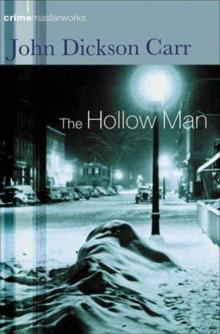
The hollow man dr gideon.., p.23
The Hollow Man (Dr Gideon Fell),
p.23


All the blinds were drawn on the house in Russell Square. It looked even more dead than yesterday, because death had come inside. And it was so quiet that even from outside they could hear the ringing of the bell when Dr Fell pressed it. After a long interval Annie, without her cap or apron, answered it. She looked pale and strained, but still calm.
‘We should like to see Madame Dumont,’ said Dr Fell.
Hadley jerked his head round to look, even though he remained impassive. Annie seemed to speak out of the darkness in the hall as she moved back.
‘She is in with the – she’s in there,’ the girl answered, and pointed towards the drawing-room door. ‘I’ll call—’ She swallowed.
Dr Fell shook his head. He moved over with surprising quietness and softly opened the drawing-room door.
The dull brown blinds were drawn, and the thick lace curtains muffled what little light filtered through. Although the room looked vaster, its furniture was lost in shadow; except for one piece of furniture, of gleaming black metal lined with white satin. It was an open coffin. Thin candles were burning around it. Of the dead face Rampole afterwards remembered that from where he stood he could see only the tip of a nose. But those candles alone, or the faint thickness of flowers and incense in the air, moved the scene weirdly from dun London to some place of crags and blasts among the Hungarian mountains: where the gold cross loomed guard against devils, and garlic wreaths kept off the prowling vampire.
Yet this was not the thing they first noticed. Ernestine Dumont stood beside the coffin, one hand gripping its edge. The high, thin candle-light above turned her greying hair to gold; it softened and subdued even the crumpled posture of her bent shoulders. When she turned her head slowly round, they saw that her eyes were sunken and smeared – though she still could not weep. Her breast heaved jerkily. Yet round her shoulders she had wound a gay, heavy, long-fringed yellow shawl, with red brocade and bead embroidery that burnt with a shifting glitter under the light. It was the last touch of the barbaric.
And then she saw them. Both hands suddenly gripped the edge of the coffin, as though she would shield the dead. She remained a silhouette, one hand outspread on either side, under the unsteady candles.
‘It will do you good, madame, to confess,’ said Dr Fell, very gently. ‘Believe me, it will do you good.’
For a second Rampole thought she had stopped breathing, so easy was every motion to follow in the unearthliness of that light. Then she made a sound as though she were half-coughing, which is only grief before it becomes hysterical mirth.
‘Confess?’ she said. ‘So that is what you think, all you fools? Well, I do not care. Confess! Confess to murder?’
‘No,’ said Dr Fell.
His voice, in that one quiet monosyllable, had a heavy note across the room. And now she stared at him, and now for the first time she began to stare with fright as he moved across towards her.
‘No,’ said Dr Fell. ‘You are not the murderer. Let me tell you what you are.’
Now he towered over her, black against the candle-light, but he still spoke gently.
‘Yesterday, you see, a man named O’Rourke told us several things. Among them was the fact that most illusions either on or off the stage are worked with the aid of a confederate. This was no exception. You were the confederate of the illusionist and murderer.’
‘The hollow man,’ said Ernestine Dumont, and suddenly began to laugh hysterically.
‘The hollow man,’ said Dr Fell, and turned quietly to Hadley, ‘in a real sense. The hollow man whose naming was a terrible and an ironic jest, even if we did not know it, because it was the exact truth. That is the horror and in a way the shame. Do you want to see the murderer you have been hunting all through this case? – The murderer lies there,’ said Dr Fell, ‘but God forbid that we should judge him now.’
And with a slow gesture he pointed to the white, dead, tight-lipped face of Dr Charles Grimaud.
XX The Two Bullets
Dr Fell continued to look steadily at the woman, who had again shrunk against the side of the coffin as though to defend it.
‘Ma’am,’ he went on, ‘the man you loved is dead. He is beyond the reach of the law now, and, whatever he has done, he has paid for it. Our immediate problem, yours and mine, is to hush this thing up so that the living may not be hurt. But, you see, you are implicated, even though you took no actual hand in the murder. Believe me, ma’am, if I could have explained the whole thing without bringing you into it at all, I should have done so. I know you have suffered. But you will see for yourself that such a course was impossible if I were to explain the entire problem. So we must persuade Superintendent Hadley that this affair must be hushed up.’
Something in his voice, something of the unweary, unchanging, limitless compassion that was Gideon Fell, seemed to touch her as gently as sleep after tears. Her hysteria had gone.
‘Do you know?’ she asked him, after a pause, and almost eagerly. ‘Do not fool me! Do you really know?’
‘Yes, I really know.’
‘Go upstairs. Go to his room,’ she said in a dull voice, ‘and I will join you presently. I – I cannot face you just now. I must think, and—But please do not speak to anybody until I come. Please! No, I will not run away.’
Dr Fell’s fierce gesture silenced Hadley as they went out. Still in silence they tramped up the gloomy stairs to the top floor. They passed no one, they saw no one. Once more they came into the study, where it was so dark that Hadley switched on the mosaic lamp at the desk. After he had made sure the door was closed, Hadley turned round rather wildly.
‘Are you trying to tell me that Grimaud killed Fley?’ he demanded.
‘Yes.’
‘While he was lying unconscious and dying under the eyes of witnesses in a nursing-home, he went to Cagliostro Street and I—!’
‘Not then,’ said Dr Fell quietly. ‘You see, that’s what you don’t understand. That’s what’s led you wrong. That’s what I meant by saying that the case had been turned not upside down, but the wrong way round. Fley was killed before Grimaud. And, worst of all, Grimaud was trying to tell us the exact, literal truth. He did tell us the exact truth, when he knew he was dying beyond hope – it’s one of the good gleams in him – but we chose to misinterpret it. Sit down, and I’ll see if I can explain it. Once you have grasped the three essential points, you will need no deduction and very little elucidation from me. The thing will explain itself.’
He lowered himself, wheezing, into the chair behind the desk. For a little time he remained staring vacantly at the lamp. Then he went on:
‘The three essential points, then, are these. (1) There is no brother Henri; there are only two brothers. (2) Both these brothers were speaking the truth. (3) A question of time has turned the case wrong way round.
‘Many things in this case have turned on a matter of brief spaces of time, and how brief they are. It’s a part of the same irony which described our murderer as the hollow man that the crux of the case should be a matter of mistaken time. You can easily spot it if you think back.
‘Now remember yesterday morning! I already had some occasion to believe there was something queer about that business in Cagliostro Street. The shooting there, we were told by three (truthful) witnesses who agreed precisely and to a second, took place at just ten twenty-five. I wondered, in an idle sort of way, why they corroborated each other with such startling exactitude. In the case of the usual street accident, even the most cool witnesses don’t usually take such notice, or are careful to consult their watches, or (even if they do) agree about the time with such uncanny precision. But they were truthful people, and there must have been some reason for their exactitude. The time must have been thrust on them.
‘Of course there was a reason. Just across from where the murdered man fell there was a lighted show-window – the only lighted window thereabouts – of a jeweller’s shop. It was the most noticeable thing in the foreground. It illuminated the murdered man; it was the first place to which the constable rushed in search of the murderer; it quite naturally focused their attention. And, facing them from that window, there was an enormous clock of such unusual design that it immediately took the eye. It was inevitable that the constable should look for the time, and natural that the others should also. Hence their agreement.
‘But one thing, not apparently important at that time, bothered me a little. After Grimaud was shot, Hadley summoned his men to this house, and instantly despatched one of them to pick up Fley as a suspect. Now, then, those men arrived here . . . about what time?’
‘About ten-forty,’ said Rampole, ‘according to a rough calculation. I’ve got it in my time-table.’
‘And,’ said Dr Fell, ‘a man was sent immediately to get Fley. This man must have arrived in Cagliostro Street – when? Between fifteen and twenty minutes after Fley was presumed to have been killed. But in the space of that brief time what has happened? An incredible number of things! Fley has been carried down to the doctor’s house, he has died, an examination has been made, a fruitless effort undertaken to identify Fley; and then, “after some delay” in the words of the newspaper account, the van is sent for and Fley removed to the mortuary. All this! For, when Hadley’s detective arrived in Cagliostro Street to pick up Fley, he found the whole business finished – and the constable back making inquiries from door to door. The entire excitement had died down. Which seemed incredible.
‘Unfortunately, I was so dense that I didn’t see the significance of this even yesterday morning when I saw the clock in the jeweller’s window.
‘Think back once more. Yesterday morning we had breakfast at my house; Pettis dropped in, and we talked to him – until what time?’
There was a pause.
‘Until exactly ten o’clock,’ Hadley answered, suddenly, and snapped his fingers. ‘Yes! I remember, because Big Ben was striking just as he got up to go.’
‘Quite right. He left us, and afterwards we put on our hats and coats and drove straight to Cagliostro Street. Now, allow any reasonable margin of time you like for our putting on our hats, going downstairs, driving a short distance on deserted roads Sunday morning – a drive that took us only ten minutes when there was Saturday-night traffic. I think you’ll say the whole process can hardly have taken twenty minutes in all . . . But in Cagliostro Street you showed me the jeweller’s shop, and that fancy clock was just striking eleven.
‘Even then in my musing density it never occurred to me to look at that clock and wonder, just as in their excitement it never occurred to the three witnesses last night. Just afterwards, you recall, Somers and O’Rourke summoned us up to Burnaby’s flat. We made quite a long investigation, and then had a talk with O’Rourke. And while O’Rourke was speaking, I noticed that the earlier dead quiet of the day – the quiet when in the street we heard only the wind – had a new sound. I heard church bells.
‘Well, what time do church bells begin to ring? Not after eleven o’clock; the service has begun. Usually before eleven, for a preparatory bell. But, if I accepted the evidence of that German clock, it must then be a very long time past eleven o’clock. Then my dull mind woke up. I remembered Big Ben and our drive to Cagliostro Street. The combination of those bells and Big Ben – against (hem!) a trumpery foreign clock. Church and State, so to speak, couldn’t both be wrong . . . In other words, the clock in that jeweller’s window was more than forty minutes fast. Hence the shooting in Cagliostro Street the night before could not have taken place at twenty-five minutes past ten. Actually it must have taken place a short time previous to a quarter to ten. Say, roughly, at nine-forty.
‘Now, sooner or later somebody would have noticed this; maybe somebody has noticed it already. A thing like that would be bound to come out in a coroner’s court. Somebody would come forward to dispute the right time. Whether you’d have instantly seen the truth then (as I hope), or whether it would have confused you even more, I don’t know . . . But the solid fact remains that the affair in Cagliostro Street took place some minutes before the man in the false face rang the bell of this house at nine forty-five.’
‘But I still don’t see—!’ protested Hadley.
‘The impossible situation? No; but I have a clear course now to tell you the whole story from the beginning.’
‘Yes, but let me get this straightened out. If Grimaud, as you say, shot Fley in Cagliostro Street just before nine forty-five—’
‘I didn’t say that,’ said Dr Fell.
‘What?’
‘You’ll understand if you follow my patient elucidation from the beginning. On Wednesday night of last week – when Fley first appeared out of the past, apparently out of his grave, to confront his brother with rather a terrible threat at the Warwick Tavern – Grimaud resolved to kill him. In the whole case, you see, Grimaud was the only person with a motive for killing Fley. And, my God! Hadley, but he did have a motive! He was safe, he was rich, he was respected; the past was buried. And then, all of a sudden, a door blows open to admit this thin grinning stranger who is his brother Pierre. Grimaud, in escaping from prison, had murdered one of his brothers by leaving him buried alive; he would have murdered the other except for an accident. He could still be extradited and hanged – and Pierre Fley had traced him.
‘Now, bear in mind exactly what Fley said when he suddenly flew in to confront Grimaud that night at the tavern. Study why he said and did certain things, and you will see that even shaky-minded Fley was very far from being as mad as he liked to pretend. Why, if he were intent merely on private vengeance, did he choose to confront Grimaud in the presence of a circle of friends and speak in just the innuendoes he used? He used his dead brother as a threat; and it was the only time he did speak of that dead brother. Why did he say, “He can be much more dangerous to you than I can”? Because the dead brother could hang Grimaud! Why did he say, “I don’t want your life; he does”? Why did he say, “Shall I have him call on you”? And then why, just afterwards, did he hand Grimaud his card on which his own address was carefully written? The giving of that card, combined with his words and later actions, is significant. What Fley really meant, veiled so that he could throw a scare into Grimaud before witnesses, was just this: “You, my brother, are fat and rich on the proceeds of a robbery we both committed when we were young. I am poor – and I hate my work. Now will you come and call on me at my address, so that we can arrange this matter, or shall I set the police on you?”’
‘Blackmail,’ said Hadley, softly.
‘Yes. Fley had a bee in his bonnet, but Fley was far from being a fool. Now mark how he twisted round his meaning in his last threatening words to Grimaud. “I also am in danger when I associate with my brother, but I am prepared to run that risk.” And in that case, as always afterwards, he was referring in strict truth to Grimaud. “You, my brother, might also kill me as you killed the other, but I will risk it. So shall I call on you amiably, or will my other dead brother come to hang you?”
‘For think of his behaviour afterwards, on the night of his murder. Remember the glee he had of smashing up and getting rid of his illusion-properties? And what words did he use to O’Rourke? Words which, if you look at them squarely in the light of what we now know, can have only one explanation. He said:
‘“I shall not need them again. My work is finished. Didn’t I tell you? I am going to see my brother. He will do something that will settle an old affair for both of us.”
‘Meaning, of course, that Grimaud had agreed to come to terms. Fley meant that he was leaving his old life for good; going back to his grave as a dead man with plenty of money; but he couldn’t be more specific without blowing the gaff. Still, he knew that his brother was tricky; he’d had good reason in the past to know it. He couldn’t leave behind him a big warning when he spoke with O’Rourke, in case Grimaud really meant to pay; but he threw out a hint:
‘“In case anything happens to me, you will find my brother in the same street where I myself live. That is not where he really resides, but he has a room there.”
‘I’ll explain that last statement in just a moment. But go back to Grimaud. Now, Grimaud never had any intention of coming to terms with Fley. Fley was going to die. That wily, shrewd, theatrical mind of Grimaud’s (who, as you know, was more interested in magical illusions than anybody else we have met) was determined not to suffer any nonsense from this inconvenient brother of his. Fley must die – but this was more difficult than it looked.
‘If Fley had come to him in private, without anybody in the world ever being able to associate Fley’s name with his, it would have been simple. But Fley had been too shrewd for that. He had blazoned forth his own name and address, and hinted at mysterious secrets concerning Grimaud, before a group of Grimaud’s friends. Awkward! Now if Fley is found obviously murdered, somebody is likely to say, “Hullo! Isn’t that the same chap who—?” And then presently there may be dangerous enquiries; because Lord knows what Fley may have told other people about Grimaud. The only thing he isn’t likely to have confided to somebody else is his last deadly hold over Grimaud; and that is the thing about which he must be silenced. Whatever happens to Fley, however he dies, there are likely to be enquiries concerning Grimaud. The only thing to do is frankly to pretend that Fley is after his life; to send himself threatening letters (not too obviously); to stir up the household in an ingenious way; finally, to inform everybody that Fley has threatened to call on him on the night he himself intends to call on Fley. You will see very shortly just how he planned to work out a very brilliant murder.
‘The effect he intended to produce was this: The murderous Fley should be seen calling on him on Saturday night. There should be witnesses to this. The two should be together alone when Fley goes into his study. A row is heard, the sound of a fight, a shot, and a fall. The door being opened, Grimaud should be found alone – a nasty-looking but superficial wound from a bullet scratched along his side. No weapon is there. Out of the window hangs a rope belonging to Fley, by which Fley is assumed to have escaped. (Remember, it had been predicted that there would be no snow that night, so it would have been impossible to trace footprints.) Grimaud says: “He thought he killed me; I pretended to be dead; and he escaped. No, don’t set the police on him, poor devil. I’m not hurt.” – And the next morning Fley would have been found dead in his own room. He would have been found, a suicide, having pressed his own gun against his chest and pulled the trigger. The gun is beside him. A suicide note lies on the table. In despair at thinking he has killed Grimaud, he has shot himself . . . That, gentlemen, was the illusion Grimaud intended to produce.’