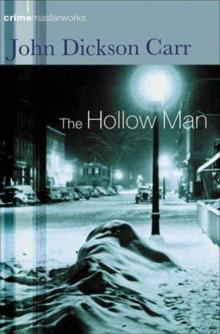
The hollow man dr gideon.., p.26
The Hollow Man (Dr Gideon Fell),
p.26


‘Mangan, unfortunately, spotted it. The watchful Dumont knew that he spotted it, and whisked it out of that cupboard to a safer place as soon as he went away. She, naturally, never saw a yellow tweed coat hanging there at all. Grimaud had it upstairs here with him, ready for his expedition. But it was found in the closet yesterday afternoon, and she had to pretend it had been there all the time. Hence the chameleon overcoat.
‘You can now make a reconstruction of just what happened when Grimaud, after killing Fley and getting a bullet himself, returned to the house on Saturday night. Right at the start of the illusion he and his confederate were in dangerous trouble. You see, Grimaud was late. He’d expected to be back by nine-thirty – and he didn’t get there until a quarter to ten. The longer he delayed, the nearer it got to the time he had told Mangan to expect a visitor, and now Mangan would be expecting the visitor he had been told to watch. It was touch-and-go, and I rather imagine the cool Grimaud was fairly close to insane. He got up through the basement entrance, where his confederate was waiting. The tweed coat, with the blood inside it, went into the hall closet to be disposed of presently – and it never was, because he died. Dumont eased open the door, rang the bell by putting her hand out, and then went to “answer” it while Grimaud was getting ready with his uniform.
‘But they delayed too long. Mangan called out. Grimaud, with his wits still not functioning well, grew a little panicky and made a blunder to ward off immediate detection. He’d got so far; he didn’t want to fail then from the nosiness of a damned penniless kid. So he said that he was Pettis, and locked them in. (You notice that Pettis is the only one with a voice of the same bass quality as Grimaud’s?) Yes, it was a spur-of-the-moment error, but his only wish was to writhe like a footballer down a field and somehow escape those hands for the moment.
‘The illusion was performed; he was alone in his room. His jacket, probably with blood on that, had been taken in charge by Dumont; he wore the uniform over his shirt-sleeves, open shirt, and bandaged wound. He had only to lock the door behind him, put on his real dressing-gown, destroy the paper uniform, and get that mirror up into the chimney . . .
‘That, I say again, was the finish. The blood had begun to flow again, you see. No ordinary man, wounded, could have stood the strain under which he had already been. He wasn’t killed by Fley’s bullet. He ripped his own lung like a rotted piece of rubber when he tried to – and superhumanly did – lift that mirror into its hiding-place. That was when he knew. Then was when he began to bleed from the mouth like a slashed artery; when he staggered against the couch, knocked away the chair, and reeled forward in his last successful effort to ignite the firecracker. After all the hates and dodgings and plans, the world was not spinning in front of him: it was only slowly going black. He tried to scream out, and he could not, for the blood was welling in his throat. And at that moment Charles Grimaud suddenly knew what he would never have believed possible, the breaking of the last and most shattering mirror-illusion in his bitter life . . .’
‘Well?’
‘He knew that he was dying,’ said Dr Fell. ‘And, stranger than any of his dreams, he was glad.’
The heavy leaden light had begun to darken again with snow. Dr Fell’s voice sounded weirdly in the chill room. Then they saw that the door was opening and that in it stood the figure of a woman with a damned face. A damned face and a black dress, but round her shoulders was still drawn a red-and-yellow shawl for love of the dead.
‘You see, he confessed,’ Dr Fell said in the same low, monotonous tone, ‘he tried to tell us the truth about his killing of Fley, and Fley’s killing of him. Only we did not choose to understand, and I didn’t understand until I knew from the clock what must have happened in Cagliostro Street. Man, man, don’t you see? Take first his final statement, the statement made just before he died:
‘“It was my brother who did it. I never thought he would shoot. God knows how he got out of that room—”’
‘You mean Fley’s room in Cagliostro Street, after Fley had been left for dead?’ demanded Hadley.
‘Yes. And the horrible shock of coming on him suddenly, as Grimaud opened the door under the street light. You see:
‘“One second he was there, and the next he wasn’t . . . I want to tell you who my brother is, so you won’t think I’m raving . . .”
‘For, of course, he did not think anybody knew about Fley. Now, in the light of that, examine the tangled, muddled, half-choked words with which – when he heard the statement that he was sinking – he tried to explain the whole puzzle to us.
‘First he tried to tell us about the Horváths and the salt-mine. But he went on to the killing of Fley, and what Fley had done to him. “Not suicide.” When he’d seen Fley in the street, he couldn’t make Fley’s death the suicide he pretended. “He couldn’t use rope.” Fley couldn’t, after that, be supposed to use the rope that Grimaud had discarded as useless. “Roof.” Grimaud did not mean this roof; but the other roof which he crossed when he left Fley’s room. “Snow.” The snow had stopped and wrecked his plans. “Too much light.” There’s the crux, Hadley! When he looked out into the street, there was too much light from the street lamp; Fley recognized him, and fired. “Got gun.” Naturally, Fley had got the gun then. “Fox.” The mask, the Guy Fawkes charade he tried to work. But finally, “Don’t blame poor—” Not Drayman; he didn’t mean Drayman. But it was a last apology for the one thing, I think, of which he was ashamed; the one piece of imposture he would never have done. “Don’t blame poor Pettis; I didn’t mean to implicate him.”’
For a long time nobody spoke.
‘Yes,’ Hadley agreed, dully. ‘Yes. All except one thing. What about the slashing of that picture, and where did the knife go?’
‘The slashing of the picture, I think, was an extra touch of the picturesque to help the illusion; Grimaud did it – or so I imagine. As for the knife, I frankly don’t know. Grimaud probably had it here, and put it up the chimney beside the mirror so that the invisible man should seem to be doubly armed. But it isn’t on the chimney ledge now. I should suppose that Drayman found it yesterday, and took it away—’
‘That is the one point,’ said a voice, ‘on which you are wrong.’
Ernestine Dumont remained in the doorway, her hands folded across the shawl at her breast. But she was smiling.
‘I have heard everything you said,’ she went on. ‘Perhaps you can hang me, or perhaps not. That is not important. I do know that after so many years it is not quite worth while going on without Charles . . . I took the knife, my friend. I had another use for it.’
She was still smiling, and there was a blaze of pride in her eyes. Rampole saw what her hands were hiding. He saw her totter suddenly, but he was too late to catch her when she pitched forward on her face. Dr Fell lumbered out of his chair and remained staring at her with a face as white as her own.
‘I have committed another crime, Hadley,’ he said. ‘I have guessed the truth again.’
About the Author
John Dickson Carr was born in Uniontown, Pennsylvania, in 1906. It Walks by Night, his first published detective novel, featuring the Frenchman Henri Bencolin, was published in 1930. Apart from Dr Fell, whose first appearance was in Hag’s Nook in 1933, Carr’s other series detectives (published under the nom de plume of Carter Dickson) were the barrister Sir Henry Merrivale, who debuted in The Plague Court Murders (1934), and Colonel March of the Department of Queer Complaints. Until the end of World War 2 Carr averaged four books a year. He died in 1977.
Also by John Dickson Carr
The Dr Fell Series
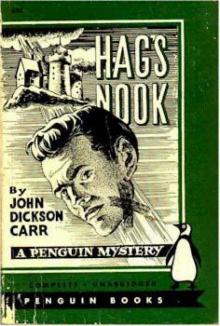
HAG’S NOOK
THE MAD HATTER MYSTERY
THE EIGHT OF SWORDS
THE BLIND BARBER
DEATH WATCH
THE ARABIAN NIGHTS MURDER
TO WAKE THE DEAD
THE CROOKED HINGE
THE PROBLEM OF THE GREEN CAPSULE
THE PROBLEM OF THE WIRE CAGE
THE MAN WHO COULD NOT SHUDDER
THE CASE OF THE CONSTANT SUICIDES
DEATH TURNS THE TABLES
TILL DEATH DO US PART
HE WHO WHISPERS
THE SLEEPING SPHINX
DR FELL, DETECTIVE
BELOW SUSPICION
THE DEAD MAN’S KNOCK
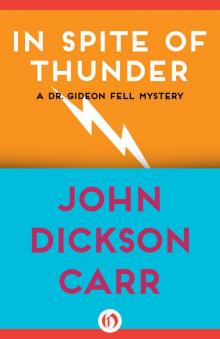
IN SPITE OF THUNDER
THE HOUSE AT SATAN’S ELBOW
PANIC IN BOX C
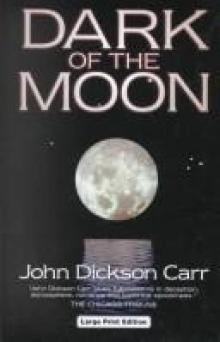
DARK OF THE MOON
FELL AND FOUL PLAY
Copyright
AN ORION EBOOK
First published in Great Britain in 1935 by Hamish Hamilton.
First published in ebook in 2012 by Orion Books.
Copyright © John Dickson Carr 1935, 1955
The moral right of John Dickson Carr to be identified as the author of this work has been asserted in accordance with the Copyright, Designs and Patents Act 1988.
All rights reserved. No part of this publication may be reproduced, stored in a retrieval system or transmitted in any form or by any means without the prior permission in writing of the publisher, nor be otherwise circulated in any form of binding or cover other than that in which it is published without a similar condition, including this condition, being imposed on the subsequent purchaser.
A CIP catalogue record for this book is available from the British Library.
ISBN: 978 1 4091 2936 3
Orion Books
The Orion Publishing Group Ltd
Orion House
5 Upper St Martin’s Lane
London WC2H 9EA
An Hachette UK Company
www.orionbooks.co.uk
John Dickson Carr, The Hollow Man (Dr Gideon Fell)