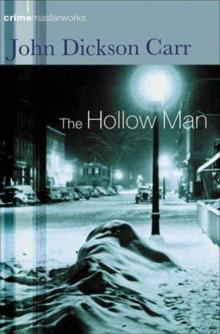
The hollow man dr gideon.., p.21
The Hollow Man (Dr Gideon Fell),
p.21


The study was dusky. Despite the few snowflakes, some faint lurid light, dull red-and-orange with sunset, glimmered through the window. It made a stormy glow across the room; it kindled the colours of the shield of arms, glittered on the crossed fencing-foils above the fireplace, and made vast and shadowy the white busts on the bookshelves. The shape of Charles Grimaud, half-studious, half-barbaric like the room, seemed to move and chuckle here after Charles Grimaud was dead. That vast blank space in the panelled wall, where the picture was to have hung, faced Rampole in mockery. And, standing motionless in his black cloak before the window, Dr Fell leaned on his cane and stared out into the sunset.
The creaking of the door did not rouse him. Rampole, his voice seeming to make echoes, said:
‘Did you—?’
Dr Fell blinked round. His breath, when he puffed it out with a sort of weary explosiveness, turned to smoke in the sharp air.
‘Eh? Oh! Did I what?’
‘Find anything.’
‘Well, I think I know the truth. I think I know the truth,’ he answered, with a sort of reflective stubbornness, ‘and tonight I shall probably be able to prove it. H’mf. Hah. Yes. D’ye see, I’ve been standing here wondering what to do about it. It’s the old problem, son, and it becomes more difficult each year I live: when the sky grows nobler, and the old chair more comfortable, and maybe the human heart—’ He brushed his hand across his forehead. ‘What is justice? I’ve asked it at the end of nearly every case I ever handled. I see faces rise, and sick souls and bad dreams . . . No matter. Shall we go downstairs?’
‘But what about the fireplace?’ insisted Rampole. He went over, peered at it, hammered it, and still he could see nothing out of the way. A little soot had been scattered on the hearth, and there was a crooked streak in the coating of soot on the back of the fireplace. ‘What’s wrong with it? Is there a secret passage, after all?’
‘Oh no. There’s nothing wrong with it in the way you mean. Nobody got up there. No,’ he added, as Rampole put his hand into the long opening of the flue and groped round. ‘I’m afraid you’re wasting your time; there’s nothing up there to find.’
‘But,’ said Rampole, desperately, ‘if this brother Henri—’
‘Yes,’ said a heavy voice from the doorway, ‘brother Henri.’
The voice was so unlike Hadley’s that at the moment they did not recognize it. Hadley stood in the doorway, a sheet of paper crumpled in his hand; his face was in shadow, but there was such a dull quietness in his tones that Rampole recognized something like despair. Closing the door softly behind him, Hadley stood in the darkening and went on calmly:
‘It was our own fault, I know, for being hypnotized by a theory. It ran away with us – and now we’ve got to start the whole case afresh. Fell, when you said this morning that the case had been turned upside down, I don’t believe you knew just how true it was. It’s not only upside down; it’s nonexistent. Our chief prop is knocked to blazes. Damn the rotten, impossible . . .’ He stared at the sheet of paper as though he meant to crush it into a ball. ‘A phone-call just came through from the Yard. They’ve heard from Bucharest.’
‘I’m afraid I know what you’re going to say,’ Dr Fell nodded. ‘You’re going to say that brother Henri—’
‘There is no brother Henri,’ said Hadley. ‘The third of the three Horváth brothers died over thirty years ago.’
The faint reddish light had grown muddy; in the cold, quiet study they could hear from far away the mutter of London awaking towards nightfall. Walking over to the broad desk, Hadley spread out the crumpled sheet on the desk so that the others could read. The shadow of the yellow jade buffalo lay across it sardonically. Across the room they could see the slashes gaping in the picture of the three graves.
‘There’s no possibility of a mistake,’ Hadley went on. ‘The case is a very well-known one, it seems. The whole cablegram they sent was very long, but I’ve copied the important parts verbatim from what they read over the phone. Take a look.’
No difficulty about information desired [it ran]. Two men now in my personal service were at Siebenturmen as warders in 1900, and confirm record. Facts: Kaŕoly Grimaud Horváth, Pierre Fley Horváth, and Nicholas Revéi Horváth were sons of Professor Kaŕoly Horváth (of Klausenburg University) and Cecile Fley Horváth (French) his wife. For robbery of Kunar Bank at Brasso, November, 1898, the three brothers were sentenced, January, 1899, to twenty years’ penal servitude. Bank watchman died of injuries inflicted, and loot never recovered; believed to have been hidden. All three, with aid of prison doctor during plague scare of August, 1900, made daring attempt at escape by being certified as dead, and buried in plague-ground. J. Lahner and R. Görgei, warders, returning to graves an hour later with wooden crosses for marking, noticed disturbance had taken place on earth at grave of Kaŕoly Horváth. Investigation showed coffin open and empty. Digging into other two graves, warders found Pierre Horváth bloody and insensible, but still alive. Nicholas Horváth had already suffocated to death. Nicholas reburied after absolute certainty made the man was dead; Pierre returned to prison. Scandal hushed up, no chase of fugitive, and story never discovered until end of war. Pierre Fley Horváth never mentally responsible afterwards. Released January, 1919, having served full term. Assure you no doubt whatever third brother dead.
Alexander Cuza, Policedirector, Bucharest.
‘Oh yes,’ said Hadley, when they had finished reading. ‘It confirms the reconstruction right enough, except for the little point that we’ve been chasing a ghost as the murderer. Brother Henri (or brother Nicholas, to be exact) never did leave his grave. He’s there yet. And the whole case . . .’
Dr Fell rapped his knuckles slowly on the paper.
‘It’s my fault, Hadley,’ he admitted. ‘I told you this morning that I’d come close to making the biggest mistake of my life. I was hypnotized by brother Henri! I couldn’t think of anything else. You see now why we knew so remarkably little about that third brother, so little that with my cursed cocksuredness I put all kinds of fantastic interpretations on it?’
‘Well, it won’t do us any good just to admit the mistake. How the devil are we going to explain all those crazy remarks of Fley’s now? Private vendetta! Vengeance! Now that that’s swept away, we haven’t a lead to work on. Not one lead! And, if you exclude the motive of vengeance on Grimaud and Fley, what is there left?’
Dr Fell pointed rather malevolently with his stick.
‘Don’t you see what’s left?’ he roared. ‘Don’t you see the explanation of those two murders that we’ve got to accept now or retire to the madhouse?’
‘You mean that somebody cooked up the whole thing to make it look like the work of an avenger? – I’m at the state now,’ explained the superintendent, ‘where I could believe nearly anything. But that strikes me as being a good bit too subtle. How would the real murderer ever know we could dig so far into the past? We’d never have done it if it hadn’t been, saving your presence, for a few lucky shots. How would the real murderer know we should ever connect Professor Grimaud with a Hungarian criminal, or connect him with Fley or any of the rest of it? It strikes me as a false trail far too well concealed.’ He paced up and down, driving his fist into his palm. ‘Besides, the more I think of it the more confusing it gets! We had damned good reason to think it was the third brother who killed those two . . . and, the more I think of that possibility, the more I’m inclined to doubt that Nicholas is dead. Grimaud said his third brother shot him! – and when a man’s dying, and knows he’s dying, what earthly reason would he have for lying? Or . . . Stop a bit! Do you suppose he might have meant Fley? Do you suppose Fley came here, shot Grimaud, and then afterwards somebody else shot Fley? It would explain a lot of the puzzles—’
‘But,’ said Rampole, ‘excuse the interruption, I mean, but it wouldn’t explain why Fley kept talking about a third brother as well! Either brother Henri is dead or he isn’t. Still, if he is dead, what reason have both victims got to lie about him all the time? If he’s really dead, he must be one hell of a live ghost.’
Hadley shook the briefcase. ‘I know. That’s exactly what I’m kicking about! We’ve got to take somebody’s word for it, and it seems more reasonable to take the word of two people who were shot by him, rather than this cablegram which might be influenced or mistaken for several reasons. Or – h’m! Suppose he really is dead, but the murderer is pretending to be that dead brother come to life?’ He stopped, nodded, and stared out of the window. ‘Now I think we’re getting warm. That would explain all the inconsistencies, wouldn’t it? The real murderer assumes the rôle of a man neither of the other brothers has seen for nearly thirty years; well? When the murders are committed, and we get on his track – if we do get on his track – we put it all down to vengeance. How’s that, Fell?’
Dr Fell, scowling heavily, stumped round the table.
‘Not bad . . . no, not bad, as a disguise. But what about the motive for which Grimaud and Fley were really killed?’
‘How do you mean?’
‘There has to be a connecting thread, hasn’t there? There might be any number of motives, plain or obscure, why a person would kill Grimaud. Mills or Dumont or Burnaby or – yes, anybody might have killed Grimaud. Also, anybody might have killed Fley: but not, I must point out, anybody in the same circle or group of people. Why should Fley be killed by a member of Grimaud’s group, none of whom had presumably ever seen him before? If these murders are the work of one person, where is the connecting link? A respected professor in Bloomsbury and a tramp actor with a prison record. Where’s the human motive that ties those two together in the murderer’s mind, unless it is a link that goes back into the past?’
‘I can think of one person who is associated with both from the past,’ Hadley pointed out.
‘Who? You mean the Dumont woman?’
‘Yes.’
‘Then what becomes of somebody impersonating brother Henri? Whatever else you decide on, you must decide that she’s not doing that. No, my lad. Dumont is not only a bad suspect; she’s an impossible suspect.’
‘I don’t see that. Look here, you’re basing your whole belief that Dumont didn’t kill Grimaud on the grounds that you think she loved Grimaud. No defence, Fell – no defence at all! Remember that she told the whole fantastic story to begin with . . .’
‘In coöperation with – Mills,’ boomed Dr Fell, with a sardonic leer. He was puffing again. ‘Can you think of any two less likely conspirators to band together at the dark of the moon and hoodwink the police with their imaginative fairy-tales? She might wear a mask; I mean a figurative mask in life. Mills might wear a mask. But the combination of those two masks, and their activities, is too much. I prefer the one literal false face. Besides, bear in mind that as the double killer Ernestine D. is absolutely O-U-T. Why? Because, at the time of Fley’s death sworn to by three good men and true, she was here in this room, talking to us.’ He pondered, and a twinkle began to appear in his eye. ‘Or will you drag in the second generation? Rosette is Grimaud’s daughter; suppose the mysterious Stuart Mills is really the son of the dead brother Henri?’
About to reply, Hadley checked himself and studied Dr Fell. He sat down on the edge of the desk.
‘I know this mood. I know it very well,’ he asserted, with the air of one who confirms a sinister suspicion. ‘It’s the beginning of some more blasted mystification, and there’s no use arguing with you now. Why are you so anxious for me to believe the story?’
‘First,’ said Dr Fell, ‘because I wish to force it into your head that Mills told the truth . . .’
‘You mean, as a point in the mystification, in order to prove later that he didn’t? The sort of low trick you played me in that Death Watch case?’
The doctor ignored this with a testy grunt. ‘And, second, because I know the real murderer.’
‘Who is somebody we’ve seen and talked to?’
‘Oh yes; very much so.’
‘And have we got a chance of—?’
Dr Fell, an absent, fierce, almost pitying expression on his red face, stared for some time at the desk.
‘Yes, Lord help us all,’ he said, in a curious tone, ‘I suppose you’ve got to. In the meantime, I’m going home . . .’
‘Home?’
‘To apply Gross’s test,’ said Dr Fell.
He turned away, but he did not immediately go. As the muddy light deepened to purple, and dust-coloured shadows swallowed up the room, he remained for a long time staring at the slashed picture which caught the last glow with its turbulent power, and the three coffins that were filled at last.
XIX The Hollow Man
That night Dr Fell shut himself up in the small cubbyhole off the library which was reserved for what he called his scientific experiments and what Mrs Fell called ‘that horrible messing about.’ Now, a liking for messing about is one of the best of human traits, and Rampole and Dorothy both offered to assist. But the doctor was so serious, and so unwontedly troubled, that they left off with an uncomfortable feeling that to make a joke would be bad taste. The tireless Hadley had already gone off to check alibis. Rampole left the matter with only one question.
‘I know you’re going to try to read those burnt letters,’ he said, ‘and I know you think they’re important. But what do you expect to find?’
‘The worst possible thing,’ replied Dr Fell. ‘The thing that last night could have made a fool of me.’
And with a sleepy shake of his head he closed the door.
Rampole and Dorothy sat on opposite sides of the fireplace, looking at each other. The snow was whirling outside, and it was not a night to venture far. Rampole at first had an idea that he ought to invite Mangan out to dinner, to renew old times; but Mangan, when he telephoned, said that obviously Rosette could not go, and he had better remain with her. So the other two, Mrs Fell being at church, had the library to themselves for argument.
‘Ever since last night,’ commented her husband, ‘I’ve been hearing about Gross’s method for reading burnt letters. But nobody seems to know what it is. I suppose you mix chemicals or something?’
‘I know what it is,’ she told him, with an air of triumph. ‘I looked it up while you people were dashing about this afternoon. And what’s more, I bet you it won’t work even if it is simple. I bet you anything it won’t work!’
‘You read Gross?’
‘Well, I read it in English. It’s simple enough. It says something like this. It says that anybody who has thrown letters on the fire will have noticed that the writing on the charred fragments stands out quite clearly, usually white or grey against a black background, but sometimes with the colours reversed. Did you ever notice that?’
‘Can’t say I have. But then I’ve seen very few open fires before I came to England. Is it true?’
She frowned. ‘It works with cardboard boxes that have printing on them, boxes of soap flakes or things like that. But regular writing . . . Anyway, here’s what you’re supposed to do. You get a lot of transparent tracing-paper and pin it to a board with drawing-pins. As you pick up each of the charred pieces of paper you cover a place on the tracing-paper with gum, press the charred paper down on it . . .’
‘When it’s crumpled up like that? It’ll break, won’t it?’
‘Aha! That’s the trick, Gross says. You have to soften the fragments. You arrange over and around the tracing-paper a frame two or three inches high, with all the bits under it. Then you stretch across a damp cloth folded several times. That puts the papers in a damp atmosphere, and they straighten out. When they’re all flattened out and fixed, you cut out the tracing-paper round each separate fragment. Then you reconstruct them on a sheet of glass. Like a jig-saw puzzle. Afterwards you press a second sheet of glass over the first, and bind the edges, and look through both against the light. But I’ll bet you anything you like—’
‘We’ll try it,’ said Rampole, impressed and afire with the idea.
The experiments at burning paper were not a complete success. First he got an old letter out of his pocket and touched a match to it. Despite his frantic manœuvring, it soared up into flame, twitched round, sailed out of his hand, and shrank to rest on the hearth as not more than two inches of shrivelled blackness rolled up like an umbrella. Though they got down on their knees and scrutinized it from every angle, no writing was visible. Rampole burnt several more pieces, which sailed apart like gentle skyrockets and powdered the hearth. Then he began to get mad and burn everything within reach. And, the madder he got, the more convinced he grew that the trick could be worked somehow if he did it properly. Typewriting was tried; he tapped out ‘Now is the time for all good men to come to the aid of the party’ a number of times on Dr Fell’s machine; and presently the carpet was littered with floating fragments.
‘Besides,’ he argued, with his cheek against the floor and one eye closed as he studied them, ‘these aren’t charred – they’re burnt to hell. They’re too far gone to fulfill the conditions. Aha! Got it! I can see “party” as plain as day. It’s much smaller than the actual typing; it seems to be indented on the black; but here it is. Have you got anything out of that handwritten letter?’
Her own excitement was growing as she made a discovery. The words ‘East 11th Street’ stood out in dirty grey letters. With some care, but much powdering of the brittle pieces, they at last deciphered plainly the words, ‘Saturday night,’ ‘ginch,’ ‘hangover,’ and ‘gin.’ Rampole got up with satisfaction.
‘If those pieces can be straightened out by dampness, then it works!’ he declared. ‘The only thing is whether you could get enough words out of any letter to make sense of it. Besides, we’re only amateurs; Gross could get the whole thing. But what does Dr Fell expect to find?’