The last days of the nat.., p.10
The Last Days of the National Costume,
p.10


I raised my shoulders. ‘Okay.’
‘Okay,’ said Rose. ‘As long as we’re straight on that one. Now.’
That afternoon I had my first lesson in piece-weaving. We took a swatch from a hidden part of a garment (I was in the Garment District, and I was saying ‘garment’ now. There needed to be a word for clothes without people in them) and wove it into the hole. It was like a skin graft, it was the way a bird makes a nest, the way rescuers hold a net to catch a person jumping from a building. I could go on till the cows come home with the metaphors. As the afternoon closed in, and even the glare of the snow subsided, Nance worked away in her pool of light, and I watched Rose fill in the hole where the nail had been. And then another and another.
Over the next two years in New York, I learned about fabric, how a tear will follow the warp or weft of the fabric, or both. Up and down, sideways. It’ll run along the weave like a mouse along a rafter. I learned how to fill in a bigger hole—more of a rip—with new threads carefully matched. I learned not to call it invisible mending, although it was almost invisible and the clients who came and went from the door, which had to be locked and unlocked each time, always wanted invisible. Rose said, ‘I’ll show you invisible’—her fine sift of rewoven threads. ‘But you know what? Almost invisible is usually enough.’
If you went out with Rose at lunchtime, it was like walking along with Mayor Giuliani. Hi Rose, Hiya Rose, all along the street. Everyone knew her. Back in the workshop, Rose had a churning voice and liked to exchange flirtatious jokes with the men. I listened to the talk, to the clients, most of them men, some of them nervous.
One day, after a jumpy man from uptown had left with his almost-invisibly mended jacket, I asked Rose, ‘Is almost invisible really enough?’
‘Why do you ask that, honey?’
‘Well, what say the wife—or the husband, for that matter—looks at the mend carefully? What say they put on their reading glasses and hold it up under a light?’
‘If that’s the case, the marriage is already doomed.’
I nodded sagely, thinking about my own shiny new marriage, my thoroughly nice husband finishing his dissertation on Settler Literary Ephemera.
As the first winter got colder, I snipped and wove. Over the quiet Chinese New Year (the New Year Giuliani banned fireworks), I threaded and trimmed. On into spring. I mended as the year turned into summer. I wove threads through dog days, my fingers sweating next to wool. Through opera in the park. I mended on into autumn. The frayed rents in jackets and skirts disappeared in my hands. And all the way around again, retniW, nmutuA, remmuS, gnirpS—that’s how I thought of it, the seasons topsy-turvy.
That’s how I got into this business; I fell into it by accident, if you can fall up the stairs of Rip Burn Snag. Well, when your world’s been turned upside down you can. That was how invisible mending—which wasn’t really invisible, was Plan B—began.
But as time went on, Art’s dissertation, always a volatile thing, morphed into something that couldn’t be finished in New York, could only be finished, in fact, at the Turnbull Library, Wellington, New Zealand, The World, The Universe. And so we came home.
One last observation. Well, not really last, but on the subject of dropping out and getting married, I promise it will be. Looking back, it seemed slightly unfair that there had been only two ways left to go ape-shit. Dropping out for good, and getting married for good.
How good meant forever.
•
The first thing I noticed, back in New Zealand, was that I earned a living, albeit a modest one. I hadn’t set out to do this. I was going to go back to varsity as soon as I’d sorted it out. But I knew a woman who knew a woman who asked if I’d do some alterations for her. She’d been on a dramatic diet and needed everything taken in. Then someone else asked me to do some mending, then more alterations, jeans to take up, hems to let down, and next thing I was buying myself a proper sewing machine and a good light. Well, I needed them anyway, because I liked doing the odd bit of sewing. I’ve never bought a ready-made curtain, for instance. But I think if Mabel (who I’d recently met because Mabel knew everybody) hadn’t rung me to say, You do know it’s the last day to put an ad in the 1997 Yellow Pages, don’t you? it would have all petered out. None of this would’ve happened. None of this. But I did, I phoned in an ad—Megan Sligo Mending and Alterations. I know! The odd client came. I did the work and they paid me. It was a blast, it really was. Such a straightforward transaction, simple but profound. I was in business! In the English department business had been a dirty word. Thinking was enough. The thing about thinking was, you couldn’t really argue with it. Well, you could, but nothing changed. You couldn’t squeeze it, or weigh it, or buy it or sell it. Well, maybe you could, but not easily. It was slippery. A garment (I continued to use that ugly word), on the other hand, came through the door and was an exquisite centrepiece of doing. I took the garment, the client, the light, my hands, I argued with it, and I won.
Within a few months I was earning more than Art—but I have to say, that wasn’t hard—and I never had to leave the house. I didn’t have to slave over a hot computer, listen to a bar-room brawl, or read Writing the New Land: Pakeha and Their Letters 1835–1885. I worked. And thought. I thought. But it was different. I liked my quiet snow of thinking, and underneath it, the grassy kerfuffle of thread, fabric, needles, scissors. After mending a garment I often couldn’t remember my fingers ever coming in contact with it. The dress or jacket would hang on the long clothes rack, mended as if by a miraculous cure. Of trousers I would think, Take up your bed and walk, a line that popped up from a brief childhood phase of Mass-going. These tasks seemed to be done by another self comprised only of bones and nerves and muscles, and muscle memory.
15
It was a week into the Blackout. Friday. Don’t you love the way we divide up our time into weeks? I can say last Friday and you know what I mean. I don’t take this for granted. Imagine if I had to say an interminable length of time ago, which was what it felt like. At about four in the afternoon, I went over to Grey Lynn. The feminist theorist and her other half were coming for dinner—takeaways, but we needed bits and pieces. Down I went, into Newton Gully and up the other side, past low-rise sixties office buildings, service stations, a few tumbledown cottages. Deserted as Christmas Day. Merry Christmas! Normally you couldn’t hear anything for the traffic and the graunch of machinery, but now, the flap of iron roofs, roller doors shuddering in their sockets.
From the top of the gully the city was spread out before me. It had the air of an archaeological dig, as if another way of life, another people and their clumsy habits, had grown up over the old, fast city. The entombed objects—traffic lights, shops, neon signs—were sunken away into the claggy air from which they might one day be gouged. The sensation vanished when I stepped over the line of the Blackout zone, and began to pass brilliantly lit showrooms with Porsches and Lamborghinis parked at rakish angles. There was traffic, people. I walked to Foodtown and bought bread, fruit, nuts, olives, canned fish, which I know has too much mercury but you have to eat something. Over the course of the Blackout, Art and I ate so much canned fish we could’ve taken someone’s temperature.
Back home the villa conversion gave out a gust of mildew as I opened the door. The wood seemed to be doing the kind of disgusting things humans do, sweating and shedding and farting as it turned over in bed. I creaked along the passage and deposited my parcels on the kitchen bench. There was another smell, worse. Like a sniffer dog I tracked it down. The fridge. The smell was leaking in a refined kind of way from around its seal. I suppose we should have propped it open at the beginning of the Blackout. I now tugged it open a crack. A tidal stink of rotten cake just about knocked me backwards. When I crept back closer I could see the insides were covered in pretty antibiotic pink. I spent half an hour, gagging occasionally, sponging away the glutinous coconut-icy mould. I made it like an altar.
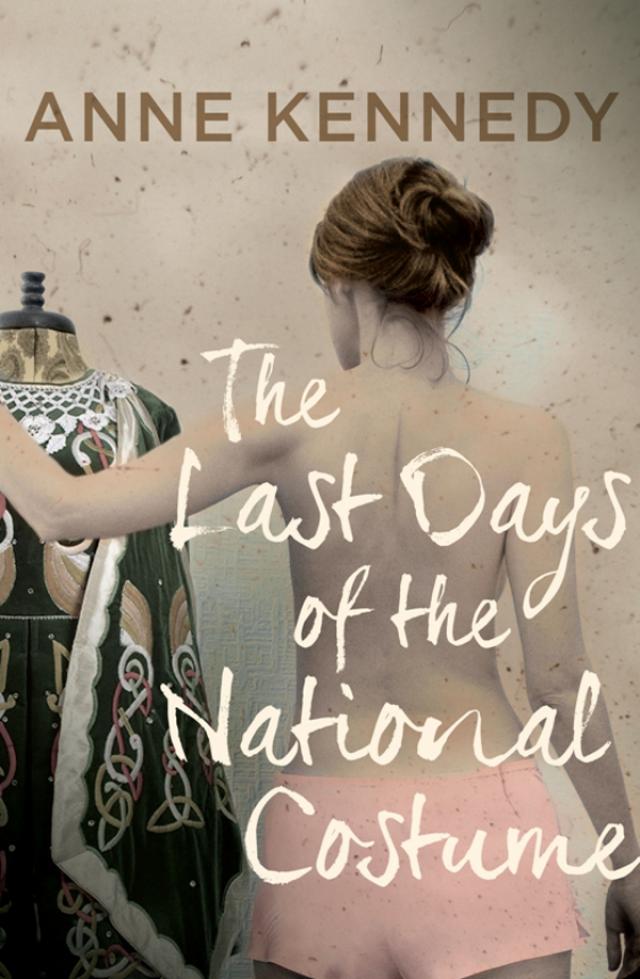
In the front room, my hands all mermaidy, I took the costume out of its wrapping. It wasn’t half bad, as well mended as you could hope for under the circumstances. If you peered closely at the inside you’d see a tight thatch of new threads, ever so slightly darker than the original, but it blended in well enough. And on the front, the hoses of silver, the twisted knotwork, as confident as ever.
•
The client didn’t come in but asked, slightly breathless on the doorstep, ‘Is it ready?’
‘No.’
He laughed, and I could see the silhouette of his square-jawed rictus against the blinding yellow sunlight. He looked out over West Auckland—the motorway, the Waitakere Ranges (like dresses), the sun—then back at me. ‘Look . . . when? Just tell me when.’
Such power I had. I smiled a gory smile. ‘I’ll check in my book.’
‘Your book?’ He followed me inside. ‘Your book?’
In the front room I offered him tea because there was a freshly made pot. He shook his head but I took a cup from the china cabinet, an eggshell cup with a dragon on it, and poured one anyway. He picked up the cup without thinking and blew steam across the surface so it was like a thermal pool. I didn’t ask him to sit down. When I couldn’t stand the silence any longer I said, ‘The thing is.’
‘Yes?’ He was cold.
‘It’s turning out to be a much harder job than I thought. I can do it. I just need good light.’
He looked into the middle distance. ‘Is it good light this afternoon?’
I squinted out the window. It was sunny as hell. I’d even had to move, earlier, away from the heat.
‘Because my wife,’ he said. ‘Milly.’
Oh, I was getting used to Milly.
‘Believe me,’ I said, ‘I’m actually looking forward to mending this costume.’ God knows where I dredged that up from. ‘I don’t often get to work with such lovely garments.’
He was glazed, yes, glazed like a wheelbarrow.
‘It’s beautiful,’ I went on. It was. I wish I could tell you how beautiful. Glittery and hard and tight. Sumptuous. ‘There should be a law against it,’ I said.
He shrugged. ‘I’ve never really looked at it.’
I knew that for a start.
He roved over to the bookcase, restless. I picked up a needle and lime organza.
‘Oh,’ I said, almost gaily (shut up, GoGo!), ‘I thought you would have looked at it quite closely.’
‘The dress?’ He had his head on one side at the bookcase.
‘Yes, the costume.’ Jesus! He gawuffed. I went on, encouraged. ‘I suppose these costumes were two a penny for you in Ireland. I suppose every time you turned around there was another one.’ I pointed at the air. ‘Look, there’s a costume, there’s another. With someone in it,’ I added.
GoGo, stop.
He straightened up from the books and was preposterously serious. No sense of humour. Oh dear. ‘I don’t think so,’ he said. ‘There was only ever the one. I wouldn’t even remember it, but—’
‘You never look at it.’
‘It was the only thing we brought with us from Belfast.’
‘Really?’ Everything had gone pink from the slant of the afternoon sun and the glow of the red curtains, as if seen through rosy cellophane.
‘Well, that and the clothes we stood up in.’ After delivering his snippet of hyperbole, he patted a pocket with cigarettes in it. I’d guessed right—he smoked. Black mark. On top of everything. Like a train, it turned out.
I went on with my stitches, white on lime. I asked him why he was leaving in the first place.
‘Because the dress isn’t finished,’ he said, as if obviously.
‘No, I mean Ireland.’
‘Oh. Oh. God knows.’
‘The Troubles?’ I ventured.
A little laugh like a bubble. ‘Troubles. I suppose it was that. A spot of bother.’
‘What do you call it then?’
‘Anything you like.’
‘Sorry,’ I said.
‘It’s fine. I was ecstatic as a child, by the way. Were you?’
It was my turn to guffaw. To gawuff.
‘If it’s a good light,’ he said, ‘couldn’t you do the costume?’
‘I work in order,’ I said. ‘Remember? I told you. I’ve got to get this done.’ I held the organza aloft. ‘I have a deadline.’
Now we both looked out the window. It was half past seven and the sun was squashing down into a lozenge over the Waitakere Ranges. The garden through the window seemed like a lit room.
He turned to me. ‘Where’s the thing now, on your list. Is it next?’
‘The costume?’
He said with exaggerated patience, ‘Yes, the costume.’ Might have rolled his eyes. ‘Is it next?’
Later I remembered that as the first exciting breakdown of politeness, the first brick from the wall. I reached over the apron and opened up my workbook, ran my finger down the page, not reading but thinking, thinking of a tablecloth, my husband, a drumming inside me. ‘It’s very soon,’ I said casually.
He cleared his throat. ‘I’m thinking, if it’s not done by tomorrow, there won’t be much point. May as well flag it.’ He was scanning the evening through the window, restless.
I felt a fine net of something string me up inside—of hurt! Ridiculous, I know, because I didn’t even know this man. ‘But what about Milly?’
He met my eyes from the window.
‘Her finding it on the wardrobe floor,’ I said, ‘and thinking it’d never been missing. What about that?’
‘Oh, I still hope to do that. I’ll just take it to another mender. Surely there must be someone.’
I could hand it over to him now. I mean it was hanging mended in the other room. I’d make up some story about why I hadn’t given it to him before. I forgot, I was mistaken—something far-fetched which he wouldn’t believe for an instant, and I’d see the look of contempt on his face and he would see me see it, and there would be another unbearable moment of intimacy, such as when I touched his fingers on the edge of the workroom door. It wouldn’t matter, because I’d never lay eyes on him again. Or I could simply tell him that I’d lied. He’d be surprised and might ask why, and I’d say, I don’t know, some madness. And he’d shrug and say at least he had it now, the costume, before it was too late. He’d take it home and drop it carefully on the wardrobe floor under a hanger, perhaps putting something on top, a raincoat, shoes, so that the sudden appearance of the lost costume wouldn’t seem too outlandish. He’d go to Milly and kiss her, but not too hungrily in case she suspected remorse. He’d kiss her tenderly, lovingly, in the hand-in-glove manner of long-term lovers. And then perhaps they’d move like a two-headed monster, joined all the way down, to their own bedroom, and make love there in that same manner.
‘It’s a beautiful thing, you know,’ I said. My voice came out rough, and I blushed and cleared my throat. ‘The costume. I don’t think you realise.’
‘I probably don’t.’
‘You’re lucky, with your traditions, you know,’ I said. Well he was.
He shook his head. ‘It’s not like that.’
‘No, no, believe me, the sentimental value, etcetera. Like your wife said. You can’t buy it for love nor money . . .’ I petered out. Then started up again. ‘Especially when you throw in a betrothal.’
He looked at me oddly.
‘That’s what you said, the first day you came to get the costume, the day—’
‘Yes, I know, the day Milly was here,’ he said, singsongish. ‘Well, I exaggerated.’
I knew that for a start.
He shrugged. ‘Family friend. I suppose they thought we’d . . . get on. You know how it is?’
Rhetorical question, but I pictured the pole house, the A-frame ceiling and the conversation pit. ‘My parents were too busy picking out partners for themselves,’ I said.
He laughed and I followed suit. I was hilarious.
‘I take it your parents are still an item,’ I said.
He did a Jim Carrey look, eyebrows dovetailed. Not worth answering.
‘Maybe splitting up is for when everything else is going swimmingly,’ I said.
Complete garbage, of course. There’s nothing like poverty to send people to the divorce courts in a handcart.
‘Anyway, it must mean that you love your wife, if you go to all this trouble—I don’t mean trouble.’ I blushed.
He smiled and picked up his briefcase. ‘So anyway, if you can’t do it by Monday . . .’
I put down my beading. I’d give him the costume tomorrow. Then he’d be happy. Happy his marriage would be saved, happy his affair with Trisha would stay secret. Who could care less? Certainly not me. I’d seen it all, the lies, the excuses. I just did my job. I used my hands, I earned money, I thought thoughts. It was a nice equation. You couldn’t fault it.
‘It’ll be ready,’ I said. ‘Come back tomorrow.’
‘Monday, you mean.’
‘Yes, Monday.’
‘Really?’ An ironic half-laugh. ‘When on Monday?’
‘Late afternoon. It’ll be done by late afternoon.’
‘Okay!’ An elation in him. He took his jacket from the back of a chair. As if to smooth things he said, ‘You have a lot of books,’ without looking at the shelves—perhaps he’d noticed them earlier and stored the information in his cheek like a hamster.
‘Yes, and Art.’
‘You studied art?’
‘Oh, no, my husband. That’s his name.’
‘Ah.’ He ran his hand over the cobbled spines of literary theory. ‘You’re a pointy head.’
‘No, not at all. Only my needles.’
He laughed. ‘Did you go to Auckland Uni?’
‘Vic,’ I said. ‘You?’
‘Auckland. MBA.’ He was moving towards the door.
‘Oh,’ I said. ‘You’ll be raking it in, then.’ (GoGo, stop!)
‘I wish.’
He was rolling in it.
Then I thought to ask him what he’d been doing when the power went off. As time went on this became a question people asked.