The last days of the nat.., p.5
The Last Days of the National Costume,
p.5


He looked blank. A strange disconnect.
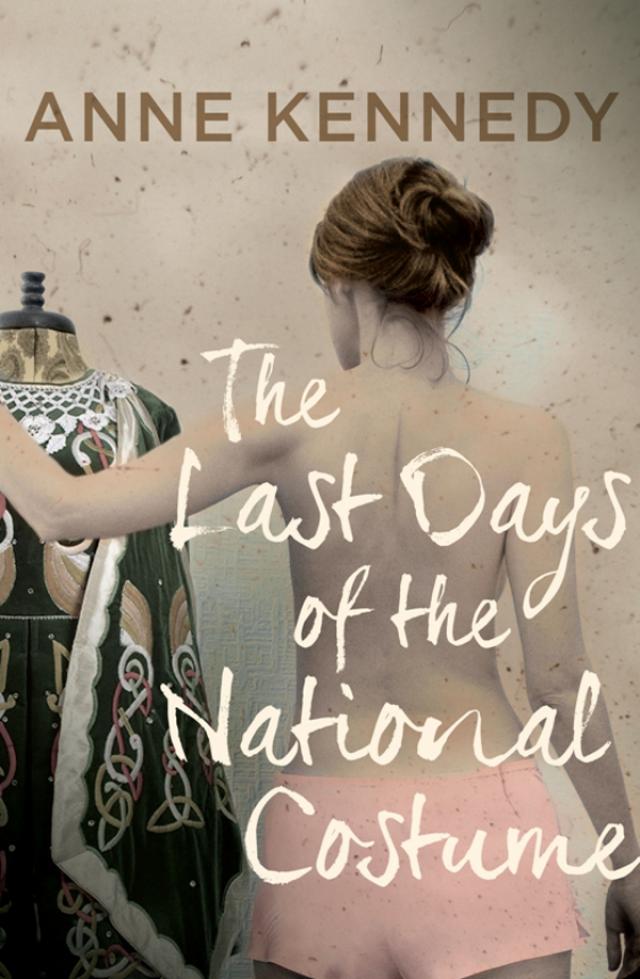
I spread the costume out on the table and invited him to inspect it. He stepped into the room.
‘It’s not perfect,’ I said. I pointed out the slight roughness of the join, the differences in colour, and explained how when the tear was this bad, and the material this old, there was only a certain amount that could be done. He wouldn’t look; he was petrified. While he gazed into the middle distance, I collected certain data. Thirty-odd, tall forehead, brown hair that was trying to be preppy but wasn’t, was just badly cut, the solid upper body, and the way his hands hung beside him. The new jeans were a fraction too big. His face was pale, jutting, the eyes deep-set so their colour was impenetrable. He’d been unfaithful to his wife. That was the single fact I knew about him.
He cleared his throat. ‘Rightio.’ He did the puffing mannerism again. ‘Is it, ah’—he hesitated—‘invisible?’
Well, how could he know if he wouldn’t look at it? I said it wasn’t. I’d just been through all this.
He winced as if I’d pricked my finger again.
‘To the naked eye,’ I said, ‘it’s not too bad.’
He still wouldn’t look. Anywhere but. ‘The naked eye?’
‘Yes, to the naked eye.’
‘Not under a microscope, then?’ he asked.
‘No,’ I said patiently, ‘it wouldn’t look good under a microscope.’ He was a pedant. ‘What I mean is,’ I said as laboriously as I could, ‘it’s invisible enough.’
He wasn’t convinced, but wanted this to be over. ‘How much?’
I’m not good at fleecing people. It’s my Marxist upbringing, which I think I’ve already mentioned. ‘Um, a hundred and sixty dollars. It was quite a job.’
‘It’s a bargain,’ he said quickly. He sorted eight shaky twenties from a very nice wallet.
‘What do you do?’ I asked. I never ask that question. It’s rude.
‘I’m in banking,’ he said.
I must have looked unimpressed because he added, ‘Donovan Brothers.’
Investment bankers down in the city. He wasn’t a teller, obviously. I should have charged like a wounded bull. I said I’d wrap the costume, but he stopped me.
‘It’s alright like that. I’ve got the car outside.’
I insisted it must be wrapped. Anything could happen on the way home—car grease, spilled drinks, the risks are legion. Another assignation. He could have taken it right then—it’s not as if I would’ve played tug-of-war with it—but he didn’t. Things would have been different. He stepped into the tiny space between the door and the table while I fossicked on my haunches under the chair where there was a stack of paper, like a sponge cake. The doorbell rang and I jumped up, told him I’d be back in a sec.
He leaned away from me as I edged past him in the doorway and as he did knocked the dish of tiny amber beads off the table. They landed with a high-frequency crunch and washed over the floor.
‘Ah, sorry.’ He bent down to the beads as if to scoop them up, but they were escaping from each other as if changing from liquid to gas. An impossible task.
‘Don’t mind those,’ I said. ‘I’ll get them later.’
He straightened, glancing at me on the way up. I felt sorry for him. ‘Okay,’ he said softly, just the consonant, the click of the K.
It was a client, a thirtyish businesswomen in a navy suit, high heels and very red lipstick—the powerful uniform I’d always had a secret desire to wear, but never would because of my line of work. Her dark blunt-cut hair was frosted with raindrops. The showers must have slackened to a drizzle. She greeted me with a firm hello, but no smile. I found myself matching both. We stood by the front door in silence, as if all our social calories had been expended on hello. Like the man in my workroom, she didn’t have a parcel. No doubt there was a silky garment in her hardboiled briefcase.
‘What can I do for you?’ I asked, although I hate it when people say that. It’s condescending. Her silence and her intense brown stare made me say it.
She said she hoped it wasn’t too late in the day, but she’d come to pick up an item. She spoke with emphasis, as if talking to a class of five-year-olds. Positive, sure-footed, with important words in italics. It was a tone that left you in no doubt.
‘A costume,’ she said. Her face was shiny and oval like those shepherdesses you see in gift shops.
‘A costume?’ I didn’t have it of course.
‘The Irish one. The dancing outfit,’ she said. Her italics.
I knew she wasn’t a Riverdance mother—I’d have remembered them, happy and hyper—and the man in my workroom was collecting the only other Irish costume I had on my books recently. It wasn’t as if it rained Irish costumes. I told her she must have confused me with another mender. That had happened before. I said I’d give her the number of Doris at Pins Alterations over in Kingsland, and I headed down the passage to get it. The woman clicked along behind me, saying, It’s unmistakable, black, fitting, heavily embroidered . . . We stopped outside my workroom and she ran her hands around her upper body, leaving a wide margin the way a dead body on the street is outlined with chalk.
‘It’s he-ah,’ said the woman. ‘Don’t you keep records?’ She eyeballed me, and I was sick of her. This was what it was to be in the Yellow Pages.
‘I have records,’ I said (I’ve told you about my workbook), ‘but I don’t have your costume.’
She closed her eyes as if to contain something. It seemed she had a thin shell of composure, and that a scrawny chick of hysteria might peck through at any moment. ‘Just look,’ she said.
I wanted her gone—I had a client waiting, after all—but I felt sorry for her. ‘Listen,’ I said.
‘No, you listen. You are Megan Sligo Mending and Alterations?’
Unfortunately that was moi.
The woman put a hand on my arm, just lightly, but wow, the transgression. I wanted to wrest it away, but something kept me trained on her narrowed eyes. She lowered her voice. ‘I saw a docket in my husband’s wallet.’
I felt the sudden wallop of facts connecting. This was his wife. The man. His flipping wife! I looked at the door to my workroom. It was ajar. As if on cue, it creaked a little.
The woman went on: ‘I thought it was odd, but didn’t put two and two together. When I went to look for the costume, I really thought it would be hanging in the wardrobe.’ Here she released my arm and leaned back to rest her case. ‘It wasn’t.’
She was anxious, and I felt oddly protective, but also drunk with a powerful, loose feeling. I could behave anyhow I liked with this woman. She was the poor jilted wife. I was the professional, in charge. Perhaps this is how psychotherapists feel when confronted with distressed clients. The woman drew herself up, as much as she could because she was petite, and said, almost viciously, ‘It’s an heirloom!’
I paused, thinking what to do. How odd it was that husband and wife should come to pick up the costume at the same time. It couldn’t be all over between them, despite the obvious third party, if they were still running around synchronised. It was always the way, so I’d noticed, that the wife (or husband) still had enormous psychological, even spiritual (if you believe in any of that stuff) power.
‘Please, just get the costume,’ said the woman—the wife—and she folded her arms over her single-breasted suit jacket to wait.
The husband in the workroom would have been listening to his wife’s voice, of course. He couldn’t have missed it. At that moment, he could have stepped out into the passage and greeted her, marvelling at the coincidence of the two of them coming to get the costume at the same time, but he didn’t.
I stood very still and changed my tack. I said to the wife, ‘You didn’t bring the costume to me, did you?’
‘No. I didn’t b-ring it to you,’ she said. ‘Obviously. My husband did. Either him or that little bitch.’
The word was like a knock on the funny bone—somehow still the most hateful word you could conjure, even taking into account the next generation of words, the reproductive parts. The woman looked, for a moment, forlorn. Her straight dark fringe fell forward. I would show her into the workroom and there she’d encounter her husband. There might be a scene, yelling and screaming. Or maybe they would keep it under wraps, escort each other tightly away. I buzzed with the awful anticipation. I’d give Art a blow-by-blow that evening as we ate fish by the light of the hurricane lamp. A man was caught out by his wife today, and the wife lunged at him on the path!
I hesitated and glanced at the workroom door, which was still ajar with the man behind it. ‘Did your husband ask you to pick it up?’
The woman frowned. ‘I don’t think that’s any of your business. Actu-ally.’
I thought about it for a moment. ‘Well,’ I said, ‘I don’t usually give out garments to, you know, people without a docket. Unless I’ve been told about it.’
The truth was the issue had never arisen before. Until the man turned up that afternoon. And I hadn’t hesitated to hand the costume over to him. Things had got tricky with many of my other clients, but this particular bit of trickery, this Restoration comedy—it took the cake.
‘I can appreciate that,’ said the woman. ‘And you probably don’t usually have sullied garments brought to you either. Garments with the stain of adultery.’
Sullied. Adultery. Such old-fashioned words! It seemed that infidelity needed a few new words in the Oxford Dictionary. I replied grimly, ‘You’d be surprised.’
The woman looked suddenly tired. ‘Look, I just want to know what’s going on.’
I nodded. I did feel sorry for her. It’d be best if she saw her husband, and they could sort it out between them. Let them yell, bicker, fume. This was nothing to do with me. I went to open the workroom door.
On the edge of the door I felt something foreign and warm at the tips of my fingers. I turned my head quickly and saw that I had encountered the husband’s fingers. An electric current ran up my arm. I looked back at the wife. Had I gasped? It seemed not because the wife continued to stare at me without a blink. I let myself glance into the workroom. He was standing in the doorway looking at me. He moved a hairsbreadth, but I knew anyway, in that second, what I was going to do.
8
I saw the relief on the man’s face when he understood I was going to hide him. The trace of a smile. I smiled myself and had to put my hand to my mouth and cough lightly. I remembered then to take my other hand from the edge of the door where it had been in contact with his fingers.
‘Excuse me a moment,’ I said to the wife.
She made to follow me, but I stopped her. ‘I’ll look,’ I said. I needed to change my story. I didn’t want this woman phoning Doris and hassling her. I stepped quickly into the workroom, skating on the beads, clinging to the jamb for balance. As I pushed the door closed I had a last glimpse of the wife’s face, tilted with surprise as it slid out of sight.
In the workroom I faced the man in the metre-wide space between the door and the table. I was briefly aware again of the structure of his body, the long back and long arms, the square torso, the set of his neck, before I tipped my head back and investigated the Carrara ceiling, its beaten, cake-like pattern. Odd that there was copper beneath the whiteness. You’d never know unless someone told you. I wondered if he understood precisely what I was doing, that I was waiting, unaccountably, for an allotted time to flip by. The time that was to be filled with the retrieval of the costume. I was letting these moments go empty into the future. I could hear his breath, uneven, a swallow once or twice. The room was sealed by the intensity of the wind. The tree outside butted the glass, squeaking and making the light wobble. After a full minute I looked down from the ceiling. He must have moved forward slightly, or maybe I had. He was so close we could almost have kissed. But didn’t, of course. We looked at each other. The expression on his face: disbelief? I stepped back out into the passage and pulled the door shut behind me.
I was aware that the wife was looking at posters on the opposite wall, the wall healed over like skin. At the sound of the door closing she spun around. Her arms were still tightly folded.
‘Well?’
‘I can’t find it,’ I said. I knew I sounded breathless.
The wife showed no visible reaction. If anything, she was more measured than before. ‘I was given this costume for safekeeping for my daughter,’ she said. ‘It’s an heirloom.’
Christ, there were children! It didn’t bear thinking about. A girl, wide-eyed, hopeful. Perhaps she spread her grandmother’s dancing costume out on the bed sometimes, ran her hands over it, felt connected to something, I don’t know what.
‘An heirloom?’ I asked. Surely an exaggeration. It was half finished, poorly made.
I had a memory of a tablecloth blooming with wine stains. (More on that later.)
The wife sniffed and shook her head. ‘It’s not that, it’s not even that.’ She turned her brown eyes on me again. ‘Can I tell you something?’
I made a yes/no sound. Did I have a choice?
‘About two weeks ago,’ said the wife, ‘I saw a woman in the supermarket wearing a costume just like mine. I caught a glimpse of her at the end of an aisle—then, gone. I thought I must be mistaken because, you know, it’s distinctive, this costume. Then I found one of your dockets in my husband’s pocket.’
(That rhymed, but I didn’t comment on it.)
‘Megan Sligo Mending and Alterations,’ she recited.
Yes, point taken.
‘Even then I didn’t think much of it. Maybe he’d picked up a stray bit of paper, written a phone number on it, I don’t know. But something . . .’
She paused and I felt kind of pinned, yes, like a garment.
‘. . . Something possessed me to check in the wardrobe to see if the costume was still there. And what do you think?’
Was I meant to answer this?
‘What do you think? It was gone!’ Her face crumpled. Something gave way. ‘The little tart! You’ve never come across such a mess. Sometimes I think I’m going mad. I don’t have much to go on. A glimpse, and—I don’t know—a feeling. But then, the costume, gone! What’s happened to it? You know, I wouldn’t be surprised if this little trollop, whoever she is, wears the costume again. As if it’s her own. The little Jezebel.’
How quaint these curly fin-de-siècle words (fin-de-the-previous-siècle)—tart, trollop, Jezebel. You half expected harlot, fallen woman. Where were the new words for people who screwed around? Women who screwed around. And what about the man in the workroom? Why were there no words to describe him, at nearly the end of the second millennium, and a blackout to prove it? An outage. I could almost see the wife’s anger wafting off her body like dry ice. No slushy stage. No tears. Perhaps I should give her the costume after all, if it would soothe her. I had no loyalty to the man in the workroom. I didn’t know him. From Adam. I hadn’t set out to hide him. There had simply been that galvanised feeling when I’d first seen him standing behind the workroom door. In all the transactions with my clients, I had never encountered the injured party. A garment was one thing, but a spouse. And a daughter waiting in the wings, to boot. I should hand over the costume. The problem was, I’d already told her I didn’t have it. I didn’t want to be caught lying. I didn’t lie. I was honest. As the day is long.
At a tiny pinging sound from the workroom, the wife cocked her head and listened. She swivelled her gaze back to me, keeping her head at its birdlike angle.
‘There’s someone in there, isn’t there?’
Later I wondered why I didn’t answer that question. Some subliminal code stopped me. Later I would break out in a curious sweat thinking about it. Curious because—why? Why should I have cared, at that point? Why was I hiding the husband anyway? If my intention was to hide the husband, then not answering the question was the right thing to do. If he hadn’t been in the workroom, if there had been nothing to hide, why would I defend myself against having a person in my own house? I somehow knew that to deny there was someone in the room was to give it away. And I didn’t. I put on what I hoped was a puzzled but not too puzzled expression. I didn’t move. I would not let the wife discover him. I’d save him from marital strife. After all, I had done this for so many of my clients. I would prop up some form of deception like a tent. That was what I always did.
The wife sighed. ‘Ms . . . ?’ Strangely formal.
‘Sligo,’ I supplied.
The wife looked down at my ring finger. ‘You’re obviously married. Or something. Tell me, has your husband ever cheated on you?’
Then I was moving away from the workroom door, ushering the wife down the passage. (Cheat? Never. We were open and honest.)
In the doorway the wife handed me her card. Milly Something. An accountant for a big firm. ‘I think the costume is he-ar. When you find it, please ring me.’
I mumbled that I would.
‘Do you know,’ said Milly, ‘when I opened the wardrobe I could smell her.’ I recalled the acrid chemical whiff I’d caught off Trisha the previous Friday. Milly turned and walked out the open front door, which closed after her, an oofing slam as the wind sucked it shut.
•
The client was standing exactly where I’d left him in the doorway. For an instant he was like one of those human statues painted in bronze, the illusion shattered when his voice rippled through his body. ‘That was my wife.’
‘I think I worked that out,’ I said.
A nervous laugh like a squeak. He sank back into the room so I could go past.
‘And thank you,’ he said. He looked waxy, almost luminous in the grey room.
‘No trouble.’ But it was trouble. A garment was one thing, a relic of infidelity—but a girlfriend, wife, whatever—I didn’t want to see the other party. The client put his head in his hands briefly and I met his eye as he came up for air. I won’t deny, I felt myself gloat over his misery as I got out my receipt book.
‘Who shall I make it out to?’
‘Pardon?’
‘What name?’