

Holmes coming, p.11
Holmes Coming,
p.11
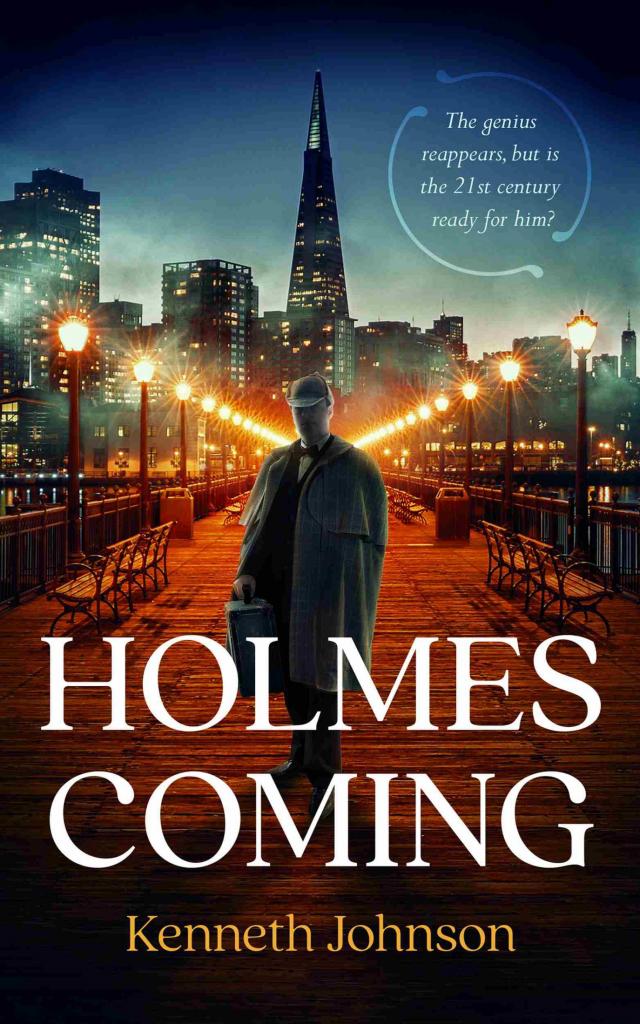


Holmes ignored Slick and spoke over Slick’s shoulder directly to Zapper, who stood several paces behind. “It’s important you tell me what you know, Zapper.”
The boy reacted again, this time with concern that Holmes knew his name.
“He don’t know nothin’, okay?” said Slick, “Now I’m tellin’ ya, get your fancy ass outta here.” He shoved Holmes in the chest.
But Holmes remained rooted to the spot, gazing into Zapper’s uneasy eyes.
Slick was getting annoyed, and a bit embarrassed in front of his cronies, so he presented a tougher attitude. “Didn’t you hear me, sucker? Are you deaf?” Holmes still ignored him. Slick was angry now. “I said beat it!” He punctuated his demand with a vicious, two-handed jab at Holmes’ chest.
That was a mistake. With the grace of a seasoned toreador, Holmes deftly pivoted aside, grabbed Slick’s passing arms, and used the boy’s momentum to propel him headfirst against the fender of a car. Slick rebounded down to the ground, stunned.
Holmes correctly anticipated an additional attack by another. He turned to see Rancho swinging a roundhouse right fist at him. Holmes easily ducked under the incoming blow, and again using the assailant’s momentum, he allowed Rancho to fall off-balance and right over Holmes’ shoulder in a posture similar to a fireman’s carry.
Holmes stood up with a snap, hurtling the boy off and sending him crashing onto the hood of the same car with which Slick just had his own encounter.
Rancho’s crash onto the car’s hood is what startled me to wakefulness in my upstairs bedroom. I sat up with an alarm usually reserved for earthquakes. Lucie was beside me on the bed and equally unnerved. She jumped off and started barking.
I leapt—or more accurately, stumbled—to my window, flipped back the curtain, and raised the roller blind. I drew a quick breath of surprise and delight as I saw Holmes standing beside my car on the street below. But then a wave of concern swept over me as I realized that he was facing off with a bunch of tough-looking street teens.
Holmes seemed totally calm and unruffled, however. He was straightening his cuffs as I heard him say to the young toughs, “I should give you proper warning, I studied Japanese baritsu with Master Barry himself.”
One of the gang had picked up a length of broom handle and swung it devastatingly at Holmes as he shouted, “Study this, sucker!”
To my amazement, Holmes casually sidestepped the arc of the wooden rod, planted his hand firmly on the boy’s passing shoulder, and shoved him mightily into the rear fender of my Accord. The boy’s head dented it and he, too, crumpled to the ground, dazed.
In that encounter, Holmes had taken possession of the length of broomstick, which was about four feet long. I blinked with awe as I watched him twirl and brandish it like a dueling sword. And just at the right moment too, because the scruffiest member of the gang had flipped open a switchblade knife that flashed with a six-inch blade.
Still, Holmes proceeded confidently and attacked with the exquisite grace of a master fencer. I swear to God, at that moment Holmes reminded me of Cary Elwes dueling Mandy Patinkin in The Princess Bride or even Errol Flynn as Robin Hood, fencing through Nottingham Castle as he battled Basil Rathbone. I had a brief flash of confused and ironic memory: Rathbone had also played Holmes in the old movies. And now on the street below me was a man who claimed to be Holmes using a broom handle to duel with some twenty-first-century street thug and— My mind was reeling.
Holmes thrust and parried forward against the threatening youth, batting the dangerous knife from his hand. As Holmes pressed closer, the kid tripped backward over his own feet.
Holmes brought his broom-handle sword down on the youth’s head, hard enough to make a point but not so fiercely as to do any permanent harm. The teen toppled backward onto the pavement.
Holmes, smugly savoring his easy triumph, lowered his “blade” and turned slowly, 360 degrees, the back of his left hand pressed against the small of his own back, in a formal dueling position. He haughtily surveyed the battlefield and his fallen opponents, who were slowly regaining their dizzied senses.
It should be pointed out that throughout this confrontation, the youngest boy, Zapper, had made no move to attack Holmes. If anything, his attitude was one of wishing the fight would cease.
Holmes glanced at Zapper, then gallantly tossed down his weapon and spoke to the group, “Have you no leader?”
Slick was still kneeling beside the car, leaning against it to steady himself and seeing butterflies. He muttered, “What you talkin’, man?”
Holmes peeled off his frock coat, folded it neatly and laid it atop the trunk of my car, saying, “Mano a mano. If you dare. Though I must warn you that I once went three rounds with famous prizefighter Shamus McMurdo before ending the match with a cross-hit under his jaw.”
He assumed that classical, Victorian boxing pose you may have seen in old period photographs: arms extended in front, elbows bent so the forearms and fists were vertical. All he needed to complete the picture would’ve been a waxed handlebar mustache. I realized I had seen a false mustache exactly like that earlier in his valise.
By then I’d managed to shake off my fascination with the scene below and had realized its true danger. I grabbed the phone and dialed 911.
Outside, another of the gang took up Holmes’ challenge. This boy was stocky, of Pacific Islands descent, perhaps Samoan, with the long, straight black hair associated with Polynesian-Asian physiognomy. He was also apparently familiar with the Oriental tradition of martial arts, for he brought up his hands into a posture worthy of Bruce Lee. He accompanied this with a series of growls and guttural threats like I’d once seen Jackie Chan do—as a joking send-up of himself and over-the-top chop-socky movies.
Holmes blinked. He had never heard such a noise or seen anything like this posture, of course, but nevertheless, he was prepared to continue. He reached forward with the toe of his black patent leather shoe and drew an imaginary line across the pavement between. It was then the beefy boy’s turn to blink. “What the hell are you doin’, man?”
The teen then resumed his best karate stance, slowly rotating his open-palmed hands in front of him as though they were lethal weapons—which they may well have been. As he did this, he slowly moved in an arc around Holmes, who remained facing the line he had drawn on the street. Holmes looked at the boy with considerable consternation. “What on earth are you doing?” he asked with an air of abject astonishment and social criticism. “Can it be that you are ignorant of the Queensbury Rules?”
In an effort to educate the obviously disadvantaged youth, Holmes turned with a sigh to face him again, and drew another line on the pavement with the toe of his polished shoe. The boy regarded him with a blank look.
Then Holmes snapped back into his formal boxing position and nodded sharply for the boy to do the same. Instead, the kid glanced with leering amusement at Slick, and mimicked Holmes’ formal fisticuffs position. Then he threw a serious punch at Holmes.
And punishing it might have been but for Holmes’ lightning-fast reflexes. He easily parried the fist, startling the young man with a brisk uppercut to his chin. He saw stars, I’m sure. Both he as well as his comrades were thunderstruck by Holmes’ unexpected skills.
The boy recovered and reattacked. Fists flew, but only Holmes connected, landing a powerful left hook with such intensity that the boy was spun around and thrown to the ground.
By now I had given up on getting through the voice menu on 911—“If you are reporting a fire, please press one now. If you are reporting a—” et cetera. I ran downstairs and grabbed the pistol out of Holmes’ valise. I flung open the front door, forgetting that I was wearing only my pajama top. Lucie rushed past, barking in an uncommonly fierce manner for her. I brandished the pistol and shouted from the front porch at the gang. “Hey! Leave him alone!”
My intrusion had an unfortunate result. Holmes turned at the sound of my voice. The boy called Rancho used the distraction to blindside Holmes by bashing a heavy flashlight hard across the back of his head, taking the Englishman down.
Zapper reacted angrily to the cheap shot, yelling, “Hey, no, bruh!”
Rancho saw my gun. “She’s got a piece! C’mon!” They all took off, headed back into the darkness of the park, with Lucie barking after them.
Rushing to the street, I knelt beside Holmes. “Are you okay?” I lifted his bloodied head onto my knee. He looked up at me with dazed confusion, perhaps unsure who I was.
“My violin,” he mumbled.
“What about it?”
“It’s under . . . under the bench.”
“Yeah, yeah, don’t worry, I’ll get it.”
We looked toward the fleeing street gang. Zapper paused in his flight to look back at us. He appeared genuinely concerned, trying to ascertain if Holmes was indeed okay.
Slick dashed back and grabbed his sleeve, “Zap! Come on, bruh! Let’s blow!” He pulled the reluctant Zapper on, into the darker section of the park.
As I watched them disappear, I found myself saying, “Welcome to San Francisco, Mr. Holmes.”
And that gave me pause. Looking down at the strange man leaning against my knee, I realized I was actually coming to believe that his remarkable story had to be true.
8
Shortly thereafter, about 2:30 a.m., Holmes was sitting in the overstuffed easy chair in my living room while I attended to his cuts and scrapes. Lucie was at his feet, with her chin resting on his right knee, watching these goings-on with attentive concern. I was on the floor beside his left foot. His trousers had a small flap torn in them where he had landed on the pavement and the skin on his knee beneath was badly abraded.
“This may sting a bit,” I warned before applying the antiseptic. He nodded that he was suitably prepared. As I proceeded, only because of the slightest tightening of his facial muscles did I perceive that he felt any pain. He glanced away from me, toward the foyer.
His case of wine was now safely on the floor inside my front door along with the old leather suitcase containing some of his clothes. He had insisted on lugging the wine inside so it would provide no further temptation in case the young thieves or any others decided to break into my car. He caught me watching him gaze at it.
“Vintage, huh?” I surmised.
“An extraordinarily rare vintage,” he said by way of explanation. That was obviously why he was so protective of them. Those bottles could have considerable monetary value that he might need to rely upon.
I continued medicating his abrasions, saying, “Thanks for defending my car.”
“It was nothing.” He sniffed as he rubbed his lean neck, which must have still been aching from the blow of that heavy Maglite. His torn shirtsleeve draped open slightly, and I saw the bleeding scrape on his left wrist—as well as the telltale injection scars on his forearm.
“Yes, it was quite gallant of you,” I insisted. “Particularly after I’d tossed you out on the street. Let me clean up that wrist too.” He laid his hand, palm up, across his leg. Lucie licked his fingertips as I folded back the cuff to sponge his current wound while referencing his older scars. “You weren’t exaggerating about your cocaine use.”
“No,” he said matter-of-factly. “Initially I found it so transcendentally stimulating and clarifying to my mind that its negative influence on me physically was merely secondary and a matter of small moment.” His face clouded. “But after the death of my archenemy, Moriarty, whose evil genius had been a challenging match for my own skills at intellectual combat, I found myself sinking into depression.”
“You no longer had a worthy adversary,” I said, studying his face as I applied the dressing on his wrist.
“Correct.” He inhaled sharply. “Give me problems, give me work, give me the most abstruse cryptogram or the most intricate analysis, and I am in my element. Then I can dispense with artificial stimulants. I do not tire from work, but idleness exhausts me. I abhor the dull routine of everyday existence. I crave mental exaltation. I cannot live without brainwork, and with Moriarty dispatched, what challenges were there to live for? Hence the cocaine.”
“What finally prompted Dr. Watson to intervene?”
“He came to feel that I was dangerously overdoing it. Bear in mind that seeing someone taking cocaine intravenously was no more alarming than watching someone have a cigarette. But being my closest friend, and a physician, he’d grown increasingly concerned about how often I indulged.”
“Which was how often?”
“Three or more times a day.” He saw me draw a reactive breath. “However, I had ceased to get satisfaction. Instead, a growing malaise and indifference to living settled over me. Watson grew evermore irritated at me until his conscience swelled one night after a glass of Beaune. He was watching me thrust the sharp tip of my syringe into a vein. He saw how eager I was to press down the tiny piston and then sink back semiconscious into my velvet-lined armchair. Watson suddenly snapped at me, ‘Which is it today, Holmes? Morphine or cocaine?’ When I made some dismissive jest, he sprang angrily to his feet. ‘It is a pathological and morbid process, you fool! Usage of these chemicals causes tissue changes and may leave a permanent weakness. Or even lead to your death!’” Holmes shook his head at the recollection. “The good doctor snatched up his greatcoat and top hat with a fury I did not know him capable of, declaring, ‘I will no longer stand by and watch you kill yourself!’ He stormed from my flat, stomping loudly down the inner stairway and slamming the outside door.”
Though Holmes sat silently there in my present-day living room, I assessed from his unfocused intense gaze and strained expression that he’d been thoroughly reliving that difficult night. After a long moment, I volunteered quietly, “And then, being such a close and caring friend, he and Doyle set about trying to find healthier ways to stimulate your ‘everyday experience’ by introducing you to the likes of H. G. Wells.”
Holmes drew a breath. “And Bernard Shaw, Joseph Conrad, Gilbert and Sullivan, Marie Curie, and—”
“Watson saved your life.”
He nodded. “Yes, bless his soul.” Then a wistful shadow passed across his face as he realized, “Rest his soul.”
I paused in my doctoring and looked up. “I’m sorry about the way I lost my temper tonight.” He shrugged as if it hardly mattered, but I tried to explain myself further. “It’s just so hard to believe this could be happening, that you’re who you say you are. I mean, how could you possibly know all you said about me?”
He didn’t look at me, but rather gave a flippant wave of his hand—a gesture I would become quite familiar with. “From a drop of water, a logician such as myself can infer the possibility of the Atlantic Ocean without ever having seen or heard of it.” He drew an expansive breath. “I simply observe the facts around me and deduce logically from there.”
“But I still don’t understand how you could have possibly ‘deduced’ all those tiny details.”
“Then let me illustrate, Winslow.” He rose, pointing to a small sculpture on a stand across the room. “That bronze bust over there is easily recognizable as yourself as a child. It was sculpted in the romantic, passionate style of the Parisian Rodin, and the bronze is signed ‘Dad.’”
Indeed it was. Holmes touched Dad’s signature, which also had quite a flare to it and was on the base of the sculpture. Holmes continued walking slowly around the room, following the same route he had taken earlier when reeling off the details of my life. He pointed toward my shelves.
“On your bookshelf there is a tankard with the California redwood tree emblem of the Leland Stanford University and the word Alumnus, although it should properly say Alumna.” He ran his fingers lightly along the shelf. “Your shelves also contain these several books written in French and Spanish, which indicates an ability to understand those languages. Three of the books are on the subject of philosophy, which attests to your . . . intelligence.” He swallowed the last, managing to slip a slight editorial edge into the word, as though still unconvinced that I possessed any meaningful brain cells at all.
Nonetheless, I was enjoying his performance. I settled into the armchair near the window, pulling my legs up under me.
He picked up from my desk a child’s painting with bits of popcorn and dried macaroni glued onto it. Also, he lifted up a little “ghost” made of Kleenex, with a crude face drawn on it.
“These objets d’art fashioned by young hands, some signed ‘Thanks, Dr. W.,’ indicate children’s fondness for you,” he held them up for my examination and went on. “The sizable quantity of them suggests the pediatric specialty of your practice.”
He set down the trophies from my kids and picked up a small plastic card, turning it over in his long fingers. “This personalized parking pass amid your mail shows that you are affiliated with the Saint Francis Hospital, and its location on Hyde Street.” He chuckled to himself, “I wonder if San Francisco has gained a corresponding street named Jekyll.”
I was about to tell him that most everyone I’d ever known at Saint Francis had asked that obvious question, but he paused not a second, steaming on, holding up a paper containing notes I’d written. “From this sample of your penmanship, even the most casual student of handwriting analysis would deduce that you’re a woman of strong opinions tempered by quieter, more circuitous approaches. Would you agree with that assessment?”
Though I tried hard, I couldn’t suppress a sheepish smile and nod.
“The white physician’s jacket hanging on the back of your desk chair has your name tag pinned on it. There is a similar name tag on your bookshelf displaying the name ‘Elizabeth Appling-Winslow, MD,’ and beside it is a framed photograph of a smiling man and a woman who much resembles you. On one corner of that frame hangs a thin gold chain holding two wedding rings, one smaller than the other. That placement, and the fact the rings would otherwise be on your parents’ fingers, indicates your loss. The small votive candle, which generally signifies a memorial, sits directly adjacent and underscores my conjecture.”


