

Holmes coming, p.20
Holmes Coming,
p.20


He tried to wrench himself free, but there was a two-hundred-pound knee pressing down painfully on his back and the thick-handed grips of the men were viselike. With his cheek pressed against the oak floor, Holmes was forced to watch helplessly as flames wrapped around his precious papers, curling the corners upward, inward, searing up through the images, engulfing all of the vital information and sending it up in smoke. He felt as if a hand of ice had grasped his heart.
Booth watched the flames complete their work and diminish, then smiled down at Holmes with pleasure over his accomplishment. “Well, look at that. I seem to have succeeded where my great-grandfather failed. I have just destroyed the famous Mr. Holmes.” He nodded to the men, who pulled Holmes to his feet while maintaining their iron grip. Then Booth leaned closer to Holmes’ face, saying sweetly, “You—whoever you are—are nothing but an escaped lunatic.”
Holmes’ hatred was white-hot, but the underworld baron’s sly grin was undiminished as he said with cheerful politeness, “Have a nice day.”
He indicated for his men to throw Holmes out. Muscular as they were, it took quite an effort on their part to drag him away. As they did, the outraged Holmes managed a final, anguished look back over his shoulder at the fireplace. He saw that beneath the burning logs nothing remained of his irreplaceable papers but glowing ashes.
As we drove back along the dark coastline, Holmes only gave me the awful headlines, barely able to speak through his fury and the humiliation I knew he felt over what Booth had done to him. From his rigid face and glaring eyes focused dead ahead, I sensed he was mentally leaning forward, feeling there might yet be one faint last hope, but he maintained his impenetrable, silent reserve throughout our return to the city. Though I was angry at him for acting so impetuously, I kept it to myself. Nor did I mention what I’d learned while waiting outside Booth’s front gate.
Not until we were back in my house did I show him the email on my phone.
Scotland Yard “regretted to inform” us that records dated prior to 17 September 1904, including any that might have existed on a “Holmes, Hubert, a.k.a. Sherlock, DOB 26-10-1858,” as well as many thousands of others, had all been lost in a fire at the Yard on that date.
The email concluded, “Unfortunately, the Yard cannot verify whether or not the information you sought was ever a part of those records.”
He endeavored to maintain an imperious air, but I monitored him closely because I knew he was now entirely devastated. As he sat there in my living room chair, he tilted his head back, letting his eyes trace blankly across the ceiling as though seeking a solution. Finding none, he avoided looking at me as he finally chuckled bitterly, forcing some gallows humor. “Well, one must admit, Winslow, it is rather a singular, ironic achievement. I don’t know of anyone else who, in one night, has been so completely burned . . . Twice!”
He breathed a long sigh of resignation, still looking away as he said, “On this extraordinarily catastrophic evening of evenings, I should be most especially grateful if you would open your heart, and your safe, so that I might retrieve my syringe and cocaine.”
I spoke gently. “I hope you know that I understand all the pain you’re suffering through, but I can’t in good conscience—”
“Oh, damn your conscience!” he spouted hotly as he stood abruptly, storming toward his room. But he stopped dead at the hallway entrance. He stood for a moment with his back to me, then bowed his head slightly. “I was very rude, madam. You have my apology.”
“That’s okay,” I said quietly. “But I do have something milder which might help if—”
“No. No thank you, Doctor. I shall require no further assistance of any kind.”
Then he continued off down the hall to his room in the back, and I heard the door close.
Soon after, I was lying in bed, turning through the pages of Doyle’s stories. It was startling how accurate his portrayal was of this man now living under my roof. I heard the melancholy sound of his violin begin echoing up from below. As I drifted to sleep, I was feeling sad for him, and for myself, because I had no idea how to help him or what might happen now.
13
I awakened at 2:00 a.m. with a sense that something was wrong. Going downstairs, I discovered that Holmes was gone. Having concerns about his mental state, I threw on some clothes and launched upon a search through the area on my motorbike, grateful that the rain had stopped. The air was clear as I cruised the dark, wet streets of my neighborhood. But I had no luck. I was on my way back toward Baker Street, thinking about the first time I’d driven Holmes into San Francisco and amazed to realize that had only been three days ago. Suddenly I remembered something else about that day. I turned my bike around and headed toward the waterfront.
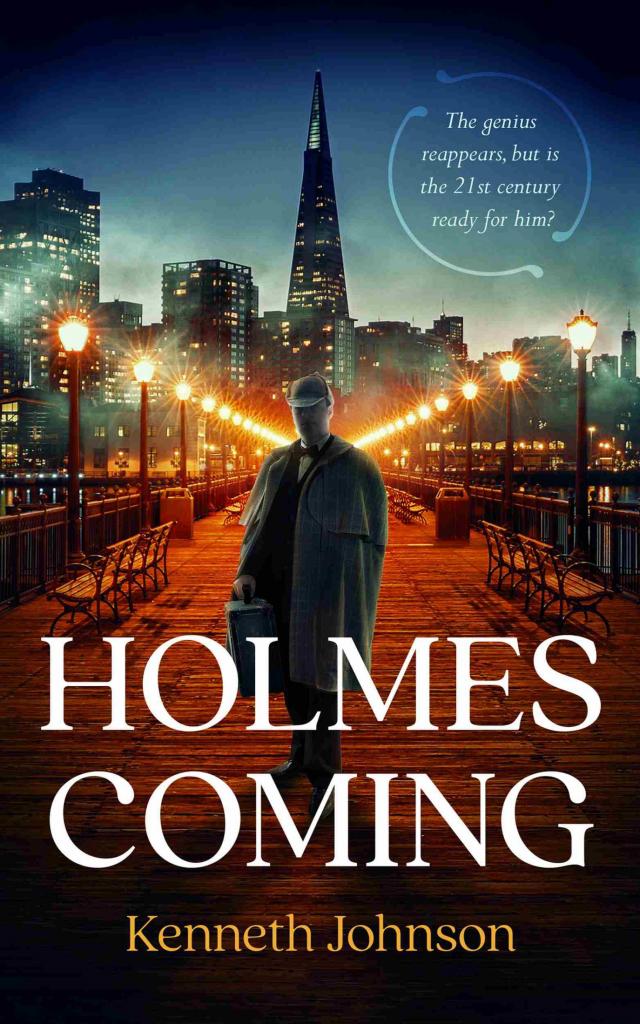
I rode to the base of Broadway and turned right at Embarcadero for a dozen yards to Pier 7, where Holmes had described to me how different it looked in 1899 when he had taken a walk there on the night before he began his long sleep. That original Pier 7 was ruined by a fire fifty years ago and the current wood-planked pier was built. It extends the length of two and a half football fields out into the bay, but being barely fifty feet wide, it has always reminded me of a long, thin finger. It’s built upon twenty-four concrete pillars, each of which is topped with a semicircular alcove about five feet wide to accommodate people fishing. Its entire perimeter is lined by a lovely wrought iron fence. Several dozen streetlamps along both sides, reminiscent of San Francisco’s gaslight era, provide warm illumination at night. Pier 7 is one of the most picturesque spots in the city, with expansive views in all directions.
Looking inland from the pier, a viewer sees the landmark Transamerica Pyramid rising up from amid the city’s sparkling nighttime skyline. That’s what was behind me as I guided my motorbike to a slow stop on the wooden decking and looked out across the pier. In the distance was the Bay Bridge with its suspension cables extending like three enormous roller-coaster waves across to Yerba Buena and Treasure Island. Their lights twinkled in the dark waters below. At the pier’s far end, I saw a pair of lovers enjoying the romantic place and each other. Between them and me, running the length of the pier, were parallel rows of benches facing outward toward the perimeter fence. They had wooden seats and graceful wrought iron backs and armrests.
Sitting on one of those benches about halfway along, turned slightly to his left and facing the bay with his back in my direction, was the person I sought. He wore the coachman’s cape but had forsaken the deerstalker for the simple newsboy cap, which diminished his overall persona. His body language was listless. He appeared disconsolate, but I determined not to join in his low spirits but instead present a positive attitude.
Out over the bay a slender, horizontal wisp of fog was drifting in, catlike. I walked up casually, marveling at the panoramic view, and said quietly, “It’s really beautiful, isn’t it?”
If Holmes felt any surprise at hearing my voice, he covered it up. I walked just past him to the far end of his bench. When I turned around, I saw he was scowling. I had never before seen his face so grim or his brow so dark. He glanced dismissively toward the spectacular nighttime San Francisco skyline behind him, and grumbled, “Ach. I cannot look at that city without seeing the leering face of James Moriarty Booth hanging over it like an evil specter.” He blew out an angry puff. “And that my valuables were used to found his nefarious empire is . . . is . . .” He laughed resentfully. “It’s beyond ironic.” He rubbed his temples with both hands. “It lays siege to my brain! How can vermin like Booth—and Enrique Pavon and other evildoers—continue to spread their diabolical poison and pestilence throughout the city, whilst I am helpless, useless?”
I waited a moment, hoping this wave of frustration and despair might subside. I noted how ashen he looked. The muscles of his face seemed flaccid, almost as though he’d physically melted a bit in the last few hours. He was clearly in the midst of darkest depression. I spoke, softly and hearteningly. “You know, you’re an amazing man, Holmes. You’ve given yourself the opportunity to do something no one’s ever done before—travel over a hundred years into the future. And you are definitely the all-time great ob-server,” I acknowledged with a delicate, encouraging smile. “But at the same time, you miss so very much!”
He glanced at me, frowning, as though unclear about what I meant.
“You’re so focused on the dark side of life,” I went on as I settled onto the other end of his bench, “that you miss its beauty. You’re so preoccupied with tiny details that you overlook the bigger picture. You miss the rich tapestry of life, of the world around you. And also the comfort of relationships.”
“That sounds like Watson’s old description of me,” he said sourly. Quoting his longtime companion, he intoned, “‘Holmes is an automaton, a calculating machine, there is something positively inhuman about him. A brain without a heart, as deficient in human sympathy as he is preeminent in intelligence.’ But”—Holmes pointed at me—“at least that was in a time when my intelligence was unique and useful. Now”—he made a sweeping gesture toward the city behind him—“now there’s an entire wing down at police headquarters possessing something called DNA which apparently gives them the power to make the kind of analyses and assessments that I alone had once been capable of.”
I didn’t want to push him further into depression by corroborating the usefulness of DNA, so I held off as he continued bitterly. “What is the use of having extraordinary skills and powers when one has no field upon which to exert them? Even my deductions are often absurdly out of date, as you yourself have enjoyed pointing out.”
“But overall,” I said warmly, determined to stay positive, “considering that you’ve catapulted yourself into the twenty-first century, you’ve still been brilliant, Holmes! And no one can always be right.”
His eyes met mine. “But I almost always was.” His gaze drifted to look out over the dark water. “Until now.”
He sat still, mulling over his defeat. “The greatest irony was hearing from you how Doyle had resurrected Sherlock—shortly after I began my sleep. That I had given up on the nineteenth century too soon. That more stories collected from Watson were published, which, had I still been awake and in London, would have led to an immediate resurgence of clients seeking my services . . . True, none would have been as challenging as Professor Moriarty, but at least I could have continued to ply my trade. I could have continued to be a man who was ahead of his time, instead of jumping into this new age that has no use for me.”
He laughed with exasperation. “I have been hoisted by my own petard, Winslow. Been too ‘brilliant’ for my own good. Well, I got exactly what I deserved. I have been laid low by my own self-confidence—that is the very definition of classic hubris: when one sets one’s ego above nature’s gods.”
He paused a moment, feeling the burden of it. “And yes, I have now realized my foolish mistake—but it’s impossible to correct it. I cannot go back. It’s impossible to change the circumstances or the punishment to which I have condemned myself. I brought down onto myself the worst kind of cursed damnation for a man such as I: as a detective,” he chuckled with resentful irony, “I am defective.”
I sat silently, trying to figure out the best approach, to find some words that might help him. But before I could, he sighed listlessly. “It would have been better if Moriarty hadn’t been the only one who plunged into the abyss. Booth is right: he has now destroyed me.”
I could see he’d reached his lowest ebb, was feeling a vast emptiness, that he had no future here in the future. And then he put the seal upon it, saying with finality, “There’s no way I can recover. It’s impossible. Simply impossible.” He shrugged slightly and opened his hand toward me. “I truly need you to give me back my vial and syringe.”
That did it—I saw red. “Oh right!” I snapped, standing up and turning away hotly. “That’s the answer, huh?” I turned and came back at him. “Shooting up is going to fix everything, is it?” I glared at him. “I’ve treated my share of addicts, mister. I know exactly what cocaine does. So tell me, is the short burst of euphoria really worth what follows? The paranoia, the hallucinations, the fresh depression deeper than the one you started with?”
He was unresponsive.
That made me angrier. “You know what? I’m sorry you’re having a hard time, but come down to my hospital and I’ll introduce you to some people who have real problems. The world was not put here for your ‘gaming pleasure,’ Mr. Holmes. You can’t just drop out when the game goes against you.”
I forced myself take a breath and tried to calm down, in hopes of discovering a way to get through to him. I came closer and sat on the bench facing him. “Listen, my mom always said a person only grows by facing challenges. By going through them and coming out the other side, better for the experience.”
He glanced flittingly at me, then away. I decided it was best to face the main issue head-on. “There may not be a Holmes from the nineteenth century anymore, but there clearly is a Holmes here in the twenty-first: a genius of a man who can create and control his own destiny—if only he doesn’t wimp out!”
He seemed to at least be listening, so I went on. “And as far as Booth or Pavon are concerned, I happen to believe in karma: what goes around comes around. The pendulum swings slowly, but it tends toward justice. Sooner or later they’ll screw up—or get screwed up. Eventually someone will provide damning evidence against them—and they’ll be condemned.”
Holmes’ simpering expression implied my thesis was idiotic, and I was forced to admit, “Orrrr maybe they won’t. But there are plenty of other crimes out there for you to solve in this day and age, plenty of other hurting people who could use your help, if you’re not too busy wallowing in your own personal problems.”
His eyes had gone distant, vacant. I saw he’d tuned me out. I got mad again.
“Fine,” I huffed as I stood up to leave, flashing both palms in his direction. “I’ve got no interest in hanging out with someone who’s up to his eyeballs in self-pity.”
I angrily stalked back up the pier and climbed onto my bike. While putting on my helmet, I said, “I’d be much more interested in a detective like the one I was reading about tonight. ‘When he was at his wits’ end was when his energy and his versatility were most admirable.’”
Holmes looked over his shoulder, and our eyes met.
“A detective who himself said, ‘There is nothing more stimulating than a case where everything goes against you.’” I kickstarted the bike and revved it. “And that same detective said to me, ‘What most people perceive as difficult I can sort out right away. It’s only the impossible that can take me a little longer.’”
I glared at him a final moment, then rammed the bike into gear, did a tight one-eighty, and roared off. I tried not to look back but couldn’t help glancing in my rearview. From the dark pier, he stared after me.
I went home, angrily pulled my old pajama top back on, and got back into bed. I was still frowning from my encounter with him and his damned reticence. Long-suffering Lucie was patiently lying beside me as I tossed and turned for an hour or so. At length I heard him come in downstairs.
I listened carefully, and after a few minutes I heard the sound of his fingers tapping my keyboard. My tension eased. I lay there listening for a few more minutes, but then I grew concerned that he might be composing a letter of farewell to leave behind for me. To my surprise, that was actually a painful thought. In spite of the difficulty he had brought into my life, he was such an extraordinary man. Such a rare, brilliant, attractive— I blinked and stopped myself. That particular line of thought was somewhat unexpected.
Nevertheless, I did not want to face the disappointment of discovering in the morning that he had left with no way for me to locate him. So I headed downstairs.
My bare feet were quiet on the wooden steps. I peered into the living room and saw him at my desk, his back to me. He had taken off his coachman’s cape and his frock coat. He was reaching into its pocket and removing a small snuff box made of gold, with a large amethyst set in the middle of the lid. Still facing away, he spoke quietly, “I sense that you are staring, Winslow.”
I whispered, “Yes, I’m sorry.”
“This was another small gift of appreciation from the king of Bohemia.”
“Very nice.”
“Quite so. But what’s important at this moment is its contents, which I collected today.” He opened the box and took out not tobacco but a small black bug.
I remained in the doorway. “What is that?”
“A beetle.”
“Dead, I hope.”
“Conclusively. And yet a matter of paramount importance.” He still had not looked at me. He began tapping again at the keyboard.
I waited, then asked gently, “What are you doing?”
He answered softly, “Taking your suggestion, Winslow. Working on behalf of my first clients of the twenty-first century: Luis and Karen Ortega.” He tapped on the keyboard, then paused to say, “Let the weight of the matter rest upon me for now, and do not let your mind dwell upon it further.”
I stood silently for a moment. He turned slowly to look at me in my faded flannel pajama top, my tousled hair and no makeup. I saw that his face had regained some color. Though he was still far from the flush of energy and eagerness he’d displayed when I’d first driven us into the city, at least his mood seemed slightly improved.
But something else was going on. His eyes focused onto mine in a way they never had previously. There was a subtle expression of what might possibly be sincere gratitude.
And there was a hint of something even deeper. I was experiencing it too: a sort of mutual discovery. As our gaze held steadily, taking on a life of its own, I sensed, and sensed that he was also sensing and trying to comprehend, an unexpected stirring, a faint awakening of—what? An emotional connection? As I tried to comprehend what was happening, he blinked, seeming to take in for the first time that my legs were bare. Then he looked away—though not instantly, I noted. But he was clearly self-conscious, and his gentlemanly eyes could not meet mine again.


