

Holmes coming, p.9
Holmes Coming,
p.9
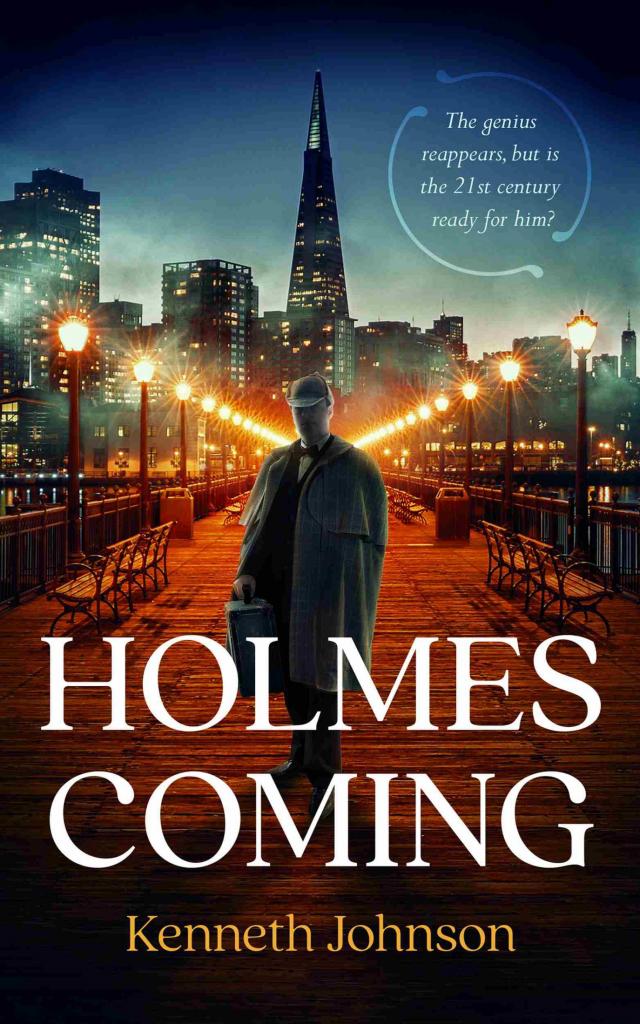


And now—thanks to Wells’ mention of his time-machine novel on that inspiring evening—here was Holmes, in a stimulating new future full of mysteries to unravel.
He inhaled deeply. He’d immediately noticed how much clearer the air was than it had been in the midst of England’s coal-fired industrial revolution. He scraped a toe of his black patent leather shoe across the sidewalk and noted there was not a bit of soot on the streets as there often was in his London. He had also noted the total absence of horse manure, which had been so ubiquitous in the city streets of his era. There were the familiar sounds of crickets and distant boat whistles from the nearby bay, but he was also cataloging new and unanticipated sounds. He heard a rhythmic boom boom boom growing ever louder as a dented, rusted automobile approached and cruised past with what sounded to Holmes like nothing less than a dozen bass drums pounding in unison. That booming was accompanied by a man’s voice shouting a patter of poorly rhyming words so fast as to be unintelligible.
Soon afterward, he heard a similar but much louder whump whump whump that seemed to come from overhead. Looking up, he saw an automobile-sized vehicle several hundred feet in the night air suspended beneath a single huge propeller carrying it forward. Holmes smiled, thinking, Of course! He comprehended immediately how the craft had evolved from ideas he’d seen in seventeenth-century sketches by Leonardo da Vinci. He also noted the much smaller vertical rotor on the tail, recognizing it as a necessity to prevent the craft from counterrotating. Holmes was delighted by how the airborne vehicle had been logically conceived and realized.
For almost two hours he sat observing passersby with fascination and accumulating a myriad of fantastic novel aspects of this modern world. He paused to recollect the remarkable events of this first day, and then his thoughts drifted back to his final evening in 1899.
He’d quadruple-checked the elaborate equipment he’d fashioned in his secret laboratory. Before proceeding as planned, he paused one last time to reconsider his entire theory. His agile mind went back over every minute detail in his research, including the thorough experimentation he had undertaken, in which seven rats had been put through the complete process. All had survived in suspended animation for over a month; they sailed through with flying colors and were revived as healthy as ever. Except one. And upon performing an autopsy on that notable exception, Holmes discovered it had an abnormally enlarged heart, to which he attributed the failure. Satisfied with his success, he took his remaining rodent colleagues out into the gardens and happily set them free. His experiments had removed any doubt that his life-extending process was well within the margins of safety and had a high probability of success.
After returning from his walk on Pier 7 that final evening in the nineteenth century, he went into the estate’s sitting room, put a favorite cylinder on Mr. Edison’s marvelous new phonographic invention, and listened to the scratchy music emerging through the large horn. He thought his selection was most appropriate for that special night. He slowly breathed in, appreciating and absorbing the strains of Johann Sebastian Bach’s Jesu, Joy of Man’s Desiring.
Afterward he went to the upstairs bedroom and exchanged his clothes for a simple, ankle-length sleeping gown. He used a roll of gauze to wrap his right leg like a mummy from toe to knee and did the same on his left. Finally, he donned a pair of soft slippers.
Returning to his cellar laboratory, Holmes carefully and securely closed the thick secret door. He used a small stool at the head of the sarcophagus to step up and into it. After inserting intravenous needles into his femoral arteries and veins, he set the preservation process in motion. He administered a final large dose of cocaine into his arm and settled into the copper chamber. Last of all, he activated the mechanism that slowly lowered the heavy lid just as he felt himself slipping into the darkness.
Sitting on the nighttime park bench in twenty-first-century San Francisco, Holmes cocked an eyebrow, feeling inflated with pride. He’d always been impressed by himself, but this achievement surpassed even his most intoxicating experiences with opiates and intravenous cocaine.
He drew a thoughtful breath, set his violin case on the bench beside him, and opened it. He carefully took out his beautiful Stradivarius, smiling slightly at his dear old friend. He plucked the strings, adjusted the tuning, and eased it onto his shoulder. He held the violin in place with his chin as he rubbed a bit of rosin on the catgut of the bow. Then he softly put the bow to the violin and began playing a plaintive Puccini melody.
Later, I remembered hearing it faintly inside my Baker Street bedroom, but at the time I didn’t realize that it was him.
Violin-playing soothed Holmes. He closed his eyes as his bow smoothly drew out the beautiful melody.
After a few moments he sensed someone approaching, and while still playing, Holmes opened one eye to espy a scruffy seventyish fellow. The man wore clothing that was secondhand but clean and a crush cap. A threadbare bedroll and apparently all else he owned was slung over his back. In his left hand he carried what looked to Holmes like a battered black cigarette case emanating pictures and a woman’s voice. The old gent had in fact been viewing the evening newscast on his cell phone but paused as he drew nearer to Holmes playing the violin.
A smile warmed his kindly, weathered face. He sighed. “How I love La Bohème.”
Holmes glanced up at him and nodded pleasantly. The septuagenarian settled on the other end of the bench, caught up in the melody and even humming along as a nicely dressed friendly-faced woman in her fifties passed. She leaned down to drop a few coins into the open violin case. Holmes paid no attention. He brought the musical piece he was playing to a gentle melancholy conclusion.
His ragtag benchmate nodded his approval. “Pretty nice interpretation.” Then he gestured toward the coins in the violin case. “You must do okay busking, huh?”
“I’ve never conscientiously endeavored.”
“You’d do great. I heard a lotta would-be musicians out here on these streets. Most of it’s just plain dog shit. But you got real talent. That vintage outfit you got on is also a smart eye-catcher. If I was you, I’d try down in the financial district, along Battery or Davis. You get a better-quality audience down there. They’ll appreciate the classics.”
“Thanks for your advice, Mr. . . . ?”
“Lefty.” He extended a clean hand in greeting.
Holmes nodded and took the offered hand. “Holmes.”
“Ah, like the old detective.”
“Yes,” Holmes chuckled. “Precisely like that.”
“I loved them stories,” Lefty said as he firmly gripped Holmes’ hand.
Holmes nodded politely. “I found some rather too melodramatic for my taste.”
“Well, I thought they were great. Loved all the Sherlock movies too,” Lefty said smiling.
Holmes inclined his head in curiosity. “Movies?”
“Yeah. Them old films they made about him back in the ’40s are still my faves. But there’s been a bunch since then.”
“Films?” Holmes was trying to coax out the meaning without sounding uninformed or daft.
“Yeah, you can still catch ’em on TCM or streaming. I even watch ’em on here sometimes,” Lefty said, referencing his cell phone. “But it’s always better to see ’em in a theater.”
It was beginning to dawn on Holmes what Lefty might be talking about, and he said, “I saw some moving picture films in 1897.” Lefty glanced curiously at Holmes, who quickly clarified, “That is, which had been made in 1897 by a Frenchman named Georges Méliès and also the Lumière brothers.”
“Can’t say I caught any of their movies. Were they about Sherlock?”
“I shall have to investigate that.” Holmes changed course and ventured, “But tell me, sir, isn’t Lefty an odd name for someone who’s right-handed?”
Lefty chuckled. “It comes from my political sympathies. But how’d you know I’uz a righty?”
“Oh, I once wrote a trifling monograph on the subject.” Holmes was carefully adjusting a string on his violin. “I was able to illustrate how seventy-four different occupations could be deduced from the observation of hands. I also analyzed the specific detection of dominance by scrutiny of size, muscle, calluses—that sort of thing.”
“Oh, yeah?” Lefty’s eyes narrowed as he decided to test Holmes. “So, what’s my line?”
“Mariner.” Holmes stated, without a moment’s hesitation.
Lefty blinked, amazed, “Y’could tell that from m’hands?”
“And from the fine lines around your eyes that sailors get from squinting on a bright sea. Also, the corner of a tattoo visible on the back of your wrist, which I take to be an anchor.”
Lefty nodded and turned his hand over to reveal the entire design of the anchor.
Lefty appeared fascinated by Holmes’ observational powers. But Holmes was even more intrigued by the cell phone in Lefty’s hand.
The tiny video screen was at that moment carrying a picture of police at a crime scene. Holmes leaned tentatively toward the small screen. “Do you mind? May I?”
Lefty generously offered it up. “Sure, turn up the volume there.”
Holmes looked at Lefty curiously, unfamiliar with that use of the word. “Volume is . . . ?”
Lefty looked at this odd character curiously for a beat. “It’s, y’know, the sound? Here.” Lefty adjusted it louder.
Holmes was intrigued by the moving picture visible on the tiny color screen—and by the police who were shown. Several were milling on the broad terrace outside the four-story glass entrance of a modern, museum-like building. On an equally tall red monolithic sign in the foreground Holmes could barely read California Academy of Sciences.
A voice coming from the small video device was saying, “And another bizarre death was reported tonight at San Francisco’s Steinhart Aquarium here in Golden Gate Park.”
Holmes watched as the tiny cell screen displayed video of a chubby, middle-aged man in a security guard uniform, sitting on the back of a fire engine and being attended to by paramedics. The newscaster continued, “Night watchman Tom Walsmith had apparently been drugged. When he awoke an hour later in his office, he immediately went through the aquarium to investigate.”
The broadcast next showed the view from a handheld camera inside the museum, moving among the tanks of octopuses, eels, and other aquatic animals. “Walsmith was unprepared for what he discovered, however . . .”
Holmes watched as the night watchman pointed out to police a specific tank in the aquarium that was about four times the size of a bathtub. Around it was yellow police tape and gathered members of the coroner’s office.
“In one tank,” the newscaster dramatically intoned, “thickly clouded by blood, was all that remained of a woman’s body.” The screen displayed a momentary glimpse of a shredded, bloody hand floating inside the tank before a police officer pushed away the inquiring camera. “A woman’s body had been partly chewed to pieces . . .”
Holmes’ thin nostrils flared, as though catching the scent of something important. He watched and listened even more intently as the newscaster continued, “This tank contained vicious, voracious piranha.”
Holmes’ head snapped back and an eyebrow raised sharply as something fell into place for him and he repeated, “Piranha!”
Lefty noticed his strong reaction and intently watched Holmes, who remained keenly focused on the cell screen showing Lieutenants Bernie Civita and Luis Ortega standing out in front of the aquarium building, surrounded by other press people.
Clearly fighting off grief, Ortega spoke to an off-camera reporter, “Yes, the coroner’s initial assessment is . . .” He swallowed painfully. “There were signs that she’d struggled against her attackers at some other location, where she suffered a skull fracture, and—” Ortega’s voice broke slightly.
Civita stepped forward and continued. “The victim’s body was brought here and dumped into the piranha tank. The victim has been identified.” Holmes noted that Ortega’s pain seemed to intensify as Civita said, “Her name is Louisa Chang. She was a judge, as well as a criminology professor at San Francisco State. Many of us on the force had been her students.”
Lieutenant Civita exchanged a pained personal glance with Ortega as another nosy reporter jabbed a microphone at the silent officer, saying, “Lieutenant Ortega, this is the second extremely unconventional murder in two days. Do you feel this crime is connected to Donald Keating’s death by the tiger?”
Ortega spoke quietly. “It’s too early to tell. Both victims were related to the police department. Both were brutally attacked by animals. We will update you when we know more.”
Lefty saw Holmes draw in his chin with surprise, as he muttered, “Oh come, come, Leftenant Ortega. Surely you realize there are at least two more connections than that. It’s so obvious.” Holmes’ voice hissed as though he wished Ortega could hear him and take note. “It was right there in front of you!”
Lefty leaned closer to the screen, completely baffled. “What is?”
Holmes didn’t answer, but rather looked up with newfound vigor. “This city really does have need of my services.”
Lefty grew a little wary. “Uh . . . you a cop?”
“No.” Holmes sniffed. “Merely a student of crime.” He took a long look at Lefty, having a sudden idea and nothing to lose by taking a wild shot. “Tell me, Lefty, did you ever happen to know an incredibly evil, clubfooted man?”
Lefty drew a startled breath. Holmes saw the old man’s eyes go wide and his face turn pale as a ghost’s. A shiver ran down Lefty’s spine as he sputtered, “Oh, Jesus save me! Yes! I did!”
“You did?” Holmes was astonished at his luck. And instantly attentive.
“Aye,” said Lefty, his frightened eyes riveted on Holmes. “Kill ya soon as look at ya!”
“Yes, yes! Do go on, old boy!” Holmes was greatly enthused.
“I seen him stab a friend of mine in the back—and twist the damn knife! Splayed him wide open. And it wasn’t the first time he got away with murder. Threatened me too. And lotsa other guys I knew.”
Holmes was sharp-focused. “Tell me more about him.”
“Big Chinese guy, he was.”
Holmes sagged.
But Lefty steamed right on, “Everybody on our crew hated him.” Then with a wink and a meaningful look that implied a bit of foul play by his shipmates, he added, “One night when we were down under, off Nuku Hiva in the Marquesas, the bastard got accidentally swept overboard—if you get my drift.”
Holmes nodded, indeed understanding, but was frustrated that Lefty hadn’t known the specific clubfooted man he sought. Then he tried another approach. “Did you ever come across an evildoer named Moriarty?”
Lefty shook his head. “Just in them old Sherlock movies. Otherwise it don’t ring a bell. Sorry,” Lefty then nodded toward the violin. “You really kick ass with Puccini. Know any Waylon Jennings?”
Holmes put the violin to his chin, “No, but if you hum a few bars . . .”
Lefty began singing a rasping, throaty rendition of a song: “Mommas, don’t let your babies grow up to be cowboys.”
Holmes grinned. “Ah, a country waltz!” He picked up the melody and played along with sprightly ease. “How jolly.”
Lefty was delighted, “That’s it! Y’got it, brother!”
Even as Holmes continued his rather brilliant violin accompaniment, his mind was elsewhere. He was analyzing the intriguing information he’d just received about the murder.
He was thinking that it must be a clever fiend indeed who would incorporate the use of horrific needle-toothed piranha into such an evil, serial-murder plot.
7
By midnight, I’d changed into my very faded Greenpeace tee and gone to my kitchen for a carrot, which got overruled by a warm oatmeal raisin cookie. My enjoyment of this was interrupted when my cell rang, labeling it “Potential Spam.” It had to be You Know Who returning my irate call.
As I stared at that spam warning, I pictured him in that old greenhouse off Fillmore that was his artist’s loft. He was wearing one of the paint-spattered tight tank tops that flattered his fullback shoulders and quarterback waist. I pictured that clever leading-man’s face and those soft, dark eyes, those full, dangerous lips, envisioning him standing in front of a half-done canvas, pouring two glasses of our favorite Mondavi Reserve merlot. But instead of me, a voluptuous redhead stood nearby, her long curls cascading down over her tacky black Frederick’s of Hollywood teddy, which barely concealed her more-than-ample breasts, the cleavage of which she had just highlighted with whipped cream from a can in her hand. It was all too easy to imagine.
Because that’s exactly the scene I had stumbled into a week before.
So, standing in my kitchen, I answered his call with a blistering hello, skipped over last week’s infuriating in flagrante debacle, and cut right to the chase: I wanted him to confirm his disgusting complicity in the outrage I’d endured today. I really uncorked on him, ripping into him like a chainsaw for two minutes straight until I took a deep breath to go on and he managed to jump in.
“Amy, Amy, Amy will you calm down and listen?” He was pleading over the phone. “I have no idea what you’re talking about!”
I slammed my hand on my kitchen counter. “Don’t do this to me, goddammit!”
“I’m not doing anything, Ame! Really. I didn’t do any of that wacky stuff! I did nothing. I’m doing nothing! Except—” His deep voice turned softer, more vulnerable. “Except missing you.”
No way would I get sucked in. “Oh, yeah. Right. You’ve probably got some candy in your hand right now.”


