

Holmes coming, p.4
Holmes Coming,
p.4
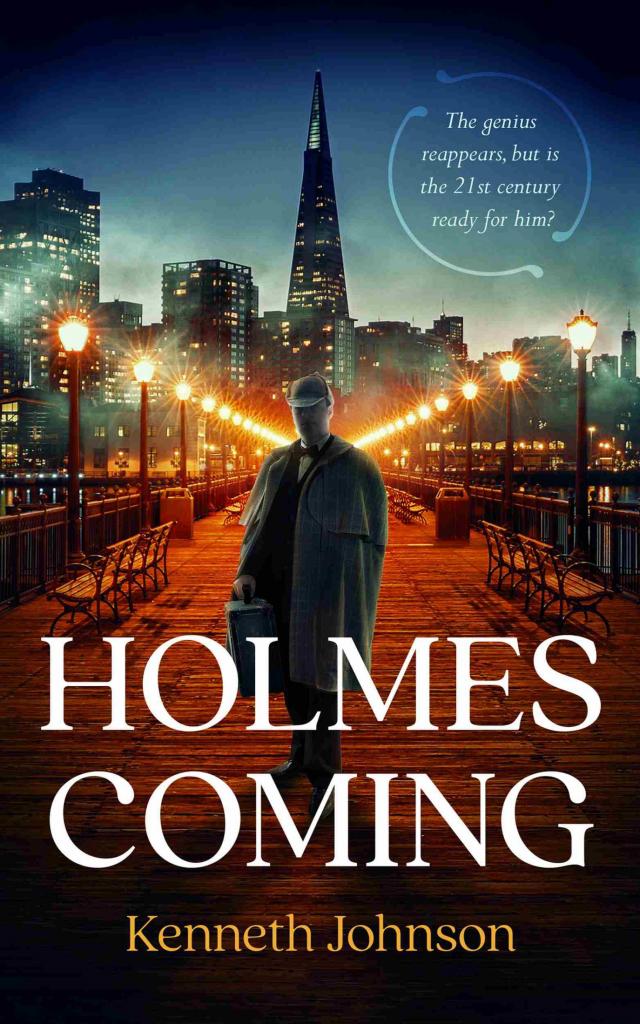


“Not good,” he mumbled again as he cautiously moved toward a lab table, seemingly mindful of the placement of each footstep.
“We’ll get it sorted out,” I said, anxious to keep him calm. “But first tell me who you are. And I won’t believe it if you say Captain Basil.”
He snorted as he busied himself looking for some object on the lab table. “Of course I’m not Captain Basil!” His back was to me as he went on, “There is no Captain Basil, my good woman. I traveled to America under that name to conceal my identity.”
“Which is?”
He turned to me, dramatically holding a large antique magnifying glass. “I am, of course, the gentleman whose name is known to the public as Sherlock Holmes.”
He tried to look astute and collected, but his shaky legs failed him, and the momentum of his rapid turn to face me carried him into a pratfall on the dusty floor. I tried to stifle a laugh, but it came out anyway as I said, “Get serious.”
“Madam,” he snapped at me ferociously as he regained his wobbly feet, “I have never been more serious in my considerably eventful life.” He then began a careful examination of the cobwebbed and dusty laboratory bottles and equipment. In spite of the draping of his stained and ragged nightgown, his body seemed lean and fit.
“Excuse me,” I said politely—and carefully, so as not to antagonize him while analyzing his mental state—“but I’ve always been under the impression that Sherlock Holmes was fictional.”
“And that is quite correct: Sherlock Holmes is indeed a fictional character. And I take it that people still read those little stories, eh?”
“Uh . . . yes, they do, but . . .” I was stumblingly trying to keep my grasp on reality while worrying that I might be dealing with a schizophrenic. “But help me out here—if Sherlock Holmes is fictional, then how can you possibly be standing there and—”
“My colleague Dr. John Watson is responsible for that sterling conundrum.” He continued scrutinizing one of laboratory tables inch by inch as he went on explaining, “Watson was attending a medical conference at the University of Edinburgh. One evening in the delightfully ancient White Hart pub, which dates from 1516, Watson chanced to be conversing with a fellow attendee, a young physician of Anglo-Irish descent who had been struggling to sustain a medical practice that might someday make him a living. Unfortunately, he had far too few patients, which was diminishing his bank account but providing an abundance of spare time. As a result, he’d begun making attempts at becoming an author. That particular evening he’d reached an impasse with a story he simply couldn’t work out.”
“He had writer’s block?” I volunteered, having no idea myself where this story was going.
“Ha. ‘Writer’s block,’” he said with some surprise, as though he’d never heard that phrase. “Rather a simplistic description I’d say, yet quite accurate.” He stepped back from the lab table, turning his attention to gaze at a section of the dusty floor. “So the young physician had given up writing that story and was searching for some entirely different concept to pursue. Watson, always a reliably warm, generous, and supportive chap, mentioned that he might be able to suggest a subject and went on to describe how he’d recently become my helpmate in investigating a most remarkable mystery.”
The ragged man turned slightly, lowered his head, and scanned slowly across a different section of the floor. His eyes seemed almost to bore into it, studying every millimeter as he continued. “The young would-be writer became quickly intrigued by the intricate details and the complexity of our exploration and analysis. It took Watson a full hour to recount the entire adventure, but he told me how the young man had sat listening, mesmerized. And when Watson reached the conclusion, telling the surprising revelations we had brought to light, the young doctor sat back and laughed heartily with great satisfaction. He asked if we might allow him to write it up as a story that he might hopefully get published.”
I had begun to smile inwardly as he talked because the fledgling medical man’s identity had become obvious to me. “And you’re going to tell me that the young physician was named Arthur Conan Doyle.”
“Mmm.” He nodded, adding snidely, “Brilliant deduction, my dear.” He looked back and forth between the first and second sections of the dusty floor he’d been assessing. “Doyle provided a few overly dramatic touches of his own and published the story, which he titled ‘A Study in Scarlet.’ It appeared in the November 1887 issue of Beeton’s Christmas Annual, which sold for one shilling each. It was quite a success for him, selling out before Christmas.” Still without moving, my newest patient then visually compared a third section of the floor to the two others. “Doyle did make one rather annoying alteration to Watson’s original documentation.” His voice took on an edge of sarcasm as he said, “He was satisfied with my surname because it reminded him of Oliver Wendell Holmes, an American physician and poet he admired. But he thought my Christian name a bit too ordinary and unmemorable. So he took ‘poetic license,’ changing it to a name that he felt would be, as he put it, ‘a bit more cheeky, to better capture the public’s fancy, stick in the reader’s consciousness—and encourage more purchases.’” He shook his head with annoyance, causing a few more flakes of dead skin to drift down from his cheek. “Doyle was an aficionado of cricket, and one popular player of the day had a name that Doyle quite liked.”
“Sherlock.”
“Just so,” he said offhandedly, still comparing the three sections of floor.
I nodded slowly, thinking it through. “Okaaay. So, the public came to know you by the fictional name of Sherlock, as in the stories, but your first name is actually . . . ?”
“Hubert.”
My eyes widened. I swallowed a chuckle, maintaining a serious composure while thinking that Doyle had chosen wisely. “Your real first name was Hubert?”
“Was and is,” he said dismissively as he lifted a particular small brown bottle from a lab table and sniffed its contents. “It having been my late grandfather’s name.”
I added it up: “Okay, so you, Hubert Holmes, were actually the real flesh-and-blood private investigator—”
His head snapped around. “The correct term, my dear,” he said sharply, “is consulting detective.”
“Right.” I nodded. “That. And you, Hubert, were the real ‘consulting detective’ who actually had the adventures and solved the mysterious cases that Doyle’s stories attributed to a fictional Sherlock Holmes?”
“Brava!” he sneered in a condescending tone as he continued his meticulous examination of the room. “You have sorted it all out magnificently.” Then he chuckled pridefully. “And I can tell you with surety that lot of criminals I sent to Newgate Prison certainly wished Hubert Holmes had been fictional.”
He dropped to the floor—not from a loss of balance this time but rather to make a scrupulous inspection of the leg of a stool, which he then pushed along ahead of him as he continued. “But I was, and am, quite real. I am Holmes in the flesh.” He brushed a few pieces of dried skin off the back of his hand. “Albeit rather flaky at the present moment.”
“Mmm. Yes, quite flaky,” I said, more to myself than to him, then asked, “And you allowed the stories about your cases to be published under that false name because . . . ?”
“Doyle proposed—actually, insisted—that Watson and I receive an appropriate percentage of the proceeds, which would help to underwrite the many pro bono investigations we undertook. And of course the stories helped spread the word to other potential clients who had the need—and sufficient means to pay—for my services.”
While speaking, he climbed with tipsy gravity to perch precariously atop the stool, still weaving to maintain his balance as he inspected the top of a hanging metal lampshade. The shreds of his stained robe swayed like a hula skirt, adding additional absurdity to the surreal scene. I had somehow dropped into a Fellini movie, or perhaps one by Mel Brooks. But I tried to remain calm since I still didn’t yet have a clue as to what kind of neurosis I was dealing with. “Naturally you have some iron-clad way to prove all of what you claim?”
He leered down from his perch, his voice dripping with sarcasm. “It would be rather foolish not to have, eh?” He climbed awkwardly down from the stool, then crawled toward the large sarcophagus across the floor, his chin nearly scraping while he examined it through his magnifying glass. From my perspective, the glass magnified and ballooned his face to look like a funhouse mirror.
“My aforementioned tin box,” he articulated pedantically and without looking at me, “had been secured in the small compartment hidden in that wall just to your left, which has clearly been discovered and breached.”
Glancing that way, I noticed that a twelve-inch square section of the dark brick wall was hinged open slightly. It was a small door with a wafer-thin facade of brick that would disguise its presence when closed. “And your tin box contains—”
“Photographs of myself with several notable friends of my day—Dr. Freud, George Bernard Shaw, P. T. Barnum, et cetera. I trust you have perhaps heard of at least one of them?”
I didn’t dignify his insult by responding, but watched him creep across the floor, punctuating his speech with an occasional groan, whistle, or chirp of enthusiasm. I was incredulous but also amused as he went on. “All of those notables provided signed documents describing their personal meetings with me. In addition,” he spat stridently, “my fingerprint records from Scotland Yard are in the box, as well as Doyle’s fingerprints and records, plus a written statement by Doyle confirming all I have told you. Everything was duly notarized, signed, witnessed, and dated by Chief Inspector Layton himself. When Doyle began writing his stories, I had him change the inspector’s name to Lestrade to avoid embarrassing Layton.”
By now he had reached the elaborate copper sarcophagus, from which cloudy gasses still slowly wafted upward. I noticed that the inside of the open lid was also lined with shining copper. “I had anticipated that my sudden reappearance in a later era might be difficult for many people to comprehend and believe.” He shot me a pointed glance, assigning me to the “many people” category—and he was right to do so. “It was therefore of vital importance for me to have unimpeachable proof of my identity so that skeptics would take me seriously and also be convinced that Doyle’s writings were, in fact, based upon my casework. I knew if his stories continued to command even slight popularity a century later, it would greatly assist me in attracting new clients for my services.” He had worked his way up the front of the sarcophagus using his magnifier, pausing several times to examine tiny details. He moved his eyes slowly along the lip of it as he said, “Also in the tin box was a quantity of jewels of considerable value to help me reestablish myself in this new day and age.”
His stern conviction made him sound almost credible, though I was convinced I was dealing with a seriously delusional man.
“Ah! Eureka! Mmmm,” he mumbled as he went down along one corner of the container and began crawling again across the floor and under another large oaken lab table. His nose was almost touching the floor. “Damn. Hmmph. Aha!”
I tried to maintain a natural, conversational tone. “Why exactly did you do all this?”
“Because I had already solved the major mysteries of the nineteenth century,” he impatiently replied. “And after the death of my archenemy”—here he paused to look up and meet my eyes to emphasize the statement—“my nemesis, that evil Napoleon of crime, Professor James Moriarty, life ceased to hold any fascination for me.” He briefly looked away as his thoughts turned inward. Then he dove aggressively again under the heavy oak table, moving across the dusty floor, not missing a millimeter in his examination with his magnifier. “Moriarty was the only man whom I felt to be my intellectual peer and a worthy adversary. With him gone, I suffered the most terrible ennui. I became increasingly morose and began succumbing more and more to my principal vice: cocaine, injected in a seven percent solution.”
Now we were getting somewhere: a connection to drugs would explain a lot. And he was talking about a massive IV dose. As he raised his left hand to slide a wooden chair, his tattered sleeve dangled, and I caught a glimpse of his sinewy forearm and wrist, where there were scars and numerous puncture marks—something I had seen too many times in the trauma unit—the telltale signs of an addict. But before I could pursue that line of questioning, he went on: “Watson and Doyle actually began to fear for my life.” He scrutinized the lower edge of a chair. “In an effort to stimulate and distract me, they introduced me to several intriguing thinkers, including Doyle’s fellow writer Herbert George Wells.” He glanced up to ascertain if I recognized that name.
I nodded, reciting, “The Invisible Man, War of the Worlds . . .”
His smirking expression implied, Well, at least she’s not an illiterate idiot. Then he resumed his meticulous exploration of the dusty environs while saying, “Wells had just published his Martian book when we met. During dinner conversation, he mentioned an earlier novel of his that I hadn’t read—about a machine that could travel through time. That concept sparked my imagination. I realized one of the greatest mysteries of life remained unsolved.” He turned his face to look up into the distance before drawing in an enthusiastic breath. “The mystery of what would happen in the future! I knew that such a machine existed only in Wells’ imagination, but I also realized I might be able to create a method of hibernation utilizing chemistry, of which I have considerable knowledge. I recognized that it would be a one-way excursion with no possibility of return, but I was nevertheless determined to turn myself into a time traveler and explore the future, hopeful that therein I might find intriguing new crimes to solve, perhaps even an adversary as stimulating as Moriarty had been. And it appears that I may have done so already.”
He continued his survey, dodging cobwebs, to inspect a tiny piece of broken glass under a lab table. He emitted a pleasurable squeak regarding that fragment. I determined to ease him along until I could get adequate help or access to a straitjacket. I asked lightly, “Why San Francisco?”
“Distance. Moriarty’s faithful minions are legion. I was concerned that one or more of them might attempt to discover my whereabouts and destroy me—which is obviously what they had sought to do.”
He came out from under the table and stood. From the tabletop he retrieved the small brown glass bottle he’d earlier sniffed. “The housekeeper at my Baker Street residence in Marylebone, London, was a Mrs. Hudson. She had a son struggling to make a living in San Francisco. I came here under the name of Captain Basil, purchased this property, prepared this laboratory, and then engaged Hudson’s family as caretakers.”
As he strode past me out of the laboratory, he blew a puff of dust from the top of the bottle right in my face, making me sneeze.
3
He went directly to the unconscious Mrs. Hudson, unstoppered the small bottle he’d brought out of the laboratory, and before I could question his intent, waved it under Mrs. Hudson’s nose. She snorted, coughed. And I caught a whiff of the ammonia.
“There now, my dear,” he said gently to Mrs. Hudson with a far more empathetic and congenial tone than he’d used with me. “No reason to be frightened. But I do need some information from you.”
As her vision cleared, Mrs. Hudson stared at him with astonishment, then glanced at me. “You—you saved him? But you said his heart had stopped! You brought him back to life?”
“Yes, yes, she’s an excellent nurse,” he said dismissively, anxious to get on with his questions. “Now tell me, madam—”
“She’s not a nurse,” Mrs. Hudson cut him off sternly. “She’s a doctor.”
His eyebrows shot up. “Ha!” He seemed entirely bemused by the concept. “Really? . . . Well, well, well.” He glanced at me, then went on with a snide edge: “It seems as though I am in your debt, Doc-tor . . . ?”
“Winslow. Dr. Amy Winslow,” I said, trying to look worthy of the title, then getting angry that I’d felt the need to impress this flaky lunatic.
“Doc-tor.” He repeated the carefully separated syllables with cynicism as he gazed at me, then with a simpering smile he added a hard-to-believe “Humph.”
Honest to God, I wanted to slug him. But then I realized he’d be quite a bit behind the times—if indeed any of his outrageous fable were true. He glanced about, inquiring of Mrs. Hudson, “Is your husband nearby, madam?”
“No,” she responded sadly, “he died last month.”
“My condolences,” he replied, without a trace of sincerity or empathy. “Then I will need your careful assistance to illuminate a detail or two. Here is what I have deduced.” He dropped down rather forcefully into a 1920s wicker wheelchair—which his momentum promptly rolled backward, carrying him completely out of sight into the shadows. It struck me as very funny, but he maintained an entirely serious mien as he wheeled it back to us, crossing his mummy-gauze-covered legs and ostentatiously clearing his throat. Even if he was completely delusional, he was without a doubt a singular and commanding orator.
“In June or July, about sixty years ago,” he began, “a robbery and a death occurred in that laboratory.”
I noticed Mrs. Hudson go even paler than she had when I’d first told her about my discovery of the secret room. The blood drained again from her face, leaving her a ghostly white. I was beginning to get intrigued.
“An elderly gentleman,” he continued, “who was stoop-shouldered and walked with a cane in his left hand, discovered this chamber with the help of a boy about ten, who wore a blue shirt and possessed very low morals.”
“What?” I blinked. I could not imagine where on earth this was going.


