

Holmes coming, p.19
Holmes Coming,
p.19
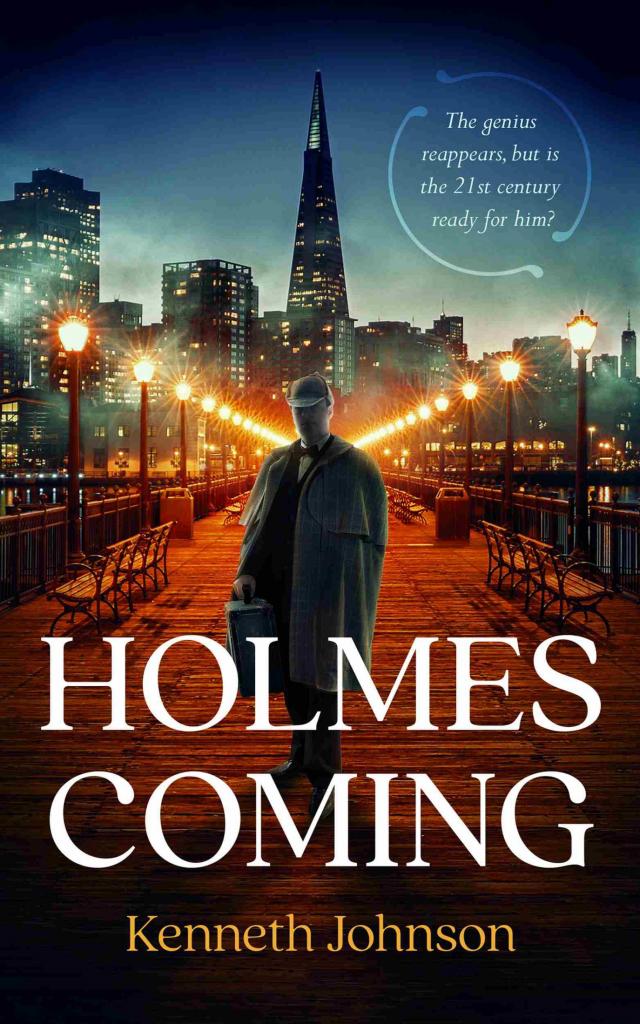


Keeping a stealthy profile, he trod through the dark, foggy compound, the master cat burglar sneaking closer to his quarry—for all of seventeen seconds, when he was blinded by bright xenon emergency lights. A blaring alarm sounded, and Holmes found himself nose-to-fangs with a giant Baskervillian hound: a two-hundred-pound, snarling English mastiff, straining against its leash, eager to bite his face off.
Holmes also felt the muzzle of a .357 Magnum tap him on top of his deerstalker.
On my side of the wall, I could see the bright lights, hear the alarm, the ferocious dog, and the deep growling voices of at least two other men, who were clearly taking my houseguest into custody.
I slapped my forehead down into the palm of my hand in frustration. Cold rain ran down my face and neck as I tried to decide what—if anything—I could do now.
Inside and out, James Moriarty Booth’s exceedingly contemporary estate consisted of broad, curving expanses of poured concrete in the I. M. Pei style of architecture. The giant mastiff was led off by its handler while the other two guards, one with a shaved head and the other a curly-haired redhead, trundled Holmes across an outdoor terrace and through a tall sliding glass door into the great room of the house.
Inside, Holmes saw that the walls were white, with many works of modern art and sculpture displayed. The ceiling of the great room was twenty-five feet high. Light reflecting off the large swimming pool outside flickered, giving shimmering blue movement to the ceiling. A large, ancient, hanging tapestry covered part of one wall in contrast to the contemporary chrome and black glass tables of various sizes, including a large gaming table and one for dining with twelve guests. There were two separate sitting areas with black leather couches and chairs.
Holmes took in all of this while being thoroughly frisked by the muscular guard with a shaved head. Holmes was being made to spread his legs and lean with both hands flat on top of a side desk, which held some paperwork, a calendar, and couple of file folders labeled with bold numbers. Hanging on the wall over the desk was the most garish painting Holmes had ever seen—as though a human face had been scrambled. It had a large eye, a small eye, two equally mismatched ears, a strangely triangular nose, and huge lips, all rendered in brilliant and conflicting clownish colors and juxtaposed in the most peculiar, nonhuman, geometric manner. He assumed it to be a purposely outlandish cartoon. It was dated 1913 but the artist’s scrawled signature was unclear. It was later determined to be a rare Picasso—stolen, of course.
The curly redhead had gone quickly up a broad, polished wood stairway and was now walking back down with cold eyes focused on Holmes.
“Did you inform your master who I am?” Holmes asked him with stern formality. In spite of his capture and being at the mercy of these men, he refused to concede a milligram of confidence.
Curly nodded darkly and directed Holmes’ attention upward toward a balcony overlooking the living room. On the wide white wall near the balcony, Holmes saw a large shadow slowly approaching like a dark cloud. A man appeared, looking down over the balcony railing with an air of menace. He stood above, assessing Holmes, who could not see the man’s face because of the light silhouetting him.
After a moment, the man withdrew from the balcony and descended the stairs. He had apparently attended a black-tie affair earlier but had removed his tuxedo jacket and untied his bow tie, which draped around his neck atop his formal white shirt.
James Moriarty Booth was seventy-two, though he looked several years older. Holmes recognized him from the photos he’d seen in Detective Griffin’s office and online, but in person it was clearer that Booth’s face and physiognomy diverged considerably from Professor Moriarty’s balding, tall, lean, and hungry looks. Booth was sturdy and an inch shorter than Holmes. His graying red hair was thick and perfectly trimmed. His face, rather than gauntly triangular, was oval and well fed. His thick Irish nose had apparently been in more than one fistfight. He walked with a slight limp due to his deformed right foot, but Booth’s countenance and presence were nonetheless imposing; he looked every bit a forbidding and powerful crime baron.
Though Booth was quite different physically from Professor Moriarty, Holmes noted their unifying genetics and lineage in Booth’s thin, sneering lips and particularly his pale eyes with their sinister glint and piercing pinpoint pupils.
Upon seeing Holmes’ face more closely, Booth reacted sharply and stared with studied amazement. He then broke into scornful laughter.
“Ah,” Holmes said with satisfaction and a raised eyebrow. “Of course you recognize me, Mr. Booth. And I see you still have the scar on the back of your hand from that night sixty years ago.”
Booth crossed the polished oak floor, circling Holmes to get a closer look. His voice, like his features, was strong. “I didn’t know that Holmes had any offspring. My great-grandfather thought he was gay.”
“Indeed I am!” Holmes said with pride, grandly sweeping his cape-like coat as he turned to face Booth full on. “And never gayer than when confronting a clever enemy.”
Booth came to a stop in front of his black marble fireplace. The light from the fire flickered, outlining Booth—rather satanically, Holmes thought.
“I am not a son or grandson, however,” Holmes stated. “I am the original Holmes.”
“Not possible.” Booth eyed him cynically. “I saw his cold corpse.”
“Cold, yes,” Holmes acknowledged, then smiled and continued authoritatively. “Corpse, not even close. I am the very man whose valuables you absconded with sixty years ago. Perhaps you’d care to refresh your memory by comparing my face to the photographs you stole—if you still possess them.”
Booth eyed Holmes coolly, keenly scrutinizing him for a long moment. Then he took up the challenge, saying, “Actually . . .” Booth stepped over to a seven-foot-tall chrome curio cabinet with clear glass doors, saying, “I think I did keep them. Among some of my family’s souvenirs.” Inside the cabinet Holmes could see on thick glass shelves a strange assortment of items including a blackjack, an old Brink’s money bag, a 1930s tommy gun, an elegant twelve-inch Lladró figurine of a woman with the head broken off, as well as a framed—and autographed—mugshot of someone named Alphonse Capone. Amid other interesting heirlooms Holmes noted a bell jar containing what looked disturbingly like a shriveled human foot.
Booth had opened the cabinet doors. “That hit up in Marin was my first big score. Those diamonds of yours set me up in business.” He looked on one shelf, then reached up to a higher one, moving a vintage axe and a tarnished set of brass knuckles to get at something behind them.
“An evil empire,” said Holmes, “which includes drug smuggling, thievery, murder, and money laundering—whatever that is.”
“What can I say?” Booth smirked. “Business is good.” He brought down from the shelf a rectangular metal box twelve by eighteen inches and nine inches deep. Holmes knew the dimensions specifically because it was, indeed, his stolen tin box. He felt a surge of emotion, but artfully concealed it within.
Booth placed the tin box on a table near the fireplace, then opened its lid.
Holmes maintained a level expression, but his mouth went dry as Booth lifted out several of the photographs that lay on top of a sheaf of other papers. The crime baron paused as he looked incredulously at the black-and-white photo in his hand. It showed George Bernard Shaw with his hand resting comradely on Holmes’ shoulder.
Holmes drew a controlled, but internally tense breath. Everything he needed to conclusively prove his identity was there, barely six feet away.
Booth held the photo up and compared it to the living, breathing Holmes in front of him. There was no denying it was the same person. At the same age.
Booth spoke with low bewilderment, “I’ll be goddamned.” He laughed. “I guess I do have you to thank for all my success. But how the hell can you be alive?”
“Merely a trifling bit of chemistry, but also a huge determination to bring villains like yourself to justice.”
Booth stared at him, still awed by the uncanny circumstances. He was slowly absorbing the impossible yet undeniable reality of the Victorian man standing before him. Finally, he smiled. “Mr.—” Booth still had difficulty acknowledging it. “Mr. Holmes,” he inadvertently chuckled, glancing around incredulously, speaking aside to himself, “I can’t even believe I’m having this conversation.” Then his pinpoint pupils zeroed in again on the detective. “Within these seriously secure walls, Mr. Holmes, I’ll admit certain things to you, but I run a very careful business. So while the cops—and the feds—have been after me for years, they’ve never even gotten close to succeeding.”
“But I was not on the case . . . until now.”
“And perhaps not for much longer,” Booth said with a cunning grin.
While Holmes was in the midst of his potentially lethal close encounter, I had hurriedly pulled his nifty ladder back over the top and thrown it in my trunk. I sped my car on up Dardenelle Avenue to the front entrance of the imposing Moriarty Booth family estate. Then, standing in the misty darkness, talking fast through the ten-foot-tall wrought iron gate to the wrought iron, steely-eyed guard behind it, I said, “I’m terribly sorry to bother you. I’m Dr. Amy Winslow from Saint Francis Hospital in the city.” I handed one of my business cards through the wet fence. “One of our mentally disturbed patients escaped tonight, and I’m afraid I saw him climbing over the wall into your estate.”
The guard turned the card over in his thick fingers, considering it for what felt to me like an endless moment. I had put on my best smile, playing it as calmly as I could, and trying to suppress my fears of what they might be doing to Holmes while I stood helplessly out there in the drizzle. Finally, the guard moved slightly away from me and took a cell phone from his jacket.
Inside Booth’s living room at that moment, Holmes had managed to inch a small step closer to Booth. He clearly saw the Scotland Yard paper with his fingerprints on it beneath the photos in Booth’s hand and saw his other documents in the box. Holmes desperately wanted to lunge and grab them, but he was wary of the two unpleasant security guards hovering behind him.
Booth was saying, “My great-grandfather Henry was obsessed with finding you.” His soft, precise fashion of speech carried a conviction of sincerity and imminent danger. “It took him decades, but his perseverance paid off. He told me you’d killed his brother James. That’s who I’m named for.”
“The easiest deduction I ever made,” Holmes said sharply. “I also have since discovered that you have been carrying on the family’s corrupt business and criminal traditions.”
Booth held Holmes’ eyes. “You know, pal, I really liked Great-Grandpa Henry.”
“Apparently not enough to report his death or reclaim his body from my laboratory.”
“Didn’t matter, and he would have agreed. What was important was the education he’d given to my grandfather, to my father, and to me.” His eyes focused on Holmes with forbidding dark humor. “And one of the most important aspects of that education was instilling in us the Moriarty commitment to vengeance.” Booth imbued the word with biting vitriol as his eyes bored into Holmes.
But as they gazed at each other, Holmes observed Booth’s deadly expression unaccountably begin to transform.
Slowly, Booth’s face became less and less menacing as its taut muscles relaxed. His left thumb and forefinger pulled slightly on his thick lower lip as he glanced again from Holmes to the photos in his own right hand and then back at Holmes. A more enlightened thought had apparently dawned on Booth. He seemed to be mulling over an idea as he eyed Holmes narrowly. Finally, he said, “An equally important lesson I learned from him, however, was to never miss a golden opportunity.” Booth drew a breath, glancing once more at the photos and documents while pondering. “If you actually did manage this, this what?” He searched for the words. “Incredible hibernation? By God, that’s a mind-bending, astonishing achievement! Worthy of congratulations and tremendous respect. It marks you as a highly valuable man of extraordinary genius.”
Holmes knew that was all true, but his brow remained tightly knit, gazing steadily at Booth, curious about the tack that the crime baron was shifting onto.
“It marks you, sir,” Booth continued slowly, “as someone to whom I might even be willing to extend professional courtesies. Perhaps even a helping hand.”
Holmes blinked in abject amazement. Booth caught it, saying with a wise grin, “Yes, yes, your knee-jerk reaction is negative, naturally. That’s to be expected. But take a breath. Like I have.” When he continued, his voice was softer, lower, with Mephistophelian smoothness. “Allow yourself to think on it just for a moment, my friend. Assuming you are who you say you are—as you do indeed seem to be—that makes you a total newcomer to this present-day world. A time very different from the one you left behind. But perhaps if you could see your way to leaving that past behind, to let bygones be bygones.” His voice grew even more cordial and confidential. “I can offer you insights, counsel, guidance, and invaluable opportunities. Into the hands of someone as clever and resourceful as you, I am capable of bringing unimaginable fortune. If you were to consider allying yourself with me, I would—”
“Well,” Holmes interrupted, laughing darkly, as though he’d had a sudden unanticipated epiphany. “That is certainly something I’d never have contemplated a century ago.”
“I’m sure not.” Booth smiled, urging, “But those who can’t keep up with changing times have little chance of surviving.” It was friendly but also a thinly veiled threat. “Those who do adjust, however . . .” He proudly indicated the grandeur of the great room and all the wealth it represented.
Holmes paused, seriously thinking it through then acknowledging, “And you are correct that under current circumstances I am slightly compromised.”
“In more ways than one, Mr. Holmes,” Booth pointed out, and let that sink in. “However, my offer is quite serious and sincere.” He saw that Holmes seemed to have relaxed slightly, which gave the impression he was allowing himself to carefully weigh the proposition. Holmes lowered his head until his chin rested on his chest, as though giving deepest consideration to Booth’s offer.
Holmes was actually doing something else entirely: he was looking downward and back to determine exactly how many inches behind him the guards’ feet were and their exact lateral placement. He was making a final assessment of the playing field. From the moment of his capture, Holmes had been formulating how to still achieve his goal and escape with his papers. He’d initially been disadvantaged by the bestial dog and the gun at his head, but now he had much better prospects. While his legs were being frisked, he’d glimpsed the pistol now resting in a shoulder holster beneath the guard’s jacket, and he’d noted the sliding glass door through which they had entered was still open. With the element of surprise also on his side, he was confident that it was now “advantage Holmes” to win the game, set, and match.
Standing there, facing Booth, Holmes knew he could eliminate the guards behind him. His scuffle with the street teens had been but a mere trifle compared to the lethal force he could unleash when necessary. His full-blown baritsu attack could be debilitating, even deadly. One night in South London, two brutal leaders of the notorious Peaky Blinders gang had him in exactly the same compromising position, but Holmes had ended their careers in a flash. He knew that with the knuckles on each of his hands sharpened into flat, axe-like wedges, he could pivot around and devastatingly pile-drive them into the throats of both guards, crushing their Adam’s apples in the blink of an eye. As they crumpled, stunned and choking, he could snatch the gun from the holster, spin back around, and have Booth at bay to use as a hostage in tow while escaping out the open door with his identity papers secured inside the pocket of his cape.
While Holmes was locking in his plan, he glanced up as Curly walked past him toward Booth with a fingertip touching his right earbud, indicating to Booth he was getting a message. Then he whispered something into Booth’s ear. The underworld chieftain listened, then seemed greatly amused. Curly walked back behind Holmes, who sensed that the moment of truth was near at hand. Holmes looked down and behind again to reconfirm Curly’s exact position, then looked up to see that Booth’s shrewd eyes had leveled on him.
“Someone’s at my front gate, Mr. Holmes,” Booth said with quiet humor. “Declaring that you’re a mental case.”
Holmes laughed, as best he could. Booth laughed along with him like hale fellows well met. Then Booth pretended to frown as he contemplated, “Of course, if they saw these photos and this identity information, they might think again.” Holmes steadily met Booth’s gaze. “But listen,” Booth resumed in his generous, comradely tone, “let’s get back to my proposition. I’m really hoping you’ll accept the opportunity to gain for yourself a future of unlimited wealth—and power. I guarantee you won’t be disappointed.” He shifted Holmes’ identity photos into his left hand then slowly extended his right hand toward Holmes and nodded encouragingly.
The tall Englishman nodded back appreciatively, then explained, “Sorry, but I would be disappointed with myself.” Internally Holmes was coiling his muscles, readying to strike like lightning and disable the minions. Success depended upon exquisite, precise timing.
Booth kept his inviting hand extended a moment longer, finally saw it was useless, and withdrew it. “Okay,” he said, exhaling a sincerely disappointed sigh. “Then let’s just save everyone a lot of trouble.”
Less than a half second before Holmes could launch his attack, Booth jumbled the timing by abruptly scooping up the rest of Holmes’ papers and blissfully tossing them all into the fire.
Holmes leapt forward shrieking, “Noooo!” but he was tackled to the floor by the guards, who immobilized him facedown as he struggled, bellowing, “No! Confound you!”


