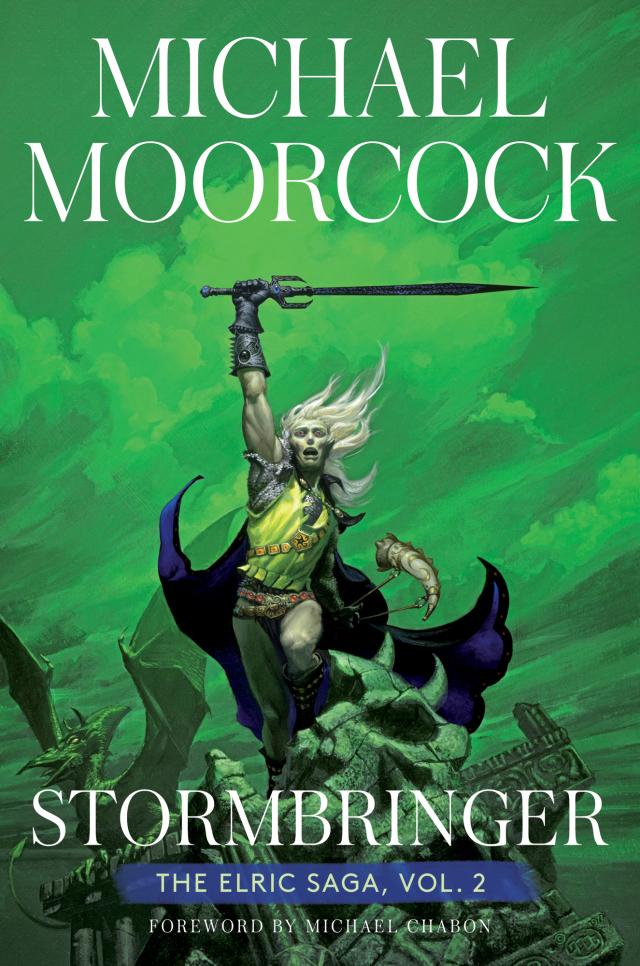
Stormbringer, p.1
Stormbringer,
p.1


Thank you for downloading this Simon & Schuster ebook.
Get a FREE ebook when you join our mailing list. Plus, get updates on new releases, deals, recommended reads, and more from Simon & Schuster. Click below to sign up and see terms and conditions.
CLICK HERE TO SIGN UP
Already a subscriber? Provide your email again so we can register this ebook and send you more of what you like to read. You will continue to receive exclusive offers in your inbox.
Publisher’s Notice
The publisher has provided this ebook to you without Digital Rights Management (DRM) software applied so that you can enjoy reading it on your personal devices. This ebook is for your personal use only. You may not print or post this ebook, or make this ebook publicly available in any way. You may not copy, reproduce, or upload this ebook except to read it on your personal devices.
Copyright infringement is against the law. If you believe the copy of this ebook you are reading infringes on the author’s copyright, please notify the publisher at: simonandschuster.biz/online_piracy_report.
FOREWORD
The minor masterpiece The Sailor on the Seas of Fate, like almost all of Michael Moorcock’s efforts in the subgenre of heroic fantasy, is a complicated work, in the original sense of the term: that is, it folds together, with an insight both sophisticated and intuitive, 1) an apparently simple adventure story told in three episodes that are themselves interleaved in puzzling ways; 2) a sharp critique, of adventure stories generally (with their traditional freight of cruelty, wish-fulfillment, sexism, and violence), and of the heroic fantasy mode in particular; and 3) a remarkable working out (independently one feels of the work of Joseph Campbell) of the Transcendentalist premise that, as Emerson wrote, “one person wrote all the books.” Moorcock took this literary universalism, with its implied corollary that one person reads all the books, and in Sailor began his career-long demonstration of the logical conclusion that all the books are one book, and all the heroes one hero (or antihero). From here it is only a short step, which the reader of heroic fantasy is eager to make, to the proposition that all readers and all writers are Odysseus, or Kull, or Elric of Melniboné, sharing through the acts of reading and writing a single essential, eternal heroic nature. This nature links us—all we heroes and Moorcocks—across all eras and lands. One might even attempt to chart these interconnections of story, hero, reader, and writer on a single map: Moorcock is such a cartographer. He called his map of our story-shaped world “the Multiverse.”
It was Moorcock’s insight, and it has been his remarkable artistic accomplishment, not just to complicate all this apparatus and insight and storytelling prowess, packing into one short novel such diverting fare as speculation on ontology and determinism, gory subterranean duels with giant killer baboons, literary criticism (the murmuring soul-vampiric sword Stormbringer offers what is essentially a running commentary on the equivocal nature of heroic swordsmen in fiction), buildings that are really alien beings, and ruminations on the self-similar or endlessly reflective interrelationship of hero, writer, and reader; but to do so with an almost offhanded ease, with a strong, plain, and unaffected English prose style that was nearing its peak in the mid-seventies.
That’s part of what I would have liked to tell Michael Moorcock, when I recently had the good fortune to attend the Nebula Awards ceremony in Austin, Texas, and watch him receive a Grandmaster Award. I would have liked to tell him that when I was fourteen years old I found profound comfort in feeling that I shared in the nature of lost and wandering Elric, isolated but hungering for connection, heroically curious, apparently weak but capable of surprising power, unready and unwilling to sit on the moldering throne of his fathers but having nothing certain to offer in its stead. I would have liked to tell him that his work as a critic, as an editor, and as a writer has made it easier for me and a whole generation of us to roam the “moonbeam roads” of the literary multiverse. But as Mike rose to accept his award all I could do was sit there, next to him—marveling down to the deepest most twisted strands of my literary DNA—and applaud.
MICHAEL CHABON
MAY 2008
THE VANISHING TOWER
For Ken Bulmer, who, as editor of the magazine Sword and Sorcery, asked me to write this book as a serial for him. The magazine, which was to be a companion to Vision of Tomorrow, never appeared due to the backer withdrawing his support from both magazines.
THE VANISHING TOWER
CONTENTS
BOOK ONE: THE TORMENT OF THE LAST LORD
CHAPTER ONE: PALE PRINCE ON A MOONLIT SHORE
CHAPTER TWO: WHITE FACE STARING THROUGH SNOW
CHAPTER THREE: FEATHERS FILLING A GREAT SKY
CHAPTER FOUR: OLD CASTLE STANDING ALONE
CHAPTER FIVE: DOOMED LORD DREAMING
CHAPTER SIX: JEWELLED BIRD SPEAKING
CHAPTER SEVEN: BLACK WIZARD LAUGHING
CHAPTER EIGHT: A GREAT HOST SCREAMING
BOOK TWO: TO SNARE THE PALE PRINCE
CHAPTER ONE: THE BEGGAR COURT
CHAPTER TWO: THE STOLEN RING
CHAPTER THREE: THE COLD GHOULS
CHAPTER FOUR: PUNISHMENT OF THE BURNING GOD
CHAPTER FIVE: THINGS WHICH ARE NOT WOMEN
CHAPTER SIX: THE JESTING DEMON
BOOK THREE: THREE HEROES WITH A SINGLE AIM
CHAPTER ONE: TANELORN ETERNAL
CHAPTER TWO: RETURN OF A SORCERESS
CHAPTER THREE: THE BARRIER BROKEN
CHAPTER FOUR: THE VANISHING TOWER
CHAPTER FIVE: JHARY-A-CONEL
CHAPTER SIX: PALE LORD SHOUTING IN SUNLIGHT
BOOK ONE THE TORMENT OF THE LAST LORD
…and then did Elric leave Jharkor in pursuit of a certain sorcerer who had, so Elric claimed, caused him some inconvenience…
—The Chronicle of the Black Sword
1 Pale Prince on a Moonlit Shore
In the sky a cold moon, cloaked in clouds, sent down faint light that fell upon a sullen sea where a ship lay at anchor off an uninhabited coast.
From the ship a boat was being lowered. It swayed in its harness. Two figures, swathed in long capes, watched the seamen lowering the boat while they, themselves, tried to calm horses which stamped their hoofs on the unstable deck and snorted and rolled their eyes.
The shorter figure clung hard to his horse’s bridle and grumbled.
“Why should this be necessary? Why could not we have disembarked at Trepesaz? Or at least some fishing harbour boasting an inn, however lowly…”
“Because, friend Moonglum, I wish our arrival in Lormyr to be secret. If Theleb K’aarna knew of my coming—as he soon would if we went to Trepesaz—then he would fly again and the chase would begin afresh. Would you welcome that?”
Moonglum shrugged. “I still feel that your pursuit of this sorcerer is no more than a surrogate for real activity. You seek him because you do not wish to seek your proper destiny…”
Elric turned his bone-white face in the moonlight and regarded Moonglum with crimson, moody eyes. “And what of it? You need not accompany me if you do not wish to…”
Again, Moonglum shrugged his shoulders. “Aye. I know. Perhaps I stay with you for the same reasons that you pursue the sorcerer of Pan Tang.” He grinned. “So that’s enough of debate, eh, Lord Elric?”
“Debate achieves nothing,” Elric agreed. He patted his horse’s nose as more seamen, clad in colourful Tarkeshite silks, came forward to take the horses and hoist them down to the waiting boat.
Struggling, whinnying through the bags muffling their heads, the horses were lowered, their hoofs thudding on the bottom of the boat as if they would stave it in. Then Elric and Moonglum, their bundles on their backs, swung down the ropes and jumped into the rocking craft. The sailors pushed off from the ship with their oars and then, bodies bending, began to row for the shore.
The late-autumn air was cold. Moonglum shivered as he stared towards the bleak cliffs ahead. “Winter is near and I’d rather be domiciled at some friendly tavern than roaming abroad. When this business is done with the sorcerer, what say we head for Jadmar or one of the other big Vilmirian cities and see what mood the warmer clime puts us in?”
But Elric did not reply. His strange eyes stared into the darkness and they seemed to be peering into the depths of his own soul and not liking what they saw.
Moonglum sighed and pursed his lips. He huddled deeper in his cloak and rubbed his hands to warm them. He was used to his friend’s sudden lapses of silence, but familiarity did not make him enjoy them any better. From somewhere on the shore a nightbird shrieked and a small animal squealed. The sailors grunted as they pulled on their oars.
The moon came out from behind the clouds and it shone on Elric’s grim, white face, made his crimson eyes seem to glow like the coals of hell, revealed the barren cliffs of the shore.
The sailors shipped their oars as the boat’s bottom ground on shingle. The horses, smelling land, snorted and moved their hoofs. Elric and Moonglum rose to steady them.
Two seamen leapt into the cold water and brought the boat up higher. Another patted the neck of Elric’s horse and did not look directly at the albino as he spoke. “The captain said you would pay me when we reached the Lormyrian shore, my lord.”
Elric grunted and reached under his cloak. He drew out a jewel that shone brightly through the darkness of the night. The sailor gasped and stretched out his hand to take it. “Xiombarg’s blood, I have never seen so fine a gem!”
Elric began to lead the horse into the shallows
and Moonglum hastily followed him, cursing under his breath and shaking his head from side to side.
Laughing among themselves, the sailors shoved the boat back into deeper water.
As Elric and Moonglum mounted their horses and the boat pulled through the darkness towards the ship, Moonglum said: “That jewel was worth a hundred times the cost of our passage!”
“What of it?” Elric fitted his feet in his stirrups and made his horse walk towards a part of the cliff which was less steep than the rest. He stood up in his stirrups for a moment to adjust his cloak and settle himself more firmly in his saddle. “There is a path here, by the look of it. Much overgrown.”
“I would point out,” Moonglum said bitterly, “that if it were left to you, Lord Elric, we should have no means of livelihood at all. If I had not taken the precaution of retaining some of the profits made from the sale of that trireme we captured and auctioned in Dhakos, we should be paupers now.”
“Aye,” returned Elric carelessly, and he spurred his horse up the path that led to the top of the cliff.
In frustration Moonglum shook his head, but he followed the albino.
* * *
By dawn they were riding over the undulating landscape of small hills and valleys that made up the terrain of Lormyr’s most northerly peninsula.
“Since Theleb K’aarna must needs live off rich patrons,” Elric explained as they rode, “he will almost certainly go to the capital, Iosaz, where King Montan rules. He will seek service with some noble, perhaps King Montan himself.”
“And how soon shall we see the capital, Lord Elric?” Moonglum looked up at the clouds.
“It is several days’ ride, Master Moonglum.”
Moonglum sighed. The sky bore signs of snow and the tent he carried rolled behind his saddle was of thin silk, suitable for the hotter lands of the East and West.
He thanked his gods that he wore a thick quilted jerkin beneath his breastplate and that before he had left the ship he had pulled on a pair of woollen breeks to go beneath the gaudier breeks of red silk that were his outer wear. His conical cap of fur, iron and leather had earflaps which were now drawn tightly and secured by a thong beneath his chin and his heavy deerskin cape was drawn closely around his shoulders.
Elric, for his part, seemed not to notice the chill weather. His own cape flapped behind him. He wore breeks of deep blue silk, a high-collared shirt of black silk, a steel breastplate lacquered a gleaming black, like his helmet, and embossed with patterns of delicate silverwork. Behind his saddle were deep panniers and across this was a bow and a quiver of arrows. At his side swung the huge runesword Stormbringer, the source of his strength and his misery, and on his right hip was a long dirk, presented him by Queen Yishana of Jharkor.
Moonglum bore a similar bow and quiver. On each hip was a sword, one short and straight, the other long and curved, after the fashion of the men of Elwher, his homeland. Both blades were in scabbards of beautifully worked Ilmioran leather, embellished with stitching of scarlet and gold thread.
Together the pair looked, to those who had not heard of them, like free-travelling mercenaries who had been more successful than most in their chosen careers.
Their horses bore them tirelessly through the countryside. These were tall Shazaarian steeds, known all over the Young Kingdoms for their stamina and intelligence. After several weeks cooped up in the hold of the Tarkeshite ship they were glad to be moving again.
Now small villages—squat houses of stone and thatch—came in sight, but Elric and Moonglum were careful to avoid them.
Lormyr was one of the oldest of the Young Kingdoms and much of the world’s history had been made there. Even the Melnibonéans had heard the tales of Lormyr’s hero of ancient times, Aubec of Malador of the province of Klant, who was said to have carved new lands from the stuff of Chaos that had once existed at World’s Edge. But Lormyr had long since declined from her peak of power (though still a major nation of the south-west) and had mellowed into a nation that was at once picturesque and cultured. Elric and Moonglum passed pleasant farmsteads, well-nurtured fields, vineyards and orchards in which the golden-leaved trees were surrounded by time-worn, moss-grown walls. A sweet land and a peaceful land in contrast to the rawer, bustling north-western nations of Jharkor, Tarkesh and Dharijor which they had left behind.
Moonglum gazed around him as they slowed their horses to a trot. “Theleb K’aarna could work much mischief here, Elric. I am reminded of the peaceful hills and plains of Elwher, my own land.”
Elric nodded. “Lormyr’s years of turbulence ended when she cast off Melniboné’s shackles and was first to proclaim herself a free nation. I have a liking for this restful landscape. It soothes me. Now we have another reason for finding the sorcerer before he begins to stir his brew of corruption.”
Moonglum smiled quietly. “Be careful, my lord, for you are once again succumbing to those soft emotions you so despise…”
Elric straightened his back. “Come. Let’s make haste for Iosaz.”
“The sooner we reach a city with a decent tavern and a warm fire, the better.” Moonglum drew his cape tighter about his thin body.
“Then pray that the sorcerer’s soul is soon sent to limbo, Master Moonglum, for then I’ll be content to sit before the fire all winter long if it suits you.”
And Elric made his horse break into a sudden gallop as grey evening closed over the tranquil hills.
2 White Face Staring Through Snow
Lormyr was famous for her great rivers. It was her rivers that had helped make her rich and had kept her strong.
After three days’ travelling, when a light snow had begun to drift from the sky, Elric and Moonglum rode out of the hills and saw before them the foaming waters of the Schlan River, tributary of the Zaphra-Trepek which flowed from beyond Iosaz down to the sea at Trepesaz.
No ships sailed the Schlan at this point, for there were rapids and huge waterfalls every few miles, but at the old town of Stagasaz, built where the Schlan joined the Zaphra-Trepek, Elric planned to send Moonglum into town and buy a small boat in which they could sail up the Zaphra-Trepek to Iosaz where Theleb K’aarna was almost certain to be.
They followed the banks of the Schlan now, riding hard and hoping to reach the outskirts of the town before nightfall. They rode past fishing villages and the houses of minor nobles, they were occasionally hailed by friendly fishermen who trawled the quieter reaches of the river, but they did not stop. The fishermen were typical of the area, with ruddy features and huge curling moustaches, dressed in heavily embroidered linen smocks and leather boots that reached almost to their thighs; men who in past times had been ever ready to lay down their nets, pick up swords and halberds and mount horses to go to the defence of their homeland.
“Could we not borrow one of their boats?” Moonglum suggested. But Elric shook his head. “The fishermen of the Schlan are well known for their gossiping. The news of our presence might well precede us and warn Theleb K’aarna.”
“You seem needlessly cautious…”
“I have lost him too often.”
More rapids came in sight. Great black rocks glistened in the gloom and roaring water gushed over them, sending spray high into the air. There were no houses or villages here and the paths beside the banks were narrow and treacherous so that Elric and Moonglum were forced to slow their pace and make their way with caution.
Moonglum shouted over the noise of the water: “We’ll not reach Stagasaz by nightfall now!”
Elric nodded. “We’ll make camp below the rapids. There.”
The snow was still falling and the wind drove it against their faces so that it became even more difficult to pick their way along the narrow track that now wound high above the river.
But at last the tumult began to die and the track widened out and the waters calmed and, with relief, they looked about them over the plain to find a likely camping place.
It was Moonglum who saw them first.
His finger was unsteady as he pointed into the sky towards the north.