

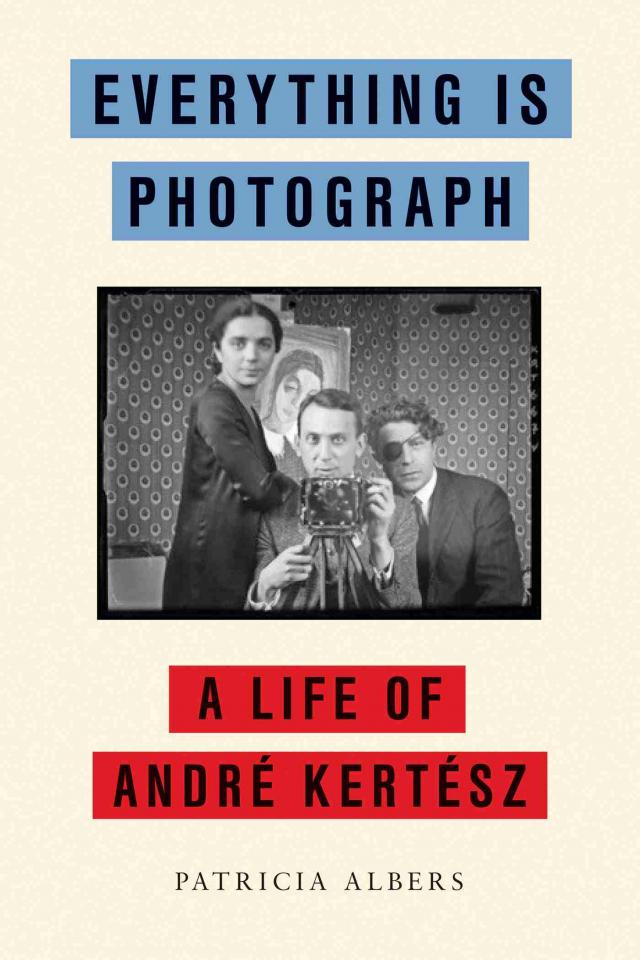
Everything is photograph, p.13
Everything Is Photograph,
p.13


For now, André was on his own. He knew only a few people in Paris and was reticent about asking for help from those he did know. Without any French, he had few job prospects. So he tried to live on thin air, eating in cheap bistros, getting by on, say, a banana and milk, or skipping meals altogether. He tracked every centime that left his pocket. Undernourished, anxious, and bereft of family and sweetheart, he couldn’t sleep either. It didn’t help that the weather turned gloomy and wet. Even so, he felt alive to the city around him.
That late fall, a lank figure could be seen ambling along the damp streets. André photographed Paris with a newcomer’s heightened visual awareness. Although he followed a tourist’s itinerary, he did not view the city with a tourist’s eye. Even the Eiffel Tower escaped postcard treatment. One foggy day, Andor visited an architect friend of Goldfinger’s who lived in an upper-floor apartment in Passy, across the river from the monument. André’s photograph from the friend’s window shows a block of apartment buildings and a sky above blank with fog except for the tower’s tip hovering like a modernist Christ in ascension.
André came away from the Place de la Concorde with a view of a fountain embellished with a mermaid clutching a sea creature. At the Moulin Rouge, he took a photograph that writes its own caption with electric signage aglow in the night:
LA REVUE MISTINGUETT
MOULIN ROUGE
BAL
That image was among those André took when his insomnia, fascination with electric lights, and search for companionship pushed him out into the streets after dark. Another late night, as he was trekking from the Dôme to a hotel on the rue Saint-Bon, he found the parvis of Notre Dame flanked by spotlights and splotchy with puddles. He halted, screwed his camera into his tripod, and opened the shutter. Then he shivered through a half-hour exposure. He came away with an otherworldly image in which the luminous wet pavement holds the eye longer than the cathedral’s facade.
André lingered longest of all along the rain-swollen Seine, where the fishermen caught his attention. Like him, they were casting lines into the unknown and waiting to see what would surface.[5]
* * *
—
In December, André opened a package from Jenő to find the developing trays, washer for large glass plates, and camera he had requested. A secondhand Goerz Anschütz, his new camera took 10 by 12.5 centimeter plates. It had a Goerz Dagor 150 millimeter lens, shutter speeds up to 1/1000th of a second, and a top-down viewfinder. By all evidence, it would not prove a favorite. That month’s mail also brought bounty from Ernesztina: some pastries, a chunk of goose liver in lard, and three pairs of long stockings. To top off the holidays, Tihanyi blew the cash he’d earned from a few sales to throw a New Year’s Eve bash, and 1926 was off to a fine start.
It was probably at Tihanyi’s that André met the Hungarian-born French sculptor Joseph Csáky. He and André liked each other immensely. A master of geometric form, Csáky was known for his prewar Cubist sculptures. He lived in the Left Bank lair known as La Ruche (the Beehive), where his studio neighbored those of Alexander Archipenko, Fernand Léger, and Marc Chagall. André was invited to visit. He photographed his new friend looking professorial in wire-rimmed spectacles and a high-buttoned sweater. Csáky had turned his energies to avant-garde marionettes and decorative furniture. But André most admired, it seems, his bronze and stone sculptures, with their complexes of interlocking masses and planes.
More portraits soon emerged from one of André’s ad hoc darkrooms, notably several of Gyula Zilzer. An engineer-turned-artist and onetime classmate of Jenő’s in Budapest, Zilzer used to hang around with the Kertész brothers in Budapest and Szitgetbecse. To André, he was almost like family. Zilzer had left Hungary in 1920 for the usual reasons: anti-Semitism and lack of work. He bounced between Trieste and Munich, then back to Budapest, before settling in Paris, where he published anti-Fascist caricatures. He was living mostly on earnings from Kaleidoscope, his portfolio of grotesque allegorical lithographs in the spirit of Goya.[6] Taken in Zilzer’s hotel room, André’s portraits convey the impression of a man who’s brainy and brooding. Zilzer clenches his pipe in his mouth. Folk objects sit on his desk. Pen and ink sit at the ready.
André also turned his lens on Tihanyi. In one memorable image, the artist stands in his digs at the Hôtel des Terrasses, the nerve center of bohemian Budapest-by-the-Seine in the thirteenth arrondissement.[7] He wears wool trousers and a wool shirt topped with a stained jacket that could be a bandleader’s cast-off. Watchful, affable, and baggy-eyed, Tihanyi faces his portraitist. Smoke from the cigarette he’s holding shoots from his lips, does a little dance, and briefly hangs in the air. Although it’s rendered with the matter-of-factness of photography, it’s also an abstract form and abstract idea: the man’s thoughts, the painter’s meandering brushstrokes, the deaf person’s atonal speech made nimble and graceful.
When the two men traipsed through Paris together, Tihanyi would steer André to places he might want to photograph. One was an atelier where used mannequins were refurbished. A lower-body mannequin caught André’s attention. In Legs, Paris, it stands upside down on a workbench, its limbs forking toward the window above. The mannequin’s waxiness and slender curves stand out in its grungy surroundings. Nearby, rather ominously, hangs a looped rope.[8] Very surreal.
If André knew anything about Surrealism when he took Legs, Paris, it would have been from Tihanyi. Launched by the French writer André Breton in 1924, the Surrealist movement mined free association, chance, dreams, anything that flowed from the subconscious. By tapping that inchoate creativity and reconciling it with everyday reality, the Surrealists were attempting to dethrone rationality and liberate humanity. They ferreted out enigmatic objects, fetishized mannequins as objects of erotic fantasy, and legitimized whatever transgressed bourgeois norms, dismembered female bodies included.
Ravaged male bodies also figured in the Surrealist lexicon. Breton’s first manifesto speaks of a phrase that came “knocking at the window“ one evening as the writer was falling asleep: “There is a man cut in two by the window.” Those words, Breton writes, were accompanied by “the faint visual image of a man walking cut half way up by a window perpendicular to the axis of his body.”[9] Change “man” to “woman” and “window” to “table,” and there’s André’s photograph, taken in Paris the following year.
Another day, André was wandering along the Seine when he chanced upon a trio of canvas-draped hulks stored on the quay. In André’s photograph, they suggest a small herd of fantastical beasts grazing next to the river. Beyond stood the Pont de l’Archevêché, its three arches mysteriously reprising the triad.[10]
Like Legs, Paris, André’s Behind Notre Dame, Paris would be labeled Surrealist. It reminded viewers of The Enigma of Isidore Ducasse, made in 1920, then remade in 1972, by the Dadaist Man Ray. The artist had wrapped a Singer sewing machine in an army blanket and tied it with twine. Later he photographed this creation inspired by a quote from the nineteenth-century writer and Surrealist idol Isidore Ducasse: “Beautiful as the accidental encounter, on a dissecting table, of a sewing machine and an umbrella.”
Stubbornly independent, André would always brush off any link to Surrealism. It’s true that he never participated in that or any other artistic movement. He would always be a movement of one, and not even a movement because his work is untheorized and instinctual. One could point out that Underwater Swimmer, taken in Esztergom in 1917, before the Surrealist movement existed, demonstrates his natural inclination toward the dreamlike. On the back of one print of Legs, Paris, André would write: “Interesting coincidence. They claim it as being surrealist, if it suits people better.”[11]
So André kept his distance from Surrealism as an ideology. But he was not immune to Surrealism as a poetic sensibility. Like artists, writers, and photographers in the Surrealist circle, he seized on the irrational side of everyday life, the marvelous inside the mundane. Even though, or because, photography is the most factual of visual mediums, it would emerge — not only in André’s work — as arguably the most Surreal and disquieting. In his first manifesto, Breton declares that “what is admirable about the fantastic is that there is no longer anything fantastic: there is only the real.”[12]
* * *
—
“Please send me a picture of yourself but don’t edit it,” coaxed André’s Szigetbecse cousin Rózsi Klopfer two months after his arrival, “because I want to see how you really look.”[13] André complied. He mailed the same picture to the family in Budapest. It showed him looking scrawny and sleep-deprived with irritated eyes. Ernesztina responded that she was happy to get the picture but expected him to look better. As if that wasn’t enough Jewish mothering, his brother Imre scolded: “With two or three hours of sleep, one cannot recover from fatigue … I don’t have to explain to you that you should take care of yourself … Bandi, this is not a joke. As I have so often repeated to you, Jewish wisdom culminates in the proverb ‘nur gesund’ (only healthy and whole).”[14]
In February, Rózsi herself visited André. Now in her early twenties, she had grown into a well-dressed young woman with hooded eyes, round cheeks, and honeyed skin. By all evidence, Rózsi and André enjoyed each other’s company. It’s a good guess that she treated him to a few solid meals and that he gave her tips about photography, an interest of hers as well.
On returning to Hungary, Rózsi would have conveyed her impressions to the family. André must have come across as forlorn because Jenő soon wrote from Budapest, pressing him to consider coming home. Did André want him to inquire about jobs at the newspapers? Only two or three weeks later, they had a chance to talk over the future when André’s younger brother traveled to Paris, off to make his fortune — so he dreamed — in Brazil. If André didn’t want to move back to Hungary, Jenő persisted, why not join him in Latin America? Would Erzsébet be willing? André felt his brother’s questions were like a dash of cold water. But Jenő persisted. Even after he left for Amsterdam, he pressed his point: “Take care of yourself. You look very bad,” he wrote.[15] And: “You’re not the kind of person who should be on his own. Being alone is not for you. You have to belong in some place.”[16]
It’s true that André was now acutely alone, emotionally, financially, and photographically. Jenő’s departure (for Buenos Aires, as it turned out, because he took the first ship he could get) shut the door on their years of working in tandem. No longer could they put their heads together to tinker with a camera or critique a print. No longer could André ask for equipment or supplies and know that Jenő would dispatch them from Budapest. André’s “most perfect collaborator” was engaged in his own fierce struggle to gain purchase in the world.[17] His life, like André’s, had become unnervingly provisional.
André also fretted about the family back home. Abruptly paralyzed one day by inexplicable anguish, he dashed off a letter to Imre, begging for news. “Tell me what’s happening with Mama. What does she do all day? Is she healthy? Is she sick? … Are there any financial problems? In one word, tell me everything because I am going crazy … I can’t explain why I’m so anxious. I just know that if I don’t receive a reply soon, it’s going to be horrible.”[18]
Did André share his disquiet in letters to Erzsébet? Did he entreat her to join him? Or did he urge her to stay in Hungary rather than partake of his hardship? Was she still adamant that he pull his life together before she made any commitment? Did she refuse to leave family and friends? A comment by Jenő suggests as much: “Bandi, you know how Bözsi [Erzsébet] would feel if she was taken from her home to Paris. According to your letter, she knows that too.”[19] She stayed in Budapest.
Drifting along the streets late one night, André lifted his camera to look through the viewfinder at the facade of a music hall on the rue des Vertus. The word BAL, spelled out in lights, was flanked by two glowing arrow-pierced hearts. Another heart blazed from a sign above. Someone had chalked a fourth heart on a wall. Out on the street, a crowd milled around, as if the dance hall had closed for the evening and night owls were figuring out where to go next. André hung back. In one of the photographs he took on that occasion, Après le Bal, the pavement stretches between him and the others.[20] If the hearts meant Erzsébet, his distance from the convivial group on the street emphasized his status as an interloper. To the French, he was a fellow who spoke some odd Central European language, wandered around taking pictures of nothing, and couldn’t scare up enough cash for a proper night on the town.
Like the clerk he’d been for so many years, André unfailingly listed his daily expenses: a stamp, a cup of coffee, a piece of cake, the Métro, the bus, a loaf of bread. Five francs here, eighty centimes there. His big purchases — a flash, printing paper, a packet of glass plates—were all photographic.
After he found a job as a retoucher at a studio in suburban Boulogne-Billancourt, he had a few extra francs in his pocket. Then someone he met at the Dôme arranged for his first commission: three pictures for the new interior design magazine Art et Industrie. It was a start. However, not only did André have to cobble together a living but he also had to invent a new way of life: that of a photographer-poet.
Today the sight of photographers casting about for subjects out on the street is unremarkable. Not in the 1920s. No one else was working the Paris streets like André. Earlier photographers, notably Charles Marville and Eugène Atget, had poetically documented the old Paris using view cameras and tripods. Their photographs imbue the city with a luminous stillness: an ancient tree, a venerable church, a shop front with a wrought-iron sign feel both ephemeral and eternal. André’s Paris has a different air: village-like but also mobile and modern.
He was probably still unaware that elsewhere others propelled by the industrial, social, and political transformations of the 1920s were taking photography in novel directions. In Germany, the Hungarian-born Constructivist László Moholy-Nagy was writing the grammar of an inherently photographic visual language for the technological age. Dismissing the traditional idea of photography as a faithful reproducer of scenes, Moholy-Nagy investigated the abilities of a camera and lens to capture and fix pure light. In the Soviet Union, Aleksandr Rodchenko put the medium at the service of the Communist state, dumping what he thought of as “belly-button photography” (conventional photography done with a camera held at waist level) for fresh ways of seeing. His extreme close-ups, tilted horizon lines, and plunging angles defamiliarized the world as a way of advancing a utopian future.
Closer to André — sometimes at a table at the Dôme — was Man Ray, and he too was challenging the status quo. The lone American in Breton’s Surrealist fold, Man Ray considered himself primarily a painter but refused to wed himself to a single medium. He also did collages, prints, assemblages, films, and photographs. A sought-after, if reluctant, photographic portraitist, Man Ray published portraits of cultural celebrities in both Surrealist tracts and mainstream magazines like Vanity Fair. Many were straightforward. Others played with multiple exposures, unusual angles, or weird props like an unfurled lampshade. For the images he dubbed rayographs, Man Ray needed no camera or sitter. A reinvention of a nineteenth-century process, rayographs involved placing an object on a sheet of light-sensitive paper, exposing it to light, and developing the print. The result (also called a photogram) inverts negative and positive, dislodging the objects from their normal contexts and suspending them in an otherworldly space.
Man Ray was a conceptual thinker, André was not. In contrast to Man Ray, André kept all ideologies at arm’s length. He had no interest in rayographs or other darkroom mumbo jumbo, as he would have thought of it. In the mid-1920s, no one else in France, Man Ray included, shared André’s simultaneous embrace of the medium’s reality and free rein to its interpretive powers. Man Ray always considered painting superior to photography; for André, photography was, and would always be, all.[21]
But how to earn a living? In France, photo-reporting was valued chiefly for its objectivity and usefulness in documenting, say, a building or a politician’s face. Considered skilled tradesmen, the relatively few photo-reporters in the French capital typically worked without recognition or credits and earned modest incomes. The agencies that employed them owned their negatives. Their standard equipment was the 9 by 12 centimeter Gaumont with its twelve plate holders.[22] In Germany, photographers for the Berliner Illustrirte Zeitung were using the new Ermanox, an innovative miniature camera with a fast lens. The Ermanox allowed them to work dynamically and unobtrusively even under low-light conditions. As a result, candids enlivened the pages of the German weeklies while photographs in the French press remained static and stiff.
Other Parisian photographers ran portrait studios. The renowned rue de Rivoli atelier of Paul Méjat, for one, offered a menu of special effects. Did the client desire a portrait in black and white or an auto-chrome (an early color process)? A pastel, watercolor, or lithography effect? Perhaps an artistically blurred likeness à la Rembrandt? Studio photography was all about pleasing the client. That typically meant precious and self-consciously arty images — shades of Angelo.
* * *
—
“During the summer months, one could see me, here and there in Paris, at the side of a puny little man with a frightened look, who held a camera in his hand or mounted it on a tripod. I piloted this poor fawn from Budapest, who spoke not one word of French, from the Luxembourg Garden to the Pont Marie, from Mondrian’s studio to my hotel room, from the Pont des Arts to Montmartre. He wanted to photograph Paris, its squares and its parks.”[23] So the Belgian painter, graphic artist, and author Michel Seuphor would write in the 1950s, remembering that summer of 1926 but forgetting that the “puny little man” was nearly six feet tall.


