

Everything is photograph, p.23
Everything Is Photograph,
p.23
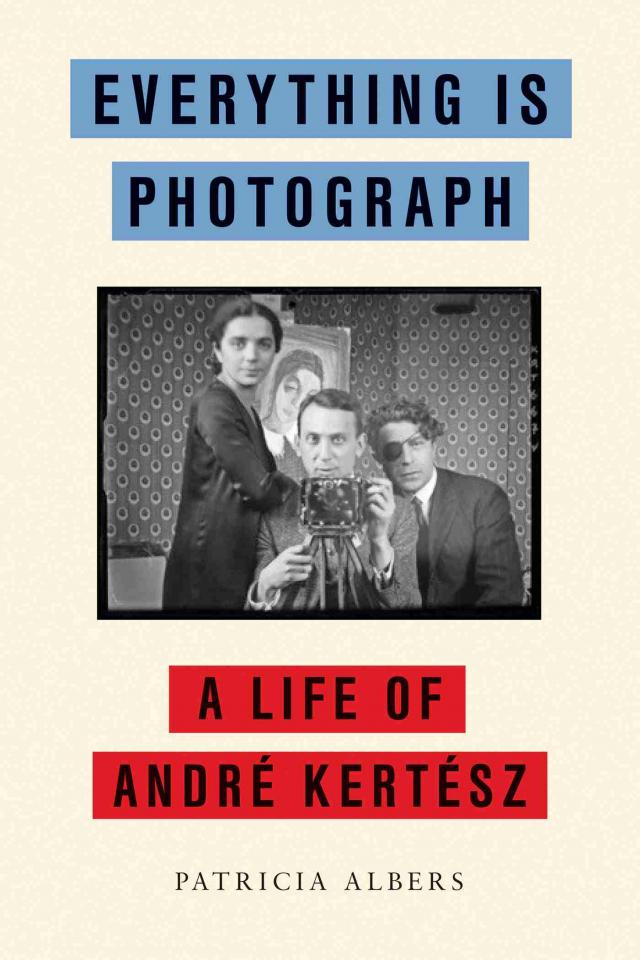


At every opportunity, André took self-portraits. Two from that year show him looking carefree as he stands across the street from the chic Hôtel Claridge. He may have been coming or going from the offices of Vu on the nearby Champs-Élysées. The thirty-seven-year-old in a suit and tie could pass for a boyish businessman in such high spirits that he could easily break into dance. Life was good. Work was a pleasure. He had money and prestige. Soon he would marry the woman he loved.
* * *
—
That summer, André and Elizabeth entertained his brother Imre, who visited with his fiancée, Margit Rosenberg, called Gréti. A stocky divorcée and soon-to-be convert from Judaism to Catholicism, Gréti was the daughter of a wealthy businessman from the minor nobility. Elizabeth’s mother visited Paris too. With Elizabeth and André, she sipped tea, picnicked with friends, and shopped on the Champs-Élysées. His snapshots reveal Elizabeth’s transformation from a schoolgirlish Budapester to a chic Parisienne in a cloche, light wool suit, and heels. They offer no insights on Pepi’s evolving opinion of André.
When it was just the two of them, Elizabeth handled some of the tasks that had once been Rózsi’s. She too spoke French, English, and German, the languages vital to André’s work life. She would sit primly at the typewriter in their home office taking dictation from André, then edit the letters, mail them, and organize his correspondence in binders.
Their models as coworkers would have been their neighbors in that same apartment building, the Soviets Ilya and Ljuba Ehrenburg. Ljuba, a painter, was her husband’s helpmeet. A prolific and widely known writer, Ilya served as the Paris correspondent for Izvestia and Joseph Stalin’s arranger in France. At the same time, he indulged in the life of a pipe-sucking bohemian and habitué of the Dôme and La Coupole, where he presided over the Soviet table. André photographed the couple in their study. It’s easy to picture him lingering to give Ilya tips about handling the Leica the Russian was using for street photographs. Published in 1933, Ehrenburg’s My Paris takes aim at the disparities between the lives of the wealthy and those of the poor in this bosom of decadent capitalism.
Around that same time, a new arrival from Budapest rented an apartment across the hall from André and Elizabeth: the glass artist and designer Júlia Báthory.[41] Back home, Báthory had reportedly been Elizabeth’s confidante during the months when she was plotting her departure for Paris. Now Báthory was preparing her first solo show in the French capital, which André would document. Her friend the ceramist and sculptor Margit Kovács also landed in Paris. A former classmate of Elizabeth’s at Álmos Jaschik’s school, Kovács was training at the renowned porcelain manufactory in Sèvres, just outside the city. The three women were tight.
As for André’s oldest companions in Paris, he turned his back on many. That September, Brassaï wrote his parents: “I haven’t seen the photographer Kertész for several months. He divorced his first wife and now lives in seclusion with his new wife.”[42]
But André had not divorced Rózsi. He had filed for divorce, and the case Kertész vs. Kertész née Klein had been assigned to a court.[43] As the process inched forward, André discovered that extricating himself from the marriage was not a given. Although French law permitted divorce by mutual consent, Rózsi would never consent.[44] So André had to establish grounds for divorce. Rózsi had not committed adultery, beaten him, deserted him, or been convicted of a major crime. He would have to rely on injures graves as his motive. This catchall concept referred to insults so grievous that they rendered continued married life impossible. As French law moved away from a concept of divorce as a sanction for vow-breaking and toward a concept of divorce justified by the collapse of the matrimonial bond, injures graves had become the most common grounds. It included everything from failure to consummate the marriage or transmission of a sexual disease to refusal to host one’s in-laws.[45]
As the petitioner, André would have hired a lawyer to prepare a summary statement of his grounds for divorce. At the hearing, however, he was required to present that statement to the judge in the presence of Rózsi. One imagines him stammering out a tale of how she had coerced or tricked him into marriage. She would have contested his account and made known her poor health. The judge weighed the testimonies and dismissed the case, likely ordering reconciliation.[46] That left André without a path to divorce.
He pretended otherwise. Word went around that André had divorced. That’s what Brassaï heard. So did André’s old friend the Hungarian photographer Max Winterstein. Aware that André’s mother disliked Rózsi when they met in Budapest and that André had been unhappy in the marriage, Winterstein wrote from Hungary to congratulate him on the divorce that “ended [his] dark period.”[47]
André probably told the same story to Elizabeth, who had no way of knowing that the legal break never happened. French courts considered divorce a strictly private matter. Testimony was taken behind the closed doors of the judge’s chambers with no reporters present. Newspaper accounts of such litigation were illegal.[48] If Rózsi’s account differed from André’s, it was her word against his.
Meanwhile, Rózsi had rented a cheap apartment and taken a job developing X-rays in a clinic. After she fell and broke several glass plates, she was fired. Later, she would join the Guttmann Agency, photograph children and dancers, and publish a dozen mediocre pictures in Vu. All were signed with her nom d’artiste Rogi André.
By one account, André had forbidden her to keep his last name, so she saucily took his first. As for Rogi, it sounds like a childhood nickname or perhaps a pet name from her once lover. In years past, their friend the model and singer Kiki had underscored her intimacy with Man Ray by fusing her name with his: Kiki Man Ray. After she and Man Ray parted ways, Kiki had shed that moniker. But, for the rest of her life, Rózsi would be Rogi André.[49]
The non-divorce would have made André nervous. Rogi knew lots of people. She had a sharp tongue. She hovered on the fringes of his everyday life. Her photographs might pop up in the same magazine or exhibition as his. She might pop up at the Dôme or Select. Those who heard her diatribes were shocked that “Kertész, gentle Kertész” had abandoned her.[50]
Around the time his legal proceedings with Rogi dead-ended, a story for Art et Médecine took André to the home of Renée Maeterlinck. She and her husband, the Flemish writer and Nobel laureate Maurice Maeterlinck, occupied a fairy-tale estate overlooking the Mediterranean between Nice and Villefranche. Surrounded by rose gardens and cypress and olive groves ending in a rocky trail that descended to the sea, Orlamonde had marble floors, frescoed ceilings, and a light-drenched salon. A borzoi and an uncaged white dove shared the estate.
André enjoyed Maeterlinck’s writing. It appealed to his sentimental side and was attuned to the Symbolist strain in André’s own art. For Maeterlinck, only indirect, irrational, and sensual language could express the mysteries of existence. Words were to be valued for their associative powers. Unlike language, photography is necessarily fact-based. Yet facts are open to interpretation, and André’s photographs make full, if seemingly artless, use of the associative powers of all they depict. And, for Maeterlink, like André, light was revelatory.
Maeterlinck’s most famous work was the Symbolist play The Blue Bird, a saccharine quest story that had captured the fancy of a generation, traveled around the world, and launched the hackneyed phrase “bluebird of happiness.” Nineteen-year-old André had seen the Budapest production in 1913.[51] A porcelain bluebird hung at Orlamonde, he noted approvingly.
In Maeterlinck’s play, a fairy disguised as a hag sends two country children, a brother and sister, in pursuit of a bluebird. Its capacity for flight and ascension makes the bird a symbol of the spiritual well-being that derives from seeking and finding the truth. Before the children depart, the fairy gives the boy a cap set with a diamond that will illuminate the souls of the people and things they meet. As the siblings proceed, allegorical places and figures like Luxury, Memory, and Night reveal themselves by the diamond’s light. Yet the bluebird remains elusive. They come home empty-handed, to discover that their pet turtle-dove has turned blue. They give it to a sick child, who is instantly cured. Then the feathered creature streaks off. The play closes with the boy’s plea to playgoers to find happiness — the bluebird — in their own lives.
For André, happiness equated with occasions like this second visit on assignment to Orlamonde. The writer was away. So he had the dazzling madame and the storybook estate to himself. Renée was, he fawned, “a figure of the purest poetry.”[52] In one of André’s portraits, she hugs her borzoi. Her animated stillness, twisting body, and caress of the animal’s fur recall Leonardo da Vinci’s painting Lady with an Ermine. Like the artist, André presents his subject as both an individual and a belle idéale of tender womanhood.
A decade would pass. During World War II, the Maeterlincks would be forced to abandon Orlamonde to looters and squatters. Then a Nazi commander occupied the estate. More years hurried by. By 1965, Maeterlinck was dead, the elderly Renée rattling around the recovered château, and André seeking salve for his psychic wounds. That year, he published a portfolio in Harper’s Bazaar.[53] It brought together his portraits of six legends of interwar Paris: Colette, Magda Förstner, Marie Laurencin, Anna de Noailles, Lady Mendl, and, hugging her borzoi, Renée Maeterlinck. Imbued with, as one writer observed of Maeterlinck’s The Blue Bird, “an unconquerable longing for what is gone forever … the beauty of what was merely a mirage,” it seemed to confirm André’s romanticized version of his life in France.[54] In photographs, happily, the clock stops ticking.
André Kertész, Elizabeth and I, 1933
7 ELIZABETH AND I, 1932–1936
It was both an old dream and a logical career move, and André was poised to achieve it in style. The owner of France’s leading type foundry, Charles Peignot, published the magazine Arts et Métiers Graphiques, a showcase for innovative design. Now Peignot was proposing a book of André’s photographs. However, he was offering only a modest advance. When André fully understood Peignot’s terms, he balked: too stingy, unbefitting a photographer of his stature. He didn’t know, or refused to believe, that the classy Arts et Métiers Graphiques was bleeding money.[1] So the project went nowhere except in the form of André griping to friends.
Among those who heard about the situation was Brassaï, who had been sleeping by day and stalking pictures by night. Seeing an opening for his own work, Brassaï prevailed on an acquaintance to introduce him to Peignot. They cut a book deal. Months passed. Then, in December 1932, Brassaï’s Paris de Nuit (Paris by Night) popped up in display windows around the city. Reviews were glowing. Bookshops sold out. Brassaï achieved instant stardom.
Paris de Nuit opens with what look like establishing shots in a film noir set in a louche and desolate city. It goes on to spy out the denizens of circuses, music halls, and bals. A has-been cocotte (high-class prostitute) dripping in pearls occupies her usual cabaret table. Members of the smart set glide by in a limousine that is lit like an aquarium. Poor devils paw through the rubbish. Mist slicks empty cobblestones. The city drifts along in a great well of night.
Shortly before the publication of Paris de Nuit, André got wind of the book. He reeled. He had taught Brassaï the techniques of night photography, which he and Jenő had learned using trial and error. Now this low blow! Brassaï had vanished for several weeks, André claimed, then reappeared with what was by rights André’s. “He came back, and the photos he had taken were absolutely Kertész photographs, in the sense that everything was done as I had done it.”[2]
It’s easy to imagine André poring over Paris de Nuit and pouncing on pictures that resembled his own. One shows an allée in the Luxembourg Garden crosshatched à la Kertész by the shadows of a grille fence. Monuments like the Arc de Triomphe and Notre Dame are angled and viewed in defamiliarizing ways — again, André’s approach. Trees overhang quais. Chimney pots, another Kertész signature subject, line up like the pipes of a pan flute. Brassaï had stolen his material, André maintained, but also “what I was doing technically and intellectually—what was important, what should be accented.”[3] Brassaï presses objects into service to block electric glare, a technique that André would have taught him. Like André, he uses the city’s light-scattering dampness to layer objects, play up shapes, and create atmosphere.
Other photographers were doing work not unlike André’s. His vision had helped spawn a communal vision. Ilse Bing, for one, photographed park chairs, streetlights, and the gestures of dancers, all favorite Kertész subjects. Like André, Bing used puddles as portals to dream worlds. But she was not André’s close Hungarian friend, nor had she published a popular book. In André’s view, Brassaï had betrayed their friendship by exploiting his fizzled deal with Peignot, going behind his back, and absconding with subjects and techniques that were rightfully his. After Paris de Nuit appeared, Brassaï wrote an article explaining night photography to the readers of Arts et Métiers Graphiques. In the article, he declares his debt to filmmakers but never mentions his teacher and friend.[4]
From Brassaï’s viewpoint, the thin-skinned André’s complaints were absurd. First, it was André, not he, who had vanished. André no longer showed up at parties or prowled the night streets, dusk until dawn, as Paris de Nuit had demanded. Where was he at 2:00 a.m.? And what did Brassaï have to apologize for? André’s deal with Peignot was dead. Besides, André had no lock on the Luxembourg Garden, the quais of the Seine, or any other subject. What’s more, night photography dated to the nineteenth century, and standard techniques had long since emerged. There were no real similarities between his work and André’s, Brassaï insisted.[5]
The two do have different sensibilities: André’s more poetic and distanced, Brassaï’s more reportorial and engaged with life’s seamy side. To those who saw his photographs as derivative, Brassaï might have countered that he was doing what André did too: soak up anything useful from those around him. Shortly after the book appeared, André confronted Brassaï. In André’s telling, the other was unrepentant. “A few weeks later, I had forgotten the whole thing,” André later implausibly asserted.[6] In truth, his anger simmered.
* * *
—
André’s ringer box shrilled. Picking up the earpiece of his telephone, he heard the voice of his Hungarian designer friend Marcel Vertès. “André, you know Querelle, the director of Le Sourire. He wants to know if you would agree to do something for his magazine.”
The next day, André called Louis Querelle: “Querelle, we know each other. Why didn’t you call me yourself?”
“I’ll tell you frankly, Kertész, because I wouldn’t have liked to hear you tell me no.”
Very delicate and very French, thought André.[7]
Querelle assumed that André was too established to accept an assignment to photograph nudes for Le Sourire (The Smile), a men’s magazine that was naughty in a wink-and-Gallic-shrug kind of way.
“Why would I say no?” André replied. “I like girls, so I like girly too. Of course I accept.”[8]
He did so knowing that Querelle was open to his ideas about the feature and seeing an opportunity to play with distorting mirrors. Distortions fascinated André, starting with shadows. So did the effects of light passing through various mediums, whether it was water visually warping a swimmer, crystal-ball glass reflecting the image of a fortune teller, or metal buckling bodies in a carnival mirror. When the writer Carlo Rim took the position as editor in chief of Vu in 1930, André introduced him to readers with portraits he took in the funhouse mirrors at Luna Park. The pictures suit Rim’s ebullient personality and his sideline as a caricaturist. In one, he looks like a gassed-up blimp ready to lift off.
Nudes were nothing new for André either. In Hungary, friends and artists’ models used to pose for him nude or seminude, but most of the glass plates had not survived the chaos after the war.[9] And André knew more than he let on about the shady side of Paris. Always alert to ways to make money, Imre had once pointed out to him that pornography disguised as art was popular in France. Some of André’s Parisian photographs would work beautifully in collectors’ editions of erotica, Imre continued. Apparently, André never acted on that suggestion and the pictures Imre was referring to evidently did not survive André’s later purges.
The Le Sourire project moved quickly. Querelle hired the models. Amused by the idea of contrasting old and young, he settled on a middle-aged ex–cabaret dancer and a seventeen- or eighteen-year-old White Russian from a good family named Najinskaya Verackhatz. Spoiled, thought André, yet graceful and lovely.[10] Querelle also provided an apartment and two mirrors from a flea market. Or maybe André found the mirrors. Accounts differ. In any case, one was a convex mirror that André would quickly discard as boring. The other, longer and heavier with an S deformation, turned out to be that rarity “an intelligent mirror” with the reflective and refractive qualities André was seeking.[11] As for the camera, he chose a 9 by 12 centimeter Linhof monorail. Used in studio and industrial photography, the monorail camera enables its operator to tilt the front and back independently and thus diminish or intensify distortion.[12] At times, André pressed his Zeiss Tessar lens into service. But mostly he relied on his Hugo Meyer Satz Plasmat triple convertible lens, which he assembled as a wide angle. Because a wide-angle lens has a short focal length, it swells objects in the foreground, showing them out of proportion to what is more distant. The Satz Plasmat’s subtle optical aberrations would add another layer of visual complexity to André’s pictures.
Juggling the mirrors, his tripod, his camera, and one or two floodlights, he threw himself into the project he originally called the Grotesques but was later known as the Distortions. Like Alexander Calder cooking up his circus or Géza Blattner reinventing the marionette theater, André straddled the line between work and play. The work side was demanding. Cameras and mirrors are unselective: neither discriminates between what’s important and what’s not. Controlling the plasticity of his images required technical acumen, a flair for improvisation, and intense concentration. The big mirror was heavy and awkward, so it had to be kept in place.[13] André and his models worked around it. That, too, was tricky. He was relying on the light from a window or two, along with the floods. He had to be careful that his light sources never showed in the mirror — too much glare.


