

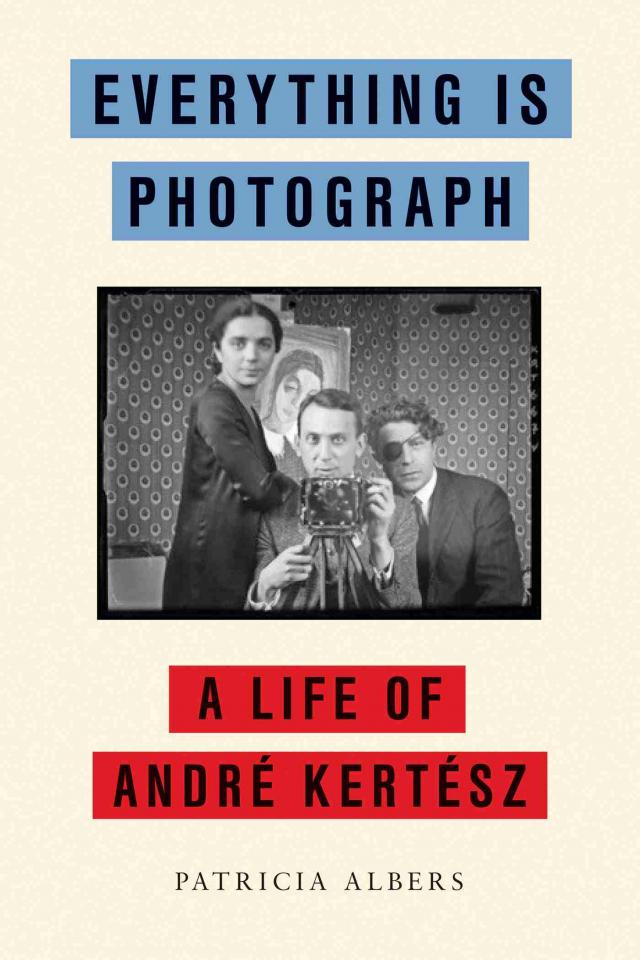
Everything is photograph, p.5
Everything Is Photograph,
p.5


Compared to most later types of film, the glass plate Andor used for Bocskay-tér, Budapest had little sensitivity to light. He could have compensated for the slowness of the plate and the darkness of parts of the scene by choosing a large aperture. But that would have resulted in a shallow depth of field when he wanted sharpness throughout. (Depth of field denotes the distance between the nearest and the farthest objects that are in focus.) So Andor resorted to six-, eight-, and ten-minute exposures with Jenő posing perfectly still. They did not have a light meter or even know what a light meter was. Andor bracketed his exposures, hoping that one of them was right. (To bracket is to take the same image several times with slightly different exposures.)
In the darkroom, they found themselves mired in another technical issue. One or more of the Bocskay Tér negatives had halation, that is, the spread of the streetlamp’s light to other areas of the negative. Halation can result from reflections off the bellows, mist in the atmosphere, or radiation from the silver bromide particles in the emulsion. The problem proved vexing until Andor discovered that he could block out the affected area by applying water-soluble red paint to the back side of the negative.
Such experiments came to an abrupt halt that October when the war rushed in and took possession of his life.
* * *
—
Conscripted into the Imperial and Royal Army of the Dual Monarchy of Austria-Hungary, Andor landed in a world of rules, ranks, restrictions, and drills. Wrapping himself in jocular cynicism, he claimed to welcome this “splendid opportunity to escape from this life.” That would solve his problems, chief among them a frustrated romance, a job he detested, and a blank future. “I want to be rid of myself, but not through my own hand,” he wrote in his diary. “I want to be annihilated.”[62] Well, not really. Besides, everyone knew the war would be over by Christmas.
Even after he started basic training in Klagenfurt, Austria, Andor managed to indulge his sweet tooth for photography. Not only did he keep taking pictures but also he found a way to get his plates developed and printed. He sent the results to the family. When they arrived, Uncle Poldi commented that photography was expensive, implying that Andor was wasting his money. As usual, Jenő had a smart reply: Soldiers’ mail was exempt from postage, so there was at least that savings. Uncle Kálmán held up the prints, one by one, and let no one distract him from looking. Then he smiled fondly and acknowledged that the pictures were very much Andor’s. One of Jolán’s sisters was also present. She took her time with the prints, too.
“Nice.” Then she picked them up again and announced, “These are not photographs.”
“Of course they are not,” deadpanned Jenő.
“We have real pictures at home,” she replied, meaning conventional soldier’s photographs like the ones her soldier brother was taking.[63]
Jenő reported it all to Andor.
From Klagenfurt, Andor was ordered to Gorizia in what is now Italy. In Gorizia, he took a self-portrait for his mother, the only type of photograph she really cared about. He mounted his camera on a tripod, then set the crude spring-loaded self-timer he’d had a mechanic build for him in Budapest.[64] (Before Andor left, he and Jenő had batted around ideas about how Andor could take self-portraits without using a mirror. A device that allowed a person to photograph at a distance from the camera, the shutter tripper, as it was then called, had existed for more than a decade but was not yet widely available.)
Flanked by a cannon and a spindly tree, the tall, slender private in Andor’s self-portrait stands in the courtyard of his caserne. His mild expression and girlish hands suggest less an Austro-Hungarian fighter in training than a boy playing soldier. He wears the standard Habsburg army pike-gray wool tunic with scalloped pocket flaps and standing collar and a high field cap. His leather belt has cartridge pouches. His breeches taper at the ankle. A quarter-century-old Steyr Mannlicher is slung over his shoulder. Wresting a little joke from his setting, he has positioned himself so that the cannon points straight at him. “Me as a ‘Jäger,’” Andor wrote on the back, meaning an Alpine rifleman. But mostly the picture was supposed to say, “See, I’m fine and correctly outfitted.” To dress well, no matter what trouble besets you, was a Hungarian thing.
When Andor was training, he shot quick portraits of his fellow soldiers during the rest breaks. When he was off duty, he joined them at a biergarten or pulled out his flute and amused them with parodies of popular songs. Other times he wandered off alone, camera in hand. He photographed a girl in Vertjoba, the cypress-flanked chapel in the Salcano cemetery, and the chapel of the medieval Castello.[65] Gorizia’s mild winters, wisteria-hung villas, and corso lined with chestnut trees had earned it the nickname of the Austrian Nice. Now laundry hung from the front gate of the chapel, the buildings looked bruised with age, and the streets lay empty and sad.
That spring, Italy would enter the Great War and capture Gorizia. According to the fictionalized autobiographical account of the American ambulance driver Ernest Hemingway, stationed in Gorizia, some of the town’s houses would lose whole sides in the shelling, gardens would be buried in rubble, and the Pannovitz forest, where Andor first trained with live ammunition, would be reduced to charred stumps.[66] Up in the mountains, more than half a million men would die in the twelve-battle bloodbath of the Isonzo. Tens of thousands of others would freeze to death. Andor’s photographs of Gorizia are unremarkable. Yet they may be the last ever taken of the town as a dowager winter resort living on time borrowed from the belle epoque.[67]
On Christmas Eve, Andor got orders to lead a four-man patrol around town to keep public order. As they made the rounds of the watering holes, Andor decided that the brothel also needed checking. But when they knocked and informed the madam, she replied that the establishment was closed until after midnight, then slammed the door in their faces. So Andor gave the command to scale a wall and break in. There the men found a warm welcome but not from the madam, who threatened to report their disgraceful behavior. What happened inside?[68] Although Andor loved to tell the story, he never elaborated. That may have been when he lost his virginity. In any case, his Christmas night in a brothel was surely an eye-opener for one whose ideas about women owed much to novels about chivalric romance.
It’s unsurprising that Andor got holiday duty. The Czech officer to whom he reported assigned the Hungarians in his unit every undesirable job. Sprawling from Bohemia (in the present-day Czech Republic) to Montenegro, from the Tyrol to Galicia, the Habsburg Empire lumped together Austrian-Germans, Magyars, Czechs, Poles, Croats, Serbs, and half a dozen other peoples. Its diversity was mirrored in its army, except at the highest levels, which were Austrian-German. Aware that his brother’s Austrian commanders did not speak Hungarian, Jenő couldn’t resist a dig in one of his letters: “How’s your German? Is it still ich sage den or it is now ich sage dir?”[69]
Minority officers with nationalist leanings, like Andor’s Czech commander, frequently took out their resentments on Hungarian underlings. Ironically, their anti-Hungarian stance dovetailed with that of the Austrian brass and the imperial family. The murdered Archduke Franz Ferdinand had once told his military chief that he considered the army primarily an instrument against the internal enemy, meaning Jews, Freemasons, Socialists, and Hungarians.[70] Andor labeled himself “a left-winger, like any normal human being, a total left-winger, student, socialist,” but not, he added, “the type to strike postures.”[71] Had he thought about it, he might have nursed his own resentment that on three counts — Jew, socialist, Hungarian — he was the enemy of the army in which he unwillingly served. Yet, aiming to avoid the most perilous assignments, he had volunteered for the officer training program for which his secondary-school diploma qualified him. He was set to begin after the first of the year.
That New Year’s Day, Andor took a portrait of his friend Andor Steiner, one of his cohorts in the assault on the brothel. Steiner was in their barracks, scratching out a letter.
“By any chance are you writing about our adventure on Christmas Eve?”
“Yes, I want my folks at home to know about it.”[72]
They burst into laughter.
In Andor’s photograph, the self-possessed Steiner applies himself to his task, using a stubby pencil and a sheet of paper. An unlit lamp, sharply focused, hangs in front of his forehead and directly over his pencil, suggesting clarity of thought and expression. All else — the racks stacked with field caps, the knapsacks on hooks, the rows of tightly made iron cots, the piles of clean sheets — is visually soft, as if viewed by one who is mentally AWOL.
The photograph’s source of illumination is an unseen window. The pale light it admits falls on the worn edge of the table at which Andor’s friend sits. That edge seals off a dark triangle in the picture’s lower left corner. Meanwhile the table’s far side visually underscores a pipe-smoking cardplayer across the room. A blurry could-be shadow, except for his face, the cardplayer seems alert to what’s happening in the room, whereas the letter writer is mentally absent. Snapshots of soldiers writing or reading letters are common in wartime. But Andor’s epistolary scene does more than document military life. Its use of selective focus, suggestion of silence, and attention to light turn an everyday occurrence into an archetype.
Andor took the picture using the Ica Bebe that Jenő had purchased and sent him in mid-December. “Just the machine for you,” Jenő assured him, and only 120 korona.[73] The camera’s main advantage, according to Jenő, was its excellent lens, a Zeiss Tessar so fast (f/5.5) that Andor could photograph even in cloudy or stormy weather. A boxy folding camera with leather bellows, the Ica Bebe came with holders in which to insert glass plates, each 4.5 by 6 centimeters. Because it could house up to seven plates at a time, Andor was able to make several exposures without changing plate holders. The Bebe could be handheld, allowing the photographer to work quickly. It could also be attached to a tripod for greater stability. Those in the know added a light meter. Andor relied on charts and guesses, considering the film speed, lighting conditions, and what he wanted in the print.
Only a week after Andor photographed Steiner, his new camera sat idle. After tumbling into a polluted creek, he had come down with typhoid fever, a life-threatening disease often caused by water contaminated with feces. Typhoid fever brings a high temperature, rashes, headaches, and diarrhea. Andor spent almost three months in a small hillside hospital, where Catholic nuns nursed him back to health. Not until the last weekend in March did he wobble out of the hospital. That Sunday, he drifted through the streets of Gorizia, once again visually decanting the town.[74]
* * *
—
On June 23rd, Andor found himself in a train station in Esztergom, Hungary, his unit’s home base. His 8th Field Battalion of the 26th Joint Regiment was bound for Galicia (now western Ukraine and southeastern Poland) — the most savage killing ground of the eastern front. On hearing the news, Imre hopped a train from the town of Galgócz, where he was working, to Esztergom. The brothers talked long into the night, Imre attempting to comfort Andor, even though both saw the order as a death warrant. As Imre left the barracks the following morning, he stopped more than once, pivoted, and looked lovingly at his scared younger brother.
By 1:30 on the afternoon their company was to depart, the men thronged the Esztergom station. A military band played a hymn. Then came a song about heroism and mothers’ grief that plunged Andor into thoughts of his own mother. Someone wept. A girl gave him a flower. The train steamed up.
Prying themselves from family and friends, the soldiers boarded, then crowded around the half-open windows. Babies were held aloft. Sweethearts and spouses reached out for one last touch. At 1:43, they inched forward. The wailing and goodbyes almost drowned out the sound of the band. Then a shrieking woman darted toward a door of the train, and a sergeant leaped off to embrace her. “But my dear little mommy,” he soothed, “don’t cry.” Squeezed up to a window inside the train, Andor stared hard at this pair acting out his ideas about matrimonial devotion and the hideousness of the war. The sergeant gave his distraught woman another farewell kiss — “a horrible kiss,” Andor felt. She clutched at the sergeant. But he tore himself out of her arms, sprinted for the train, and hoisted himself up. She ran after him, her arms flung up as if she expected to be lifted inside. It felt to Andor as if everyone except that one desperate woman had frozen. The train built up speed. As she receded into the distance, he watched, still transfixed. Her head drooped in abject sorrow.[75]
Six hours later, the train crept into Budapest. The men’s families had received notice that their journey would include a halt at a suburban station. Jenő, Uncle Poldi, Uncle Józsi, and Andor’s cousins Ilonka and Jenő Sommer stood on the platform. Mama and Jolán were absent: Andor was hiding from them the news that he was bound for the front. The family visit had barely begun when the train lurched. At first, Andor thought it was backing up. But it was moving forward, and he had to scramble aboard without properly hugging and kissing each person. Jenő sprinted to the door of Andor’s compartment, and the two managed a strong handshake that left Andor limp with emotion. As the train rattled out, he leaned from a window. At first, he could see the family but then only Ilonka’s hair in a pool of light.
Settling in for the long journey, the men told stories and sang. Twenty-four hours after they left Budapest, the baking heat of the Hungarian plains gave way to chill as they ascended the Carpathian Mountains dividing Galicia from the rest of the Habsburg Empire. They lumbered through the tunnel at the Łupków Pass, emerging the next morning into a landscape littered with bombed-out bridges, charred houses, and smashed railcars. When they passed a train crammed with the wounded and headed in the opposite direction, Andor observed that its occupants had “already looked death in the eyes.”[76]
André Kertész, Forced March to the Front, 1915
2 FORCED MARCH TO THE FRONT, 1914–1918
As soon as he reached Galicia, Andor wired Uncle Poldi. Then he wrote to Jolán, revealing that he was bound for the front, begging her forgiveness for keeping his deployment a secret, and bidding her farewell “because there is no hope that I will come out alive.”[1]
Andor was arriving at a perilous moment indeed. In the first weeks of the war, the Russians had seized Galicia’s capital, Lemberg (today Lviv, Ukraine). That positioned them to cross the Carpathian Mountains and swoop onto the Hungarian plains. The Habsburg high command had responded with three disastrous campaigns in the Carpathians. Hundreds of thousands perished. That March, the Austro-Hungarians took another shattering blow when their garrison at Przemyśl (now in southern Poland) laid down its arms.
Come spring, the Austro-Hungarians’ German allies inched forward, raining artillery shells and cannon fire upon the Russians in one deafening attack after another. The Slavic retreat left behind muddy corpses, smoldering rubble, and makeshift signs in Cyrillic. In early June, the Central Powers retook Przemyśl. Three weeks later, they marched into Lemberg. Berlin, Vienna, and Budapest exploded with joy.
Andor’s 26th Regiment reached Galicia as the Austro-Hungarians continued to claw their way forward. Decisive battles were brewing. With its professional army decimated by the fiasco in the Carpathians, Austria-Hungary was depending on raw boys. Many could barely load their rifles or fire properly. Or, as in the case of Andor, had decided to shoot into the air.
Andor was still insisting that his mother not know where he was. So Uncle Poldi, Imre, and Jenő had closed ranks to protect Ernesztina by pretending to write and visit Andor in Esztergom. They assured her that he didn’t mind the summer heat up the Danube. They led her to believe they had mailed the box of sour cherries she had lovingly packed for him. Poor Mama, thought Andor. He would die leaving her with little more than three letters, twelve postcards, and some photographs to remember him by.
His unit quickly marched out. One night they bivouacked in a boggy village where Jews had been tortured and robbed. It had escaped Russian torching only because the locals scrawled Eastern Orthodox crosses on every possible surface. Most of Galicia’s Ruthenians backed the Russians, their coreligionists and fellow Slavs. But Roman Catholic Polish Galicians remained loyal to the Habsburgs. So did the nine hundred thousand Galician Jews, horror-struck by the czar’s pogroms and now brutalized by the Russians.[2]
Andor’s diary says little about the treatment of Jews in Galicia, but what it says suggests that he was shaken by the anti-Semitism he observed. It wasn’t only the Russians. In Budapest, Jews were generally assumed to be worthy and loyal citizens. But that was not true throughout Hungary. On the way to Galicia, the train carrying Andor’s unit had passed the charred remains of a synagogue. A comrade, unaware that Andor was Jewish, had hooted with glee. Andor stayed mute.
Almost two weeks passed between that incident and Andor recording it in his diary. With his days and nights ensnarled, he jotted down what he could when he could. On July 8th, he wrote: “On July 2, I spent my 21st birthday in the unknown in a dirty Polish nest,” meaning a hut.[3] One night, he slept in a parked railcar. Once he awoke at 2:00 a.m., agitated by a dream about Jolán and unable to get back to sleep. Pulling out at daybreak that day (or the next or the next), he discerned through the fog what perhaps no one else did: a battalion sleeping on haystacks in the distance. As he trod on, Andor imagined the civilian dreams those men were dreaming.[4]


