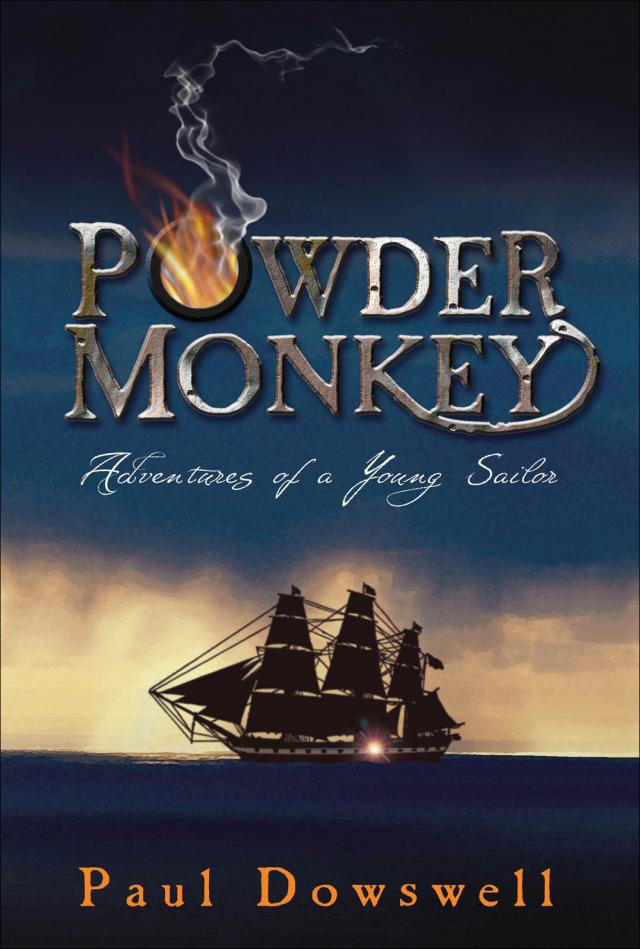
Powder monkey, p.13
Powder Monkey,
p.13


‘He’ll have to make do with a catfish,’ said Richard. ‘Maybe Ben’s mermaids will have one as a pet.’
Chapter 10
To Quarters
As we sailed up the Portuguese and Spanish coast on our journey home, the talk around the mess table and forecastle was mainly about battle. If and when it would come, who we would fight, how quickly we would overwhelm our enemy, how much prize money we’d make. Most of all, the men liked to boast about how they had fought in previous battles. Down on the mess deck, among our gun crew and on neighbouring tables, I overheard far more than I wanted to know about the awful reality of hand-to-hand combat.
‘And I crept up behind him and cracked his napper with my musket butt . . .’
‘I dodged that knife he threw down from the fighting top, and felled him with my pistol . . .’
‘Just as we drew alongside, I threw down a grenade and it landed in a group of French marines, and killed five of them . . .’
James Kettleby was more wary. ‘The French and Spanish carry more men and marines aboard their ships,’ he told me. ‘That’s why we try to kill as many of them as possible before we get to boarding. They, in turn, try to destroy our rigging so we can’t manoeuvre the ship. Then they can board us and crush us.’
None of this helped to ease my fear of boarding.
When talk turned to battle I always kept quiet. Ben noticed my silence. When we were alone he said, ‘They like to brag, don’t they? A good battle gives a chappie the chance to show his mates what he’s made of. Don’t you worry, Sam. I’ll look after you. And besides . . . us Tars have a well-deserved reputation. When we meet Johnny Dago or Johnny Frog, you can bet your life he’ll be more frightened of us than we are of him. I’m not frightened of battle, lad. So you shouldn’t be either. It’s what we’ve been training so hard for over the whole of this voyage. And if things get bad, just remember “The hotter the battle, the sooner the peace”.’
Richard was keen to avoid a scrap too, but he understood why the men were keen to fight. ‘I’d be quite happy never to see a single Spanish or French ship, believe me. But for this lot, it’s a bit of variety. Still, if we ever do get dragged into a fight there’s always the prospect of prize money – that’s something to look forward to.’
Every morning I woke fearful that the day would be the one in which we’d meet an enemy ship. At every dusk I felt a bitter-sweet twinge of anxiety. Today I survived, I’d tell myself, but tomorrow . . .? Several of my messmates reassured me most frigate patrols passed without incident, but I just knew in my bones that the Miranda was not going to be so lucky.
Eventually it happened.
‘Sail ho!’ We all heard the cry from the lookout at the main mast. A shiver went through me. It was half an hour before noon, on a bright January morning. We were just off Cape Ortegal, on the northern tip of Spain. A ship was coming up from the coast and heading straight for us.
Soon after we heard that warning cry, the bosun’s whistle summoned the whole crew on deck. The Captain, surrounded by his lieutenants and a squad of marines, was waiting to address us from the quarterdeck. We gathered around the mainmast, waist rail and up the rigging, each of us straining to hear the Captain speak. He looked excited. In fact, he looked rather pleased with himself.
‘Men. A Spanish frigate is approaching us from starboard, no doubt keen to claim us as a prize. I intend to meet her head on in battle. The Spanish sailor is poorly trained and poorly led, and I’m confident that by the end of the day we shall all be drinking a victory toast. Meanwhile, I estimate our foe will be upon us within an hour or so, which leaves enough time for a good dinner. You shall all have an extra ration of rum today. I should like to remind you that the British Tar is unbeatable in battle. Nevertheless, according to the Articles of War, the penalty for desertion of post, refusal to obey an order, and open cowardice, is death. But I’m sure you will do me proud today.’
With that, the men burst into a loud cheer. Then they began to sing the battle song ‘Hearts of Oak’.
Hearts of oak are our ships,
Jolly tars are our men,
We always are ready,
Steady, boys, steady,
We’ll fight and we’ll conquer again and again.
It is an extraordinary thing to hear two hundred and fifty men singing at the top of their voices. Despite my fear, it filled me with euphoria. Even Richard, who was by my side, joined in. When we were alone together he would quietly scoff at displays of British patriotism. But not today. ‘When in Rome . . .’ he whispered to me between lines, and winked.
We headed for the mess deck and sat down at our usual table. The atmosphere was certainly lively. I looked around the mess at my friends and comrades, stuffing their faces and talking excitedly with their mouths full. I wondered how many of them would live to see the coming evening, and how many gaps there would be in the benches the next time we all sat down to eat.
‘Now then, Sam,’ said Ben. ‘No gloomy thoughts.’
Richard chided me. ‘You should feel lucky. You’re down on the gun deck, safe behind your wooden walls and big gun. I’m up in the mizzenmast with a musket – plain as daylight for anyone to pick off!’
‘You sound remarkably cheerful about it,’ I managed to say.
My messmates were in a fine good humour, but I could barely eat. My mouth was so dry every mouthful of dinner seemed like a cold stone in my throat. I had to force myself to concentrate on what was being said to me. From that moment the lookout issued his warning, with everything I did I wondered if I would be doing it for the last time. I thought fleetingly of Mother, Father, Tom and Rosie. What were they doing now that death was staring me in the face? Peeling potatoes, buying tea in Norwich, picking mussels from the rocks?
The Spanish frigate was making slow progress – sailing up to meet us against the wind. We ate our meal with no great sense of urgency. I began to regain confidence when I downed my ration of grog. My fear receded, and I felt a brief surge of pride. Ben was right. These men were magnificent. They would give our Spanish foes a good hiding.
By the time we were called to quarters by the marine drummer boy my fear had returned, but I was trying hard to keep it well hidden. I bid Richard a hearty farewell, and put out my hand. He ignored it, and gave me a bear hug instead.
‘See you later . . .’ he said with a grin. But I could tell he was frightened too and trying hard not to show it.
We were called to quarters every day – it was a tedious drill that had always irked me. But now I could see our months of practice had been worth the effort. It took us barely more than five minutes to prepare the Miranda for action. Every man and boy on board knew exactly what he had to do, but this time the significance of what we were doing struck me hard. While some of us hurriedly carried the Captain’s furniture and the ship’s remaining livestock to the safety of the hold, others soaked the decks, then scattered wet sand around to stop us from slipping on any blood that was bound to be spilt.
The crews cast loose the guns and opened the gun ports. I ran as fast as I could to the ship’s after magazine, to collect my gunpowder. On the way I heard the angry sizzle of water on hot coals as the galley fire was extinguished. On the orlop deck Dr Claybourne would be laying out his horrible implements, saws and forceps and all, to treat any wounded man brought down to him.
When we had crossed the French corvette close to the start of the voyage, it had never felt like we were going to fight. But this, I knew, was going to be the real thing.
Our preparations completed, we waited at our stations. I don’t know whether it was because my heart was thumping so hard in my chest, but in those long minutes before action I saw everything with a crystal-clear clarity. I stood behind my gun, watching dust whirl in a thin, bright shaft of sunlight which poured in through a vent in the deck. Ben stood before me in a striped shirt. Next to him was Tom, calm as anything. Surrounding the gun were James and Silas, Oliver and Edmund. Each wore a determined look. Coiled, ready to spring into action. Two of them had taken their shirts off, in anticipation of the hot, sweaty work to come. All of them wore a strip of cloth tied around their forehead and over their ears, to keep the sweat from their eyes and deaden the roar of the guns.
As the seconds ticked away we waited at our posts, every muscle tense, wondering at the significance of every command we heard shouted out on the quarterdeck above us. We knew the enemy were approaching from the shore, and I kept hoping for a glimpse through the open gun port. But until action began we did not know which side of the ship would fire first. Perhaps we would be called over to assist the starboard gun crews. I hoped not. I had faith in my crew. I wanted us to be firing our gun, and them assisting.
As the Spanish ship drew closer, several of the topmen were called away from the guns. Then we heard Lieutenant Middlewych call out a series of commands concerning the setting of the sails.
‘Mandeville is trying to get astern of the Spaniard,’ whispered Tom. ‘If we can rake her, we’ll have won the battle from the start.’
If a frigate could get in front of or behind the enemy, she could pour devastating fire right through the length of the ship. If the Spanish crew were as poorly trained and led as we hoped they were, we had a good chance of doing this.
There on the gun deck, waiting for action to commence, we lived in a world of sound. Our view of the outside was restricted by what we could glimpse from our gun port, and what we could deduce from the noises we heard. So we listened hard to Middlewych call out his commands. Apart from his instructions, the ship was silent. Although we occasionally whispered to each other, most of what I heard was the creaking of the rigging, or the rattle of the ropes of the tiller as the men on the wheel swung the rudder to try to get us in the best position to fire our guns.
They say men in the pit of fear soil themselves. I never understood that. Inside me every bit of my stomach and gut just tensed up fast into some cramped uncomfortable ball. My fingers clutched so tightly to my cartridge box I wondered how I might ever let go . . .
When I had long ceased to expect it, I heard two loud explosions rolled across the sea. An instant later, there were two great splashes of water either side of our bow. Instinctively I reached to touch Rosie’s letter in my shirt pocket. ‘Keep me safe, keep me safe,’ I whispered to myself. A rumble of muted voices swept through the ship. I heard Silas say, ‘She’s firing her bow chasers,’ before Lieutenant Spencer shouted us all back to silence.
So, our opponent was now in range, although she had already wasted her opening salvo. We too had a pair of guns in the bow, and Spencer issued the order, ‘Bow chasers, fire when ready.’
We waited in tense anticipation. Then, after a minute, both our bow guns were discharged. One shot brought a splash of water, the other a rending crunch of metal on wood. The crew gave a triumphant cheer and Spencer yelled, ‘Steady, boys, steady. Bow chasers, fire when your target presents. The rest of you, await your orders.’
‘First blood to us,’ whispered Ben. I sensed a growing excitement among the crew.
We heard another loud bang, and a terrifying crash. The air was immediately rent with screaming from a couple of badly injured men. I hardly dared look, yet could not help a glance up to the bow. A cannonball had blown one of our bow chasers off its carriage. Fortunately for the rest of us, the gun had blocked the enemy shot, and it had carried no further along the deck. One of the gun crew, horribly injured, was turfed overboard. Another was swiftly carried to the forward hatchway by four of his companions, and down to Dr Claybourne.
The First Lieutenant called out, ‘Port your helm . . . steady!’ and we could sense the ship slow down and turn in the water. ‘Steady! Standby larboard guns. Prepare to fire when target in sight . . .’
Oliver Macintosh, nearest to the gun port, caught a glimpse of the enemy frigate. ‘She’s got her stern to us. We’re all set to rake her.’
It was a perfect manoeuvre. Mandeville had succeeded in getting the Miranda behind his foe.
‘Larboard guns. Fire when ready!’ yelled Spencer. As the Miranda sailed on, each of us, from the bow to the stern, unleashed our shot. At intervals of a few seconds, five cannon fired before us. Every shot but one hit home with a violent crash. I waited for our turn with an unholy eagerness. As the frigate came into view I could see the damage we had done. Most of the windows in the Captain’s cabin were smashed, giving the stern the appearance of jagged teeth in a gaping mouth. I saw, too, that the vessel was called La Flora. Then, Ben yelled, ‘Make ready!’ – the signal for all of us to stand clear of our gun before firing.
He pulled the trigger lanyard for the gunlock and the gun lurched back with a huge roar. I could not see whether our shot hit home, as smoke immediately obscured the view through the gun port. Neither could I hear, as the discharge of our gun had set my ears ringing. But I imagined our shot ripping through the gun deck of the ship, leaving carnage and chaos in its wake. Four shots had gone before it, carving great chunks from the insides of La Flora.
Through the smoke and the singing in my ears I suddenly became aware that Ben was yelling at me. ‘Powder, Number Twelve. Jump to it!’ I took the top from my cartridge box, pulled out a cartridge and handed it to Tom. As the rest of the crew loaded the gun for the next salvo, I ran as fast as my legs would carry me to the after magazine. Ahead of me, waiting by the wet curtain for his next cartridge, was another powder boy. It was Michael Trellis. He looked as white as a sheet, and had a purple bruise on his forehead.
‘What happened to you?’ I said. The boy said nothing, but instead of hostility I saw only shame. The marine guarding the powder room spoke harshly.
‘Tried to run and hide in the orlop deck, didn’t he! Mr Neville walloped him with a pistol butt to send him back up here.’ The marine turned directly to Trellis. ‘You’re damned lucky Mr Neville didn’t shoot you dead, son. I would have done.’
I disliked Trellis too much to feel sorry for him, but I could not despise him for his actions. He was nearer to the bow gun than me, so he must have seen the effect of the enemy shot in sickening detail. I decided to say nothing more to him, and nodded grimly. I could still hear muffled screams, though, from the orlop deck. Whoever had been brought down there was howling like a banshee. Above us, to add to the noise, four more of the larboard gun deck guns fired their shot, along with the guns and carronades on the quarterdeck above them.
When I ran back with my cartridge box, I immediately noticed how much hotter it had become on the gun deck. All around was frantic activity. Every gun was at various stages of reloading. Barrels were being swabbed, burning fragments hooked out, cartridges and cannonballs loaded, and wads rammed home. I had been gone barely sixty seconds, and already our crew were needing my cartridge, which was snatched from my hand the moment I returned.
‘You need to be quicker than that, Sam,’ scolded Ben. I could only just hear him. ‘We’ve been waiting a good ten seconds for this.’ I shot off again for the next one, not wanting a further telling off.
On the way down into the ship my hearing returned, and I heard the First Lieutenant call, ‘Brace up the weather yards’ – further orders for the topmen to turn the Miranda around, so that the crews on the starboard side could discharge their guns. Moving swiftly within a lurching ship is very disorientating – especially when you have no way of seeing outside to determine your bearings. I returned to the gun deck, and needed to check where my crew were, in case I rushed to the wrong side of the ship.
Within a couple of minutes the Miranda was sailing back across the stern of our opponent. One by one our starboard guns began to splutter out their deadly load. Once again my ears began to ring, and although I could see Ben or Tom shouting orders to me, I could not hear what they said. I felt grateful for those endless afternoons of gun drill. I knew exactly what to do, and exactly where to stand.
Again, the First Lieutenant called out to the topmen to adjust the sails, and again we turned to allow the larboard guns to bear.
‘I’ll wager we’re closing in to board,’ said Ben.
‘So soon,’ I said, with more apprehension than I meant to show. After such a long wait for action to begin, I never expected things would be moving so fast.
Sure enough, the Miranda began to edge towards La Flora. ‘Larboard side. Prepare to fire,’ shouted Spencer. ‘Guns one to five reload with chain shot and aim at the rigging. Guns six to ten load with grapeshot and aim at the upper deck.’
As we grew level with La Flora I could see she was in distress. Only one of the gun deck guns was still firing. Others poked out of their gun ports at odd angles, or not at all. From two ports towards the stern, smoke poured out. I caught a glimpse of angry yellow flame in the inside of the ship. Our raking broadsides had wreaked terrible destruction. But the quarterdeck was not badly damaged, and as we grew closer, the guns began to fire.
Again, the gun crews on La Flora let her down. The first three shots fell wide, causing great fountains of water to shoot up in front of our bow. But others hit home. One shot slammed into the foremast with a sickening splinter, and I heard something – almost certainly one of the yards – crash on to the deck. Further sounds of splintering and crashing followed. I heard a man scream, and a bosun call for help. I prayed it wasn’t Richard that was hurt, and all at once I felt mortally afraid.
The next shot from La Flora landed near us, showering our crew with dust, tar and debris. A hole appeared in the deck timbers close above us, and one of the mizzentopmen lay sprawled across the gap, his head and arms dangling down. I looked into his face and could see at once he was dead. A steady stream of blood began to pour down one of his arms, collecting on his outstretched fingers, and dripping down on us. The poor man was grabbed by a couple of unseen hands, and pitched over the side. If this was not enough of an indignity, they lugged him over right by our gun, so his lifeless body crumpled into the neck of our gun, before sliding off and into the deep.