Powder monkey, p.20
Powder Monkey,
p.20
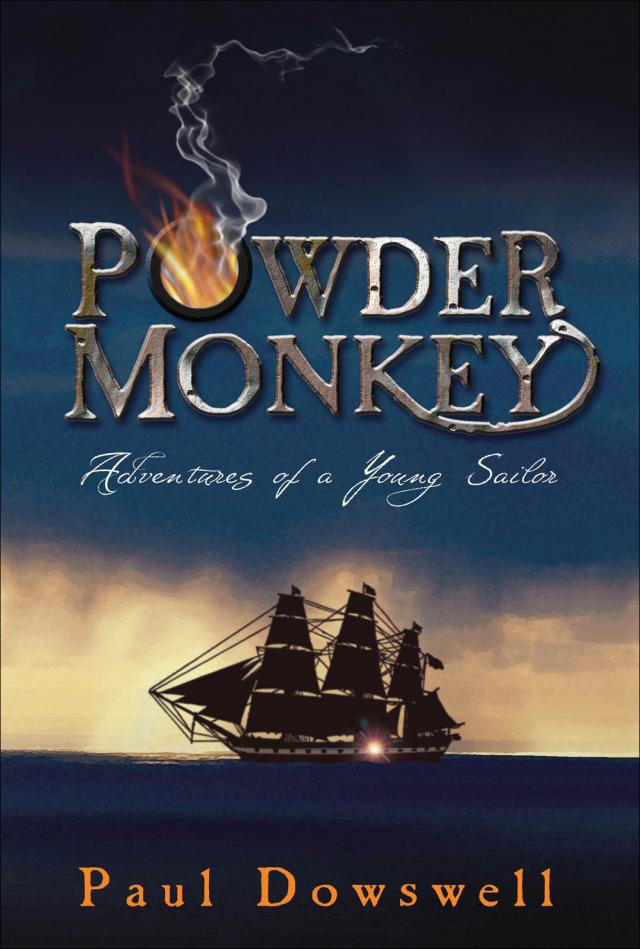


I ran to the magazine hoping fervently this would be the last cartridge I would have to fetch for this battle, and by the time I returned we would be calling off the action. But when I got back, Nelson and Captain Foley had come close to the rail by our cannon and I heard almost all of what they said.
‘You know Foley,’ said Lord Nelson, ‘I have only one eye – I have a right to be blind sometimes.’ Then he put his telescope to his blind eye, turned it towards Hyde Parker’s ship and said, ‘I really do not see the signal.’
I had to bite my tongue. I wanted to scream ‘Don’t be stupid. Do what you have been ordered you to do! What if the Swedish and Russian fleets are coming?’ But I knew such insolence could get me flogged to death or hanged. What had made Hyde Parker make such a signal, though? Whenever I could, I squinted through the smoke to see if there were any more masts on the horizon.
As midday turned to early afternoon the Dannebrog began to burn steadily and acrid smoke drifted towards. I could also see that several of the Danish ships had surrendered. Some burned fiercely. I wondered if their magazines would explode and cause carnage on the neighbouring ship in the Danish line. Aboard the blazing ships the sailors who had survived our merciless barrage were trying to escape by throwing themselves from the gun ports or over the side of the upper deck. Some of our ships had launched their boats to try to rescue these poor wretches. Many of them were badly injured and struggled pitifully in the freezing water. But even as we tried to rescue their seamen the Danes still fired upon us from their shore batteries.
Then the Dannebrog struck her colours to surrender. All at once I began to breath a little easier and allowed myself to hope I would come out of this battle alive. We were ordered to stop firing, and I sat down on the carriage of the carronade to drink some water. I realised with a twinge of guilt that Lord Nelson had been right not to withdraw. He had sensed, far earlier than me, that we were winning.
Bosun’s whistles peeped as some of the Elephant’s boats were lowered to cross over the narrow stretch of water between us and the Dannebrog to help the men who were trying to escape a fiery death. But as they approached they were fired upon with muskets. Lord Nelson, clearly angered, ordered us to start firing again as soon as our boats were out of danger. Vincent Thomas loaded grapeshot into the maw of our carronade and we peppered their deck.
Just after the carronade discharged, while my ears were still ringing, I was thrown to my feet by a violent explosion. When I got up I could see enemy shot had hit the quarterdeck between two guns just down from us and men from the crews were lying dead or dying. They were swiftly picked up by their comrades and thrown over the side. Most of those were beyond caring, but one of them, almost sliced in two by grapeshot, was a young boy who had been powder monkey to the gun next to us. He was clutching at a gaping hole in his belly, trying to stop his insides pouring out, and livid fear danced in his eyes. When they picked him up he started yelling, ‘Mother, help me! God help me! Mother, don’t let them do this to me …’ The marines hesitated, then their sergeant came over and shouted at them: ‘He’s a goner. Let him go over and finish him.’ They swung the boy as they threw him, which must have hurt him terribly and he screamed all the way down to the water.
I had seen many men die horribly in battle, but this was the worst. That could have been me, howling in agony for my mother. A lieutenant on the quarterdeck swiftly reordered the gun crews from whoever was left alive. Richard was told to act as powder monkey for the carronade next to ours. He was handed the leather cartridge box that the dead boy had been using, and flinched when he saw there was blood all over one side of it.
‘I’ll show you the drill,’ I shouted. ‘Whatever happens, keep the lid firmly down. Now follow me.’
We sprinted down the stairwell and ran through the middle of the upper gun deck to the stern. The noise was deafening, the heat unbearable. Then another ladder took us to the lower deck and immediately down to the orlop deck beneath the waterline. From there it was just a few steps to the after powder room. No one else was outside, not even the marine who usually stood guard there. ‘Sometimes you have to wait with several powder boys,’ I said, ‘sometimes not. We’re lucky this time.’ Then I called for a cartridge and a hand appeared through the wet curtains that shielded the men inside from flying sparks. Richard did the same. As I made sure his lid was screwed tight, Oliver Pritchard came running up to us.
‘You two, drop your boxes and follow me now,’ he said. We looked at each other in puzzlement, but an order was an order. He said, ‘Quickly, down the ladder to the hold.’ We did as we were asked. He did not follow. Instead he stood at the top of the ladder and shouted, ‘Macintosh, come here at once.’ Then he turned to us and drew his pistol. A marine, bayonet on the end of his musket, arrived at his shoulder.
‘Caught these two trying to hide in the hold,’ he said to the soldier. ‘Lock them in the bread room and make sure they stay there.’ He tossed the soldier a key and marched off.
‘But we were ordered down here,’ said Richard.
‘And we need to get back to the quarterdeck with our powder,’ I shouted.
The marine waved his bayonet at us. ‘Shut up or I’ll run this through the pair of you.’
We were bundled into the store room and left there in the dark. ‘What will our crews do without us?’ said Richard. He sounded scared. I felt utterly bewildered.
It was bizarre being in the heat of battle one moment, then the next being locked away from it all at the bottom of the ship. My heart was beating fast and I was bursting with energy. I just had to sit there in the dark with the stifling smell of mouldy bread in my nostrils.
There beneath the waterline we could still hear the muffled discharges of the guns, and more clearly, from the orlop deck above us, the screams of men brought down to the ship’s surgeon.
‘What the hell is this all about?’ Richard said angrily. It was too dark to actually see him.
I began to think more clearly and grew suddenly afraid. Of what I was not quite sure, but I knew we were in terrible trouble.
‘I didn’t tell you about last night. We’ve not had time to talk,’ I said. ‘You know I was gone a while fetching that tobacco. I overheard Nathaniel Pritchard and John Giddes arguing. They were both drunk, and were talking about charges for clothes and tobacco they would take from dead men’s wages.
‘And then, when they were quarrelling, Pritchard said something to Giddes about him not being who he says he is.’
‘Well, we all thought that,’ said Richard. ‘So who the hell is he?’
‘I didn’t hear that much –’ Then I understood in an instant what was happening to us.
‘Oh Jesus Christ help us,’ I wailed, crushed by a terrible certainty.
Richard was alarmed. ‘What? What is it?’
‘Last night – Giddes came to the door. Caught me standing there. I said I’d just arrived and didn’t hear a thing. That must have given me away. Now Pritchard has got his son involved, and they’re trying to set us up.’
‘Why me?’ said Richard. His voice seemed angry, even accusatory, as if it was my fault.
Now I felt angry with him. ‘Oh, I don’t know. Maybe it was because you were here with me just now, maybe they thought I’d tell you anyway. They’d know we were friends.’
Silence fell between us. The battle above our heads was winding down. Only occasional cannon fire could be heard and no one was screaming on the surgeon’s table. It was so dark in there neither of us could see our hands in front of our faces.
Richard spoke again. ‘So what happens next? We get court-martialled. If we’re lucky, we’ll be flogged, probably severely. If were unlucky, we get hanged from the yardarm.’
A NCSS-CBC Notable Social Studies Trade Book for Young People
“Readers will be absorbed in the day-to-day life of young Sam, and his vivid tale will keep them on edge as he tries to escape his commission. … Not for the faint of heart, this novel is a brilliant introduction to the likes of C. S. Forester’s classic ‘Horatio Hornblower’ saga.”—SLJ
“Readers who prefer their wooden decks awash in blood ‘and worse’ will not be disappointed… . Voracious fans of the nautical genre will happily sign on.”—Kirkus Reviews
“Fans of the Master and Commander series or movie will enjoy this seafaring adventure. Sam is an engaging narrator who includes tremendous detail about daily life aboard ships.”—VOYA
“Sam leads an exciting and dangerous life as a powder monkey… . A gripping adventure story on the high seas.”—Travelforkids.com
Copyright © 2005 by Paul Dowswell
All rights reserved. You may not copy, distribute, transmit, reproduce, or otherwise make available this publication (or any part of it) in any form, or by any means (including without limitation electronic, digital, optical, mechanical, photocopying, printing, recording, or otherwise), without the prior written permission of the publisher. Any person who does any unauthorized act in relation to this publication may be liable to criminal prosecution and civil claims for damages.
Published by Bloomsbury U.S.A. Children’s Books
175 Fifth Avenue, New York, NY 10010
First published by Bloomsbury U.S.A. Children’s Books in October 2005
Electronic edition published in October 2012
www.bloomsburykids.com
Distributed to the trade by Holtzbrinck Publishers
The Library of Congress has cataloged the hardcover edition as follows:
Dowswell, Paul.
Powder monkey : [adventures of a young sailor] / by Paul Dowswell. — 1st U.S. ed.
p. cm.
Summary: Thirteen-year-old Sam endures harsh conditions, battles, and a shipwreck after being pressed into service aboard the HMS Miranda during the Napoleonic Wars.
1. Great Britain—History, Naval—19th century—Juvenile fiction. [1. Great Britain—History, Naval—19th century—Fiction. 2. Napoleonic Wars, 1800-1815—Fiction. 3. Sea stories.] I. Title.
PZ7.D7598Po 2005 [Fic]—dc22 2005013049
Bloomsbury Publishing, Children’s Books, U.S.A. 175 Fifth Avenue, New York, NY 10010
ISBN 978-1-61963-135-9 (e-book)
Paul Dowswell, Powder Monkey