Powder monkey, p.14
Powder Monkey,
p.14
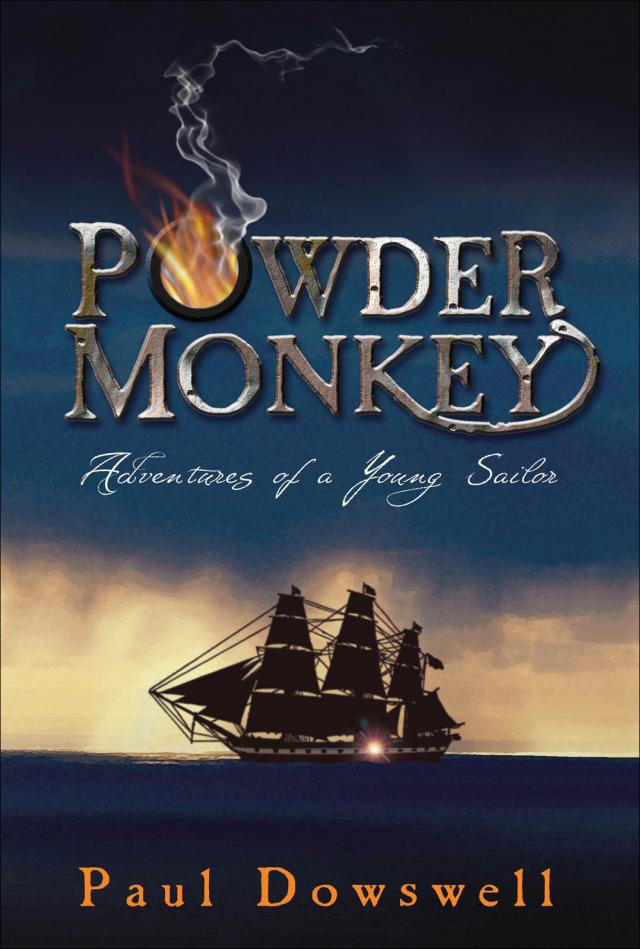


An instant later, La Flora came within scope of our gun. ‘Make ready!’ We fired. As soon as I had delivered my cartridge for the next shot I hurtled below for another. By the time I returned, the crew had already fired again, and were waiting for me. Ben clasped an encouraging hand on my shoulder, and so we continued as the Miranda edged closer to her quarry. Our gun-fire was devastatingly effective. The Spanish broadside that had damaged our foremast and upper deck were among the last useful shots the enemy gunners discharged.
Through the ringing in my ears, and constant series of explosions, I sensed the bosun’s whistle. Then I heard the command: ‘Prepare boarders.’
This was the moment I had been dreading. But now I felt only great excitement. La Flora was struggling terribly. We were winning, just as the men had said we would. I sprang to pick up a pistol and a cutlass from a rack placed in the centre of the gun deck, and charged on deck to await further orders. There was Richard, safe, thank God! It wasn’t his yardarm that had fallen to the deck. He looked quite exhilarated, having watched the whole action from high in the mizzenmast.
Now I was out on deck it was possible to see just how much damage the Miranda had sustained. Our rigging was a shambles and shots had ripped many of our sails. Worst of all, our fore yardarm was lying across the forecastle and the foremast leaned giddily awry above the topsail yardarm.
But when I looked over to La Flora, she was in a more pitiful state. Sails were torn and drooping, and her yards and upper masts had crashed down on her deck. Just at that moment a loud explosion erupted near her bows, and thick black smoke billowed out. She was now on fire on the gun deck both fore and aft. We were close enough to see that the crew were in disarray. I could hear officers shouting orders, but no one was taking any notice. One officer tried to gain the attention of a cluster of men on the deck by drawing a pistol and firing it into the air. This had no effect so he fired his other pistol at one of the men. This worked, but not in the way he intended. Two of the men stepped forward, ran him through with daggers, and threw him over the side.
Mandeville called out, ‘Hold your fire!’ When the Miranda had lapsed into silence, he had Lieutenant Middlewych call over to La Flora, shouting with all his might through a speaking trumpet. Middlewych spoke a little of many languages, and I presume he asked the Spanish if they were prepared to surrender.
We were not expecting the response. There was a loud explosion. I nearly jumped out of my skin, and thought La Flora had begun firing at us again. But instead more smoke began to billow from her stern. It must have been another cartridge going off in the heat of the fire already raging on the gun deck.
At that moment I realised we would not be boarding La Flora. The crew we could see milling around the deck were in such a state because they knew first hand how badly she was burning.
‘Hove to,’ shouted Mandeville. ‘This fellow is going to go up like a firework.’
As the Miranda drifted a safe distance away, we saw the crew abandon their ship. One of her boats was launched, but it was so overloaded that it sank soon after, its occupants clinging pathetically to the upturned hull. Two other boats packed almost to capsizing did get away, and began to pull for the distant shore.
As the fire began to eat into the belly of the ship, those left on board faced a dreadful decision. They could take their chances in the water, or perish in the coming inferno. By now the excitement of battle had begun to fade. I no longer felt elated or afraid. In fact I felt a twinge of sorrow for my Spanish foe. Over on La Flora men balanced on the deck rail crossed themselves before plunging into the chilly sea. On a warm day I would not have fancied their chances of getting to shore. But on this January afternoon the sea was cold enough to take the breath away, and chill the life out of a man in the water.
On the quarterdeck of La Flora we saw an extraordinary sight. The captain and his first lieutenant stood surveying their ship. I could see who they were by the distinctive scarlet plumes on their hats, and the scarlet trousers and waistcoats they wore. They were conversing with each other in a calm and measured manner, almost as if they were sipping coffee in a drawing room. They seemed determined to go down with their ship. I wondered what they could possibly be talking about.
It was only a matter of time before the fire got to one of La Flora’s magazines. The stern erupted in a bright white flash, sending shards of wood, canvas, the captain and his lieutenant, and most of La Flora’s few remaining crew, high into the air. We were far enough away from her to avoid any injury to our ship, but even so, we were peppered with some fragments. As the smoke cleared and debris settled, a greater flash tore the forward section of the ship asunder. This was the larger forward magazine, and the explosion broke the back of the ship. Within seconds both blazing bow and stern were pointing up to the sky, rigging and yards from the masts were horribly tangled, and La Flora was beginning her final voyage to the bottom of the sea.
There on the deck of the Miranda, we all stood transfixed by the spectacle – too awestruck to even cheer. The more seasoned among us were probably cursing their lost prize money.
Then, as the smoke from the rapidly sinking ship drifted over us, the bosun called out, ‘Three cheers for Captain Mandeville!’
That seemed to break the spell. Action had not found us wanting. We had lain waste our opponent with skill and courage. We cheered for our captain, and cheered for our lives. We had faced down death and survived. I felt a savage rush of glee, found Richard and hugged him tight, the two of us leaping around in a two-headed, four-legged jig. We were alive! Alive!
Then, as the smoke thinned and the heat haze of the explosion settled into a shimmer, those of us who cared to look towards the coast could see the black outline of another ship right behind the tangled remains of La Flora. She was heading straight towards us.
Again, a man high in the mast called out, ‘Sail ho!’
It seemed the day was repeating itself. Only this time we were exhausted from battle, had a badly damaged foremast, and dusk was fast approaching.
Chapter 11
Another Prize
All eyes turned to Mandeville. To my surprise he looked unruffled.
‘Gentlemen, another prize awaits.’
This time there would be no long delay before combat. The enemy ship was much closer, and the wind had changed direction. They would be upon us within half an hour. In the brief lull between the fighting, topmen swarmed up the rigging to bind up the damaged foremast and the carpenter’s crew hurriedly set about patching up the holes in the ship.
We had another problem. Although the pale winter sun was still shining in an almost cloudless sky, the sea was growing choppy. A stiff breeze was blowing in from the north-west, and sea water was swilling in through the damaged bow. Some of it ran out through the vents in the strakes, but water was beginning to seep down to the hold. Mandeville called for the ship’s pump to be constantly manned.
By now, in that late afternoon, the effect of the midday grog had worn off. I felt sick with both exhaustion and the horrible sights I had witnessed. The fear I felt at having to fight another frigate hung over me like a clammy thunderous sky. Perhaps the Captain sensed our mood, for we were quickly issued with another double dose of grog.
Before we returned to the gun deck, a few of us were picked at random to clear some of the debris scattered across the upper deck. I found myself grappling with a broken length of yardarm and Silas came to help me heave it over the side of the ship. Lewis Tuck was overseeing the work, and as we strained to lift the yard he hit me with his rope.
‘Put your back into it, y’ lubberly slug.’ Maybe it was the grog that made me do it, but I was so shocked I let go of the yard and furiously turned towards him. Instantly I regretted it, for I had placed myself in danger of a flogging. But before I could turn back to my work he had seized me by my shirt and placed his face right next to mine. ‘What?’ he hissed.
Silas snapped too, and before I could stop him he pushed Tuck away from me. ‘Leave that boy alone,’ he said with cold anger.
Tuck lashed back with his rope. ‘You two get back to work. I’ll deal with you both when this is over.’
I could not believe it. Now, if we survived the coming battle, we both faced the almost certain prospect of a flogging. ‘Silas,’ I said, trying to stop myself from crying. ‘Thank you for trying to help me, but aren’t we both in terrible trouble now?’
Silas looked stunned, as if he too could not believe what had just happened. ‘It’s too late to worry about now, Sam,’ he said. ‘Whatever happens with Tuck isn’t going to be half as bad as whatever’s going to happen in the next hour or two.’
Before I went below I took a final look at our new enemy. She was larger than La Flora, to be sure, and I knew for certain she would prove to be a tougher opponent. Back at our guns we waited in that awful tense silence. We could hear the Captain and First Lieutenant issue increasingly bad-tempered commands to the topmen as they tried to manoeuvre the Miranda with her damaged sails.
Then we caught a glimpse of the approaching frigate on our larboard side. She would soon be near enough to fire her bow chasers. Perhaps she was waiting to get close enough for a really shattering broadside.
‘Heave to,’ shouted Mandeville, and presently the Miranda creaked and groaned as her sails strained against the wind to bring her to a halt. This was too much for our damaged masts and rigging, and we heard a grinding, cracking sound as rope and wood split asunder. Down on the gun deck we did not know for sure which masts or yards had fallen, but judging from the direction of the sound, it was the foremast. This would certainly hinder our ability to outmanoeuvre an enemy frigate.
Ben spoke for us all when he whispered, ‘It’s down to us now, boys. Let’s make quick work of this.’
A bare minute later, the starboard gun crews were ordered to the larboard guns, and we were joined by the six men who worked opposite us. We had trained together almost every day, but they kept to themselves in the mess, and I barely knew them. Almost immediately, Lieutenant Spencer shouted, ‘Fire!’ We set off our guns in sequence along the deck, from bow to stern, as the Miranda passed along the course of the approaching frigate. The orderly sequence of gunshot gave me heart. Again, my ears immediately began to ring, as the noise on the gun deck was deafening. The enemy frigate returned fire too, and shots began to whistle between our rigging.
As I ran from the magazine with a new cartridge, the crew were waiting for another clear shot. ‘She’s called the Gerona,’ said Tom, who had caught a glimpse of her stern as she passed by. Although my hearing was returning I could still hardly make out what he said. Then, we waited. No shots came from either side, and only the creaking rigging and sloshing of the sea could be heard. We strained our ears to give us some clue as to the course of action. Spencer called for the starboard men to return to their guns, and for us all to fire when the enemy came on to our sights.
‘Make every shot count, lads,’ shouted the Lieutenant.
In the silence we heard a lieutenant order the quarterdeck gunners to move the two 6 pounders to the stern gun ports. My stomach turned over. This could only mean that the Gerona was trying to place herself behind us. We heard the exertions of the men above us, and the creaking and grinding of the gun carriage wheels against the deck. We understood from the angry shouting that moving the guns was a desperately urgent task.
As we waited, an awful air of expectation filled the gun deck. I glanced fearfully down the ship, and wondered how the men closest to the stern were feeling. If we were raked, they would be the first to suffer. Then we all heard a distant bang, followed a second later by horrible pandemonium. A shot from the Gerona came crashing through the starboard deck. I looked over to see the two aftermost guns mangled together – their crews crushed and dismembered. All at once an horrific screaming came from that quarter of the deck, before another shot whistled through on the starboard side. This one met nothing more solid than flesh and bone as it passed the length of the ship, before lodging near to the bowsprit. Men on the starboard side were torn in two, or had arms or legs plucked away by the speeding cannonball. Blood and worse began to cover the deck, and the doctor’s men rushed to carry the less seriously wounded below. Those who had escaped the carnage had to gather up the remains of their dead and mortally injured friends and send them tumbling through the gun ports and into the sea, before their lifeblood and innards made the deck too slippery to work on.
God forgive me, but at that awful moment I thought, It’s them, not us. Let it keep being them. Please, God, don’t let me be thrown over the sides with half my insides spilling out.
Among the chaos, I became aware that our ship was again crossing the path of the Gerona. Spencer yelled, ‘Larboard guns. Fire when ready!’ and once again we started to set off our guns. As the Gerona came into view, and just before we fired off our shot, I noticed she was now close enough for us to see her crew on deck and in the rigging.
We closed in, side by side. Once again Spencer commanded the starboard gun crews to join the larboard men. The Gerona was firing steadily too, and we could hear parts of our masts and rigging crack and fall. Mandeville must have decided to slug it out, because from this moment on we kept getting closer and closer. Among the deafening noise and bright flashes, I ran back and forth to fetch powder while people mouthed words I could not hear. Amid the drifting smog and encroaching dusk, everything happened with a strange slowness or impossible haste. The gun deck became unbearably hot, and I was drenched in sweat. The smoke from our guns caught my parched throat and I ran to the water barrel to quench my thirst.
Hurrying between decks I began dreading the return to my station. I began to long for the moment when I could run below for another cartridge to the safety of the mess deck and magazine where enemy shot would be less likely to fall. As I emerged from the mess deck companionway and back on to the gun deck, I knew that death was waiting there for me.
Events began to merge into one swirling blur. Sometime during the action, I could not tell you when, rigging and canvas from the foremast fell over the gun ports of the forward guns, and the crews were immediately dispatched on deck to help clear the debris. As we closed in on the Gerona, their gun crews turned their fire away from our masts and sails and on to the hull. One shot crashed into the quarterdeck. Another shot landed on the gun deck near to the bow. At this point I sensed that our crew began to work even faster and with greater fury than even before. We were matched one to one against our opponents in a duel where rapid fire was the only thing that mattered. I stood by my gun, waiting for the wall to crumple before me, clutching the box of gunpowder. If anything hit it I would be blown to pieces. Then, this overwhelming terror would ebb away as soon as the cartridge was taken from my hand, and once again I had the blessed relief of rushing down to the magazine for a few moments’ safety.
I returned to an utter shambles. While I was gone, the gun crew next to ours had been hit. Three men around the gun were sprawled in various positions, dead, unconscious or screaming. The boy who served that gun was lying dead on the deck. Let it be them. Not me. That was all I could think. Now I would have to take over his job and serve the surviving crew as well.
With two guns to fetch cartridges for, I could spend less time in the shooting gallery, and more below deck. As the battle continued, the deck by the after magazine filled with injured bodies. Some sat waiting, grimly patient – with splinters sticking from their arms or legs. Others, especially those who had lost limbs, writhed in mortal agony. The rules for the doctor’s attentions were fair. Men were dealt with strictly in the order they arrived – with no favourable treatment for officers. On one trip to the magazine I glimpsed my friend Tom Nisbit, with a bloody red stain over his shirt. I had no time to speak to him, and he died soon after. He had been shot through the chest by one of the Gerona’s marksmen. He had survived Captain Bligh’s Bounty mutiny, but not the Miranda.
Soon we were so close to the enemy that we could glimpse inside her gun deck, and see the silhouettes of men darting about their business. The closer we got, the more fearful I became that a gun crew on the Gerona would be able to blast a shot straight through our gun port. Our crew had been firing almost constantly for over half an hour, and must have felt quite spent. But still they laboured, toiling with their hot and heavy gun.
Ben could see a gun inside one of the Gerona’s gun ports right opposite ours, which would soon be pointing straight at us. ‘They’re just swabbing out for another shot,’ he shouted. ‘Quickly, lads, or we’ll all be blown to kingdom come.’
I waited helplessly for Tom Shepherd to take the cartridge off me so I could go and get another. As I waited I checked in my shirt pocket. Rosie’s letter was still there, but the envelope was damp with sweat and the ink of the address had begun to run on to my white shirt. ‘Don’t fail me, Rosie,’ I mouthed to myself.
Then Tom shouted at me to hand over the cartridge. Quick as a flash I unscrewed the top of the cartridge box, whipped out the gunpowder and was gone. Down to the magazine I ran, feeling like the last few seconds of my life were ticking away. When I returned, our crew were just aligning their gun with stays, and Ben was calling for another quoin to lower the elevation.
‘Quick, lads, quick,’ fretted James Kettleby, sweat pouring down his grimy face in rivulets.
‘Steady as she goes,’ said Ben, who was working with an ice-cold determination. Through the hatch I could see the other gun crew trying to aim their gun. I could make out their gun captain placing a burning rope to the powder hole.
‘They’re going to fire!’ I shouted.
Ben didn’t flinch. Then he yelled, ‘Make ready!’ and pulled the cord on the flintlock. Our gun burst into life, and when the smoke cleared I could see our shot had sailed clean through the enemy gun port and knocked their gun right over. We yelled ourselves hoarse with delight. If we had been a second later, all of us would have been killed.