Powder monkey, p.3
Powder Monkey,
p.3
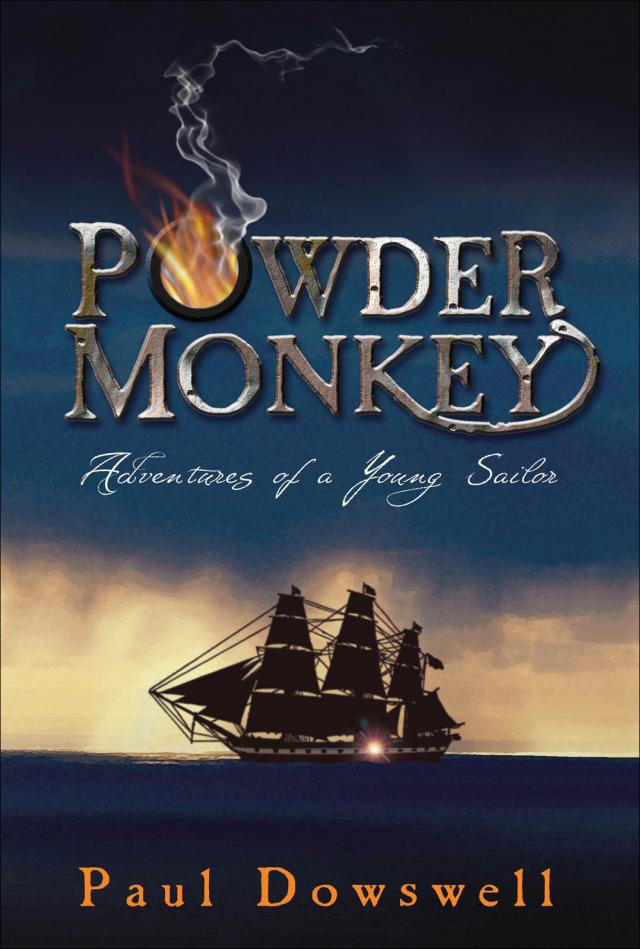


As I ran below I saw Silas. He was looking agitated. ‘I’m not going back to that. They’ll not take me alive,’ he said as I passed him.
‘They’ll not take you alive or dead,’ said another seaman, but his joke fell rather flat.
I went at once to the hold, but it was almost bare – we had emptied it trying to pick up speed to escape the Isabelle. I began to panic, realising I had only minutes before the Navy men would board our ship. Then I remembered a large locker in the forecastle near to my bunk, used for storing canvas sheets for sail repairs. I ran there at once, past George who seemed to be sleeping, and pulled out a large piece of canvas. I placed it untidily under the blanket of my bed, and squeezed into the locker as best as I could. Then I waited...
At first I could only hear my own breathing, and even fancied I could hear my heart, it was thumping so hard in my chest. I heard the dull clatter of a boat pressed hard against our hull, and the sound of feet scurrying aboard. There were muffled but agitated voices, and then Captain Rushford calling for all hands to assemble. With four of us dead and two of us down in the forecastle, the nine men standing before the press gang must have looked suspiciously few in number.
I heard raised voices and the sound of a struggle. I thought at once of Silas, and wondered if they had picked him. He, more than any of the surviving crew, looked every inch the hardened sea dog. Then there was a clatter of feet rattling down the ladder, and I peered through a small crack in the door to see who was coming.
Leading them down was a young man in a blue coat with brass buttons, white breeches and a cocked hat. A sheathed sword swung at his waist. He looked immaculately smart, and I recognised his uniform as that of a Navy lieutenant. He must have been sent along to accompany the crew of the pressing tender. His face was refined but sharp, and he wore a determined expression that declared him open to neither argument nor reason. With him were four burly thugs. They were not wearing any recognisable uniform and all of them carried wooden clubs. One time in Norwich I had seen the local hangman whip a felon through the streets. Each looked as villainous as the other, and if they had changed places no one would have been surprised in the least. Those men obviously had brothers, and here they were now.
They went at once to George. ‘There you are, my fine fellow,’ said the Lieutenant, with just a hint of mockery. ‘Was that you we saw in the rigging?’
George seemed unruffled by their attention, until they made it plain they intended to take him off immediately. Then fear crept into his voice.
‘I have documents, sir,’ he cried, trying to sound important. ‘I am apprentice to the Captain.’
The Lieutenant looked incredulous, and his cronies all laughed. ‘I’ve heard that a few times, I can tell you,’ he said. George raised himself from his bed, revealing his bandaged left arm, and plucked a key from a chain around his neck. With his good right hand he pulled a heavy chest from under his bunk, unlocked it, fetched out a plain envelope and handed it over.
The Lieutenant cast a brief eye over it, and tossed it back on the bed. ‘You’re obviously not the ragamuffin we saw in the rigging. Any idea where he might be?’
I held my breath and somehow I knew what would happen next. George didn’t say anything. He just glanced over to the locker, lowered his head slightly and raised his eyebrows. I cursed myself for finding such a poor hiding place, but I was still white with anger that George had so readily betrayed me. Two of the men strolled leisurely over. The door creaked open and I froze as the light fell on me, feeling entirely naked and foolish.
‘Come here, you,’ said the Lieutenant. ‘Was that you climbing the mast?’ I stared at him, too furious to speak. He placed a hand on my arm and pulled me out of the cupboard. ‘Up you go.’
Out on the deck, our crew were still standing before the rest of the party from the pressing tender – three other men and another officer. Also on board were three marines. I recognised them at once in their bright red coats. Silas was lying on the deck, with one of the gang standing over him. At first I wondered if he were dead, but then I saw he was breathing hard and his eyes were open, darting to and fro. He looked very, very angry.
‘Just the two, I think, Mr Collinge,’ said the Lieutenant. Then he went to talk to Captain Rushford.
The other officer came over to me and said, ‘Fetch your belongings, lad. If you can write, you’ve got ten minutes to pen a letter to your mother telling her what’s happened.’ Then he walked over to Silas, and prodded him with his polished black boot. ‘You go and fetch your belongings too, and if there’s any more trouble out of you we’ll club you unconscious.’
I had only a small bag of possessions – clothes, a few keepsakes from home – and they were quickly gathered. I was so flummoxed by this turn of events I could think of nothing to say to my parents other than the plain facts of what had happened.
I passed George Mansell and whispered, ‘You weasel.’ He didn’t look the least bit ashamed. I was so vexed I grabbed his injured arm and twisted it, and he yelped in agony. Then, on deck, Silas and I were each presented with a document from Captain Rushford, guaranteeing our pay up until this day. I wondered bitterly why I felt grateful.
I gave the Captain my letter and he wished me well. It was a formal farewell and I supposed he had said goodbye to several ship’s boys in these circumstances. Just before we left, the Lieutenant spoke to us both again.
‘If you volunteer at this point, then you will be entitled to a five pound bounty. The Royal Navy makes this offer to all men who come aboard, regardless of whether they have been pressed or volunteered.’
This was a significant sum – maybe nine months’ wages aboard the Franklyn. But I was so angry at being seized, I refused it. Silas did too, and looked at me with a fierce pride.
‘Very well,’ said the Lieutenant, and smiled in a way that suggested he cared not a jot what we chose to do with his offer.
Almost immediately I regretted not taking the money. After all, it made no difference to my fate.
Then we were manhandled off the Franklyn and into the boat, and pushed off towards the Navy tender. I knew a little of what awaited me, and what I knew was enough to make me feel very afraid.
As the boat rowed closer to the tender, I wondered if I should jump into the sea and try to swim for shore. But it looked a formidable distance, and it was a cold morning – the kind of late summer day when the sunshine feels tired, and a chill wind blows in to remind you that autumn is coming. Besides, I was sat facing a marine with a bayonet pointed right at my stomach. I would almost certainly be run through before my head hit the water. Silas had even less chance of escape with his hands tied behind his back.
As we approached the tender I could see that she was perhaps half the size of the Franklyn. About her upper deck there were several more red-coated marines, all of them carrying muskets with fixed bayonets.
We pulled up alongside, and Silas and I were told to climb aboard. A marine untied his hands, and up the boarding ladder we clambered, bayonets to greet us, bayonets to prod us on our way. There were only a few souls on deck, but I could hear the low murmur of a large number of men coming up from below – like a strange human hive. A ghastly stench rose up to greet us.
We were swiftly ushered below, to a ladder which led to a large holding pen in the bowels of the vessel. Peering down through a hatch I could see scores of upturned faces – the hold was crammed with the most desperate bunch of men I had ever seen. Silas and I made our way down the small ladder and tried to find a place to stand. Although it was a cold day, the hold felt unbearably airless and hot. There was straw on the floor, and among the forest of arms and legs I could make out the occasional overflowing bucket. The smell was vile. Along with the usual human waste were pools of vomit from seasick men. I felt sick myself, but managed to control the urge to empty my stomach. There must have been a hundred men in the hold – certainly not enough room for all of us to sit or lie down at the same time. Some had managed to slump against the wall and sleep. Others had passed out, for want of air, I imagined.
The hatch closed over our heads and Silas and I stood staring at each other. By the look on his face I guessed he was as dumbfounded as me. At first nobody talked to us – everyone seemed wrapped up in his own little bubble of misery. I saw that there was a large barrel of water at one end of the hold, and pushed my way over to drink from it.
Then, after half an hour, the hatch opened again, and the same lieutenant who had picked me out from the crew of the Franklyn called down. ‘I want four volunteers to come up, two at a time, with the buckets of waste.’ Immediately there was a score of men raising their hands to be chosen, hoping for a moment of fresher air away from the hold. The Lieutenant announced we would be given a midday meal – ship’s biscuits. Each man had to come up separately to be presented with his ration. The process took nearly two hours. The Lieutenant then called down again. ‘Gentlemen,’ he said with a quaint formality, ‘we have a good wind behind us and intend to reach Portsmouth by this evening, so you will not have to wait in the hold for much longer.’
The news seemed to brighten everyone’s mood, and Silas and I began to talk to some of the other prisoners near to us. From what I could gather, most of the men in the hold came from Weymouth, where the press gang had descended with a vengeance. But several, like Silas and me, had been lifted from merchant ships.
One fellow with thinning blond hair and several days’ growth of beard told us he and three of his companions had been returning from a French prison.
‘Three years, we’d been held,’ he told us with mounting anger. ‘Caught by privateers in the Channel, we were, and left to starve in a stinking Froggy jail. Three years . . . then there was one o’ them exchanges of prisoners. They get some of ours, we give back some of theirs. ’Bout bloody time too. But soon as we reached the coast, the bastard Royal Navy plucks us from our ship . . .’ By the time he finished his sorry tale he was so angry he could barely speak.
We did reach Portsmouth that evening. Slowly, we went from Navy ship to Navy ship, gradually emptying our human cargo. There were ten of us left in the hold when Silas and I were called up along with the last of the men. We assembled on deck, shivering in the sunset, surrounded by around twenty marines all pointing their muskets and bayonets directly at us. The Lieutenant came up to address us.
‘Well, my lucky lads – this will be your new home.’ He turned and gestured expansively towards a sleek-looking man-o’-war, which we were fast approaching. ‘This is the frigate Miranda – the bravest, deadliest ship in the Navy.’
I guessed from his speech that he was a serving officer aboard the Miranda. Perhaps us ten men remaining on the tender he had judged to be the best of the crop? I turned to look at the ship, its three tall masts and rigging stark against the fading sky. In size she was perhaps twice the length of the Franklyn, and stood taller in the water.
She looked both elegant and lethal. From what I had been told, I knew that frigates were lightly armed – there was only one gun deck – but they were fast. ‘The greyhounds of the sea’, the Franklyn’s crew had called them. I also knew that of all the Navy ships, frigates were the most likely to be involved in action. At that moment I understood that whatever terrors I had been through the previous day with the Isabelle would be nothing compared to what I would have to face on the Miranda.
Chapter 3
His Majesty’s Ship Miranda
As we grew nearer the Miranda I began to see her more clearly, and could now make out the ship’s figurehead – a magnificent, bare-shouldered, buxom woman, with flowing white robes and long golden hair. A few dark shapes scurried around on deck. I felt tense and wary, and a painful knot had lodged in my gut. Silas was standing next to me and he spoke softly.
‘I’ve been on one of these, my lad, and a frigate is a dangerous place to be.’
One of the marines hissed at him to shut up – and pointed his bayonet close to Silas’s stomach. Shortly after, we bumped alongside the Miranda’s gangway. It was so small only a child could enter without stooping. We were shoved through and on to the gun deck one by one.
It was chilly outside, but inside the ship there was a clammy warmth, and a sharp tang of tar and creosote. Mixed with this was a rank, stale dishcloth odour that seemed to rise beneath my feet. I sensed it like an animal senses a beast of prey. It was the sort of smell that drifted from the prison in Norwich.
It was too dark to see much of the gun deck, other than a long row of guns receding into the gloom at either end of the ship. As we stood there, I heard a lone voice singing to a violin.
Red and rosy were her cheeks,
And yellow was her hair,
And costly were the robes of gold
My Irish girl did wear.
We were taken quickly below to the crowded mess deck, where there was no natural light, just one or two lanterns and a stifling fug. Faces turned round in sudden silence to look at us new arrivals. The dim lights cast murky shadows over their features, giving them something of the look of Hallowe’en ghouls. Then we were hustled even further below, to the hold. Here too only a few lanterns lit the way. We were now below the waterline, in the belly of the ship. All around, piled high, were boxes, ropes and barrels. Rancid bilge-water, tar and hemp mingled to make an intimidating stench. The ship reeked of fear and brutality.
‘Gentlemen,’ said the Lieutenant, who had followed us all the way from the Franklyn, ‘perhaps you’d be good enough to wait here while we go though the formalities.’
I found his mock courtesy irritating. Silas did too and said, ‘Perhaps you’d be good enough to provide us all with a nice cup of tea. Only the best china cups, mind.’
All at once a thick-set thug, standing in the shadows behind us, stepped forward and delivered a hefty thwack to Silas’s back with a knotted rope.
‘Perhaps you’d be good enough to shut your face,’ said the man in a matter-of-fact way – all the more effective for its calm authority. I noticed he wore a tall black hat with the ship’s name painted on it.
The Lieutenant seemed completely unaffected by this act of unexpected violence. ‘Meet Mr Tuck,’ he said to us. ‘He’s one of the Miranda’s bosun’s mates. He’s here to keep an eye on you all. Now, I’m going to ask you to wait here while we enter your names into the ship’s muster book.’ He turned and vaulted up the stairs.
We crouched down on the floor and were called up two at a time. Even in the dim light I could see that the hold was spotlessly clean, like the rest of the ship. Silas began to tell me what to expect, but another blow from the knotted rope cut short our exchange. Eventually the two of us were marched up to the mess deck. Again, all conversation stopped. The entire deck was watching. Here we waited to be called further up. A few men continued to stare unashamedly, especially at me. Some were the cold, intimidating stares of bullies and thugs. Others were more leery – the kind of faces I had noticed on men staring at young women. I thought of a picture I had seen in one of my father’s books of a lone antelope wandering the plains of Africa, being eyed up by a pack of lions.
‘Don’t show them you’re frightened, lad,’ whispered Silas, risking another clout from the rope. This time none came. Instead, the marines gave me an encouraging smile.
‘You stare back and show them you’re made of stern stuff,’ said one.
I breathed deeply, and tried to feel angry rather than afraid. Now my eyes had grown accustomed to the light, I could take a proper look at the men I would be sailing with. The Franklyn’s crew numbered barely fifteen or twenty men. Here there were hundreds. Most I judged to be in their twenties – hardened sea dogs like Silas, brown and weather-beaten, tough as leather. There were a few older men too, and a scattering of youths and boys like me. The crew were a mixture of races too, with some darker faces, and a few black ones. Some carried the disfigurements of war – patches covering empty eye sockets, scarred arms and faces, missing fingers, even one or two missing legs . . . Some had tattoos – here a fiery sun or green mermaid, there a red dragon. One man, who wore only breeches, had a large and gory depiction of the crucifixion across his broad back. Underneath, close to his hips, were the words ‘The Lord is a man of war’. I sensed he was not a good fellow to annoy.
I stood there aghast, wondering how I would survive with this brutal crew, and my eyes darted to and fro searching for a means of escape. Whatever happened, I was going to get away. Then a terse order came from above. A marine shoved me in the back to usher me upstairs. Silas was left below. There on the almost deserted gun deck, under the glow of a couple of lanterns, was a table at which sat the Lieutenant and another man. Now I was used to the gloom I could see the deck more clearly. Hefty beams crossed over a low ceiling that most grown men would have to stoop to navigate. The rows of red- and black-painted guns stood lurking by the gun ports on either side, catching some of the faint light of the lanterns. For a brief second I could imagine the noise and terror played out here when the Miranda went into battle.
‘Good evening,’ said the Lieutenant, in his cheery way. ‘I am Lieutenant Middlewych, first officer on the Miranda. This is the ship’s surgeon Dr Claybourne. We’re going to ask you several questions about yourself, and make sure you’re in suitably good health to serve aboard one of His Majesty’s ships.’
Anger rose in my chest. I’d been dragged here against my will, and now they were telling me I might not be good enough for them. But I knew it was wise to say nothing.
‘Sit down, lad,’ said Middlewych, beckoning to a stool in front of the table.