Powder monkey, p.19
Powder Monkey,
p.19


Richard put his hand on my shoulder. ‘What’s it to be, Sam?’
‘I’m staying with you,’ I said quietly.
Acknowledgements
I’m especially grateful to my agent Charlie Viney who inspired this book by encouraging me to have a go at writing fiction. Children’s books consultant Alison Stanley gave me useful help during the book’s early stages, and Dilys Dowswell offered invaluable advice on all my first drafts.
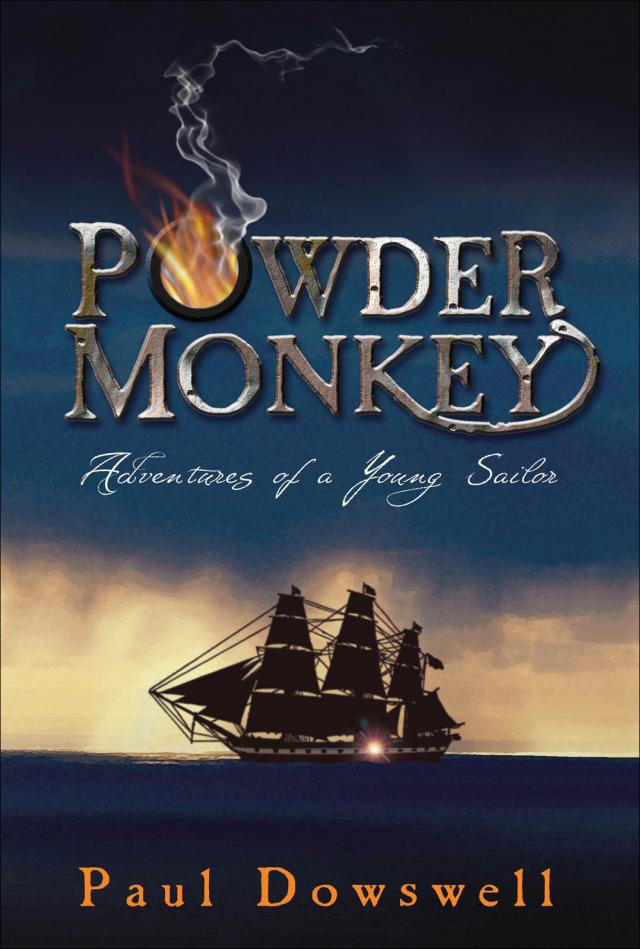
At Bloomsbury Ele Fountain patiently helped shape the narrative and hone the style while Georgia Murray ensured the nuts and bolts of the story were tightened securely. Maritime expert Nicholas Blake gave generous advice on the historic and technical aspects of the book. I was not able to make all his recommended changes, for which I apologise both to him and anyone else more steeped than me in the salty subject of Nelson’s Navy. Phillip Beresford and Katherine Grimes were responsible for the elegant look of the book, and Ian Butterworth created the evocative cover. Peter Bailey’s fine line drawings decorate the inside pages.
Thank you to Kate Lee, Caroline Yates and Leslie Harris for their loan of valuable reference material, and also the staff of the National Maritime Museum Library, Greenwich, and Wolverhampton and Birmingham Public and Reference Libraries for their help during the researching of this book. A bibliography detailing some of the sources used can be found here.
I would also like to thank Anna Claybourne, Alex Costello, Fergus Fleming, Lucy Lethbridge, William and Debbie Lucas, Heather Nolan and Christine Whitley for their advice and encouragement, and, most especially, my wife and daughter, Jenny and Josie, for their help and support in the writing of this book.
Some notes on sources
The poem in Chapter 12 is ‘The Price of Experience’ by William Blake. Although it was first published in The Writings of William Blake (eds Edwin J. Ellis and William Butler Yeats, 1893) it was written in 1797, so it’s not impossible to imagine that someone who knew Blake personally, a character similar to Tom Shepherd, in fact, would have seen it.
Parts of the conversations in Chapter 7 and Chapter 10 were inspired by passages in The British Tar in Fact and Fiction by Commander Charles N. Robertson (Harper and Brothers, London, 1911). These capture the language of the era so wonderfully I did not want to change them beyond recognition.
Although I was determined to base the characters and their circumstances firmly in historic reality, Powder Monkey is first and foremost a novel rather than a history book. For any reader wanting to find out more about the real history here, I can recommend any of the following:
Jack Aubrey Commands: An Historical Companion to the Naval World of Patrick O’Brian by Brian Lavery (Conway Maritime Press, London, 2003)
The Seafarers: Fighting Sail by A.B.C. Whipple and the editors of Time-Life Books (Caxton Publishing Group, London, 2004)
Hornblower’s Navy: Life at Sea in the Age of Nelson by Steve Pope (Orion Books, London, 1998)
Life in Nelson’s Navy by Dudley Pope (Chatham Publishing, London, 1981)
These are all accessible, highly readable books, which should be available in most public libraries. The first three are also full of fascinating and colourful illustrations – some from the era, others artwork recreations.
If you want to dig a little deeper you could try:
Nelson’s Navy: The Ships, Men and Organisation 1793–1815 by Brian Lavery (Conway Maritime Press, London, 1989)
The Wooden World: An Anatomy of the Georgian Navy by N.A.M. Rodger (Collins, London, 1986)
Sea Life in Nelson’s Time by John Masefield (Leo Cooper, 2002 – first published 1905)
The Star Captains: Frigate Command in the Napoleonic Wars by Tom Wareham (Chatham Publishing, London, 2001)
The Sea Warriors by Richard Woodman (Constable Publishers, London, 2001)
The Merchant Navy by Captain A.G. Course (Frederick Muller, London, 1963)
Real enthusiasts could trawl the second-hand book shops for:
The British Tar in Fact and Fiction by Commander Charles N. Robertson (Harper and Brothers, London, 1911)
Memoirs of a Seafaring Life by William Spavens (facsimile edition published by the Folio Society, London, 2004 – originally published in 1796)
Books aside, there’s nothing like a trip to a real fighting ship from the era to get a flavour of what life must have been like aboard. British readers can visit the frigate HMS Trincomalee in Hartlepool – upon which the Miranda is closely based (see www.hms-trincomalee.co.uk), and Nelson’s famous flagship HMS Victory in Portsmouth. The Victory’s excellent website (www.hms-victory.com) includes a list of all 820 men serving on the ship during the Battle of Trafalgar, together with their age, nationality and position.
North American readers can visit another frigate from the era, USS Constitution, berthed in Boston, Massachusetts (see www.ussconstitution.navy.mil).
And finally. . .
Peter Weir’s Master and Commander film (2003), starring Russell Crowe as Patrick O’Brian’s character Captain Jack Aubrey, painstakingly recreates a frigate similar to HMS Miranda. It’s a rip-roaring action adventure too!
The Adventures of Sam Witchall in reading order:
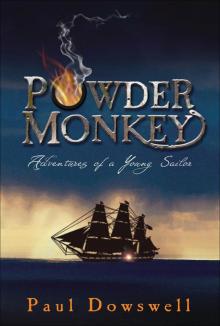
Powder Monkey
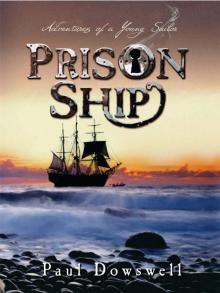
Prison Ship
Battle Fleet
A Note on the Author
Paul Dowswell is a former editor as well as the author or co-author of more than fifty acclaimed nonfiction books for children on historical and scientific topics. He lives in Wolverhampton, England, with his wife and daughter. Powder Monkey is his first work of fiction.
PRISON SHIP Sneak Peek
Read on for a sneak peek at Prison Ship, a thrilling new Sam Witchall adventure!
A mere six weeks after Sam Witchall’s ship wrecked off the Cornish coast in March 1801, Sam has rejoined the Navy as a powder monkey. But his hopes for a second chance at sea are dashed when he and his friend Richard are framed for cowardice during battle. Will they be able to prove their innocence? Or will Sam and Richard find themselves facing a more terrifying future than the hangman’s noose? Find out in this exciting new adventure that details every nail-biting moment of Sam Witchall’s life as a young sailor.
That night my sleep was constantly disturbed by the sound of ice bumping against the hull of the Elephant. The temperature was so cold that when a man carrying a lantern made his way through the deck you could see his breath curling like smoke from his nose and mouth. Water dripped from the low wooden ceiling and condensation settled like dew, chilling me to the marrow.
Breakfast burgoo and scotch coffee never tasted better. I wondered why the body craved sweet things when it was cold. James had told me about a dried fruit and brown sugar delicacy the Scots called ‘black bun’, which they fried in batter in a deep pan of oil. It sounded just right for a day like this.
As we ate I asked Tom what he thought our tactics would be. He paused between mouthfuls then said, ‘We’ve all seen that row of Danish ships. I reckon we’re gonna squeeze up next to them and slug it out. We’ll be so close we won’t be able to miss.’
I lost my appetite. But James offered me a crumb of comfort.
‘We’re used to fighting, whereas the Danes aren’t scrappers. Whatever happens I’ll bet we’ll be firing at least twice as quickly as them. So our 74s ’ll be like 148 gun ships to them. And their 74s, if they’ve got any, will be like our frigates. I think we’ll make short work of it.’
John Giddes looked sceptical and put in a rare word. ‘Most of those Danish ships ’ve had their masts taken down. They’re probably grounded in the mud, so there’s no retreat for them. We might ’ave better ships, better guns and better commanders, but we’re still foreigners here. The Danes are fightin’ for their lives and for their city so I don’t think they’re gonna be a walkover.’
Giddes was acting as though the incident last night had never happened, but he refused to meet my eye. I wanted to talk to Tom and Richard about him, and what I had heard, but so far I hadn’t had the chance.
* * *
Talk around the table dried up. As I finished my burgoo knocked back the dregs of my coffee I wondered if this was the last meal I would ever eat? After breakfast we were called out on deck so the Reverend Eaves could hold a brief service. I peered through the cold morning light at this short, thickset man in his clerical robes, and strained to hear him speak.
Almighty and everlasting God, mercifully look upon our infirmities,
And in all our dangers and necessities,
Stretch forth thy right hand to help and defend us;
Through Jesus Christ our Lord, Amen.
The words consoled me, although I couldn’t help but wonder whether the Danes were reciting exactly the same prayers too, and whether their infirmities, dangers and necessities would be looked upon any less mercifully by the Almighty.
The ship was called to quarters and we scattered sand on the decks to soak up the blood that was sure to be spilt. Richard pointed out that much of our fleet were still at their anchor to the North, and wondered why they were not closer. ‘Too many ships, too little space,’ I said. I was glad Richard would be close to me in the battle. I liked to think we would be able to look out for each other. I hoped I would not be called upon to throw him over the side if he were terribly injured.
We waited in silence by our gun, growing tense and numb. Being out in the open the quarterdeck was much colder than the gun decks, and I longed to be down there under cover. The wind rattled the netting that had been placed above our heads to protect us from any yardarms that might fall when fighting started. It was an uncomfortable reminder of how dangerous it was out here. My experience of battle had taught me first hand that enemy ships always aimed at our masts and rigging to try to cripple us. And here on the quarterdeck we were also easy targets for snipers up in the enemy’s fighting tops – something we had never had to worry about on the gun deck. Worst of all, with all those disadvantages, we were close to the middle of the ship – the spot where the enemy always concentrated his fire. During any battle, I’d heard it said, most of those killed were from the middle of the ship. My eyes began to water in the face of that wind. I hoped no one would think I was crying in fear.
Just after ten o’ clock the rumble of cannon fire rolled across the water. The battle was finally beginning and I would soon be able to forget about the wind and the cold. At once we were called over to the larboard guns and waited for our ship to move into action. The harbour guns were flashing in the middle distance, although their shot was falling short. Gun smoke began to drift across the water towards us and catch in our throats.
For the first time, I could see what a battle looked like rather than just hear and feel it. On the gun deck of my old ship, the Miranda, we could only tell what was happening by listening to the commands of our officers. Once the firing started, with the roar of the cannons and the ringing in our ears, even that became impossible.
For now, seeing events unfolding from the quarterdeck was thrilling – like watching a forbidden play or hearing a fascinating conversation not meant for our ears. But I also felt terribly exposed. It was like a dream I sometimes had where I stood naked in the congregation at a christening or wedding.
We watched our ships slowly move towards the Danish line. HMS Edgar was first to edge forward along a narrow stretch of water in front of the enemy. I did not envy them their task. As soon as she reached the Danes their muzzles flashed in the grey morning light. There was something random and ill-judged about the Danish barrage. Their gunners were obviously not men who had trained every day, as we had.
In reply the Edgar unleashed a thunderous, ordered broadside. Splinters flew into the air and peppered the sea, as the first ship in the Danish line was ravaged by her cannon fire. But as the Edgar sailed down the enemy line she began to take fire too. Before she dropped anchor in front of the fifth ship in the line, several of the Danish guns had found their target. I could barely bring myself to look as splinters burst from the Edgar’s wooden walls. It was easy to imagine the carnage left in the wake of the shot as it tore through her decks. Two more of our ships followed behind the the Edgar to take up their positions opposite Danish vessels.
As two further 74s followed, disaster struck. On their approach to the narrow channel, they grounded in the shallows. But they carried on firing from where they had halted and their shot was hitting home. Then another of our ships moved forward but she too was caught on the Middle Ground before she could even reach the channel. I wondered if Spavens had taken the wrong soundings on our trip the night before. Now, all of a sudden, the battle was turning against us.
‘Let fall’ came the order. Our sails filled and the Elephant edged forward. It was our turn to brave the fire of the Danish line and I struggled to keep my fear at bay. It was time to stop watching and start taking part. We sailed before the wind and I wondered if we too would be grounded. But the Elephant carried on moving forward and we were soon within range of our enemies. Shots from the shore batteries began to scream down around us. They landed fore and aft, throwing up plumes of water or whistling close by the sails and rigging. The fire was fierce but none hit home and we sailed on without damage.
As we approached the Danish ships I began to feel something close to terror. Standing there in the open, clutching my cartridge box, I expected at any moment to be hit and vanish in a fiery, bloody flash. James could see the fear in my eyes and placed a hand on my shoulder. ‘Hold fast Sam, hold fast.’
We reached the first enemy ship and the gunnery officer shouted, ‘Fire at will’. Our carronade exploded into life, lurching back on its wooden runner. The 32lb shot made a terrible mess of the quarterdeck of the ship opposite.
‘That’s why they call it the smasher,’ yelled James. No sooner had we fired than Tom, James, Vincent and Richard began swabbing out and reloading. I handed over my cartridge, relieved not to be holding something that could blow me into tiny pieces, and then ran for all my worth down the four staircases that led to the after powder room in the hold. Grabbing another cartridge I stuffed it in my box, screwed the lid down tight and was back before Tom and his crew could fire again.
‘Well done Sam,’ said Tom. ‘Hold fast now, we’ll be firing any second.’ I could barely hear him over the noise of the guns.
Each Danish ship passed before us, close enough for me to see their crew. Muskets cracked from their masts, and shots thudded down on to our deck. Close by, one of the marines clutched his shoulder and fell backwards, his musket clattering to the deck and discharging its ball. It buried itself in the wooden rail close by our carronade. I said a silent prayer of thanks. To be shot by one of our own men would have been inglorious.
I thanked God too that we were wearing our dull sailor’s slops and not the bright red jackets of the marines. Even through the smoke of battle they made an easy target here on our deck, as did the officers in their blue jackets and gold braid.
Each Danish ship fired its long guns at us as we passed, but the fire was slapdash. Tom was right. The Danes were unskilled in handling their guns. Again our carronade exploded into life. The shot hit home, crashing into the foremast of a Danish 74, causing several men in the fighting top to fall to the deck. Now I could see the work of our gun as it mauled ships and claimed lives with every discharge, I wished again that I was down in the gun deck as I had been on the Miranda. But then a sliver of shot landed right at my foot, missing my cartridge box and my toes by a fraction of an inch. That fired me up. ‘Give the bastards one from me, Tom,’ I said before I ran off to collect more powder.
We passed a dozen or so of their ships, all firing as the Elephant moved forward. Then came the order to stop. Across the sea from us was the Dannebrog, so close we could see the men on her deck, even through the gun smoke.
‘She’s a 60 by the look of her,’ said Tom, ‘and she’s flyin’ the Danish admiral’s flag.’
Over the top of the gun port I could see she was a handsome man-o’-war, tall in the water and bristling with cannon along her two gun decks and quarterdeck. She was also badly damaged, having suffered the attentions of the British ships who had passed down their line before us.
My ears began to ring from the sound of cannon fire. I was glad of it as I could no longer hear the screams of injured men. Immediately to our stern was HMS Glatton, which I had learned was commanded by the notorious Captain Bligh, but I could barely see her through the gun smoke, nor any of the other ships who fought alongside us.
Our carronade fired constantly and I began to tire of my incessant trips to the powder room. The Danish forces, though formidable, seemed to be doing little damage to the Elephant. Perhaps we’d been lucky for now.
The battle continued; more of our ships took up position in front of the Danish fleet. Through the smoke I saw a squadron of frigates pass down the line behind us. Although we pounded her steadily, the Dannebrog continued to fire back.
As we fought, Lord Nelson walked up and down the quarterdeck behind us – excitedly urging us on. He seemed unconcerned for his safety, and his courage gave me heart. When a shot hit the mainmasts and showered us with splinters I heard him say to an officer, ‘It is warm work, and this day may be the last for any of us at a moment.’ Then he laughed and said, ‘Mark you, I would not be elsewhere for thousands!’ I could not agree. I would have given thousands to be elsewhere.
As a musket shot whistled over my head I heard a midshipman rush up to inform Lord Nelson that Hyde Parker had hoisted a signal ordering him to break off the action. I wondered at first how such a signal could be seen, but perhaps the view was clearer atop our masts? ‘Thank the Lord,’ I thought. ‘Let’s get away from here before we’re all killed.’