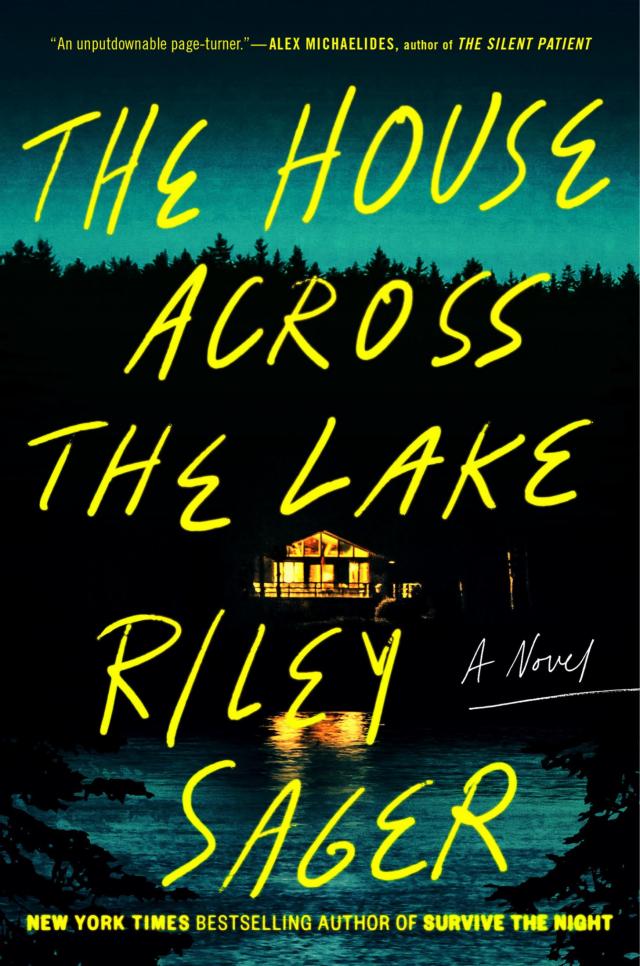
The house across the lak.., p.29
The House Across the Lake,
p.29


No wonder Wilma had been so certain about his innocence. Unlike me, she knew the whole story. And what looked like blind trust was in reality a beautiful kind of loyalty.
“She’s a good friend,” I say.
“She is. She did her thing and convinced everyone we worked with that I was innocent. I hope that, eventually, you’ll believe me, too.”
I think I already do.
I don’t know enough about his marriage to judge Boone—something I had no trouble doing when there was more bourbon than blood in my system. Right now, all I know is that, deep down, Boone seems like a good person who’s struggling to tame his demons just like the rest of us. And as someone who’s been terrible at demon taming, I should give him the benefit of the doubt.
“Thank you for stating your case,” I say. “And I believe you.”
“Really?”
“Really.”
“Then I should go before you change your mind,” Boone says, flashing me that killer grin one last time. Before leaving the porch, he hands me a business card. Printed on it is the name of a nearby church, a day of the week, and a specific time.
“That’s the weekly AA meeting I go to,” he says. “Just in case you ever feel the need to give it a try. It can be intimidating at first. And it might be easier for you if there’s a familiar face present.”
Boone leaves before I can respond, already assuming that my answer is no. He’s right, of course. I have no intention of subjecting myself to the indignity of standing before a group of strangers and exposing my many, many flaws.
Right now.
But maybe soon.
It all depends on how what I’m about to do next goes.
Before today, I would have downed several drinks before calling Wilma Anson. Now, though, I don’t hesitate, even when I know I’m about to be hit with major anger from her and a likely murder charge from her colleagues.
I’ve avoided it long enough.
It’s well past time to come clean.
Wilma is clearly not a fan of the life vest I forced her to put on before leaving the dock. She tugs at it the way a toddler strains at a car seat, unhappy and constricted.
“This really isn’t necessary,” she says. “I damn well know how to swim.”
“Safety first,” I say from the back of the boat, where I man the motor in a matching life vest.
I refuse to allow a repeat of what happened to Katherine Royce. Lake Greene might look harmless, especially now as the reflection of sunset makes the water sparkle like pink champagne, but I know it’s not.
Len is still down there.
I’m sure of it.
He left me and returned to the water. Now he lurks just beneath the surface, biding his time, waiting for someone else to come along.
Not on my watch.
Wilma also casts a wary glance at the water, although for a completely different reason. The western side of the lake, out of reach from the setting sun, has grown dark. Shadows gather on the shoreline and creep across Lake Greene’s surface.
“Can’t this wait until tomorrow?” she says.
“Afraid not.”
I get why she’s tired. It’s been a long, trying day. After I called to tell her Katherine had been found, Wilma spent the afternoon interviewing all of us. Katherine and Tom went first, giving their scripted version of events. Katherine swore she got lost on a hike. Tom swore he thought she’d left him. As for where he was last night when Wilma stopped by, he told her he had been worried about the severity of the storm and decided to ride it out in the Fitzgeralds’ basement.
I learned all of this from Wilma herself, when she came over to get my statement. I went through my side of the story, which lined up completely with the Royces’. If she still harbored suspicion about any of us, Wilma didn’t show it. No surprise there.
“There’s something else I need to tell you,” I said. “But not here. On the lake.”
Now we’re here, the lake’s surface split into two distinct halves. To the left, heavenly pink. To the right, shimmering black. I steer the boat down the middle, the wake from the motor stirring the light and the dark together.
“I talked to Boone,” I say as we glide over the water. “He told me the truth about what happened to his wife.”
“Oh.” Wilma sounds unsurprised. I suspect she already knows. “Does it change your opinion of him?”
“Yes. And of you. I thought you were a by-the-book kind of gal.”
“I am,” Wilma says. “But I’m also willing to make an exception now and again. As for Boone, he’s one of the good guys, Casey. Trust me on that.”
We’ve reached Old Stubborn, which sits on the shadow side of the lake. I cut the motor, remove the handkerchief from my pocket, and hand it to Wilma. She unfolds it, and her eyes go wide with shock.
Finally, an unambiguous reaction.
“I found them in the basement,” I say. “My basement.”
Wilma doesn’t take her eyes off the licenses and locks of hair. She knows what it all means.
“All three women are in the lake.” I point to Old Stubborn, now a silhouette in the quickening dusk. “Right there.”
“How do you know?”
“Because there’s no other place my husband would have put them.”
I can’t tell her the truth, for oh so many reasons, the chief one being that she wouldn’t believe me. My hope is that this—one wife confiding to another—might be enough to convince her.
“I’ll bring in divers tomorrow and see if you’re right,” she says. “If you are, well, life’s about to get a whole lot more complicated for you. People will know your husband was a killer—and they’re going to judge you for it.”
“I know.”
“Do you? This is a lot more damning than a tabloid headline,” Wilma says. “You’re going to spend the rest of your life tied to that man. You can try to distance yourself from his actions, but it’ll be hard. You might not be able to show your face in public for a very long time.”
I think about that picture of me raising a glass to the paparazzi that ran on the front page of the New York Post. “I’ve already got that covered. Besides, I just want there to be justice. I want everyone who knew and loved Megan, Toni, and Sue Ellen to know what happened to them—and that the man who did it can’t hurt anyone else.”
Quiet settles over the boat—a moment of silence for the three women whose bodies now rest far below. When it ends, the last of the sunset has slipped behind the mountains, leaving the two of us sitting in the murkiness of early evening.
“How long have you known?” Wilma says.
“Long enough.”
“Enough to have taken matters into your own hands?”
“If I did,” I say, “it’ll be awfully hard to prove now.”
I stay motionless, too nervous to move as I wait for Wilma’s response. She doesn’t make it easy for me, taking almost a full minute before saying, “I suppose you’re right.”
Hope blooms in my chest. I think that this is maybe, hopefully, possibly one of those rare exceptions Wilma talked about earlier.
“Len was cremated, after all,” I say. “There’s no body to examine.”
“That makes it impossible,” Wilma says. “Besides, I see no reason to reopen that case, considering no foul play was ever found in the first place.”
I exhale, letting go of most of the fear and tension that had been rising inside of me. Apparently it’s my lucky day. I was given a second chance at life by Katherine Royce. Now here’s Wilma Anson offering me a third.
I have enough self-awareness to know I don’t deserve them.
But I’ll accept them all the same.
All that remains is concern over one small loose end.
“What about the postcard?”
“What about it?” Wilma says. “That thing’s been examined six ways to Sunday. We’ll never know who sent it. In fact, it wouldn’t surprise me if it just up and vanished from the evidence room. Things like that get lost all the time.”
“But—”
She stops me with a look uncharacteristically readable in every way. “Are you seriously going to argue with me about this? I’m giving you an out, Casey. Take it.”
I do.
Gladly.
“Thank you,” I say.
“You’re welcome.” Two seconds pass. “Never bring it up again or I’ll change my mind.” Two more seconds. “Now take me back to shore. It’s late, and you’ve just given me a shitload of paperwork to deal with.”
Night has fully fallen by the time Wilma leaves. I go through the dark house turning on lights before heading to the kitchen to decide what to make for dinner. The glass of bourbon I poured last night still sits on the counter. The sight of it makes me quake with thirst.
I pick it up.
I bring the glass to my lips.
Then, thinking better of it, I take it to the sink and pour the bourbon down the drain.
I do the same with the rest of the bottle.
Then another.
Then all the bottles.
My mood swings like a pendulum as I rid the house of alcohol. There’s the same fury one feels when clearing out a no-good lover’s belongings. There’s I-can’t-believe-I’m-doing-this laughter. There’s excitement, wild and chaotic, along with catharsis and desperation and pride. And there’s sadness—a surprise. I didn’t expect to be mourning a drinking life that has only brought me trouble. Yet as the contents of bottle after bottle swirl down the drain, I’m overcome with grief.
I’m losing a friend.
A horrible one, yes.
But not always.
Sometimes drinking did indeed bring me great joy, and I’ll miss it.
After an hour, the doors to the liquor cabinet sit wide open, exposing only emptiness within. Filling the counter are all the bottles it had once contained, each one now drained. Some were older than a millennial; others were bought this week.
Now only one remains, a five-thousand-dollar bottle of red on the dining room table that belonged to Tom Royce. Knowing how much it cost, I couldn’t bring myself to pour that one down the drain. Through the dining room window, I see the Royce house blazing in the October night. I’d return the wine now if it weren’t so late and I weren’t so tired.
Emptying all those bottles has left me exhausted. Or maybe that’s just a symptom of withdrawal. Already, I’m dreading the myriad side effects that are surely in store.
A new Casey is on her way.
A strange feeling. I’m me—but also not. Which, come to think of it, is probably how Katherine felt before Len completely took over.
I’m just not myself lately, she told me. I haven’t felt right for days.
The memory arrives with the force of a thunderclap. Loud. Jarring. Charged with electricity.
Because what Katherine told me that day doesn’t track with everything else. When I learned that Len had returned and was controlling her like a marionette, I assumed he was the reason she’d felt so weird, so weak.
He was partly to blame, of course. I learned that myself from the short time he was inside me.
But Len wasn’t the sole reason Katherine felt that way.
I know because when she confessed to not feeling quite herself, it was the morning we had coffee on the porch. One day after I pulled her out of the lake. But according to Katherine, she felt off earlier than that—before Len entered the picture.
It was like my entire body stopped working.
I turn away from the window and look at the bottle of wine sitting on the table.
Then I grab my phone and call Wilma Anson.
The call immediately goes to voicemail. After the beep, I don’t leave my name or number. I simply shout what I need to say and hope Wilma hears it in time.
“That piece of wineglass I made you take? Did a report come back from the lab yet? Because I think I was right, Wilma. I think Tom Royce was—is—trying to murder his wife.”
I end the call, rush out to the porch, and grab the binoculars. It takes me a second to adjust the zoom and the focus. The Royce house blurs and unblurs before becoming crystal clear.
I scan the house, checking each room.
The kitchen is empty.
So is the office directly above it and the master bedroom to the right.
I finally locate Katherine in the living room. She’s on the sofa, propped up by throw pillows and lying under a blanket. On the coffee table beside her sits a large glass of red wine.
Still holding the binoculars to my eyes with one hand, I reach for my phone with the other. It bobbles in my hand as my thumb slides along the screen, scrolling to Katherine’s number.
Across the lake, she reaches for the wine, her hand curling around the glass.
I grip the phone tighter and hit the call button.
Katherine brings the glass to her lips, about to take a sip.
The phone rings once.
She perks up at the sound, the hand holding the glass going still.
Second ring.
Katherine looks around the room, trying to locate her phone.
Third ring.
She spots it sitting on a nearby ottoman and sets the glass back down on the coffee table.
Fourth ring.
Katherine reaches for the phone, the blanket slipping from her lap. She clutches it with one hand while the other stretches for the phone.
Fifth ring.
“Hang up the phone, Casey.”
I lower the binoculars and whirl around as Tom emerges from my house, joining me on the porch. The bottle of wine is in his hand, gripped by the handle like a club. He smacks the blunt end into the open palm of his free hand as he comes closer.
Katherine’s voice squawks from my phone as she finally answers.
“Hello?”
Tom wrenches the phone from my hand, hangs up, and flings it over the porch railing. The phone lands with a crack in the darkness below before bleating out a ring. Katherine calling me back.
“By now, I bet you wish you hadn’t been so nosy,” Tom says. “None of this would be happening if you had just stayed out of it. Katherine would be dead, you’d be here drinking yourself into a stupor, and I’d have enough money to save my company. But you just had to rescue her and then watch us nonstop, like our lives were a fucking reality show. And you ruined everything once you got the police involved. Now I can’t just slowly poison Katherine. Now I need to be extra careful, cover my tracks, make it truly look like an accident. That’s why I kept her tied up in the basement instead of killing her outright. Lucky for me, your husband had a lot of interesting things to say about that.”
I flinch—a reaction I can’t prevent because I’m too focused on the heavy glass of the wine bottle still slapping into Tom’s palm.
“We talked a lot while he was in that basement,” he says. “Chatted for hours. There wasn’t much else to do once your detective friend started breathing down my neck. You want to know the most surprising thing he told me?”
He lifts the bottle, brings it down.
Slap.
“That I killed him,” I say.
“Not just that. It was how you did it that was so fascinating.”
Slap.
“A perfect murder,” Tom says. “Far better than what was in that play of yours. That’s where I first got the idea, but you already know that. Poisoning my wife little by little so she dies of something else and I inherit everything.”
Slap.
“But your husband—good old talkative Len—gave me a much better idea. Antihistamine in some wine. Make her good and drowsy. Drop her into the water and let her sink. The police around these parts never seem to suspect foul play when a person drowns. As you well know.”
Slap.
Somewhere below, my phone stops ringing as Katherine gives up.
“She’s probably taking a sip right now.” Tom gestures to the binoculars still clutched in my hands. “Go ahead and watch. I know you enjoy doing that.”
I raise the binoculars, needing both hands to keep them from shaking. The Royce house jitters anyway, as if an earthquake is taking place. Through the shimmying lenses, I see that Katherine has moved to the living room window. She stares outside, the glass of wine back in her hand.
She brings it to her lips and drinks.
“Katherine, no!”
I don’t know if Katherine hears my scream flying across the lake because Tom is upon me in an instant. I swing the binoculars at his head. He blocks them with his arm before slamming the bottle against mine.
I drop the binoculars as pain shoots through my arm.
I cry out, stumble backwards against a rocking chair, and collapse onto the porch.
“Now you know how it feels,” Tom says.
He swings the bottle again. It whooshes past my face, mere inches away.
I scramble backwards along the porch, my right arm throbbing as Tom continues to swing the bottle, slicing the air, bringing it closer.
And closer.
And closer.
“I know how to make you disappear,” Tom says. “Len told me that, too. All it takes is some rope, some rocks, some deep, deep water. You’ll vanish, just like those girls he killed. No one will ever know what happened to you.”
He swings the bottle again, and I scoot out of the way, edging onto the top of the porch steps.