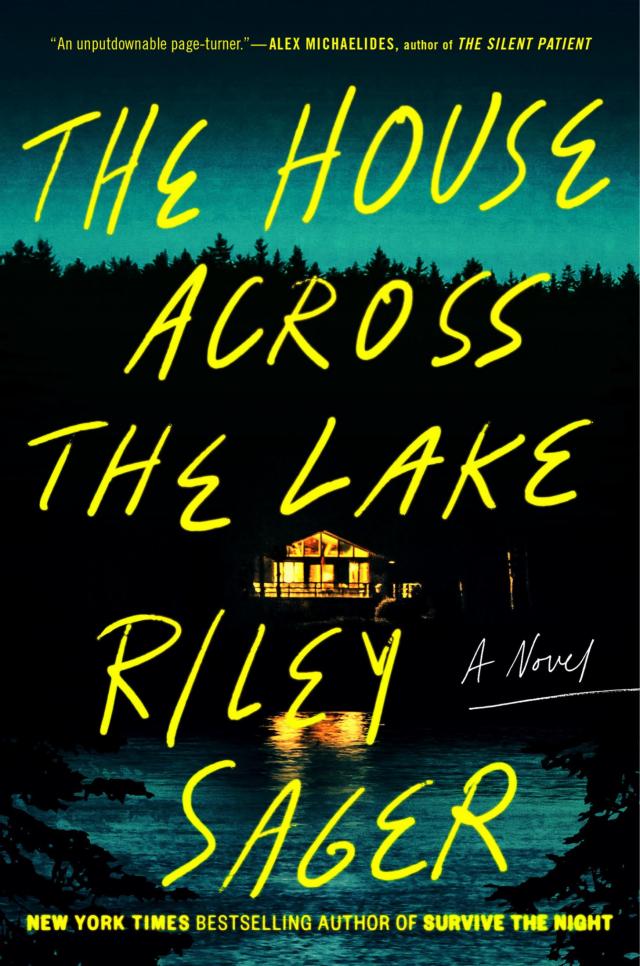
The house across the lak.., p.3
The House Across the Lake,
p.3


“This isn’t a business call,” she announces when I answer.
“I assumed that,” I say, knowing there’s no business to call about. Not now. Maybe not ever again.
“I just wanted to know how the old swamp is doing.”
“Are you referring to me or the lake?”
“Both.”
Marnie pretends to have a love-hate relationship with Lake Greene, even though I know it’s really only love. When we were kids, we spent every summer here together, swimming and canoeing and staying up half the night while Marnie told ghost stories.
“You know the lake is haunted, right?” she always began, scrunched at the foot of the bed in the room we shared, her tanned legs stretched, her bare feet flat against the slanted ceiling.
“It feels weird to be back,” I say as I drop into a rocking chair. “Sad.”
“Naturally.”
“And lonely.”
This place is too big for just one person. It started off small—a mere cottage on a lonely lake. As the years passed and additions were added, it turned into something intended for a brood. It feels so empty now that it’s just me. Last night, when I found myself wide awake at two a.m., I roamed from room to room, unnerved by all that unoccupied space.
Third floor. The sleeping quarters. Five bedrooms in all, ranging in size from the large master suite, with its own bathroom, to the small two-bedder with the slanted ceiling where Marnie and I slept as children.
Second floor. The main living area, a maze of cozy rooms leading into each other. The living room, with its great stone fireplace and pillow-filled reading nook under the stairs. The den, cursed with a moose head on the wall that unnerved me as a child and still does in adulthood. It’s home to the lake house’s sole television, which is why I don’t watch much TV when I’m here. It always feels like the moose is studying my every move.
Next to the den is the library, a lovely spot usually neglected because its windows face only trees and not the lake itself. After that is a long line of necessities sitting in a row—laundry room, powder room, kitchen, dining room.
Wrapped around it all, like ribbon on a present, is the porch. Wicker chairs in the front, wooden rockers in the back.
First floor. The walkout basement. The only place I refuse to go.
More than any other part of the house, it makes me think of Len.
“It’s natural to feel lonely,” Marnie says. “You’ll get used to it. Is anyone else at the lake besides Eli?”
“As a matter of fact, there is. Katherine Royce.”
“The model?”
“Former model,” I say, remembering what Katherine told me as she was getting out of the boat. “She and her husband bought the house across the lake.”
“Vacation with the stars at Lake Greene, Vermont!” Marnie says in her best TV-pitchwoman voice. “Was she bitchy? Models always strike me as being bitchy.”
“She was super sweet, actually. Although that might have been because I saved her from drowning.”
“Seriously?”
“Seriously.”
“If the paparazzi had been around for that,” Marnie says, “your career prospects would look very different right now.”
“I thought this wasn’t a business call.”
“It’s not,” she insists. “It’s a please-take-care-of-yourself call. We’ll deal with the business stuff when you’re allowed to leave.”
I sigh. “And that’s up to my mother. Which means I’m never leaving. I’ve been sentenced to life in prison.”
“I’ll talk to Aunt Lolly about getting you parole. In the meantime, you have your new model friend to keep you company. You meet her husband?”
“Haven’t had the pleasure yet.”
“I heard he’s weird,” Marnie says.
“Weird how?”
She pauses, choosing her words carefully. “Intense.”
“Are we talking Tom Cruise jumping-on-a-couch intense? Or Tom Cruise dangling-from-an-airplane intense?”
“Couch,” Marnie says. “No, airplane. Is there a difference?”
“Not really.”
“Tom Royce is more like the guy who holds meetings during CrossFit sessions and never stops working. You don’t use his app, do you?”
“No.”
I avoid all forms of social media, which are basically hazardous waste sites with varying levels of toxicity. I have enough issues to deal with. I don’t need the added stress of seeing complete strangers on Twitter tell me how much they hate me. Also, I can’t trust myself to behave. I can’t begin to imagine the nonsense I’d post with six drinks in me. It’s best to stay away.
Tom Royce’s endeavor is basically a combination of LinkedIn and Facebook. Mixer, it’s called. Allowing business professionals to connect by sharing their favorite bars, restaurants, golf courses, and vacation spots. Its slogan is “Work and play definitely mix.”
Not in my line of work. God knows I’ve tried.
“Good,” Marnie says. “That wouldn’t be a good look for you.”
“Really? I think it’s very on brand.”
Marnie’s voice drops an octave. Her concerned voice, which I’ve heard often in the past year. “Please don’t joke, Casey. Not about this. I’m worried about you. And not as your manager. As your friend and as family. I can’t begin to understand what you’re going through, but you don’t need to do it alone.”
“I’m trying,” I say as I eye the glass of bourbon I abandoned in order to rescue Katherine. I’m gripped by the urge to take a sip, but I know Marnie will hear it if I do. “I just need time.”
“So take it,” Marnie says. “You’re fine financially. And this madness will all die down eventually. Just spend the next few weeks focusing on you.”
“I will.”
“Good. And call me if you need anything. Anything at all.”
“I will,” I say again.
Like the first time, I don’t mean it. There’s nothing Marnie can do to change the situation. The only person who can get me out of the mess I’ve created is me.
Something I’m not inclined to do at the moment.
I get another call two minutes after hanging up with Marnie.
My mother making her daily four p.m. check-in.
Instead of my cell, she always calls the ancient rotary phone in the lake house’s den, knowing its annoying ring makes it more likely I’ll answer. She’s right. In the three days since my return, I’ve tried to ignore that insistent trilling but have always given in before five rings.
Today, I make it to seven before going inside and picking up. If I don’t answer now, I know she’ll keep calling until I do.
“I just want to know how you’re settling in,” my mother says, which is exactly what she told me yesterday.
And the day before that.
“Everything’s fine,” I say, which is exactly what I told her yesterday.
And the day before that.
“And the house?”
“Also fine. That’s why I used the word everything.”
She ignores my snark. If there’s one person on this earth unfazed by my sarcasm, it’s Lolly Fletcher. She’s had thirty-six years of practice.
“And have you been drinking?” she asks—the real purpose of her daily phone call.
“Of course not.”
I glance at the moose head, which gives me a glassy-eyed stare from its perch on the wall. Even though it’s been dead for almost a century, I can’t shake the feeling the moose is judging me for lying.
“I sincerely hope that’s true,” my mother says. “If it is, please keep it that way. If it’s not, well, I’ll have no other choice but to send you somewhere more effective.”
Rehab.
That’s what she means. Shipping me off to some Malibu facility with the word Promise or Serenity or Hope in its name. I’ve been to places like that before and hated them. Which is why my mother always hints at the idea when she wants me to behave. It’s the veiled threat she’s never willing to fully reveal.
“You know I don’t want that,” she adds. “It would just cause another round of bad publicity. And I can’t bear the thought of you being abused by those nasty gossip people more than you already are.”
That’s one of the few things my mother and I agree on. The gossip people are indeed nasty. And while calling what they do abuse is taking it a bit too far, they certainly are annoying. The reason I’m sequestered at Lake Greene and not my Upper West Side apartment is to escape the prying gaze of the paparazzi. They’ve been relentless. Waiting outside my building. Following me into Central Park. Covering my every move and trying to catch me with a drink in my hand.
I finally got so sick of the surveillance that I marched to the nearest bar, sat outside with a double old-fashioned, and gulped it down while a dozen cameras clicked away. The next morning, a picture of that moment appeared on the cover of the New York Post.
“Casey’s Booze Binge” was the headline.
That afternoon, my mother showed up at my door with her driver, Ricardo, in tow.
“I think you should go to the lake for a month, don’t you?”
Despite her phrasing it as a question, I had no say in the matter. Her tone made it clear I was going whether I wanted to or not, that Ricardo would drive me, and that I shouldn’t even think about stopping at a liquor store along the way.
So here I am, in solitary confinement. My mother swears it’s for my own good, but I know the score. I’m being punished. Because although half of what happened wasn’t my fault, the other half was entirely my doing.
A few weeks ago, an acquaintance who edits celebrity memoirs approached me about writing my own. “Most stars find it very cathartic,” she said.
I told her yes, but only if it I could call it How to Become Tabloid Fodder in Seven Easy Steps. She thought I was joking, and maybe I was, but I still stand by the title. I think people would understand me better if I laid out my life like Ikea instructions.
Step One, of course, is to be the only child of Beloved Lolly Fletcher, Broadway icon, and Gareth Greene, a rather milquetoast producer.
My mother made her Broadway debut at nineteen. She’s been working nonstop ever since. Mostly onstage, but also in movies and television. YouTube is chock-full of her appearances on The Lawrence Welk Show, The Mike Douglas Show, Match Game, several dozen awards shows. She’s petite, barely five feet in heels. Instead of smiling, she twinkles. A full-body sparkle that begins at her Cupid’s bow lips, spreads upward to her hazel eyes, and then radiates outward, into the audience, enveloping them in a hypnotic glow of talent.
And my mother is talented. Make no mistake about that. She was—and still is—an old-school Star. In her prime, Lolly Fletcher could dance, act, and land a joke better than the best of them. And she had a powerhouse singing voice that was somewhat spooky coming from a woman so small.
But here’s a little secret about my mother: Behind the twinkle, inside that tiny frame of hers, is a spine of steel. Growing up poor in a Pennsylvania coal town, Lolly Fletcher decided at an early age that she was going to be famous, and that it was her voice that would make it happen. She worked hard, cleaning studios in exchange for dance lessons, holding three after-school jobs to pay for a voice coach, training for hours. In interviews, my mother claims to never have smoked or drunk alcohol in her life, and I believe it. Nothing was going to get in the way of her success.
And when she did make it big, she worked her ass off to stay there. No missed performances for Lolly Fletcher. The unofficial motto in our household was “Why bother if you’re not going to give it your all?”
My mother still gives it her all every damn day.
Her first two shows were mounted by the Greene Brothers, one of the prime producing duos of the day. Stuart Greene was the in-your-face, larger-than-life publicity man. Gareth Greene was the pale, unflappable bean counter. Both were instantly smitten with young Lolly, and most people thought she would choose the PR guy. Instead, she picked the accountant twenty years her senior.
Many years later, Stuart married a chorus girl and had Marnie.
Three years after that, my parents had me.
I was a late-in-life baby. My mother was forty-one, which always made me suspect my birth was a distraction. Something to keep her busy during a career lull in which she was too old to be playing Eliza Doolittle or Maria von Trapp but still a few years away from Mrs. Lovett and Mama Rose.
But motherhood was less interesting to her than performing. Within six months, she was back to work in a revival of The King and I while I, quite literally, became a Broadway baby. My crib was in her dressing room, and I took my first steps on the stage, practically basking in the glow of the ghost light.
Because of this, my mother assumed I’d follow in her footsteps. In fact, she demanded it. I made my stage debut playing young Cosette when she did Les Misérables for six months in London. I got the part not because I could sing or dance or was even remotely talented but because Lolly Fletcher’s contract stipulated it. I was replaced after two weeks because I kept insisting I was too sick to go on. My mother was furious.
That leads us to Step Two: rebellion.
After the Les Mis fiasco, my level-headed father shielded me from my mother’s star-making schemes. Then he died when I was fourteen and I rebelled, which to a rich kid living in Manhattan meant drugs. And going to the clubs where you took them. And the after parties, where you took more.
I smoked.
I snorted.
I placed candy-colored pills on my tongue and let them dissolve until I could no longer feel the inside of my mouth.
And it worked. For a few blissful hours, I didn’t mind that my father was dead and that my mother cared more about her career than me and that all the people around me were only there because I paid for the drugs and that I had no real friends other than Marnie. But then I’d be jerked back to reality by waking up in a stranger’s apartment I never remembered entering. Or in the back of a cab, dawn peeking through the buildings along the East River. Or in a subway car with a homeless man asleep in the seat across from me and vomit on my too-short skirt.
My mother tried her best to deal with me. I’ll grant her that. It’s just that her best consisted of simply throwing money at the problem. She did all the things rich parents try with troubled girls. Boarding school and rehab and therapy sessions in which I gnawed at my cuticles instead of talking about my feelings.
Then a miracle happened.
I got better.
Well, I got bored, which led to betterment. By the time I hit nineteen, I’d been making a mess of things for so long that it grew tiresome. I wanted to try something new. I wanted to try not being a trainwreck. I quit the drugs, the clubs, the “friends” I’d made along the way. I even went to NYU for a semester.
While there, Step Three—another miracle—occurred.
I got into acting.
It was never my intention to follow in my mother’s footsteps. After growing up around showbiz, I wanted nothing to do with it. But here’s the thing: It was the only world I knew. So when a college friend introduced me to her movie-director father, who then asked me if I wanted to play a small part in his next feature, I said, “Why not?”
The movie was good. It made a lot of money, and I made a name for myself. Not Casey Greene, which is my real name. I insisted on being billed as Casey Fletcher because, honestly, if you’ve got the kind of heritage I do, you’d be foolish not to flaunt it.
I got another part in another movie. Then more after that. Much to my mother’s delight and my surprise, I became my worst fear: a working actress.
But here’s another thing: I’m pretty good at it.
Certainly not legendary, like my mother, who truly is great at her craft. But I take direction well, have decent presence, and can put a fresh spin on the most tired of dialogue. Because I’m not classically beautiful enough for leading lady status, I often play the supportive best friend, the no-nonsense sister, the sympathetic coworker. I’m never going to become the star my mother is, which isn’t my goal. But I am a name. People know me. Directors like me. Casting agents put me in big parts in small movies and small parts in big movies and as the lead in a sitcom that lasted only thirteen episodes.
It’s not the size of the role I care about. It’s the character itself. I want complicated, interesting parts into which I can disappear.
When I’m acting, I want to become someone else entirely.
That’s why my main love is theater. Ironic, I know. I guess growing up in the wings really did rub off on me. The parts are better, that’s for damn sure. The last movie offer I got was playing the mother of an actor six years younger than me in a Transformers reboot. The character had fourteen lines. The last theater offer was the lead role in a Broadway thriller, with dialogue on every page.
I said no to the movie, yes to the play. I prefer the palpable spark between performer and audience that exists only in theater. I feel it every time I step onstage. We share the same space, breathe the same air, share the same emotional journey. And then it’s gone. The whole experience as transitory as smoke.
Kind of like my career, which is all but over, no matter what Marnie says.
Speaking of things that don’t last, welcome to Step Four: Marry a screenwriter who is also a name but not one big enough to eclipse yours.
In my case, Len. Known professionally as Leonard Bradley, who helped pen a few movies you’ve definitely seen and quite a lot that you haven’t. We met at a party first, then on the set of a movie on which he did some uncredited script polishing. Both times, I thought he was cute and funny and maybe secretly sexy under his gray hoodie and Knicks cap. I didn’t think of him as boyfriend material until our third meeting, when we found ourselves boarding the same flight back to New York.