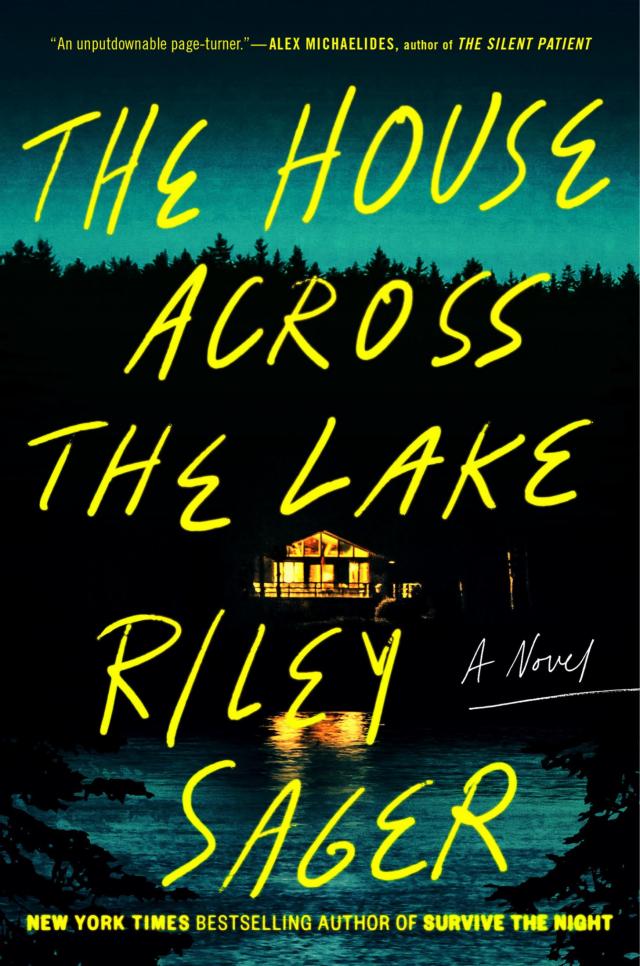
The house across the lak.., p.30
The House Across the Lake,
p.30


Tom swings again and I duck, trying to keep my balance. A moment of weightlessness follows—cruel in its deception that I might be able to resist the pull of gravity. It ends with a thud onto the next step.
Then I tumble, backflipping down the steps, the edge of each one feeling like a punch.
To my hip.
To my back.
To my face.
When it’s over, I’m flat-backed on the ground, clanging with pain and woozy from the fall. My vision blurs. Tom drifts in and out of focus as he follows me down the steps.
Slowly.
One at a time.
The bottle again smacking into his hand.
Slap.
I try to scream, but nothing comes out. I’m too hurt, too out of breath, too scared. All I can do is try to stand, stumble toward the water, hope someone will see me.
Tom catches up to me at the lake’s edge. I’m sloshing into the water when he snags my shirt, tugs me toward him, swings the bottle.
I lurch to the left, and the bottle crashes down onto my right shoulder.
More screaming pain.
The blow knocks me to my knees. I splash deeper into the lake, the water now at my hips, cold as ice. The chill zaps me with just enough energy so I can twist toward Tom, wrap my arms around his knees, and pull him down with me.
We submerge as one—a seething, writhing mass of tangled arms and kicking legs. The wine bottle slips from Tom’s hand, vanishing into the water just as he drags me out of it. He wraps his hands around my neck and, squeezing, dunks me back under.
I run out of air instantly. The lake is so cold and Tom’s hands are so tight around my neck and I can’t see anything in the dark water. Shoved to the bottom of the lake, I kick and writhe and thrash as my chest gets tighter and tighter. So tight I fear it’s going to explode.
Yet all I can think about is Len.
In this very same lake.
Waiting for me to die in the dark water so he can take over once more.
I can’t let that happen.
I fucking refuse.
I run a hand along the lake bed, seeking out a rock I can use to hit Tom. Maybe it’ll be enough to make him stop pressing against my throat. Maybe he’ll let go entirely. Maybe I’ll be able to escape.
Instead of a rock, my fingernails brush glass.
The wine bottle.
I reach for it, grab it by the neck, swing.
The bottle bursts from the surface, slicing through the air before slamming into the side of Tom’s skull.
His hands fall away from my neck as he grunts, sways, topples over. I rise from the water. Tom splats into it, facedown and motionless.
On the other side of the lake, police cars have started to gather in the Royces’ driveway. Their lights reflect off the water in spinning streaks of red, white, and blue as officers swarm the back patio and rush inside.
Wilma got my message.
Thank God.
I try to stand, but am only able to bring myself into a kneeling position. When I attempt to yell to the cops, my cries come out a muted croak. My throat’s too battered.
Next to me, Tom remains facedown in the water. Just above his left ear is a small crater where the bottle connected with his skull. Blood pours from it, mixing with the water and forming a black cloud that blooms and spreads.
I know he’s dead the moment I flip him over. His eyes are as dull as old nickels and his body eerily still. I touch his neck, finding no pulse. Meanwhile, the blood continues to ooze from the dent in his head.
I finally stand, bending my legs to my will. The wine bottle, still intact, remains gripped in my hand. I take it to shore, placing it in a strip of rocks between lake and land.
Behind me, Tom jerks back to life with a watery gasp.
Not a shock.
Not in this lake.
I march back into the water and grab his arms. I try not to look at him, but it can’t be avoided as I drag him ashore, making sure no part of his body is still touching the lake. He catches my eye and smiles.
“We need to stop meeting like this,” he says before hissing the nickname I’m both dreading and expecting. “Cee.”
“We will,” I say.
I grab the bottle, smash it against the rocks, and, with a stab and a twist, drive the jagged edge into his throat until I’m certain he’ll never be able to speak again.
LATER
I’m the last one awake.
Of course.
It’s easy to sleep in now that the sun’s path in the sky has changed with the seasons, entering the row of windows at an oblique angle that misses the bed entirely. When I do rise, the smell of coffee and the sounds of cooking are already slipping under the door. Everyone else, it seems, has been up for ages.
Downstairs, I find the kitchen abuzz with activity. Marnie and my mother huddle at the stove, debating the correct way to make French toast. I kiss them both on the cheek and let them bicker while I pour a cup of coffee.
In the dining room, Eli and Boone set the table. Six place settings in all.
“Morning, sleepyhead,” Boone says. “We thought you’d never get up.”
I take a sip of coffee. “I was tired. Had a long night.”
“New Year’s Eve will do that to you.”
We all rang in the new year on the back porch, raising glasses of ginger ale in a toast at the stroke of midnight.
It was a good night.
That got even better.
“Casey could learn a thing or two from you about being an early riser,” my mother tells Boone from the kitchen. “When I got up this morning, you were already awake and your bed already made.”
Across the dining room, Boone gives me a sneaky look that almost makes me break out into laughter. We’re still not sure if my mother hasn’t yet figured out that we’re together or if she realized it weeks ago and is now toying with us. Either way, it’s a game we all seem to enjoy. Unlike Monopoly, which Boone beats me at every damn time.
I haven’t told him the truth about what really happened to Katherine and how I knew that Len murdered three women. The same goes for Marnie and my mother. They, like most of America, still think Katherine got lost on a hike—her sense of direction addled by the small doses of poison Tom had been slipping her—and that I found the hair and driver’s licenses of the three missing women while going through Len’s belongings.
I plan on telling Boone, Marnie, and my mother the truth someday. I really do. I just need more time. It was hard enough admitting to Boone that I’d watched him from the porch as he stood naked on the Mitchells’ dock.
He told me he had assumed that.
He also suggested I do it again as soon as the weather gets warmer.
As for everything else, that story is a little bit harder to tell, and I’m not ready for the honeymoon phase of whatever it is Boone and I are doing to end. Also, at least for the time being, I need one thing in my life not tainted by the events of October.
The day after Tom’s attack, a state police search-and-rescue team swarmed the lake. The bodies of Megan Keene, Toni Burnett, and Sue Ellen Stryker were all recovered at the same time, found exactly where Len said they were.
The press lost their collective minds. I can only imagine how many editors needed smelling salts after hearing Mixer founder Tom Royce tried to poison fashion icon Katherine Royce but was stopped by Troubled Casey Fletcher, who had just learned her dead husband was a serial killer.
Talk about a headline.
It was madness at Lake Greene for more than a week. So many press vehicles rolled down the gravel road circling the lake that police had to put up barricades to keep them away. That’s when the helicopters arrived, hovering just above the water, photographers leaning out the sides like they were Navy SEALs about to leap into battle. One reporter even hiked two miles in heels to ring the doorbell and ask some questions. Eli gave her a bag of ice for her sore feet and sent her packing.
Since then, I’ve rarely left the lake house. Unlike the Casey of old, who thought nothing of drunkenly toasting the paparazzi camped outside a bar, I know any appearance I make will only fan the media flames. Although I engendered a lot of goodwill for saving Katherine’s life, Wilma Anson was right that I would be judged for Len’s crimes. While most people don’t think I helped him murder three young women, everyone blames me for not realizing it while he was alive. I’m okay with that for two reasons.
One, I know the truth.
Two, I also still blame myself.
When I do go out, it’s incognito. I attended the funerals of all three of Len’s victims—an anonymous woman in oversized sunglasses and a floppy hat sitting in the back of sparsely attended churches. Katherine wanted to go along, but I discouraged it by telling her she’d stick out too much. In truth, I wanted to be alone so that I could whisper a prayer to Megan, Toni, and Sue Ellen.
I apologized for not helping to find them sooner and I prayed that they would forgive me.
I desperately hope they heard it.
“Breakfast will be ready in five minutes,” Marnie says. “Go fetch Katherine. She’s out on the porch.”
I grab one of the many parkas now hanging in the foyer and head to the back porch. Katherine’s in one of the rocking chairs, nursing a cup of coffee and wearing a designer coat that makes it look like she just flew in from St. Moritz.
“Happy New Year,” she says, beaming up at me from beneath a hood lined with fake fur.
“Likewise.”
Katherine put her glass castle on the market and moved into my family’s lake house the moment both of us left the hospital. Unlike mine, her reputation has only improved since the events of October. That sort of thing happens when your husband tries to kill you—and the police have a broken wineglass tainted with poison to prove it.
Also unlike me, Katherine’s been out and about on a full publicity gauntlet. She landed on the cover of People, told her story on Good Morning America, wrote a personal essay for Vanity Fair. In all of them, she took great pains to mention how good of a friend I’ve been and how I went through just as much trauma as she did. Because of this—and because those daredevil photographers caught Katherine and me laughing on the porch—the media has dubbed us the Merry Widows.
I’m not going to lie. I kind of like it.
“Was it weird not to be drinking champagne at midnight?” Katherine says.
It’s been ten weeks since my last real drink. Ten long, slow, white-knuckle weeks. But I’m doing better than I did last week, which was better than the week before. My urge to drink has lessened in that time. That encourages me, even though I know the urge won’t permanently leave me. That thirst will haunt me like a phantom limb—missing yet keenly felt.
But I can manage.
The meetings help.
So does having a support system that now fills every bedroom of this once-empty house.
“Honestly, it was a refreshing change of pace,” I say.
“Cheers to that.”
We clink mugs and look out at the lake. It froze over in mid-November, and will likely remain that way until March. The valley got a foot of snow two days before Christmas, turning everything into a gleaming white oasis right out of Currier and Ives. The other day, Marnie and I slipped our feet into too-tight ice skates and slid around the lake just like we did when we were kids.
“Do you really think they’re gone?” Katherine says.
I look at her, surprised. Despite everything the two of us have gone through, we’ve barely talked about it in private. I think it’s because we’re both afraid of cursing the present by mentioning the past.
This morning, though, the dawn of the new year brings a sense of hopefulness bright enough to eclipse whatever darkness talking about it might summon.
“I think they are,” I say. “I hope they are.”
“What if they’re not? What if both of them are still out there, waiting?”
I’ve thought about that a lot, especially on nights when I’m craving a drink and end up roaming the house like a restless spirit. I look out at the water and wonder if Len somehow managed to return there, once more waiting for someone to fall victim to the lake, or if Tom has taken his place in the dark depths. Because we still have no idea how and why any of it happened, it’s hard to put it to rest. Maybe the water of Lake Greene is touched by something both magical and vile. Or maybe it was Len himself, cursed by his horrible deeds.
Either way, I know there’s a chance—however small—that it could happen again.
If that day comes, I’ll be here.
And I’ll be ready.
ACKNOWLEDGMENTS
This book would not exist without the assistance and support of many wonderful people. Chief among them are my editor, Maya Ziv, and my agent, Michelle Brower, who cheered me on from the moment I first told them the bonkers plot of this book. Without their encouragement, there’d be no Casey, no Katherine, no house across Lake Greene.
Thank you to Emily Canders, Katie Taylor, Stephanie Cooper, Lexy Cassola, Christine Ball, Ivan Held, John Parsley, and everyone at Dutton and Penguin Random House for their hard work and support. On the business side, I’m indebted to Erin Files, Arlie Johansen, Sean Daily, Shenel Ekici-Moling, Kate Mack, and Maggie Cooper.
Sarah Dutton deserves a place in the First Reader Hall of Fame for diving into uncertain waters each and every book. Her keen insights and unvarnished opinions are invaluable.
Thank you to all the family members and friends who continue to cheer me on from the sidelines. Even though we saw a lot less of each other in the past two years, you are always in my thoughts.
Finally, massive thanks go to Michael Livio, whose love and patience helped me get through writing another book during a global pandemic. I truly couldn’t do this without you.
ABOUT THE AUTHOR
Riley Sager is the New York Times bestselling author of six novels, most recently Home Before Dark and Survive the Night. A native of Pennsylvania, he now lives in Princeton, New Jersey.
What’s next on
your reading list?
Discover your next
great read!
Get personalized book picks and up-to-date news about this author.
Sign up now.
_140193378_
Riley Sager, The House Across the Lake