The 13th immortal, p.1
The 13th Immortal,
p.1


Version 1 - 27-01-2015
Table of Contents
CAST OF CHARACTERS
Prologue
I
II
III
IV
V
VI
VII
VIII
IX
X
XI
XII
XIII
XIV
XV
XVI
THE END
THE SECRET OF THE FORBIDDEN CONTINENT
“Who was your father?” the mutant asked Dale Kesley.
And try as he might, Kesley could not remember; his past was an utter blank. But he knew one thing—the answer to his life’s riddle lay in Antarctica, the once frozen continent, now an earthly paradise surrounded by an impenetrable barrier.
But how to get there? The only means of transportation were the spindly six-legged mutant horses. And it was suicide for Kesley to travel on the American continents. Two immortal dictators had set king-size rewards for his capture—dead or alive. But somewhere in the two continents there was someone who would help him, someone he had to find. The future of the world depended on his success.
CAST OF CHARACTERS
DALE KESLEY
He couldn’t find the answers until he knew the right questions.
DRYLE VAN ALEN
The South Pole was his summer resort
NARELLA
She loved two men with one face.
DON MIGUEL
He was a childless sire, an impotent potentate.
DUKE WINSLOW
Once he had been wise; twice he had been fooled.
LOMARK DAWNSPEAR
In his blindness, he saw all things.
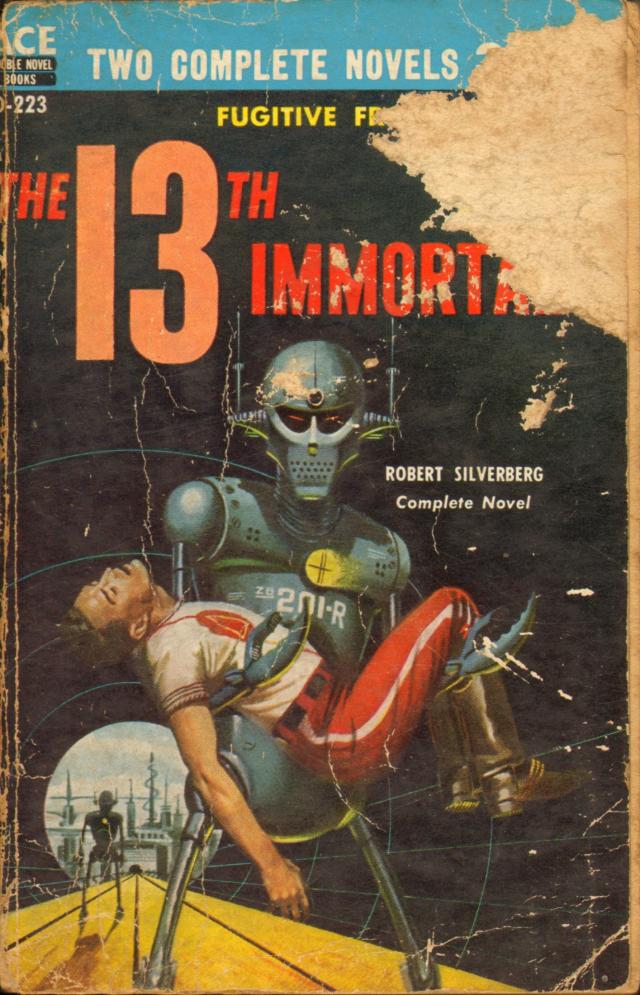
THE 13th IMMORTAL
by
ROBERT SILVERBERG
ACE BOOKS
A Division of A. A. Wyn Inc.
23 West 47th Street
New York 36, N.Y.
Copyright ©, 1957, by A. A. Wyn, Inc.
All Rights Reserved
To Barbara
THIS FORTRESS WORLD
Copyright, 1955, by James E. Gunn
Printed in U.S.A.
Prologue
Centuries later, men would talk of those years as the Years of the Freeze. They would mean the years between 2062 and 2527, the years when mankind, shattered by its own hand, maintained a rigid cultural stasis while rebuilding.
Those were the years when what was, would be. The years when there would be nothing new under the sun because mankind willed it so. The century of war, culminating in the almost total global destruction of 2062, had.taught lessons that were not soon forgotten.
The old ways returned to the world—ways that had held sway for thousands of years, and which had regained ascendancy after the brief, nightmarish reign of the machine. Mankind still had machines, of course; life would have been impossible without them. But the Years of the Freeze were years of primarily hand labor, of travel by foot or by horse, of slow living and fear of complexity. The clock rolled back to an older, simpler land of world—and froze there.
Like all ages, this one had its symbols and, conveniently, the symbols of the status quo were actual as well as symbolic forces in maintaining the Freeze. There were twelve of them—the Twelve Dukes, they called themselves, and they ruled the world between them. They had no power over the forgotten land of Antarctica, but otherwise they were virtually supreme. North America, South America, East and West Europe, Scandinavia, Australia, North Africa, Equatorial Africa, South Africa, China, India, Oceanica—each boasted its Duke.
They were products of the great blast of 2062, and they had found their way to power tortuously. Most of them had lived ordinary lives, picking their way through the wreckage with the others in the first three confused decades after the great destruction. But the others had died and the Twelve had not.
They had endured through forty, fifty, sixty years, themselves frozen indefinitely in middle life. And as the decades passed, each forced his way to control of a segment of the world. Each carved himself a Dukedom and, in 2162, the centennial of the Old World's death, they gathered together to divide the world among themselves.
There was a bitter struggle for power, but from it emerged the world of the Twelve Empires, stable, sedate, unchanging, determined never to allow the technology-born nightmare of old to return. The picture was attractive: twelve immortals, guiding the world along an even keel to the end of time.
Rumors filtered through the Twelve Empires occasionally that danger threatened from Antarctica. Man had redeemed Antarctica from the ice before the great cataclysm, and the polar land was known to be inhabited. But Antarctica remained detached from humanity, erecting an impassable barrier that cut itself off from the Twelve Empires as effectively as if it were on another planet. And so, the stasis held. The battered world rebuilt, on a more modest scale than of old, clinging to the simple ways, and froze that way. Here, there, an isolated city refused to participate in the Freeze. They, however, didn't matter. They intended to stay isolated, as did Antarctica, and the Twelve Dukes did not worry long over them.
In ninety percent of the world, time had stopped.
I
Half an hour before the neat fabric of his life was to be shattered forever, Dale Kesley was thinking desperately, This will be a good day for the planting.
He stood at the end of a freshly-turned furrow, one brown hand gripping the sharebeam, the other patting the scaly gray flank of his mutant plough-horse. The animal neighed, a long croaking wheeze of a sound. Kesley looked down at the fertile soil of the furrow.
He was trying to tell himself that this was good land, that he had found a good place, here in the heart of Duke Winslow’s sprawling farmland. He was compelling himself to believe that this was where he belonged, here where life held none of the uncertainty of the cities of the Twelve Empires. Right here where he had lived and worked for four years, here in Iowa Province.
But it was all wrong. Somewhere deep in the cloaked depths of his mind, he was trying to protest that there had been some mistake.
He wasn’t a farmer.
He didn’t belong in Iowa Province.
Somewhere, out there in the cities of the Twelve Empires, maybe in the radiation-blasted caves of the Old World, perhaps in the remote fastness of the unknown Antarctican empire, life was waiting for him.
Not here. Not in Iowa.
As always, a cold shudder ran through him and he let his head wobble as the sickness swept upward. He swayed, tightened his grip on the plough, and forced himself grimly back into the synthetic mood of security that was his one defense against the baseless terror that tormented him.
The farm is good, he thought.
Everything here is good.
Slowly, the congealed fear melted and drained away, and he felt whole again.
“Up, old hoss.”
He slapped the flank and the horse neighed again and swished its bony tail. It was a good horse too, he thought fiercely. Somehow, everything was good now, even the old horse.
Experienced hands had warned him against buying a mutie, but when he’d bought the half-share of the farm he had had to do it. The Old Kind were few and well spaced in Iowa Province, and all too expensive. They fetched upward of five thousand dollars at the markets; a good solid mutie went for only five hundred.
Besides, Kesley had argued, the Old Kind belonged with the Old World—dead five hundred years, and long covered with dust. Only the distant towers of New York still blazed with radiation; the chain reaction there would continue through all eternity, as a warning and a threat. But Kesley wasn’t concerned with that.
He started down a new furrow, guiding the plough smoothly and well, strong arms gripping the beam while the horse moved steadily onward. In front of him, the broad expanse of Iowa Province stretched out till it looked like it reached to the end of the world. The brown land rolled on endlessly, stopping only where it ran into the hard blueness of the cloudless sky.
Suddenly, the horse whinnied sharply. Kesley stiffened. The old mutie could smell trouble half a mile away. Kesley had learned to value the animal’s warning. He stepped out from behind the plough and looked around. The horse whinnied again and raked the unbroken ground with its forepaws.
Kesley shaded his eyes and squinted. Far down at the other end of the field, near the rock fence that separated his land from Loren’s, a dark-blue animal was slinking unobtrusively over the ground.
Blue wolf.
And today I’ll have your hide, old henstealer, Kesley thought jubilantly.
He patted the horse’s flank once again and started to run, crouching low, moving silently across the bare field. The wolf hadn’t seen him yet. The blue-furred creature was edging across the field down below, probably heading past the farmhouse to rob the poultry yard.
A daylight raid? Times must be bad, Kesley thought. The blue wolf normally struck only at night. Well, something had brought the old wolf out in broad daylight, and this time Kesley would nail him.
He circled sharply, staying downwind of the animal, and stepped up his pace. Without breaking stride, he unsheathed his knife and gripped it tightly. The wolf was nearly the size of a man; if Kesley caught up with him, it would be a bloody fight for both of them. But a wolf’s hide was a treasure well worth a few scratches.
The wolf caught the scent, now, and began to run up the path toward the farmhouse. Kesley realized the animal was confused, was running into a dead end.
S
o much the better. He’d kill the beast in the sight of Loren and the farm wenches and old Lester.
He clenched his teeth and kept running. The wolf looked back at him, bared its mouthful of yellow daggers, snarled. Its blue fur seemed to glitter in the bright morning sunlight.
Kesley’s breath was starting to come hard as he ascended the steep hill that led to the farmhouse. He slackened just a bit; he’d need to conserve his strength for the battle to come.
As he reached the crest of the hill, he saw Loren stick his head out of the second floor of the farmhouse.
“Hey, Dale!”
Kesley pointed up ahead. “Wolf!” he grunted.
The animal was drawing close to the poultry yard now. Kesley stepped up his clip again. He wanted to catch it just as it passed the door of the farmhouse. He wanted to nail it there, to plunge the knife into its heart and—
Abruptly, a strange figure stepped out of the farmhouse door. In one smooth motion, the figure put hand to hip, drew forth a blaster, fired. The wolf paused in mid-stride as
if frozen, shuddered once, and dropped. There was the sickening smell of burning fur in the air.
Kesley felt a quick burst of hot anger. He looked down at the smouldering ruin of the wolf huddled darkly against the ground, then to the stranger, who was smiling as he reholstered the blaster.
“What the hell did you do that for?” Kesley demanded hotly. “Who asked you to shoot? What are you doing here, anyway?”
He raised his knife in a wild threatening gesture. The stranger moved tentatively toward his hip again, and Kesley quickly relaxed. He lowered his knife, but continued to glare bitterly at the stranger.
“A thousand pardons, young friend.” The newcomer’s voice was deep and resonant, and somehow oily-sounding. “I had no idea the wolf was yours. I merely acted out of reflex. I understand it’s customary for farmers to kill wolves on sight. Believe me, I thought I was helping you.”
The stranger was dressed in courtly robes that contrasted sharply with Kesley’s simple farmer’s muslin. He wore a flowing cape of red trimmed with yellow gilt, a short stiff beard stained red to match, and a royal blue tunic. He was tall and powerful looking, with wide-set black eyes and heavy, brooding eyebrows that ran in a solid bar across his forehead.
“I don’t care if you are from the court,” Kesley snapped. “That wolf was mine. I chased it up from the fields—and to have some city bastard step out of nowhere and ruin my kill for me just as I’m—”
“Dale!”
The sharp voice belonged to Loren Harker, Kesley’s farming partner, a veteran fieldsman, tall and angular, face dried by the sun and skin brown and tough. He appeared from the farmhouse door and stood next to the stranger.
Kesley realized he had spoken foolishly. “I’m—sorry,” he said, his voice unrepentant. “It’s just that it boiled me to see—dammit, you had no business doing that!”
“I understand,” the stranger said calmly. “It was a mistake on my part. Please accept my apologies.”
“Accepted," Kesley muttered. Then his eyes narrowed suspiciously. “Say, what kind of tax-collector are you, anyway? You’re the first man out of Duke Winslow’s court who ever said anything but *Give me*”
“Tax-collector? Why call me that?"
“Why else would you come to the farmlands, if not for the tithe? Don’t play games,” Kesley said impatiently. He kicked the worthless wolf-carcass to one side and stepped between Loren and the stranger. “Come on inside, and tell me how much I owe my liege lord this time.”
“You don’t understand—” Loren started to say, but the stranger put one hand on his shoulder and halted him. “Let me,” he said.
He turned to Kesley. “I’m not a tax-collector. I’m not from the court of Duke Winslow at all.”
“What are you doing in farm country, then?”
The stranger smiled evenly. “I came here because I’m looking for someone. But what are you doing here, Dale Kesley?”
The question was like a stinging slap in the face. For a moment, Kesley remained frozen, un reacting. Then, as the words penetrated below the surface, a shadow of pain crossed his face. His mouth sagged open.
What are you doing here, Dale Kesley?
The words blurred and re-echoed like a shout in a cavern. Kesley felt suddenly naked, as the mask of self-deception and
hypocrisy that had erected itself during his four years
in Iowa Province crumbled inward and fell away. It was
the one question he had dreaded to face.
“You look sick,” Loren said. “What’s wrong, Dale?” The older man’s voice was hushed, bewildered.
“Nothing,” Kesley said hesitantly. “Nothing at all.” But he was unable to meet the stranger’s calm smile and, worse, he had no idea why.
His thoughts flashed back to that moment at the plough earlier that morning, when Iowa had seemed like the universe and he had made life appear infinitely good.
Lies.
Farm life was his natural state, he had pretended. He belonged behind the plough, here in Iowa.
Lies.
But—where did he belong?
He realized that he was acting irrationally. Loren's face hung before him, uncomprehending, frightened. The stranger seemed almost gloatingly self-confident.
“What did you mean by that?" Kesley asked, slowly. His voice sounded harsh and unfamiliar in his own ears.
“Have you ever been in the cities?" the stranger asked, ignoring Kesley's question.
“Once, maybe twice. I don't like it there. I'm a farmer; always have been. I came down from Kansas Province. But what the hell—?"
The stranger raised one hand to silence him. An amused twinkle crossed the cold black eyes, and the thin lips curved upward. “They did a good job," the stranger said, half to himself. “You really believe you're a farmer, don't you, Dale? Have been, all your life?"
Again the words stung; they bit deep into a hidden reservoir of fear, and rose to the surface again, leaving Kesley strangely disturbed. “Yes,” he said stubbornly. “What are you trying to do?" Anger came over him again, and he snapped, “Suppose I order you off my farm?"
The stranger laughed. “Your farm?” His eyes probed searchingly. “How can you call this your farm?”
Kesley quailed at the incomprehensible pain this third attack brought. What is he after? Why cant he leave me alone?
This is my farm.
1 belong here.
He stood poised, swaying on the balls of his feet, staring mystifiedly at his tormentor. I belong here, he thought fiercely—but without any conviction, this time. Something within his mind kept insisting that it was a lie, that he belonged elsewhere.
The glitter of the cities suddenly rose as an image in his mind.
Rage boiled over. “Let me alone!” he shouted, and jumped forward, raising the knife high.
“No!”
The stranger’s voice was almost a shriek of fear, but he was cool enough to draw and fire. A bright spurt of flame nudged from the muzzles of the blaster, and Kesley felt a sudden intolerable warmth in his hand. He dropped the hot knife and stepped back, panting like a trapped tiger.
“I wish you hadn’t done that,” the stranger said.
“I wish you had never come here,” Kesley retorted. It was like a nightmare. He felt blind, unable to defend himself, unable even to understand the source of the attack.