Deep space eight stori.., p.1
Deep Space - Eight Stories of Science Fiction,
p.1
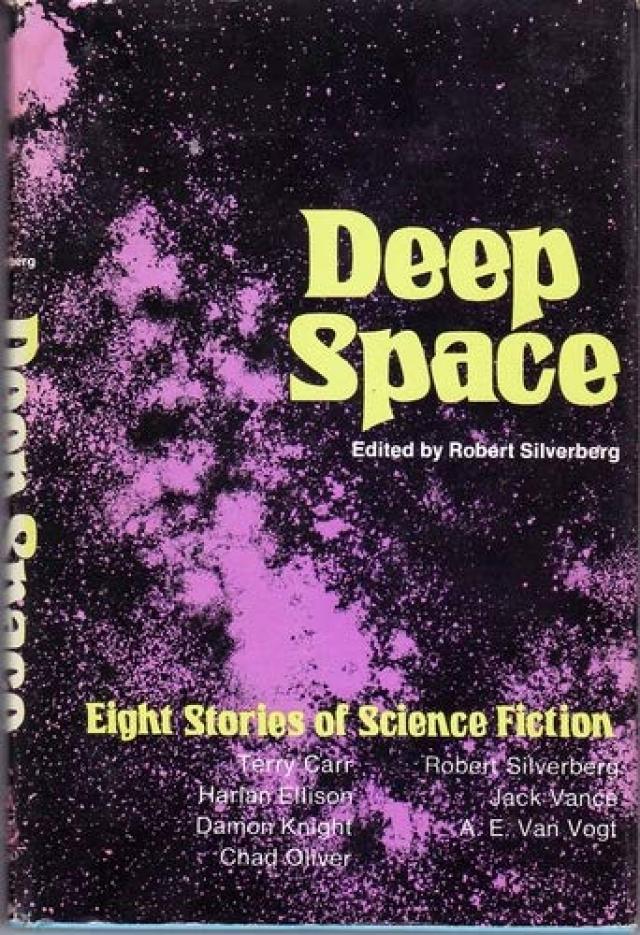


Deep Space: Eight Stories of Science Fiction
edited by Robert Silverberg
* * *
THOMAS NELSON INC.
Nashville • Camden • New York
No character in this book is intended to represent any actual person; all the incidents of the stories are entirely fictional in nature.
Copyright © 1973 by Robert Silverberg
All rights reserved under International and Pan-American Conventions. Published in Nashville, Tennessee, by Thomas Nelson Inc. and simultaneously in Toronto, Canada, by Thomas Nelson & Sons (Canada) Limited. Manufactured in the United States of America.
ACKNOWLEDGMENTS
“Blood’s a Rover,” by Chad Oliver. Copyright © 1952 by Street & Smith Publications, Inc. Reprinted by permission of the author.
“Noise,” by Jack Vance. Copyright © 1952 by Better Publications, Inc. Reprinted by permission of the author and his agents, Scott Meredith Literary Agency, Inc., 580 Fifth Avenue, New York, N.Y. 10036.
“Life Hutch,” by Harlan Ellison. Copyright © 1956 by Quinn Publishing Co., Inc. Reprinted by permission of the author and his agent, Robert P. Mills, Ltd.
“Ticket to Anywhere,” by Damon Knight. Copyright © 1952 by Galaxy Publishing Corporation. Reprinted by permission of the author and his agent, Robert P. Mills, Ltd.
“The Sixth Palace,” by Robert Silverberg. Copyright © 1965 by Galaxy Publishing Corporation. Reprinted by permission of the author and his agents, Scott Meredith Literary Agency, Inc.
“Lulungomeena,” by Gordon R. Dickson. Copyright © 1953 by Galaxy Publishing Corporation. Reprinted by permission of the author and his agent, Robert P. Mills, Ltd.
“The Dance of the Changer and the Three,” by Terry Carr. Copyright © 1968 by Joseph Elder. Reprinted by permission of the author.
“Far Centaurus,” by A. E. van Vogt. Copyright © 1944 by Street & Smith Publications, Inc. Reprinted by permission of the author and his agent, Forrest J. Ackerman.
Introduction
Reality keeps making life complicated for the writers of science fiction. Every day we move into the future at a remorseless rate, and as the present becomes the past, huge areas of what once had been the domain of science fiction are conquered. No longer can one write of the first manned voyages to the moon or the first probes of Mars and Venus or the first controlled nuclear reaction: those belong to history now, not to science fiction. Not only technological progress but the growth of scientific understanding deprive science-fictionists of their cherished themes. Because a good science-fiction writer plays according to the rules of science, he is no longer free to write of creatures native to the moon (as H. G. Wells did) or feudal principalities on Mars (as Edgar Rice Burroughs did) or unchanging hemispheres of darkness and light on Mercury (as practically everybody did). We have learned too much about those places, and as a result, certain tempting areas of speculation are denied to us by the inexorable hand of scientific truth. Science tells us that the other worlds and moons of our solar system are inhospitable, forbidding places; we are not likely to find intelligent civilizations on them, or even any very advanced life-forms at all. And this imposes restrictions on today’s science-fiction writers that did not inhibit the tale spinners of previous generations.
But the universe is a big place. It still offers dizzying, limitless possibilities to the writer of science fiction who wishes to unleash his imagination and give it full play. He need only move out beyond the rim of the solar system, past the orbit of Pluto, into the uncharted vastnesses of deep space. There lie stars beyond counting, whole galaxies and clusters of galaxies, an infinite array of wonders and miracles. We know a good deal about the realm of deep space, but ever so much more is still a mystery to us, and where mystery exists, science fiction has room to explore. We can postulate planets of astonishing colors and textures and shapes, alien species of life, solar systems that dance in delicious intricacy around multiple suns—anything at all, so long as it does not blatantly contradict the underlying laws of the universe as we think we understand them today. An inexhaustible treasure trove of virtually unbounded probability awaits those whose imaginations voyage to the stars. Here are eight such voyages, only a thin sample of the wonders that science-fiction writers have brought back from that uncharted and all-encompassing realm of infinity known as deep space.
—Robert Silverberg
Blood's a Rover
Chad Oliver
* * *
Symmes C. Oliver is an anthropologist; his special fields of interest are the Plains Indians and the ethnology of East Africa, and he holds the title of chairman of the Department of Anthropology at the University of Texas at Austin. Chad Oliver is a science fiction writer whose stories, usually based on anthropological themes, have won him a wide and enthusiastic readership over the past twenty-odd years. The two Olivers are, of course, the same man: Chad Oliver's science-fiction stories draw freely on Symmes C. Oliver’s deep and rich background in anthropology, and Professor Oliver approaches his studies of primitive tribes with a science-fictionist’s wide-open receptiveness to strangeness. The benefits of such an interchange are evident in this warm-hearted and moving tale of distant worlds.
* * *
Clay lies still, but blood’s a rover;
Breath’s a ware that will not keep.
Up, lad: when the journey’s over
There’ll be time enough to sleep.
—A. E. Housman.
I.
Night sifted through the city like flakes of soft black snow drifting down from the stars. It whispered along the tree-lined canyons between the clean shafts of white buildings and pressed darkly against windows filled with warm light. Conan Lang watched the illumination in his office increase subtly in adjusting to the growing darkness outside and then looked again at the directive he held in his hand.
It still read the same way.
“Another day, another world,” he said aloud. And then, paraphrasing: “The worlds are too much with us—”
Conan Lang fired up his pipe and puffed carefully on it to get it going properly. Then he concentrated on blowing neat cloudy smoke rings that wobbled across the room and impaled themselves on the nose of the three-dimensional portrait of the President It wasn’t that he had anything against President Austin, he assured himself. It was simply that Austin represented that nebulous being, Authority, and at the moment it happened that Authority was singularly unwelcome in the office of Conan Lang.
He looked back at the directive. The wording was friendly and informal enough, but the meaning was clear:
Headquarters, Gal. Administration.
Office of Admiral Nelson White, Commander, Process Planning Division. 15 April, 2701. Confidential.
One Agent Conan Lang
Applied Process Corps
G.A. Department Seven
Conan:
We got another directive from the Buzzard yesterday. Seems that the powers that be have decided that a change in Sirius Ten is in order—a shift from Four to Five. You’re it. Make a prelim check and report to me at your convenience. Cheer up—maybe you’ll get another bag of medals out of it.
Nelson.
Conan Lang left the directive on his desk and got to his feet. He walked over to the window and looked out at the lights sprinkled over the city. There weren’t many. Most people were long ago home in the country, sitting around the living room, playing with the kids. He puffed slowly on his pipe.
Another bag of medals. Nelson wasn’t kidding anybody—wasn’t even trying to, really. He knew how Conan felt because he felt the same way. They all did, sooner or later. It was fascinating at first, even fun, this tampering with the lives of other people. But the novelty wore off in a hurry—shriveled like flesh in acid under a million eyes of hate, a million talks with your soul at three in the morning, a million shattered lives. Sure, it was necessary. You could always tell yourself that; that was the charm, the magic word that was supposed to make everything fine and dandy. Necessary—but for you, not for them. Or perhaps for them too, in the long run.
Conan Lang returned to his desk and flipped on the intercom. “I want out,” he said. “The Administration Library, Division of Extraterrestrial Anthropology. I’d like to speak to Bailey if he’s there.”
He had to wait thirty seconds.
“Bailey here,” the intercom said.
“This is Lang. What’ve you got on Sirius Ten?”
“Just like that, huh? Hang on a second.”
There was a short silence. Conan Lang smoked his pipe slowly and smiled as he visualized Bailey punching enough buttons to control a space fleet.
“Let’s see,” Bailey’s voice came through the speaker. “We’ve got a good bit. There’s McAllister’s ‘Kinship Systems of Sirius Ten’; Jenkins’—that’s B. J. Jenkins, the one who worked with Holden-Sirius Ten Social Organization; Bartheim’s ’Economic Life of Sirius Ten; Robert Patterson’s ‘Basic Personality Types of the Sirius Group’; ‘Preliminary and Supplementary Ethnological Surveys of the Galactic Advance Fleet’—the works.”
Conan Lang sighed. “O.K.,” he said. “Shoot them out to my place, will you?”
“Check—be there before you are. One thing more, Cone.”
“Yes?”
“Been reading a splendid eight-volume historical novel of the Twentieth Century. Hot stuff, I’ll tell you. You want me to send it along in case you run out
of reading material?”
“Very funny. See you around.”
“So long.”
Conan Lang switched off the intercom and destroyed the directive. He tapped out his pipe in the waster and left the office, locking the door behind him. The empty hallway was sterile and impersonal. It seemed dead at night, somehow, and it was difficult to believe that living, breathing human beings walked through it all day long. It was like a tunnel to nowhere. He had the odd feeling that there was nothing around it at all, just space and less than space—no building, no air, no city. Just a white antiseptic tunnel to nowhere.
He shook off the feeling and caught the lift to the roof. The cool night air was crisp and clean and there was a whisper of a breeze out of the north. A half moon hung in the night, framed by stars. He looked up at it and wondered how Johnny was getting along up there, and whether perhaps Johnny was even then looking down on Earth.
Conan Lang climbed into his bullet and set the controls. The little ship rose vertically on her copter blades for two thousand feet, hovered a moment over the silent city, and then flashed off on her jets into the west.
Conan Lang sat back in his cushioned seat, looking at the stars, trying not to think, letting the ship carry him home.
Conan Lang relaxed in his armchair, his eyes closed, an icy bourbon and soda in his hand. The books he had requested—neat, white, uniform microfilm blowups from the Administration Library—were stacked neatly on the floor by his side, waiting. Waiting, he thought, sipping his drink. They were always waiting. No matter how much a man knew, there was always more—waiting.
The room closed in around him. He could feel it—warm, friendly, personal. It was a good room. It was a room filled with life, his life and Kit’s. It was almost as if he could see the room better with his eyes closed, for then he saw the past as well as the present. There was the silver and black tapestry on the wall, given to him by old Maharani so long ago, on a world so far away that the very light given off by its sun when he was there had yet to reach the Earth as the twinkle of a star in the night sky. There were his books, there were Kit’s paintings, there was the smudge—the current one—on the carpet where Rob had tracked dirt into the house before supper.
He opened his eyes and looked at his wife.
“I must be getting old, Kit,” he said. “Right at the moment, it all looks pretty pointless.”
Kit raised her eyebrows and said nothing.
“We tear around over the galaxy like a bunch of kids playing Spacemen and Pirates,” he said, downing his drink. “Push here, pull there, shove here, reverse there. It’s like some kind of half-wit game where one side doesn’t even know it’s playing, or on which side of the field. Sometimes—”
“Want another drink?” Kit asked softly.
“Yes. Kit—”
“I know,” she said, touching his shoulder with her hand. “Go ahead and talk; you’ll feel better. We go through this every time there’s a new one, remember? I know you don’t really mean things the way you say them, and I know why you say them that way anyhow.” She kissed him lightly on the forehead and her lips were cool and patient. “I understand.”
Conan Lang watched her leave the room with his empty glass. “Yes,” he whispered to himself. “Yes, I guess you do.”
It was necessary, of course. Terribly, urgently necessary. But it got to you sometimes. All those people out there, living their fives, laughing and crying, raising children. It hurt you to think about them. And it wasn’t necessary for them, not for him, not for Kit. Or was it? You couldn’t tell; there was always a chance. But if only they could just forget it all, just live, there was so much to enjoy—
Kit handed him a fresh bourbon and soda, icy and with just a trace of lemon in it the way he liked it, and then curled up again on the couch, smiling at him.
“I’m sorry, angel,” he said. “You must get pretty sick of hearing the same sad song over and over again.”
“Not when you sing it, Cone.”
“It’s just that sometimes I chuck my mind out the nearest window and wonder why—”
There was a thump and a bang from the rear of the house. Conan Lang tasted his drink. That meant Rob was home. He listened, waiting. There was the hollow crack—that was the bat going into the comer. There was the heavy thud—that was the fielder’s glove.
“That’s why,” Kit said.
Conan Lang nodded and picked up the first book off the floor.
Three days later, Conan Lang went up the white steps, presented his credentials, and walked into the Buzzard’s Cage. The place made him nervous. Irritated with himself, he paused deliberately and lit his pipe before going on. The Cage seemed cold, inhuman. And the Buzzard—
He shouldn’t feel that way, he told himself, again offering his identification before entering the lift to the Nest. Intellectually, he understood cybernetics; there was nothing supernatural about it. The Cage was just a machine, for all its powers, even if the Buzzard did sometimes seem more—or perhaps less—than a man. Still, the place gave him the creeps. A vast thinking machine, filling a huge building, a brain beside which his own was as nothing. Of course, men had built it Men made guns, too, but the knowledge was scant comfort when you looked into a metallic muzzle and someone pulled the trigger.
“Lang,” he said to himself, “you’re headed for the giggle ward.”
He smiled then, knowing it wasn’t so. Imagination was a prime requisite for his job, and he just had more than his share. It got in the way sometimes, but it was part of him and that was that.
Conan Lang waded through a battery of attendants and security personnel and finally reached the Nest. He opened the door and stepped into the small, dark room. There, behind the desk where he always was, perched the Buzzard.
“Hello, Dr. Gottleib,” said Conan Lang.
The man behind the desk eyed him silently. His name was Fritz Gottleib, but he had been tagged the Buzzard long ago. No one used the name to his face, and it was impossible to tell whether or not the name amused him. He spoke but seldom, and his appearance, even after you got used to it, was startling. Fritz Gottleib was squat and completely bald. He always dressed in black and his heavy eyebrows were like horizontal splashes of ink against the whiteness of his face. The Buzzard analogy, thought Conan Lang, was more than understandable; it was inevitable. The man sat high in his tower, in his Nest of controls, brooding over a machine that perhaps he alone fully understood. Alone. He always seemed alone, no matter how many people surrounded him. His was a life apart, a life whose vital force pulsed in the shifting lights of the tubes of a great machine.
“Dr. Lang,” he acknowledged, unmoving, his voice almost a croak.
Conan Lang puffed on his pipe and dropped into the chair across from Gottleib. He had dealt with the Buzzard before and most of the shock had worn off. You could get used to anything, he supposed. Man was a very adaptable animal.
“The smoke doesn’t bother you, I hope?”
Gottleib did not comment He simply stared at him, his dark eyes unblinking. Like looking at a piece of meat, thought Conan Lang.
“Well,” he said, trying again, “I guess you know what I’m here for.”
“You waste words,” Fritz Gottleib hissed.
“I hadn’t realized they were in short supply,” Lang replied, smiling. The Buzzard was irritating, but he could see the justice in the man’s remark. It was curious the number of useless things that were said all the time—useless, at any rate, from a purely communicative point of view. It would have been sheerly incredible for Gottleib—who after all, had been checking his results in the computer—not to have known the nature of his mission.
“Okay,” said Lang, “what’s the verdict?”
Fritz Gottleib fingered a square card in his surprisingly long-fingered hands, seeming to hover over it like a bird of prey.
“It checks out,” he said sibilantly, his voice low and hard to hear. “Your plan will achieve the desired transfer in Sirius Ten, and the transfer integrates positively with the Plan.”
“Anything else? Anything I should know?”