Deep space eight stori.., p.19
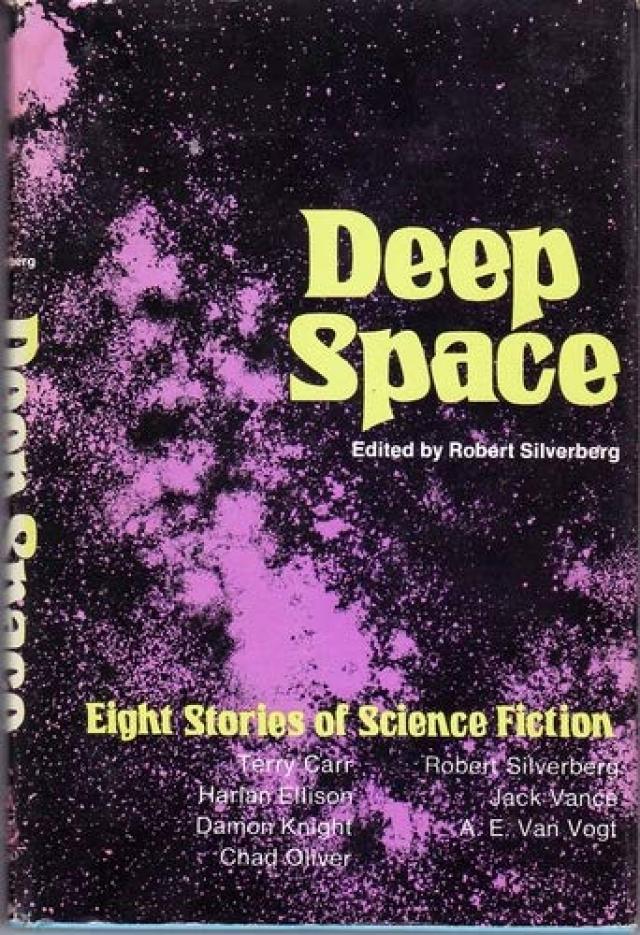
Deep Space - Eight Stories of Science Fiction,
p.19


“Well, here goes!” Renfrew said.
He looked at Blake and me, grinned, rubbed his hands together gleefully, and added:
“For a week I’ve been watching, thinking up questions to ask this cluck and—”
He faced Cassellahat. “What,” he began, “makes the speed of light constant?”
Cassellahat did not even blink. “Velocity equals the cube of the cube root of gd,” he said, “d being the depth of the spacetime continuum, g the total toleration or gravity, as you would say, of all the matter in that continuum.”
“How are planets formed?”
“A sun must balance itself in the space that it is in. It throws out matter as a sea vessel does anchors. That’s a very rough description. I could give it to you in mathematical formula, but I’d have to write it down. After all, I’m not a scientist These are merely facts that I’ve known from childhood, or so it seems.”
“Just a minute,” said Renfrew, puzzled. “A sun throws this matter out without any pressure other than its—desire—to balance itself?”
Cassellahat stared at him. “Of course not. The reason, the pressure involved, is very potent, I assure you. Without such a balance, the sun would fall out of this space. Only a few bachelor suns have learned how to maintain stability without planets.”
“A few what?” echoed Renfrew.
I could see that he had been jarred into forgetting the questions he had been intending to ask one by swift one. Cassellahat’s words cut across my thought; he said:
“A bachelor sun is a very old, cooled class M star. The hottest one known has a temperature of one hundred ninety degrees Fahrenheit, the coldest forty-eight. Literally, a bachelor is a rogue, crochety with age. Its main feature is that it permits no matter, no planets, not even gases in its vicinity.”
Renfrew sat silent, frowning, thoughtful. I seized the opportunity to carry on a train of idea.
“This business,” I said, “of knowing all this stuff without being a scientist, interests me. For instance, back home every kid understood the atomic-rocket principle practically from the day he was born. Boys of eight and ten rode around in specially made toys, took them apart and put them together again. They thought rocket-atomic, and any new development in the field was just pie for them to absorb.
“Now, here’s what I’d like to know: what is the parallel here to that particular angle?”
“The adeledicnander force,” said Cassellahat. “I’ve already tried to explain it to Mr. Renfrew, but his mind seems to balk at some of the most simple aspects.”
Renfrew roused himself, grimaced. “He’s been trying to tell me that electrons think; and I won’t swallow it”
Cassellahat shook his head. “Not think; they don’t think. But they have a psychology.”
“Electronic psychology!” I said.
“Simply adeledicnander,” Cassellahat replied. “Any child—” Renfrew groaned: “I know. Any child of six could tell me.” He turned to us. “That’s why I lined up a lot of questions. I figured that if we got a good intermediate grounding, we might be able to slip into this adeledicnander stuff the way their kids do.”
He faced Cassellahat. “Next question,” he said. “What—”
Cassellahat had been looking at his watch. “I’m afraid, Mr. Renfrew,” he interrupted, “that if you and I are going to be on the ferry to the Pelham planet, we’d better leave now. You can ask your questions on the way.”
“What’s all this?” I chimed in.
Renfrew explained: “He’s taking me to the great engineering laboratories in the European mountains of Pelham. Want to come along?”
“Not me,” I said.
Blake shrugged. “I don’t fancy getting into one of those suits Cassellahat has provided for us, designed to keep our odor in, but not theirs out.”
He finished: “Bill and I will stay here and play poker for some of that five million credits’ worth of dough we’ve got in the State bank.”
Cassellahat turned at the door; there was a distinct frown on the flesh mask he wore. “You treat our government’s gift very lightly.”
“Yeih!” said Blake.
“So we stink,” said Blake.
It was nine days since Cassellahat had taken Renfrew to the planet Pelham; and our only contact had been a radiotelephone call from Renfrew on the third day, telling us not to worry.
Blake was standing at the window of our penthouse apartment in the city Newmerica; and I was on my back on a couch, in my mind a mixture of thoughts involving Renfrew’s potential insanity and all the things I had heard and seen about the history of the past five hundred years.
I roused myself. “Quit it,” I said. “We’re faced with a change in the metabolism of the human body, probably due to the many different foods from remote stars that they eat. They must be able to smell better, too, because just being near us is agony to Cassellahat, whereas we only notice an unpleasantness from him. It’s a case of three of us against billions of them. Frankly, I don’t see an early victory over the problem, so let’s just take it quietly.”
There was no answer; so I returned to my reverie. My first radio message to Earth had been picked up; and so, when the interstellar drive was invented in A.D. 2320, less than one hundred forty years after our departure, it was realized what would eventually happen.
In our honor, the four habitable planets of the Alpha A and B suns were called Renfrew, Pelham, Blake and Endicott Since 2320, the populations of the four planets had become so dense that a total of nineteen billion people now dwelt on their narrowing land spaces. This in spite of migrations to the planets of more distant stars. '
The space liner I had seen binning in A…D. 2511 was the only ship ever lost on the Earth-Centauri lane. Traveling at full speed, its screens must have reacted against our spaceship. All the automatics would instantly have flashed on; and as those defenses were not able at that time to stop a ship that had gone Minus Infinity, every recoil engine aboard had probably blown up.
Such a thing could not happen again. So enormous had been the progress in the adeledicnander field of power, that the greatest liners could stop dead in the full fury of mid-flight.
We had been told not to feel any sense of blame for that one disaster, as many of the most important advances in adeledicnander electronic psychology had been made as the result of theoretical analyses of that great catastrophe.
I grew aware that Blake had flung himself disgustedly into a nearby chair.
“Boy, oh, boy,” he said, “this is going to be some fife for us. We can all anticipate about fifty more years of being pariahs in a civilization where we can’t even understand how the simplest machines work.”
I stirred uneasily. I had had similar thoughts. But I said nothing. Blake went on:
“I must admit, after I first discovered the Centauri planets had been colonized, I had pictures of myself bowling over some dame, and marrying her.”
Involuntarily, my mind leaped to the memory of a pair of bps lifting up to mine. I shook myself. I said:
“I wonder how Renfrew is taking all this. He—”
A familiar voice from the door cut off my words. “Renfrew,” it said, “is taking things beautifully now that the first shock has yielded to resignation, and resignation to purpose.”
We had turned to face him by the time he finished. Renfrew walked slowly toward us, grinning. Watching him, I felt uncertain as to just how to take his built-up sanity.
He was at his best. His dark, wavy hair was perfectly combed. His startlingly blue eyes made his whole face come alive. He was a natural physical wonder; and at his normal he had all the shine and swagger of an actor in a carefully tailored picture.
He wore that shine and swagger now. He said:
“I’ve bought a spaceship, fellows. Took all my money and part of yours, too. But I knew you’d back me up. Am I right?”
“Why, sure,” Blake and I echoed.
Blake went on alone: “What’s the idea?”
“I get it,” I chimed in. “We’ll cruise all over the universe, live our life span exploring new worlds. Jim, you’ve got something there. Blake and I were just going to enter a suicide pact.”
Renfrew was smiling. “We’ll cruise for a while anyway.”
Two days later, Cassellahat having offered no objection and no advice about Renfrew, we were in space.
It was a curious three months that followed. For a while I felt a sense of awe at the vastness of the cosmos. Silent planets swung into our viewing plates, and faded into remoteness behind us, leaving nostalgic memory of uninhabited, wind-lashed forests and plains, deserted, swollen seas and nameless suns.
The sight and the remembrance brought loneliness like an ache, and the knowledge, the slow knowledge, that this journeying was not lifting the weight of strangeness that had settled upon us ever since our arrival at Alpha Centauri.
There was nothing here for our souls to feed on, nothing that would satisfactorily fill one year of our life, let alone fifty. Nothing, nothing.
I watched the realization grow on Blake, and I waited for a sign from Renfrew that he felt it, too. The sign didn’t come. That of itself worried me; then I grew aware of something else. Renfrew was watching us. Watching us with a hint in his manner of secret knowledge, a suggestion of secret purpose.
My alarm grew; and Renfrew’s perpetual cheerfulness didn’t help any. I was lying on my bunk at the end of the third month, thinking uneasily about the whole unsatisfactory situation, when my door opened, and Renfrew came in.
He carried a paralyzer gun and a rope. He pointed the gun at me, and said:
“Sorry, Bill. Cassellahat told me to take no chances, so just lie quiet while I tie you up.”
“Blake!” I bellowed.
Renfrew shook his head gently. “No use,” he said. “I was in his room first.”
The gun was steady in his fingers, his blue eyes were steely. All I could do was tense my muscles against the ropes as he tied me, and trust to the fact that I was twice as strong, at least, as he was.
I thought in dismay: Surely I could prevent him from tying me too tightly.
He stepped back finally, said again, “Sorry, Bill.” He added: “I hate to tell you this, but both of you went off the deep end mentally when we arrived at Centauri; and this is the cure prescribed by the psychologists whom Cassellahat consulted. You’re supposed to get a shock as big as the one that knocked you for a loop.”
The first time I’d paid no attention to his mention of Cassellahat’s name. Now my mind flared with understanding.
Incredibly, Renfrew had been told that Blake and I were mad. All these months he had been held steady by a sense of responsibility toward us. It was a beautiful psychological scheme. The only thing was: what shock was going to be administered?
Renfrew’s voice cut off my thought. He said:
“It won’t be long now. We’re already entering the field of the bachelor sun.”
“Bachelor sun!” I yelled.
He made no reply. The instant the door closed behind him, I began to work on my bonds; all the time I was thinking:
What was it Cassellahat had said? Bachelor suns maintained themselves in this space by a precarious balancing.
In this space! The sweat poured down my face, as I pictured ourselves being precipitated into another plane of the space- time continuum—I could feel the ship falling when I finally worked my hands free of the rope.
I hadn’t been tied long enough for the cords to interfere with my circulation. I headed for Blake’s room. In two minutes we were on our way to the control cabin.
Renfrew didn’t see us till we had him. Blake grabbed his gun; I hauled him out of the control chair with one mighty heave, and dumped him onto the floor.
He lay there, unresisting, grinning up at us. “Too late,” he taunted. “We’re approaching the first point of intolerance, and there’s nothing you can do except prepare for the shock.”
I scarcely heard him. I plumped myself into the chair, and glared into the viewing plates. Nothing showed. That stumped me for a second. Then I saw the recorder instruments. They were trembling furiously, registering a body of infinite size.
For one long moment I stared crazily at those incredible figures. Then plunged the decelerator far over. Before that pressure of full-driven adeledicnander, the machine grew rigid; I had a sudden fantastic picture of two irresistible forces in full collision. Gasping, I jerked the power out of gear.
We were still falling.
“An orbit,” Blake was saying. “Get us into an orbit.”
With shaking fingers, I pounded one out on the keyboard, basing my figures on a sun of Solish size, gravity, and mass.
The bachelor wouldn’t let us have it.
I tried another orbit, and a third, and more—finally one that would have given us an orbit around mighty Antares itself. But the deadly reality remained. The ship plunged on, down and down.
And there was nothing visible on the plates, not a real shadow of substance. It seemed to me once that I could make out a vague blur of greater darkness against the black reaches of space. But the stars were few in every direction and it was impossible to be sure.
Finally, in despair, I whirled out of the seat, and knelt beside s Renfrew, who was still making no effort to get up.
“Listen, Jim,” I pleaded, “what did you do this for? What’s going to happen?”
He was smiling easily. Think,” he said, “of an old, crusty, human bachelor. He maintains a relationship with his fellows, but the association is as remote as that which exists between a bachelor sun and the stars in the galaxy of which it is a part.”
He added: “Any second now we’ll strike the first period of intolerance. It works in jumps like quantum, each period being four hundred ninety-eight years, seven months and eight days plus a few hours.”
It sounded like gibberish. “But what’s going to happen?” I urged. “For Heaven’s sake, man!”
He gazed up at me blandly; and, looking at him, I had the sudden, wondering realization that he was sane, the old, completely rational Jim Renfrew, made better somehow, stronger. He said quietly:
“Why, it’ll just knock us out of its toleration area; and in doing so will put us back—”
Jerk!
The lurch was immensely violent. With a bang, I struck the floor, skidded, and then a hand—Renfrew’s—caught me. And it was all over.
I stood up, conscious that we were no longer falling. I looked at the instrument board. All the lights were dim, untroubled, the needles firmly at zero. I turned and stared at Renfrew, and at Blake, who was ruefully picking himself up from the floor.
Renfrew said persuasively: “Let me at the control board, Bill. I want to set our course for Earth.”
For a long minute, I gazed at him; and then, slowly, I stepped aside. I stood by as he set the controls and pulled the accelerator over. Renfrew looked up.
“We’ll reach Earth in about eight hours,” he said, “and it’ll be about a year and a half after we left five hundred years ago.”
Something began to tug at the roof of my cranium. It took several seconds before I realized that it was my brain jumping with the tremendous understanding that suddenly flowed in upon me.
The bachelor sun, I thought dazedly. In easing us out of its field of toleration, it had simply precipitated us into a period of time beyond its field. Renfrew had said…had said that it worked in jumps of…four hundred ninety-eight years and some seven months and—
But what about the ship? Wouldn’t twenty-seventh century adeledicnander brought to the twenty-second century, before it was invented, change the course of history? I mumbled the question.
Renfrew shook his head. “Do we understand it? Do we even dare monkey with the raw power inside those engines? I’ll say not. As for the ship, we’ll keep it for our own private use.”
“B-but—” I began.
He cut me off. “Look, Bill,” he said, “here’s the situation: that girl who kissed you—don’t think I didn’t see you falling like a ton of bricks—is going to be sitting beside you fifty years from now, when your voice from space reports to Earth that you had wakened on your first lap of the first trip to Centaurus.”
That’s exactly what happened.
Robert Silverberg, Deep Space - Eight Stories of Science Fiction