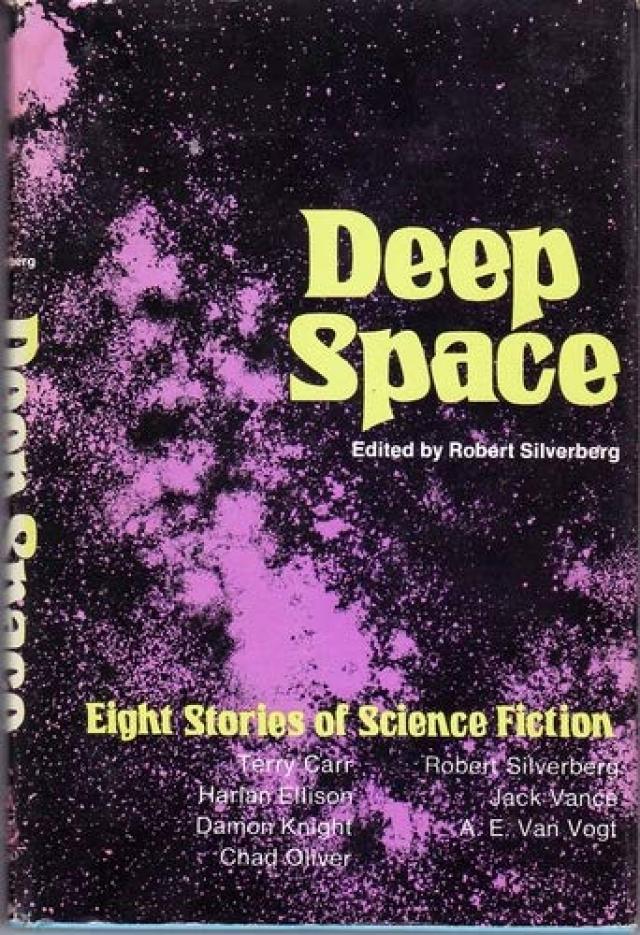
Deep space eight stori.., p.7
Deep Space - Eight Stories of Science Fiction,
p.7


The dark red sun is sinking. Every day—it must be clear that I use “day” as the interval between my sleeps—finds it lower in the sky. Night is almost upon me, long night How shall I spend my time in the dark?
I have no gauge other than my mind, but the breeze seems colder. It brings long mournful chords to my ears, very sad, very sweet. Mist-wraiths go fleeting across the meadow.
Wan stars already show themselves, nameless ghostlamps without significance.
I have been considering the slope behind my meadow; tomorrow I think I will make the ascent.
I have plotted the position of every article I possess. I will be gone some hours, and—if a visitor meddles with my goods, I will know his presence for certain.
The sun is low, the air pinches at my cheeks. I must hurry if I wish to return while light still shows me the landscape. I picture myself lost; I see myself wandering the face of this world, groping for my precious lifeboat, my tanks, my meadow.
Anxiety, curiosity, obstinacy all spurring me, I set off up the slope at a half-trot.
Becoming winded almost at once, I slowed my pace. The turf of the lake shore had disappeared; I was walking on bare rocks and lichen. Below me the meadow became a patch, my lifeboat a gleaming spindle. I watched for a moment. Nothing stirred anywhere in my range of vision.
I continued up the slope and finally breasted the ridge. A vast rolling valley fell off below me. Across it rose a range of great mountains, rearing above me into the dark sky. The wine-colored light slanting in from the west lit the prominences, the frontal sallies and bluffs, left the valleys in gloom, an alternate sequence of red and black beginning far in the west, continuing past, far to the east.
I looked down behind me, down to my own meadow, and was hard put to find it in the fading fight. Ah, there it was! And there, the lake, a sprawling hourglass. Beyond was dark forest, then a strip of old rose savannah, then a dark strip of woodland, then delicate laminae of colorings to the horizon.
The sun touched the edge of the mountains, and with what seemed almost a sudden lurch, fell half below the horizon. I turned down-slope; a terrible thing to be lost in the dark. My eye fell upon a white object, a hundred yards along the ridge. I stared, and walked nearer. Gradually it assumed form: a thimble, a cone, a pyramid—a cairn of white rocks. I walked forward with feet achingly heavy.
A cairn, certainly. I stood looking down on it.
I turned, looked swiftly over my shoulder. Nothing in view. I looked down to the meadow. Swift shapes? I strained through the gathering murk. Nothing.
I tore at the cairn, threw rocks aside. What was below?
Nothing.
In the ground a faintly-marked rectangle three feet long was perceptible. I stood back. No power I knew of could induce me to dig into that soil.
The sun was disappearing. Already at the south and north the afterglow began, lees of wine: the sun moved with astounding rapidity; what manner of sun was this, dawdling at the meridian, plunging below the horizon?
I turned down-slope, but darkness came faster. The scarlet sun was gone; in the west was the sad sketch of departed flame. I stumbled, I fell. I looked into the east. A marvelous zodiacal light was forming, a strengthening blue triangle.
I watched, from my hands and knees. A cusp of bright blue lifted into the sky. A moment later a flood of sapphire washed the landscape. A new sun of intense indigo rose into the sky.
The world was the same and yet different; where my eyes had been accustomed to red, and the multitudinous red subcolors, now I saw the intricate cycle of blue.
When I returned to my meadow, the breeze carried a new sound: bright allegro chords that my mind could almost form into melody. For a moment I so amused myself, and thought to see dance-motion in the wisps of vapor which for the last few days had been noticeable over my meadow.
In what I will call a peculiar frame of mind, I crawled into the lifeboat and went to sleep.
I crawled blinking out of the lifeboat into an electric world. I listened. Surely that was music—faint whispers drifting in on the wind like a fragrance.
I went down to the lake, as blue as a ball of that cobalt dye so aptly known as bluing.
The music came louder; I could catch snatches of melody—sprightly quickstep phrases carried on a flowing legato like colored tinsel on a flow of cream.
I put my hands to my ears; if I was experiencing auditory hallucinations, the music would continue. The sound—if it was music—diminished, but did not fade entirely; my test was not definitive. But I felt sure it was real. And where music was there must be musicians…I ran forward, shouted, "Hello!”
“Hello!” came the echo from across the lake.
The music faded a moment, as a cricket chorus quiets when disturbed, then gradually I could hear it again—distant music, “horns of Elfland faintly blowing.”
It went completely out of perception. I was left standing haggard in the blue light, alone on my meadow.
I washed my face, returned to the lifeboat, sent out another set of SOS signals.
Possibly the blue day is shorter than the red day; with no dock I can’t be sure. But with my new fascination, the music and its source, the blue day seems to pass more swiftly.
Never have I caught sight of the musicians. Is the sound generated by the trees, by diaphanous insects crouching out of my vision?
One day I glanced across the lake, and wonder of wonders! a gay town spread along the opposite shore. After a first dumbfounded gaze, I ran down to the water’s edge, stared as if it were the most precious sight of my life.
Pale silk swayed and rippled: pavilions, tents, fantastic edifices…Who inhabited these places? I waded knee-deep into the lake, the breath catching and creaking in my throat, and thought to see flitting shapes.
I ran like a madman around the shore. Plants with pale blue blossoms succumbed to my feet; I left the trail of an elephant through a patch of delicate reeds.
And when I came panting and exhausted to the shore opposite my meadow, what was there? Nothing.
The city had vanished like a dream, like specters blown on a wind. I sat down on a rock. Music came clear for an instant, as if a door had momentarily opened.
I jumped to my feet. Nothing to be seen. I looked back across the lake. There—on my meadow—a host of gauzy shapes moved like May flies over a still pond.
When I returned, my meadow was vacant. The shore across the lake was bare.
So goes the blue day; and now there is fascination to my life. Whence comes the music? Who and what are these flitting shapes, never quite real but never entirely out of mind? Four times an hour I press a hand to my forehead, fearing the symptoms of a mind turning in on itself…If music actually exists on this world, actually vibrates the air, why should it come to my ears as Earth music? These chords I hear might be struck on familiar instruments; the progressions and harmonies are not at all alien…And these pale plasmic wisps that I forever seem to catch from the comer of my eye: the semblance and style is that of gay and playful humanity. The tempo of their movement is the tempo of the music: tarantella, saraband, farandole…
So goes the blue day. Blue air, blue-black turf, ultramarine water, and the bright blue star bent to the west…How long have I lived on this planet? I have broadcast the SOS sequence until now the batteries hiss with exhaustion; soon there will be an end to power. Food, water are no problem to me, but what use is a lifetime of exile on a world of blue and red?
The blue day is at its close. I would like to mount the slope and watch the glory of the blue sun s passing—but the remembrance of the red sunset still provokes a queasiness in my stomach. So I will watch from my meadow, and then, if there is darkness, I will crawl into the lifeboat like a bear into a cave, and await the coming of light.
The blue day goes. The sapphire sun wanders into the western forest, the sky looms to blue-black, the stars show like unfamiliar home places.
For some time now I have heard no music; perhaps it has been so all-present that I neglect it.
The blue star is gone, the air chills. I think that deep night is on me indeed…I hear a throb of sound, plangent, plaintive; I turn my head. The east glows pale pearl. A silver globe floats up into the night like a lotus drifting on a lake: a great ball like six of Earth’s full moons. Is this a sun, a satellite, a burnt-out star? What a freak of cosmology I have chanced upon!
The silver sun—I must call it a sun, although it casts a cool satin light—moves in an aureolelike oyster shell. Once again the color of the planet changes. The lake glistens like quicksilver, the trees are hammered metal…The silver star passes over a high rack of clouds, and the music seems to burst forth as if somewhere someone flung wide curtains: the music of moonlight, medieval marble, piazzas with slim fluted colonnades, soft sighing strains that Claude Debussy might have conceived.
I wander down to the lake. Across on the opposite shore once more I see the town. It seems clearer, more substantial; I note details that shimmered away to vagueness before—a wide terrace beside the lake, spiral pilasters, a row of decorative urns. The silhouette is, I think, the same as when I saw it under the blue sun: great silken tents, shimmering, reflecting cusps of light; pillars of carved stone, lucent as milk-glass; fantastic fixtures of no obvious purpose…Barges drift along the dark quicksilver lake like moths, great sails bellying idly, the rigging a mesh of cobweb. Nodules of light, like fairy lanterns, hang on the stays, along the masts…On sudden thought, I turn, look up to my own meadow. I see a row of booths as at an old-time fair, a circle of pale stone set in the turf, a host of filmy shapes.
Step by step I edge toward my lifeboat. The music waxes, chords and structures of wonderful sweetness. I peer at one of the shapes, but the outlines waver. It moves to the emotion of the music—or does the motion of the shapes generate the music?
I ran forward, shouting hoarsely. One of the shapes slips past me, and I look into a blur where a face might be. I come to a halt, panting hard; I stand on the marble circle. I stamp; it rings solid. I walk toward the booths, they seem to display complex things of pale cloth and dim metal—but as I look my eyes mist over as with tears. The music goes far, far away, my meadow lies bare and quiet. My feet press into silver-black turf; in the sky hangs the silver-black star.
I am sitting with my back to the lifeboat, staring across the lake, which is still as a mirror. I have arrived at a set of theories.
My primary proposition is that I am sane—a necessary article of faith; why bother even to speculate otherwise? So—events occurring outside my own mind cause everything I have seen and heard. But—note this!—these sights and sounds do not obey the laws of classical science; in many respects they seem particularly subjective.
It must be, I tell myself, that both objectivity and subjectivity enter into the situation. I receive impressions which my brain finds unfamiliar, and so translates to the concept most closely related. By this theory the inhabitants of this world are constantly close; I move unknowingly through their palaces and arcades; they dance incessantly around me. As my mind gains sensitivity, I verge upon rapport with their way of life and I see them. More exactly, I sense something which creates an image in the visual region of my brain. Their emotions, the pattern of their fife set up a kind of vibration which sounds in my brain as music…The reality of these creatures I am sure I will never know. They are diaphane, I am flesh; they live in a world of spirit, I plod the turf with my heavy feet
These last days I have neglected to broadcast the SOS. Small lack; the batteries are about done.
The silver sun is at the zenith, and leans westward. What comes next? Back to the red sun? Or darkness? Certainly this is no ordinary planetary system; the course of this world along its orbit must resemble one of the pre-Copernican epicycles.
I believe that my brain is gradually tuning into phase with this world, reaching a new high level of sensitivity. If my theory is correct, the elan vital of the native beings expresses itself in my brain as music. On Earth we would perhaps use the word telepathy…So I am practicing, concentrating, opening my consciousness wide to these new perceptions. Ocean mariners know a trick of never looking directly at a far light lest it strike the eyes’ blind spot. I am using a similar device of never staring directly at one of the gauzy beings. I allow the image to establish itself, build itself up, and by this technique they appear quite definitely human. I sometimes think I can glimpse the features. The women are like sylphs, achingly beautiful; the men—I have not seen one in detail, but their carriage, their form, is hauntingly familiar.
The music is always part of the background, just as rustling of leaves is part of a forest. The mood of these creatures seems to change with their sun, so I hear interpretive music to suit The red sun gave them passionate melancholy, the blue sun merriment. Under the silver star they are delicate, imaginative, wistful, and in my mind sounds Debussy’s La Mer and Les Sirenes.
The silver day is on the wane. Today I sat beside the lake with the trees before me like a screen of silver filigree, watching the moth-barges drift back and forth. What is their function, I wonder? Can life such as this be translated in terms of economies, ecology, sociology? I doubt it. The word “intelligence” may not even enter the picture; is not our brain a peculiarly anthropoid characteristic, and is not intelligence a function of our peculiarly anthropoid brain? A portly barge sways near, with swamp-globes of orange and blue in the rigging, and I forget my hypotheses. I can never know the truth, and it is perfectly possible that these creatures are no more aware of me than I originally was aware of them.
Time goes by; I return to the lifeboat. A young womanshape whirls past. I pause, peer into her face; she tilts her head, her eyes bum into mine as she passes, mocking topaz, not unkindly…I try an SOS—listlessly, because I suspect the batteries to be dank and dead…
And indeed they are.
The silver star is like an enormous Christmas tree bauble, round and glistening. It floats low, and once more I stand irresolute, half expecting night.
The star falls; the forest receives it The sky dulls, and night has come.
I face the east, my back pressed to the pragmatic hull of my lifeboat. Nothing.
I have no conception of the passage of time. Darkness, timelessness. Somewhere clocks turn minute hands, second hands, hour hands—I stand staring into the night, perhaps as slow as a sandstone statue, perhaps as feverish as a salamander.
In the darkness there is a peculiar cessation of sound. The music has dwindled, down through a series of wistful chords, a forlorn last cry…
A glow in the east, a green glow, spreading. Up rises a magnificent green sphere, the essence of all green, the tincture of emeralds, glowing as grass, fresh as mint, deep as the sea.
A throb of sound, music: rhythmical strong music, swinging and veering.
The green light floods the planet, and I prepare for the green day.
I am almost one with the native things. I wander among their pavilions, I pause by their booths to ponder their stuffs and wares: silken medallions, spangles and circlets of woven metal, cups of fluff and iridescent puff, puddles of color and wafts of light-shot gauze. There are chains of green glass, each link shaped like a horseshoe; captive butterflies; spheres which seem to hold all the heavens, all the clouds, all the stars.
And to all sides of me goes the flicker and flit of the dreampeople. The men are all vague, but familiar; the women turn me smiles of ineffable provocation. But I will drive myself mad with temptations; what I see is no more than the formulation of my own brain, an interpretation…And this is tragedy, for there is one creature so unutterably lovely that whenever I see the shape that is she, my throat aches and I run forward, to peer into her eyes that are not eyes…
Today I clasped my arms around her, expecting yielding wisp. Surprisingly there was the feel of supple flesh. I kissed her, cheek, chin, mouth. Such a look of perplexity on the sweet face as I have never seen; Heaven knows what strange act the creature thought me to be performing.
She went her way, but the music is strong and triumphant: the voice of comets, the shudder of resonant bass below.
A man comes past; something in his stride, his posture, plucks at my memory. I resolutely step forward; I will gaze into his face, I will plumb the vagueness.
He whirls past like a figure on a carousel; he wears flapping ribbons of silk and pompoms of spangled satin. I pound after him, I plant myself in his path. He strides past with a side glance, and I stare into the rigid masklike face.
It is my own face.
He wears my face, he walks with my stride. He is me.
Already is the green day gone?
The green sun goes, and the music takes on depth. No cessation now; there is preparation, imminence…What is that other sound? A far spasm of something growling and clashing like a broken gear-box.
It fades out
The green sun goes down in a sky like a peacock’s tail. The music is slow, exalted.
The west fades, the east glows. The music goes toward the east, to the great bands of rose, yellow, orange, lavender. Cloud flecks burst into flame. A golden glow consumes the sky, north and south.
The music takes on volume, a liturgical chanting.
Up rises the new sun—a gorgeous golden ball. The music swells into a paean of light, fulfillment, regeneration…Hark! a second time the harsh sound grates across the music.
Into the sky, across the sun, drifts the shape of a spaceship. It hovers over my meadow, the landing jets come down like plumes.
The ship lands.
I hear the mutter of voices—men’s voices.
The music is vanished; the marble carvings, the tinsel booths, the wonderful silken cities are gone.
Galispell looked up, rubbed his chin.
Captain Hess asked anxiously, “What do you think of it?” For a moment Galispell made no reply; then he said, “It’s a strange document…He looked for a long moment out the window. “What happened after you picked him up? Did you see any of these phenomena he talks about?”
“Not a thing.” Captain Hess solemnly shook his big round head. “Sure, the system was a fantastic gaggle of dark stars and fluorescent planets and burnt-out old suns; maybe all these things played hob with his mind. He didn’t seem too overjoyed to see us, that’s a fact—just stood there, staring at us as if we were trespassers. We got your SOS,’ I told him. ‘Jump aboard, wrap yourself around a good meal!’ He came walking forward as if his feet were dead.