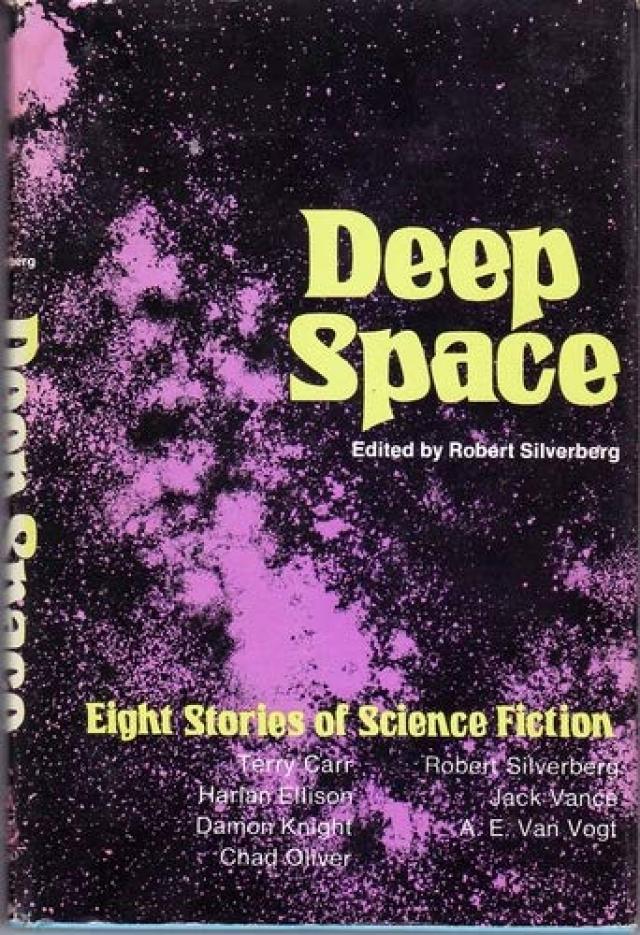
Deep space eight stori.., p.9
Deep Space - Eight Stories of Science Fiction,
p.9


Terrence nodded. He understood. So did the Kyben. It grinned at him and drew its blaster. It fired point-blank, crimsoning the hull of the Kyben ship.
He swerved to avoid running into his gun’s own backlash. The movement of the bucket seat sliding in its tracks to keep his vision steady while maneuvering made him dizzy.
The abyss was nearer, and he teetered, his lips whitening as they pressed together under his effort to steady himself. With a headlong gasp he fell sighing into the stomach. His long, silken fingers jointed steely humming clankingly toward the medicine chest over the plate behind the bulkhead.
The robot advanced on him grindingly. Small fine bits of metal rubbed together, ashing away into a breeze that came from nowhere as the machine raised lead boots toward his face.
Onward and onward till he had no room to move.
The light came on, bright, brighter than any star Terrence had ever seen, glowing, broiling, flickering, shining, bobbing a ball of light on the chest of the robot, who staggered, stumbled, stopped.
The robot hissed, hummed and exploded into a million flying, racing, fragments, shooting beams of fight all over the abyss over which Terrence teetered. He flailed his arms back trying to escape at the last moment, before the fall.
He saved himself only by his subconscious. Even in the hell of a nightmare he was aware of the situation. He had not moaned and writhed in his delirium. He had kept motionless and silent.
He knew this was true, because he was still alive.
Only his surprised jerking, as he came back to consciousness started the monster rolling from its niche. He came fully awake and sat silent, slumped against the wall. The robot retreated.
Thin breath came through his nostrils. Another moment and he would have put an end to the past three days—three days or more now? how long had he been asleep?—of torture.
He was hungry. Lord, how hungry he was. The pain in his side was worse now, a steady throbbing that made even shallow breathing tortuous. He itched maddeningly. He was uncomfortably slouched against a cold steel bulkhead, every rivet having made a burrow for itself in his skin. He wished he were dead.
He didn’t wish he were dead. It was all too easy to get his wish.
If he could only disable that robot brain. A total impossibility. If he could only wear Phobos and Deimos for watchfobs. If he could only shack-up with a silicon-deb from Penares. If he could only use his large colon for a lasso.
It would take a total wrecking of the brain to do it enough damage to stop the appendage before it could roll over and smash Terrence again.
With a steel bulkhead between him and the brain, his chances of success totaled minus zero every time.
He considered which part of his body the robot would smash first. One blow of that tool-hand would kill him if it were used a second time. On top of the ribs, even a strong breath might finish him.
Perhaps he could make a break and get into the air chamber…
Worthless, (a) The robot would catch him before he had gotten to his feet, in his present condition, (h) Even allowing for a miracle, if he did get in there, the robot would smash the lock doors, letting in air, ruining the mechanism, (c) Even allowing for a double miracle, what the hell good would it do him? His helmet and gloves were in the hutch itself, and there was no place to go on the planetoid. The ship was ruined, so no signal could be sent from there.
Doom suddenly compounded itself.
The more he thought about it, the more certain he was that soon the fight would flicker out for him.
The fight would flicker out
The light would flicker…
The light…
.…light…?
His God, if he had had anything to do with it, had heard him. Terrence was by no means a religious man, but this was miracle enough to make even him a disciple. It wasn’t over yet, but the answer was there—and it was an answer.
He began to save himself.
Slowly, achingly slowly, he moved his right hand, the hand away from the robot’s sight, to his belt. On the belt hung the assorted implements a spaceman needs at any moment in his ship. A wrench. A packet of sleep-stavers. A compass. A geiger counter. A flashlight.
The last was the miracle. Miracle in a tube.
He fingered it almost reverently, then unclipped it in a moment’s frenzy, still immobile to the robot’s “eyes.”
He held it at his side, away from his body by a fraction of an inch, pointing up over the bulge of his spacesuited leg.
If the robot looked at him, all it would see would be the motionless bulk of his leg, blocking off any movement on his part. To the machine, he was inert. Motionless.
Now, he thought wildly, where is the brain?
If it is behind the relay machines, I’m still dead. If it is near the refrigerator, I’m saved. He could afford to take no chances. He would have to move.
He lifted one leg.
The robot moved toward him. The humming and sparking was distinct this time. He dropped the leg.
Behind the plates above the refrigerator!
The robot stopped, nearly at his side. Seconds had decided. The robot hummed, sparked, and returned to its niche.
Now he knew!
He pressed the button. The invisible beam of the flashlight leaped out, speared at the bulkhead above the refrigerator. He pressed the button again and again, the flat circle of light appearing, disappearing, appearing, disappearing on the faceless metal of the life hutch’s wall.
The robot sparked and rolled from its niche. It looked once at Terrence. Then its rollers changed direction and the machine ground toward the refrigerator.
The steel fist swung in a vicious arc, smashing with a deafening clang at the spot where the light bubble flickered on and off.
It swung again and again. Again and again till the bulkhead had been gouged and crushed and opened, and the delicate coils and plates and wires and tubes behind it were refuse and rubble. Until the robot froze, with arm half-ready to strike again. Dead. Immobile. Brain and appendage.
Even then Terrence did not stop pressing the flashlight button. Wildly he thumbed it down and down.
Suddenly he realized it was all over.
The robot was dead. He was alive. He would be saved. He had no doubts about that. Now he could cry.
The medicine chest grew large through the shimmering in his eyes. The relay machines smiled at him.
God bless you, little life hutch, he thought, before he fainted.
Ticket to Anywhere
Damon Knight
* * *
Even so far-reaching a transportation system as the Flew York subways offers only a relatively limited number of choices of destination: uptown or downtown, Brooklyn or the Bronx, East Side or West Side. But how does one cope with a system that offers every passenger the whole universe? Damon Knight examines some of the implications of such a cosmic express with his characteristic grace and thoughtfulness.
* * *
Richard Falk was a sane man. Up until three months ago he had been, so far as he could discover, the only sane man left in a world of lunatics.
Now he was a dead man.
He lay in a metal coffin twenty yards long by three wide, airless, soundless. Behind the faceplate of his helmet, under the rime of frozen air, his lips were bright blue, his cheeks, nose, forehead a lighter color, almost violet. The flesh was stiff as frozen leather. He did not move, breathe, or think: he was dead.
Beside him, strapped to the bulging torso of his suit, was a metal box labeled “Scato heart probe. See instructions inside.”
All around him, strapped tight to the walls by broad loops of webbing, were boxes, canisters, canvas bags, kegs. Cargo. His coffin was a freighter, going to Mars.
In his frozen brain the memories were neatly stacked, just as he had left them. Not coupled now, each cell isolated, the entropy of his mind fallen to zero. But uppermost among them, waiting for the thaw that might never come, were the memories of his last few hours of life.
Once the ship was launched and free, he had had to wait until its dancing molecules had stilled, their heat all radiated away into space. Then to wait again, heater turned off, listening to the silence while his own life’s heat drained away: fingers and toes numb first, ears and nose following, then Ups, cheeks, and all his flesh; shivering in an agony of cold, watching his breath fill the helmet with cloud, the cold drops beading on the colder faceplate.
Tricky, that, and a thing that demanded courage. Act too soon, and the last drop into stillness would be too slow—the freezing liquids in his body would crystallize, gashing his cells with a million tiny stabs. Wait too long, and the cold would steal his ability to act at all.
He had waited until the false warmth of the dying had crept over him, the subtle destroyer, cumbering his limbs not with harshness but with too much peace. Twisting then in the dead center where he floated, he had drawn himself into the lane between two looped bundles of cargo, forcing them aside, until he reached the naked hull. There, spread-eagled against the chill metal, embracing it as one who crucifies himself gladly, he had died.
The ship, stillest of sepulchers, hung fixed in the center of the starry globe. So it might have remained for time without end, changeless, knowing no time; for there was no time here, no “events”—the ship and all its contents—except its robot control, inactive now but warmed by a minute trickle of electrons—now being very nearly at zero Absolute.
But a relay clicked, communicating its tremor through support frame and girder and hull. Time had begun again. The radar assembly in the prow began to emit timed clusters of radiation; presently other relays snapped over, and then the engine awoke, whispered to itself an instant, and was silent. For an instant the ship had become once more a thing in motion, a pebble flung between the stars. Another such instant came, then another; then, at long last, the hull shuddered to the whip and carom of atmospheric molecules. Lightly it dipped into Martian air, out again, in again, making a great circuit of the globe. A final relay clicked, and Falk’s coffin hurled itself groundward, free of the skeletal ship whose rockets now flamed again, driving it back into the timeless deep.
A parachute opened as the cargo hull hurtled downward: a preposterous parasol that would not have held the weight a minute against Earth’s gravity, in Earth’s air; but here it slowed that plummeting fall until the box met Martian sand at not quite killing speed.
In the shell, Falk’s corpse slowly thawed.
His heart was beating. That was Falk’s first conscious realization, and he listened to the tiny sound thankfully. His chest was rising and falling in a deep, slow rhythm; he heard the hiss and whisper of breath in his nostrils and felt the veins twitch at his temples.
Then came a prickling, half pain, in his arms and legs; then he saw a ruddy haze of light on his closed lids.
Falk opened his eyes.
He saw a pale glow that turned itself into a face. It went away briefly, then came back. Falk could see it a little better now. Young—about thirty—pale-skinned, with a blue beard shadow. Black straight hair, a little untidy. Black-rimmed spectacles. Ironic lines on either side of the thin mouth.
“All right now?” said the face.
Falk murmured, and the face bent closer. He tried again. “Think so.”
The young man nodded. He picked up something from the bed and began taking it apart, fitting the components into the cushioned troughs of a metal box. It was the heart probe, Falk saw: the bulky control box and the short, capillary-thin needle.
“Where did you get this?” the young man asked. “And what the devil were you doing aboard that freighter?”
“Stole the probe,” said Falk. “And the suit, and the rest of the stuff. Dumped enough cargo to match my weight. Wanted to get to Mars. Only way.”
The young man let his hands fall into his lap. “You stole it,” he repeated incredulously. “Then you never had the analogue treatment?”
Falk smiled. “Had it, all right. Dozen times. Never took.” He felt very tired. “Let me rest a minute, will you?”
“Of course. Sorry.”
The young man went away, and Falk closed his eyes, returning to the slow surge of memory that moved in his mind. He went through those last hours, painful as they were, and then again. There was trauma there; mustn’t let it get buried to cause him trouble later. Accept it, know the fear, Eve with it.
After a while the young man came back, carrying broth that steamed in a cup, and Falk drank it gratefully. Then he fell unknowing into sleep.
When he awoke he was stronger. He tried to sit up, and found to his mild surprise that he could. The other, who had been sitting in an armchair across the room, put down his pipe and came over to thrust pillows behind Falk’s back. Then he sat down again. The room was cluttered and had a stale odor. Floor, walls and ceiling were enameled metal. There were books and rolls of tape, records, in shelves; more piled on the floor. A dirty shirt was hanging from the doorknob.
“Want to talk now?” the young man asked. “My name’s Wolfert.”
“Glad to know you. Mine’s Falk…You want to know about the analogue business first, I suppose.”
“And why you’re here.”
“It’s the same thing,” Falk told him. “I’m immune to analogue treatment. I didn’t know it for sure till I was ten, but I think I was born that way. From seven on, I remember the other kids talking about their Guardians, and me pretending I had one too. You know how kids are—anything to run with the mob.
“But for a long time, years, I wasn’t certain whether everyone else was pretending like me, or whether I really was the only one without an invisible Guardian to talk to. I was pretty sure the kids were lying when they said they could see theirs, but whether they were there at all or not was another question. I didn’t know; actually it didn’t bother me much.
“When I was ten, I stole something. It was a book I wanted that my father wouldn’t let me have. The clerk was looking the other way—I put it under my jacket Funny, I was halfway through it before it struck me that I’d just proved I had no Guardian. By that time, you see, I’d decided that I’d just never seen mine because I’d never done anything bad. I was proud of that, a little prissy about it, if you want the truth—only I wanted this book…
“I had sense enough, thank God, to bum that book after I’d finished it. If I hadn’t, I don’t suppose I would have lived to grow up.”
Wolfert grunted. “Should think not,” he said. His eyes were fixed on Falk, interested, alert, wary. “One man without any control could turn the whole applecart over. But I thought immunity was theoretically impossible?”
“I’ve thought about that a good deal. According to classic psychology, it is. I’m not unusually resistant to hypnotic drugs; I go under all right. But the censor mechanism just doesn’t respond. I’ve had the fanciful notion that I may be a mutation, developed in response to the analogue treatment as an anti-survival factor. But I don’t know. As far as I’ve ever been able to find out, there are no more like me.”
“Umm,” said Wolfert, puffing at his pipe. “Should think your next move would be to get married, have children, see if they were immune too.”
Falk stared at him soberly. “Wolfert—no offense, but can you imagine yourself settling down happily in a community of maniacs?”
The other’s face flushed slowly. He took the pipe out of his mouth, looked down at it. Finally he said, “All right, I know what you mean.”
“Maybe you don’t,” said Falk, thinking, Foe offended him. Couldn’t help it. “You’ve been out here ten years, haven’t you?”
Wolfert nodded.
“Things are getting worse,” Falk told him. “I’ve taken the trouble to look up some statistics. They weren’t hard to find; the damned fools are proud of them. The number of persons in mental institutions has gone steadily down since 1980, when the world-wide analogue program got under way. Extension of analogue program, steadily up. The two curves cancel out perfectly.
“There are fewer and fewer people that have to be put away in madhouses—not because of any improvement in therapy, but because the analogue techniques are getting better and better. The guy who would have been hopelessly insane fifty years ago now has a little man inside his head, steering him around, making him act normal. On the outside he is normal; inside, he’s a raving madman. Worse still, the guy who would have been just a little bit cracked fifty years ago—and gotten treatment for it—is now just as mad as the first guy. It doesn’t matter any more. We could all be maniacs, and the world would go on just as before.”
Wolfert grimaced wryly. ‘Well? It’s a peaceful world, anyhow.”
“Sure,” said Falk. “No war or possibility of war, no murders, no theft, no crime at all. That’s because every one of them has a policeman inside his skull. But action begets reaction, Wolfert, in psychiatry as well as in physics. A prison is a place to get out of, if it takes you a lifetime. Push one plunger down, another will rise. Just a few years more, I think—ten or twenty, say—and you’ll see that madhouse curve rise again. Because there’s no escape from the repression of the Guardians except a further retreat into insanity. And eventually a point is reached where no amount of treatment can help. What are they going to do then?”
Wolfert tamped his pipe out slowly and stood up, sucking absently at the stem. “You say they,” he said, “meaning the psychiatrists who really govern Earth, I suppose. You’ve evidently figured out what you’re going to do.”
Falk smiled. “Yes. With your help—I’m going to the stars.”
The other stood frozen a moment. “So you know about that,” he said. “Well—Come into the next room. “I’ll show it to you.”
Falk had known about the Doorway, but not that it looked like this. It was a cubicle of something that looked like slick brown glass. Ten feet high, six wide and deep. Inside, at waist level on the far wall, a lever—curiously shaped, like the head of an old-fashioned walking stick, the slightly curved bar of the L parallel to the wall. Nothing more than that. The floor of Wolfert’s hut had been assembled around it. It was the reason for the hut’s existence, for Wolfert’s dearly bought presence on Mars.