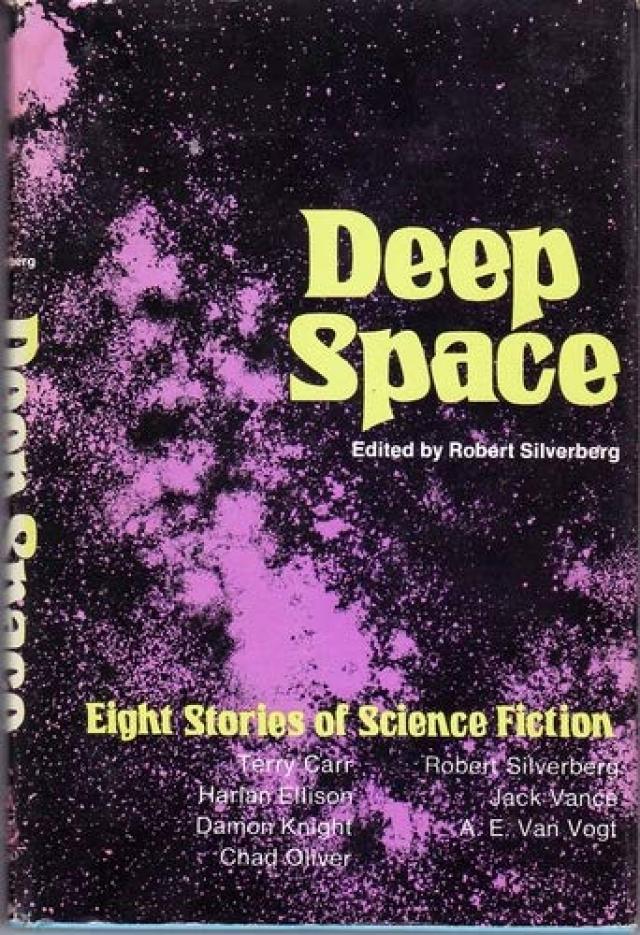
Deep space eight stori.., p.8
Deep Space - Eight Stories of Science Fiction,
p.8


“Well, to make a long story short, he finally came aboard. We loaded on his lifeboat and took off.
“During the voyage back, he had nothing to do with anybody-just kept to himself, walking up and down the promenade.
“He had a habit of putting his hands to his head: one time I asked him if he was sick, if he wanted the medic to look him over. He said no, there was nothing wrong with him. That’s about all I know of the man.
“We made Sun, and came down toward Earth. Personally, I didn’t see what happened, because I was on the bridge, but this is what they tell me:
“As Earth got bigger and bigger Evans began to act more restless than usual, wincing and turning his head back and forth. When we were about a thousand miles out, he gave a kind of furious jump.
“ ’The noise!’ he yelled. The horrible noise!’ And with that he ran astern, jumped into his lifeboat, cast off, and they tell me he disappeared back the way we came.
“And that’s all I got to tell you, Mr. Galispell. It’s too bad, after our taking all that trouble to get him, Evans decided to pull up stakes—but that’s the way it goes.”
“He took off back along your course?”
“That’s right. If you’re wanting to ask, could he have made the planet where we found him, the answer is, not likely.”
“But there’s a chance?” persisted Galispell.
“Oh, sure,” said Captain Hess, “there’s a chance.”
Life Hutch
Harlan Ellison
* * *
Here is a tight, tense, and ingenious story of conflict aboard a rescue station in the far reaches of space—an early but thoroughly professional piece by the dynamic and turbulent Harlan Ellison, many-times winner of the Hugo and Nebula awards and editor of the impressive Dangerous Visions anthology series.
* * *
Terrence slid his right hand, the one out of sight of the robot, up his side. The razoring pain of the three broken ribs caused his eyes to widen momentarily in pain.
If the eyeballs click, I’m dead, thought Terrence.
The intricate murmurings of the life hutch around him brought back the immediacy of his situation. His eyes again fastened on the medicine cabinet clamped to the wall next to the robot’s duty-niche.
Cliche. So near yet so far. It could be all the way back on Antares-Base for all the good it’s doing me, he thought, and a crazy laugh trembled on his lips. He caught himself just in time. Easy! Three days is a nightmare, but cracking up will only make it end sooner.
He flexed the fingers of his right hand. It was all he could move. Silently he damned the technician who had passed the robot through. Or the politician who had let inferior robots get placed in the life hutches so he could get a rake-off from the government contract. Or the repairman who hadn’t bothered checking closely his last time around. All of them; he damned them all.
They deserved it.
He was dying.
He let his eyes close completely, let the sounds of the life hutch fade from around him. Slowly the sound of the coolants hush-hushing through the wall-pipes, the relay machines feeding without pause their messages from all over the Galaxy, the whirr of the antenna’s standard turning in its socket atop the bubble, slowly they melted into silence. He had resorted to blocking himself off from reality many times during the past three days. It was either that or exist with the robot watching, and eventually he would have had to move. To move was to die. It was that simple.
He closed his ears to the whisperings of the life hutch; he listened to the whisperings within himself.
To his mind came the sounds of war, across the gulf of space. It was all imagination, yet he could clearly detect the hiss of his scout’s blaster as it poured beam after beam into the lead ship of the Kyben fleet.
His sniper-class scout had been near the face of that deadly Terran phalanx, driving like a wedge at the alien ships, converging on them in loose battle-formation. It was then it had happened.
One moment he had been heading into the middle of the battle, the left flank of the giant Kyben dreadnaught turning crimson under the impact of his firepower.
The next moment, he had skittered out of the formation which had slowed to let the Kyben craft come in closer, while the Earthmen decelerated to pick up maneuverability.
He had gone on at the old level and velocity, directly into the forward guns of a toadstool-shaped Kyben destroyer.
The first beam had burned the gun-mounts and directional equipment off the front of the ship, scorching down the aft side in a smear like oxidized chrome plate. He had managed to avoid the second beam.
His radio contact had been brief; he was going to make it back to Antares-Base if he could. If not, the formation would be listening for his homing-beam from a life hutch on whatever planetoid he might find for a crash landing.
Which was what he had done. The charts had said the pebble spinning there was technically 1-333, a-A, M & S, 3-804.39#, which would have meant nothing but three-dimensional co-ordinates, had not the small # after the data indicated a life hutch somewhere on its surface.
His distaste for being knocked out of the fighting, being forced onto one of the fife hutch planetoids, had been offset only by his fear of running out of fuel before he could locate himself. Of eventually drifting off into space somewhere, to finally wind up as an artificial satellite around some minor sun.
The ship pancaked in under minimal reverse drive, bounced high and skittered along, tearing out chunks of the rear section; but had come to rest a scant two miles from the life hutch, jammed into the rocks.
Terrence had high-leaped the two miles across the empty, airless planetoid to the hermetically sealed bubble in the rocks. His primary wish was to set the hutch’s beacon signal so his returning fleet could track him.
He had let himself into the decompression chamber, palmed the switch through his thick spacesuit glove, and finally removed his helmet as he heard the air whistle into the chamber.
He had pulled off his gloves, opened the inner door and entered the life hutch itself.
God bless you, little life hutch, Terrence had thought as he dropped the helmet and gloves. He had glanced around, noting the relay machines, picking up messages from outside, sorting them, vectoring them off in other directions. He had seen the medicine chest clamped onto the wall, the refrigerator he knew would be well stocked if a previous tenant hadn’t been there before the stockman could refill it. He had seen the all-purpose robot, immobile in its duty-niche. And the wall chronometer, its face smashed. All of it in a second’s glance.
God bless, too, the gentlemen who thought up the idea of these little rescue stations, stuck all over the place for just such emergencies as this. He had started to walk across the room.
It was at this point that the service robot, who kept the place in repair between tenants and unloaded supplies from the ships, had moved clankingly across the floor, and with one fearful smash of a steel arm thrown Terrence across the room.
The spaceman had been brought up short against the steel bulkhead, pain blossoming in his back, his side, his arms and legs. The machine’s blow had instantly broken three of his ribs. He lay there for a moment, unable to move. For a few seconds he was too stunned to breathe, and it had been that, perhaps, that had saved his life. His pain had immobilized him, and in that short space of time the robot had retreated, with a muted internal clash of gears, to its niche.
He had attempted to sit up straight, and the robot had hummed oddly and begun to move. He had stopped the movement The robot had settled back.
Twice more had convinced him his position was as bad as he had thought
The robot had worn down somewhere in its printed circuits. Its commands distorted so that now it was conditioned to smash, to hit, anything that moved.
He had seen the clock. He realized he should have suspected something was wrong when he saw its smashed face. Of course! The hands had moved, the robot had smashed the dock. Terrence had moved, the robot had smashed him.
And would again, if he moved again.
But for the unnoticeable movement of his eyelids, he had not moved in three days.
He had tried moving toward the decompression lock, stopping when the robot advanced and letting it settle back, then moving again, a little nearer. But the idea died with his first movement The agonizing pain of the crushed ribs made such maneuvering impossible. He was frozen into position, an uncomfortable, twisted position, and he would be there till the stalemate ended, one way or the other.
He was twelve feet away from the communications panel, twelve feet away from the beacon that would guide his rescuers to him. Before he died of his wounds, before he starved to death, before the robot crushed him. It could have been twelve light-years, for all the difference it made.
What had gone wrong with the robot? Time to think was cheap. The robot could detect movement, but thinking was still possible. Not that it could help, but it was possible.
The companies who supplied the life hutch’s needs were all government contracted. Somewhere along the line someone had thrown in impure steel or calibrated the circuit-cutting machines for a less expensive job. Somewhere along the line someone had not run the robot through its paces correctly. Somewhere along the line someone had committed murder.
He opened his eyes again. Only the barest fraction of opening. Any more and the robot would sense the movement of his eyelids. That would be fatal.
He looked at the machine.
It was not, strictly speaking, a robot. It was merely a remote-controlled hunk of jointed steel, invaluable for making beds, stacking steel plating, watching culture dishes, unloading spaceships and sucking dirt from rugs. The robot body, roughly humanoid, but without what would have been a head in a human, was merely an appendage.
The real brain, a complex maze of plastic screens and printed circuits, was behind the wall. It would have been too dangerous to install those delicate parts in a heavy-duty mechanism. It was all too easy for the robot to drop itself from a loading shaft, or be hit by a meteorite, or get caught under a wrecked spaceship. So there were sensitive units in the robot appendage that “saw” and “heard” what was going on, and relayed them to the brain—behind the wall.
And somewhere along the line that brain had worn grooves too deeply into its circuits. It was now mad. Not mad in any way a human being might go mad, for there were an infinite number of ways a machine could go insane. Just mad enough to kill Terrence.
Even if I could hit the robot with something, it wouldn't stop the thing. He could perhaps throw something at the machine before it could get to him, but it would do no good. The robot brain would still be intact, and the appendage would continue to function. It was hopeless.
He stared at the massive hands of the robot. It seemed he could see his own blood on the jointed work-tool fingers of one hand. He knew it must be his imagination, but the idea persisted. He flexed the fingers of his hidden hand.
Three days had left him weak and dizzy from hunger. His head was light and his eyes burned steadily. He had been lying in his own filth till he no longer noticed the discomfort. His side ached and throbbed, the pain like a hot spear thrust into him every time he breathed.
He thanked God his spacesuit was still on, else his breathing would have brought the robot down on him. There was only one solution, and that solution was his death.
Terrence had never been a coward, nor had he been a hero. He was one of the men who fight wars because they must be fought by someone. He was the kind of man who would allow himself to be torn from wife and home and flung into an abyss they called Space because of something else they called Loyalty and another they called Patriotism. To defend what he had been told needed defense. But it was in moments like this that a man like Terrence began to think.
Why here? Why like this? What have I done that I should finish in a filthy spacesuit on a lost rock—arid not gloriously but starving or bleeding to death alone with a crazy robot? Why me? Why me? Why?
He knew there could be no answers. He expected no answers.
He was not disappointed.
When he awoke, he instinctively looked at the clock. Its shattered face looked back at him, jarring him, forcing his eyes open in after-sleep terror. The robot hummed and emitted a spark. He kept his eyes open. The humming ceased. His eyes began to burn. He knew he couldn’t keep them open too long.
The burning worked its way to the front of his eyes, from the top and bottom, bringing with it tears. It felt as though someone were shoving needles into the soft orbs. The tears ran down over his cheeks.
His eyes snapped shut. The roaring grew in his ears. The robot didn’t make a sound.
Could it be inoperative? Could it have worn down to immobility? Could he take the chance of experimenting?
He slid down to a more comfortable position. The robot charged forward the instant he moved. He froze in mid-movement, his heart a lump of snow. The robot stopped, confused, a scant ten inches from his outstretched foot. The machine hummed to itself, the noise of it coming both from the machine before him and from somewhere behind the wall.
He was suddenly alert.
If it had been working correctly, there would have been little or no sound from the appendage, and none whatsoever from the brain. But it was not working properly, and the sound of its thinking was distinct.
The robot rolled backward, its “eyes” still toward Terrence. The sense orbs of the machine were in the torso, giving the machine the look of a squat gargoyle of metal, squared and deadly.
The humming was growing louder, every now and then a sharp pfffft! of sparks mixed with it. Terrence had a moment’s horror at the thought of a short-circuit, a fire in the fife hutch, and no service robot to put it out.
He listened carefully to figure out where the robot’s brain was built into the wall.
Then he thought he had it. Or was it there? It was either in the wall behind a bulkhead next to the refrigerator, or behind a bulkhead near the relay machines. The two possible housings were within a few feet of each other, but it might make a great deal of difference.
The distortion created by the steel plate in front of the brain, and the distracting background noise of the robot broadcasting it made it difficult to tell exactly which was it.
He drew a deep breath.
The ribs slid a fraction of an inch together, their broken ends grinding.
He moaned.
A high-pitched tortured moan that died quickly, but throbbed back and forth inside his head, echoing and building itself into a paean of sheer agony! It forced his tongue out of his mouth, limp in a comer of his lips, moving slightly. The robot rolled forward. He drew his tongue in, clamped his mouth shut, cut off the scream inside his head at its high point!
The robot stopped, rolled back to its duty-niche.
Beads of sweat broke out on his body. He could feel them trickling inside his spacesuit, inside his jumper, inside the undershirt, on his skin. The pain of the ribs was suddenly heightened by an irresistible itching.
He moved an infinitesimal bit within the suit, his outer appearance giving no indication of the movement. The itching did not subside. The more he tried to make it stop, the more he thought about not thinking about it, the worse it became. His armpits, the bends of his arms, his thighs where the tight service-pants clung—suddenly too tightly—were madness. He had to scratch!
He almost started to make the movement. He stopped before he started. He knew he would never live to enjoy any relief. A laugh bubbled into his head. God Almighty, and I always laughed at the joes who suffered with the seven-year itch, the ones who always did a little dance when they were at attention during inspection, the ones who could scratch and sigh contentedly. God, how I envy them.
The prickling did not stop. He twisted faintly. It got worse. He took another deep breath.
The ribs sandpapered again.
This time he fainted from the pain.
“Well, Terrence, how do you like your first look at a Kyben?”
Ernie Terrence wrinkled his forehead and ran a finger up the side of his face. He looked at his Commander and shrugged. “Fantastic things, aren’t they?”
“Why fantastic?” asked Commander Foley.
“Because they’re just like us. Except of course the bright yellow pigmentation and the tentacle-fingers. Other than that they’re identical to a human being.”
The Commander opaqued the examination-casket and drew a cigarette from a silver case, offering the Lieutenant one. He puffed it alight, staring with one eye closed against the smoke at the younger man beside him. “More than that, I’m afraid. Their insides look like someone had taken them out, liberally mixed them with spare parts from several other species, and thrown them back in any way that fitted conveniently. For the next twenty years we’ll be knocking our heads together trying to figure out how they exist.”
Terrence grunted, rolling his unlit cigarette absently between two fingers. “That’s the least of it.”
“You’re right,” agreed the Commander. “For the next thousand years we’ll be trying to figure out how they think, why they fight, what it takes to get along with them, what motivates them.”
If they let us live that long, thought Terrence.
“Why are we at war with Kyben?” he asked the older man. “I mean really.”
“Because the Kyben want to kill every human being that can realize he’s a human being.”
“What have they got against us?”
“Does it matter? Perhaps it’s because our skin isn’t bright yellow; perhaps it’s because our fingers aren’t silken and flexible; perhaps it’s because our cities are too noisy for them. Perhaps a lot of perhaps. But it doesn’t matter. Survival never matters until you have to survive.”