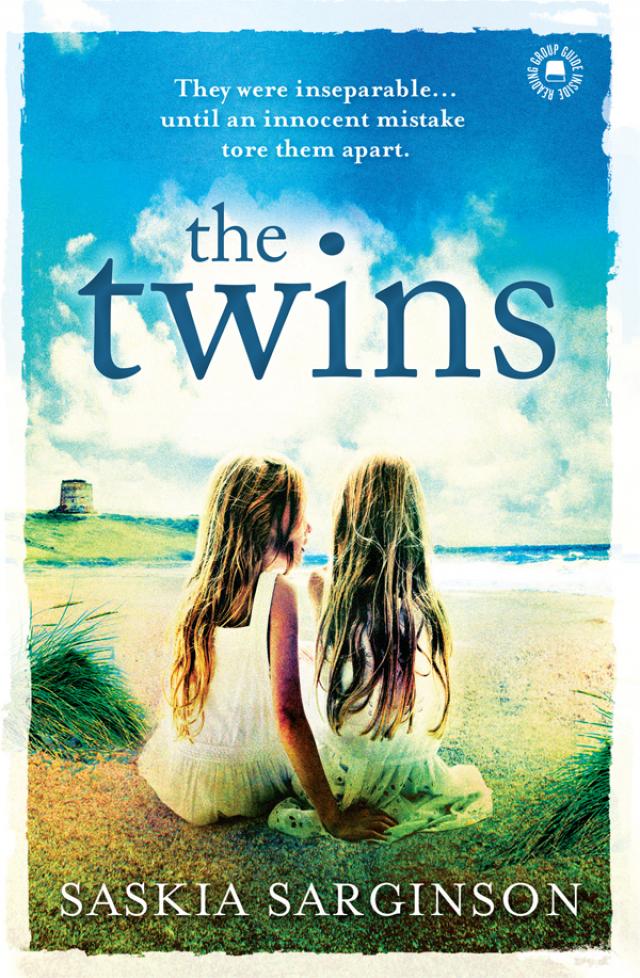
The twins, p.16
The Twins,
p.16


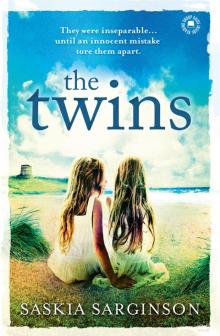
Isolte is inside the sea, splashing up to her knees in icy water. The cold shock explodes inside her bones, crushing her. Her mother is just ahead, water lapping around her waist, around her shoulders. Isolte cries out, but no words emerge. Her lungs struggle, lips and tongue flail; ragged sounds puncture the air, are torn away by the wind. She is sobbing in frustration and pain. Her limbs are numb; the waves shove and push her.
She staggers. ‘Mummy!’ she manages.
But Rose has gone. The water has taken her and Isolte didn’t even see the moment that she went. Isolte’s hands sweep through the grainy chill of the water, hopelessly searching for the feel of a sodden nightdress, a handful of hair, a hand to grasp.
This time she’s not waking in bed with Ben leaning over her: ‘It’s that nightmare again, sweetheart.’ His hands on her shoulder, sleepy voice, yawning, ‘Issy–wake up.’
She is wet. She is shivering.
She opens her eyes into night sky, stars and flicker of moonlight on black water. She gasps and stumbles on stones, goes under, and there is real seawater in her mouth, a salty rush up her nose, stinging behind her eyes, shocking her brain. She’s choking and snorting, flapping her arms, as she struggles to her feet. The waves drag at her. She tries to resist the pull and tug of them, but the force of the sea swells and breaks across her, digging the ground from beneath her feet.
Hands hold her firmly: human fingers gripping, pinching her skin. She turns, eyes stretched wide, and there is Dot, knee-deep in the water, her face open with shock, her mouth a grimace. They clutch each other and stagger up from the steep shingle slope and clawing waves. Wet fabric clings to Isolte’s legs; she’s wearing her pyjamas. She feels sick. She blinks through seawater, pushes a snarl of hair from her face.
‘What happened…?’ Her voice trails away, losing energy. She can’t stop her teeth from chattering. Her body is stiff and stuttering with convulsions that grip her limbs, heart, lungs, so that she can hardly move or breathe or talk.
‘Don’t talk,’ Dot says. ‘Let’s get you inside.’
Dot has her arm around Isolte’s shoulder. ‘You’re freezing. Come on. Got to get you into the warm.’ They burst through the front door. The pug yaps and bounces at their feet, bangs into her shins. Warm breath on her ankles.
‘Get out of those wet things. You’ll get hypothermia in those. I’ll run you a hot bath.’ Dot pauses for a moment. ‘Would you like a bath?’
Isolte nods. She can’t think for herself. Her mind is empty.
Later, warmed and wrapped in Dot’s old dressing gown, Isolte curls up in an armchair with a cup of sweet tea. She feels limp and exhausted, her body hollowed out.
‘Sure you don’t want me to put a slug of whisky in that?’ Dot asks.
Isolte shakes her head. ‘Alcohol doesn’t agree with me.’
There is a pause.
‘I suppose I was sleepwalking…’ Isolte says. ‘Odd. I’ve never done it before.’
Dot, looking relieved, nods. She leans forward to open the door of the stove. The coals inside glow red. ‘So this is the first time?’
Isolte nods.
‘Must be the jolt of being somewhere different.’ Dot looks at her sideways. ‘Places have a big impact on us, don’t they?’
Isolte sips the tea. It is thick with sugar.
The room is lit by one lamp, a fringed, amber shade shielding a low-wattage bulb. Isolte is glad of the gloom. She knows that Dot is looking at her intently; the questions forming on her tongue are already pressing into the space between them. Isolte squints into folds of light and dark. There is a bronze head of a boy. The shadows catch the slope of his cheeks, turning his smile into a grimace. Curling postcards and bits of driftwood clutter the mantelpiece. She looks at it all, pulling the reality of the room to her, pushing the nightmare away. The pug is snoring on a colourful Moroccan rug. She puts her toes on to his coarse fur, presses against the warm rolls of his fat. She waits for Dot to speak.
‘You know,’ Dot says quietly, ‘when I first saw you out there in the water… well, I thought maybe you were… you were going to drown yourself.’
‘No. God, no!’ Isolte is shocked.
‘To be honest, I‘ve been rather worried since you arrived,’ Dot goes on. ‘You seemed so distracted. And when I saw you in the pub I had a feeling that you were… frightened of something.’
‘Suffolk has some bad memories.’ Isolte’s heart is beating fast. ‘My mother,’ she says shortly, ‘she drowned at this beach.’
‘Oh!’ Dot puts her hand to her mouth.
‘It was a long time ago. She…’ Isolte’s face twists, ‘she was drunk.’
Why is she reducing her mother’s death? She couldn’t tell Ben the truth and now she’s doing it again. It was her fault: hers and Viola’s. They’d ruined their mother’s happiness, stolen her chance of a future. Isolte feels her silence like a betrayal. But she can’t force any more words out, they are stuck inside her, clogging her throat.
‘What a tragedy,’ Dot leans forward, ‘and you were just a child?’ Her voice trembles slightly.
There is silence, only the sound of waves, muted behind glass. At their feet comes the stutter and wheeze of the dog and his sudden sleeping yap, paws twitching the carpet.
‘It was lucky I saw you,’ Dot says quietly. ‘I’d gone to bed. It was the phone ringing that got me up again. Then I saw the back door wide open.’
Isolte can’t think about what would have happened if Dot hadn’t seen her. The cold sea swirls closer and she hears the suck of the tide. She breathes deeply, leaning into the curve of the armrest, her fingers tight around the circle of the cup.
‘Well, I think it’s time we both got some sleep…’ Dot stands up, bent over awkwardly, hands on the small of her spine. She groans. ‘Wretched back. Stiff as a board.’
Dot hobbles over to the phone. ‘But first,’ she says, ‘perhaps I should see who it was…’ She leans down, wincing, and presses the blinking answerphone button, muttering that it might be urgent. ‘It was awfully late.’
Ben’s voice enters the room, loud, confident and familiar. ‘Hello? I’m trying to reach Isolte.’ There’s a hesitation and then, ‘Not sure who will get this message. But can you tell her Ben called? Tell her he sends his love. All of it.’
‘Sorry,’ Isolte says, not sorry at all, but glad. ‘He has no idea about time.’
‘Don’t apologise,’ Dot says gravely. ‘I think he probably saved your life.’
Isolte sips her tea and looks at the machine. She wants to reach out and press the replay button. She wants to hear his voice again. Those words.
21
The four of us sat in our garden on the patchy lawn, exactly where John and I had lazed on the rug, drawing pirates and snakes. Sunlight misted the edges of gorse bushes and pine trees. I sat away from John, plucking daisies from the grass, pulling them to bits, one petal at a time, crushing yellow hearts between my fingers. John hovered at the edges of my vision, staring at the ground. I caught him in fleeting glances, watched him worrying the raw skin around his bitten nails, tearing at it with wolfish teeth. When he looked up, I was unable to meet his eyes. He was quiet too. And I was afraid that he was embarrassed by our afternoon, that he regretted keeping it secret from Michael.
The time I’d spent with him pressed into the air like a parallel universe. I thought that Issy and Michael must be able to see it too–it hung so clearly before us: the colours of our drawings, the tickle of the grass against my bare legs, his hand on my arm. How could the others not see it? I’d never concealed anything from Isolte before and it caught like a pain inside me.
‘Let’s go to the tower,’ Michael suggested.
‘We could have a swim,’ Issy said, getting to her feet. ‘I’ll get some towels.’
I heard a sudden clatter of pans from the kitchen. Frank and Polly were coming to supper. Mummy was chopping and mixing already. ‘Be back by five,’ she’d said, slicing skin from a chicken viciously, ‘or else.’
‘We can’t go to the tower. There isn’t time,’ I said blankly, staring hard at my arm as if examining the glinting hairs. I felt I was coming down with flu. And we had to get through an evening with Frank and Polly. I groaned faintly.
Meals that Mummy prepared for Frank and Polly acquired the importance of Christmas dinner. This time Mummy had made elderflower water ice for pudding. The sugary smell remained in the kitchen, a sweet thickness in the air. I’d helped her pick the elderflowers days ago, delicate stems holding sprays of tiny flowers. We’d stuffed them into cheesecloth bundles to steep in sugar water. Dead insects floated on the bubbling scum.
‘Well, what shall we do then?’ Isolte scuffed her heels, looking impatient.
‘Let’s find a dead rabbit,’ John suggested. ‘Make good luck charms. We can wear them in the oak woods.’
‘What’s lucky about a dead rabbit?’ Issy asked.
I blushed and looked down at my dirty toes sticking out of the holes in my plimsolls.
‘It’s their feet that are lucky,’ John explained. ‘Gypsies use them.’
We set off down the sandy track. The pines stood straight and tall, trapping shadows inside a thicket of trunks. I could smell the seep of sticky resin and fermented cuckoo spit. I batted a mosquito away from my neck. Michael had picked a piece of bracken and was tearing away the fronds, his hands stained with green. He whipped the naked stalk around his head.
‘What’s going on with this Frank bloke, anyway?’ Michael said. ‘He’s always round at your place.’
‘Yeah,’ Issy sighed, ‘he’s annoying. Mum will get sick of him.’
‘You dossy woop!’ Michael shoved her. ‘He’s her boyfriend!’
‘Is not!’ Issy snapped, pushing him back, hard enough to make him stagger.
The two of them sprinted ahead, yelling at each other as they ran up the track. A pheasant flew up with a sudden fan of wings, squawking. John and I followed on slowly, our silence closing in on us like a tight and impenetrable trap.
Michael was laughing over his shoulder: ‘Boyfriend! Boyfriend!’ Issy lunged for him and he dodged her, laughing still, teeth bared. ‘She’s got a lovey-dovey boyfriend!’
The riotous noise of the other two had become our private embarrassment. I struggled to think of something to say to John. Anything.
He cleared his throat. ‘Viola,’ he said quietly, ‘I made this for you.’
He pressed a shape into my hands. It was a stone: a grey pebble worn flat and smooth. On one side he had carved my name in spiky letters.
I examined it carefully, tracing my finger over the shape of the letters, and then curled the stone inside my palm. We walked on side by side, not looking at each other. My chest felt big with happiness. The feeling swelled and crashed inside me, thunderous in my ears. I didn’t realise that my heart could radiate such joy. I sneaked glimpses of John’s profile from under my hair. His face was quiet, indecipherable, but then I saw a smile twitch his lips, heard him humming tunelessly under his breath. He felt it too.
As we got nearer to Issy and Michael, I slipped the pebble into my pocket; it sat among the biscuit crumbs and bits of tissue and a broken pencil stub. I kept touching it to make sure it was still there.
‘Over here!’ Michael was beckoning to us.
A dead rabbit lay on the sandy track, stretched out as if it had died in mid-run. We gathered round the carcass in a circle. John prodded it with his foot. The brittle skeleton stood up through parchment skin.
‘Shot,’ announced Michael, and he bent to touch the rabbit’s back. ‘Been dead a while.’ Squatting, he gripped a back leg and twisted hard, pulling until the skin tore. He stood up, holding the foot high like victory spoils.
There was movement inside the dusty fur. Ants. I grimaced, grabbing the left front foot with one hand, and the top of the leg with the other. And then it was a kind of tug of war with the fabric of sinew, bone and hair, all parts of it clinging together as if they’d been glued, until with a sickening snap I felt the bone break. Removed from the body it became a talisman: sun-warm, patched with fur, the curved claws packed with dirt.
‘Now what?’ Issy asked, flushed and clutching her rabbit foot.
‘Tie it on some string,’ Michael said, ‘and hang it round your neck.’
At dinner, pushing my fork through bits of chicken and gravy, I felt the rabbit foot pressing against my skin. I put up my hand and touched the lump it made under my top. It hung low on the string, itching the space between my breasts. I scratched, wondering if it had fleas.
Noticing Polly looking, I took my hand away quickly. Put a mouthful of chicken to my lips. I could hardly taste it. I’d lost my appetite, filled instead with thoughts of John: his secret look as he’d explained about rabbit feet being lucky, the memory of our afternoon shared without the others knowing.
There were roses in a vase on the table: red velvet mouths on long, thorny stalks. Frank had arrived with them wrapped in cellophane. Mummy made a fuss, smelling them and admiring the fleshy petals. Whenever we picked wild flowers she said she didn’t like to see them in vases; it made her sad to watch them dying.
Frank was leaning over his food, eating with concentration. He stopped for a moment to take off his glasses and wipe them on his napkin. Mummy had gone to the trouble of folding napkins at each place. Even so, I saw that there was an oily dribble of red juice on his shirt.
‘How nice,’ Frank said, swallowing and smiling. ‘This is what I call a proper meal. It’s delicious, Rose,’ he proclaimed. ‘Isn’t it, girls?’ He looked at the three of us, nodding encouragingly.
Polly beamed. ‘Yummy.’
Issy and I remained silent. We refused to be lumped into a threesome.
‘I like brain fungus more,’ Issy said.
My mother gave her a hard smile.
‘Odd name,’ Mummy explained quickly to Frank. ‘But it tastes wonderful, actually.’ She waved her hands, making a frilly shape in the air. ‘Prettier than a real brain. It’s sort of lacy.’
‘A fungus?’ Frank frowned. ‘Do be careful, Rose. It’s hard to distinguish between deadly and edible sometimes.’
‘Oh.’ Mummy flushed. ‘Well, if you saw it… it’s unique. We’ve eaten it lots of times.’
He cleared his throat. ‘Don’t take this the wrong way, but I do worry about the weeds and leaves you cook. Food poisoning is a nasty thing.’
Issy and I raised our eyebrows at each other.
After supper Mummy suggested that ‘we three girls’ get a puzzle out to do together. Isolte and I bridled at her words, and it wasn’t as if we ever did puzzles. We rooted about in the untidy games cupboard and pulled out one called The Whispering Island, from an Enid Blyton book of the same name. It was a very easy puzzle. It had been a present from Aunt Hettie. She got confused about our ages, and often sent us things for much younger children.
I knelt on the floor, running my hand across the scattered bits of puzzle. I longed to dip my hand in my pocket to check that the pebble was still there. I had a need to push my thumb over the scratches and trace my name. But Issy would know something was up if I touched it. What’s the matter with you? she’d demand, her eyes narrowing. You’ve gone all weird.
‘Do you read Enid Blyton books?’ Polly asked, fitting a piece of turret into the castle.
‘Sometimes.’ Issy was guarded. ‘They’re a bit babyish now.’
‘I like them.’ Polly grinned. ‘I like the one where they go on holiday and there are wild ponies on the moor and then they discover the gypsies are stealing them. I can ride. I have lessons. Do you have riding lessons?’
‘No,’ Issy muttered.
Delighted to find us on the floor, the cat came over and walked backwards and forwards over the puzzle, purring and dislodging pieces, her tail flicking against our faces.
Frank was sitting comfortably on our sofa, his face shiny and smug, like an overfed and overgrown baby, with his smooth pink cheeks and fat lips. Mummy had kicked off her flip-flops and curled next to him, tucking her feet under her. The way she kept fiddling with her hair–twisting it and making little half-finished plaits–I could tell she was dying for a rollie. Frank disapproved of smoking. Mummy said it was about time she gave up anyway.
I looked at her warily: the mother I knew was changing. Mummy thought discipline and rules inhibited the natural development of the child. She’d read all Rudolf Steiner’s philosophies, underlining bits in firm pencil. I’d heard her quote him to add weight to her own ideas. Routines and clean socks weren’t important; fathers were not necessary. Love was the thing, she said. Give a person love and they’d be all right.
‘I don’t think you ever told me why this part of the world tempted you?’ Frank asked, sipping from his mug of tea.
‘Oh, you know, Suffolk is so beautifully out of the way, isn’t it?’ She angled her head, glancing at him briefly. ‘Proper country. I can’t breathe in cities.’ She shuddered. ‘And suburbs are so… deadening. And then,’ she continued, ‘I used to spend time here when I was a child. So I wasn’t a stranger.’
I was half listening. We’d already heard the story about how her uncle and aunt ran a small tearoom in Aldeburgh, how she and Hettie had spent holidays there, helping put cream on scones and serving old ladies tea in green china cups. When Uncle Horace died he’d left her a small amount. A surprise windfall. Unhappy with the Welsh commune, she’d thought that she should use the money to settle in Suffolk, find a place where just the three of us could live.
But Frank was caught up in the death thing, not listening to the important part about the three of us together, alone. He was mumbling condolences.
‘Oh, don’t be sorry. Poor Horace was in a terrible state,’ Mummy interrupted him. ‘I needed the money, and Horace… well, at eighteen stone and missing a leg, he wasn’t enjoying life. Blood poisoning.’ She raised her eyebrows. ‘They couldn’t find a coffin to fit him. When the undertakers rang to explain the problem, Aunt Sarah suggested cutting off another limb.’