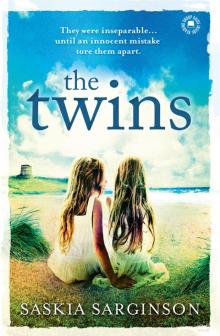
The twins, p.9
The Twins,
p.9


‘Maybe we’ll have chip sandwiches again?’ Issy wondered hopefully.
It was a long walk along a narrow, winding road. Thick mud lay crusted on the outer rim of the tarmac. On either side of us the grass verges rose at steep angles, sloping up to meet scrubby hawthorn hedges. It was like being enclosed in a maze. Nettles sprouted tall, tangling with cow parsley, throwing thin green stalks towards the sky. Every time a tractor or a car came past we had to scramble on to the verge, hopping and teetering to avoid the vicious nettles. We passed a couple of dead rabbits–heads crushed flat as cardboard cutouts. A rook lay torn to shreds at the crossroads, black wing feathers scattered in the dust, the fragile bones tossed like skittles in the dirt. I bent down and put one in my pocket. A slender fluted thing, smooth against my thumb. Farm dogs barked at us as we passed gates. When we saw the familiar row of cottages we stepped up our pace, thinking of cups of sweet tea and the flicker and blare of the television.
But at the drunken gate fallen off its hinges, we slowed down, dragging our feet, suddenly aware of our lack of invitation. The cottage looked deserted. Smeary windows held the smudged reflection of clouds and sky.
‘Let’s go round the back,’ Issy suggested, thinking, as I was, of the boys’ plump, smiling mother. We imagined that she would always be in her kitchen. She’d welcomed us warmly, told us to call her Linda.
The kitchen door stood open, but as we put our heads round, we saw that the room was empty. No Linda with her chipped nail varnish, breathing out cigarette smoke. No Judy snapping gum between her teeth. We entered cautiously. The small room was cluttered. Fishing rods against the walls, boots piled up on the mat. It smelt faintly of hot oil and burnt toast, as if someone had only just finished a meal. We lingered nervously by the table. Doubt twisted in my stomach, and when Issy made a grab for my arm, I let out a tight yelp. ‘Don’t move,’ she hissed. She inclined her head. ‘Look!’
I glanced down and stiffened. A long creature with a pointed face had slunk into the room, nose quivering, tail flicking from side to side. When it heard or smelt us it reared up on its back legs and squatted there, glittering red eyes regarding us intently. It opened its mouth, showing a row of sharp little teeth.
‘What is it?’ Issy whispered.
‘Don’t know. Keep still.’ I’d noticed the creature’s curved claws.
There was the sound of footsteps, a shout from somewhere above us and the thunder of feet on the stairs. John crashed into the room. The creature fled, scrabbling across the kitchen floor, a streak of muscle rippling under white fur.
‘Shut the door!’ John yelled.
But it was too late. The animal had shot across the yard and under the fence, swallowed by the long grass behind.
‘Shit!’ John smacked his forehead, and slammed his other hand down hard on the table. ‘Shit! Shit!’
‘What was it?’
‘Dad’s ferret. I left the latch off,’ he frowned, ‘they’re gone. All of ’em. Bollocking hell.’
A teenager with a face full of acne wandered in. He was wearing blue overalls tucked into enormous wellingtons. It was Ed, the twins’ older brother.
‘What yer shou’in about, boi?’
‘Ferrets’re gone.’
Ed winced and shook his head. ‘Better clear off–he’ll be back soon.’
‘Where’s your mum?’ Isolte asked nobody in particular, gripping the back of a chair.
‘Cleaning job,’ Ed answered shortly. He was at the sink, turning the tap on with his elbow, sticking his hands under the gush of water.
Michael came into the room. He went straight up to his twin and clipped him around the ear. ‘Dozy dollup!’ He stared furiously. ‘Now we’ll have t’ leg it. He’s gonna kill us this time.’
John hardly flinched, although I saw his ear smart purple.
‘What about them?’ He jerked his head at us.
‘They can ride behind.’ Michael pulled at my sleeve. ‘You comin’?’
They took their bikes, sprawled in the dust in the garden, leading them on to the side of the road as if they were horses. Two beaten-up choppers. We perched on the bike seats. They stood up in front. I was on John’s chopper. The bike swung from side to side as he pressed his weight down on each pedal in turn. I didn’t like to put my arms around his waist. But if I took my hands away I wobbled and the bike lurched, making John swear, his knuckles blanching on the handlebars. So I kept my fingers there against the curve of his ribs, feeling his boy-heat through the worn-smooth acrylic sweater, the twist of his back muscles jumping beneath my touch.
We went quickly past the farm, past the church with our school behind, and the turning into the village. After bumping along the sea wall we came to a Martello tower, a huge circular fortress of sombre stone, built as a lookout post in the Napoleonic wars. It stood, empty and abandoned, a hulking silhouette against the flat landscape.
The boys dragged the bikes under bushes, concealing them inside the scratchy depths, throwing grass and burdock leaves over the spokes.
‘We’re going to let yer in on our secret,’ John told me, his forehead glistening. ‘Swear on yer life you’ll never tell.’
I looked into his hot face. His eyes were a startling blue. I nodded. The tang of him was in my nostrils: salty, yeasty, and strangely pleasant.
The tower seemed impenetrable. There were no doors. The glassless windows were high up in the blank stone face. Rooks flapped in and out, wings spread dark against the sky. In the side facing away from the sea, about ten foot above ground level, with no apparent way to reach it, was a battered wooden door. Issy and I stood below in the thistles, perplexed, shading our eyes as we watched the birds flying off. Behind us was a stream cut deep into the ground, and we could smell the reedy, black water drifting past. Michael placed his hands against the wall, leaning his cheek against the rough surface as if he was listening to something. He closed his eyes and his fingers felt above his head for handholds in the crumbling mortar. Then with a low grunt, he heaved himself away from the ground. He moved slowly, inching from one shallow toehold and fingerhold to another. I watched anxiously. It seemed impossible that he could scale the wall. But soon he was pushing the door open and wriggling on to the stone lintel. I looked up to see his hand opening like a star, and a snake came slithering towards us. A rope dangled by my nose, frayed ends swinging.
John gave me a small push. ‘Go on then.’
My knees sagged. But the others were watching. I had no choice, or I’d always be teased about it. Then John was behind me, stooping to make his linked hands a step. I felt his arm on my leg, steadying me as I hauled myself up, hand over hand on the rope, feet scrabbling against the stone, palms on fire. And I was kneeling in the grit of the opening, smelling something acrid over the stink of damp. The rope was tied to a rusty metal plank set at the foot of the door. Michael gave my shoulder a brisk pat, while he reached past me to catch my sister’s hand in his.
We’d come in on the second level, clambering into the echoing, vaulted space that used to be the soldiers’ quarters. The air was a slow mass, thickened with dust motes that shimmered inside shafts of light coming from the windows. My limbs twitched with tired muscles. I followed the others, not wanting to be left behind, edging carefully over rotten floorboards, jagged gaps revealing a long drop into blackness. The floor was covered with scattergun splotches of white, green and grey. Seagull shit. Rook shit. This was what I’d smelt; the whole place reeked of it. Hundreds of small feathers glowed at our feet. Issy had begun to sing tunelessly, so I knew that she was scared too. We followed Michael and John up the narrow stone staircase set against the curved wall, stepping over a straggly nest with three blue eggs in it.
Salty wind blew in our faces as we stepped on to the roof. We opened our mouths to the relief of it. The stone floor, cracked around sprouting weeds, had a high surrounding wall. The boys beckoned and we climbed up. The ground fell away far below, and we could see for miles across the fields and marshes to the church tower behind trees. I could see someone walking along the edge of the trees, a stick figure cut out of black.
‘Wow!’ Issy forgot to be cool; she was grinning and staring at the view, two dots of red flaming on her cheeks.
Three white swans stood in the middle of the field, one of them spreading its wings. On the other side was the sea wall, with the beach stretching down to the sea: a brown weight of water, darkening under cloud shadows. The waves shone where they caught the gleam of the dying sun. My stomach turned at the steepness of the drop, but I felt a longing to stretch out and embrace the vaulted sweep of sky.
‘This is our place,’ John said, leaning over at a dangerous angle. ‘No one ever comes. Nobody can get us here. We fixed the rope up. It’s the only way in.’
‘They had the cannons here,’ Michael patted the solid wall, ‘when it was a fortress. Two of them.’
He put a pretend gun to his face, and closing one eye as if taking aim, he made shooting noises. ‘Take that, bastard Froggies.’
There was one ship on the horizon, small as a Dinky car inside the curl of my fist. Gulls wheeled and dived over our heads. John brought up armfuls of driftwood from their supply below and Michael squatted to strike a match. The wood was dry and it caught immediately. We sat around blue flames, looking into the disintegrating branches, watching them turn from molten gold to ash white. Sometimes an ember would leap out and land on our feet. But the fire was greedy, and there wasn’t any more wood. It died, falling in on itself, blackened skeleton twigs curling and collapsing. I shivered, realising how cold it had got. Issy bit her lip, looking regretfully into the grey sky. ‘Suppose we’d better go.’
Michael and John let us down by the rope. When we stood at the foot of the tower staring up we could see only parts of their faces, distant and disembodied, suddenly impossible to tell which one was which.
It took hours to walk home. Issy got a blister. She sat on the ground and rolled down her sock to reveal a raw, weeping patch on her heel. We tried padding out her shoe with dock leaves and she hobbled beside me, her face grim. It grew darker, until we were fumbling through moonlight, so that we stumbled over potholes and caught our feet on stones. When we got to the road we had to throw ourselves on to the verge to avoid oncoming cars, no longer caring about nettle stings, squinting against the glare of headlights. Once we heard some loud male voices jeering at us as their car accelerated away.
When we reached the forest track we cheered up, thinking of our supper. ‘Do you think they stay there often?’ Isolte mused. ‘I mean, they don’t have anything to sleep in or eat or anything.’
I thought of the twins, huddled shivering in the dark, the flap of rook and seagull wings around them. I imagined the wash of the sea and sigh of the wind. They must have been very scared of going home. But I don’t remember talking about it. It seemed disloyal somehow, to admit that the boys were frightened.
It was a relief to see our cottage. Lights on in the window. It looked tiny, like an illustration from a fairy tale. Shadowy trees almost engulfed it. Our mother was waiting. We knew at once that she’d been drinking. She staggered getting up, her hand slipping off the edge of the table. We stood open-mouthed as she swung her arm back and struck. It was me she slapped. I felt the imprint of each finger. A roaring went off in my head, my ear ringing. I let out a noise halfway between a gasp and a grunt, and Issy took hold of my arm.
‘Where the hell have you been?’ Mummy’s voice sounded strangled. Her breath stank. ‘Have you any idea—’
She let out a sob and turned away, trying to light a cigarette, but her hand was shaking too much. She dropped the match and pressed her hand over her mouth as if she was going to be sick. Unwashed, ratty hair fell forward across her eyes. She shook her head from side to side. She kept shaking it.
‘Sorry. We got lost,’ Issy whispered, slipping her hand down to find mine. ‘Sorry.’
Fingers squeezing fingers.
We went to bed without any supper. The kitchen door shut with a bang behind us.
Issy looked at me. ‘You’ve got marks on you.’ She came close, touching me cautiously. I smelt her–briny air, bonfire smoke and faint traces of the dank tower–could see the freckles on her skin, the individual speckles of brown. ‘Does it hurt?’
I shook my head.
I didn’t want to think about it. Mummy had never hit us before. I wanted to pretend it hadn’t happened. But I kept seeing her face. It was as if she’d unravelled before us, losing herself in messy threads, becoming naked and strange. I thought about the boys instead.
We’d only seen their father a couple of times. He was a longdistance lorry driver. Linda urged us home when she heard the lorry. She’d suddenly cock her head, listening, eyes glassy and small. ‘Best go now, girls,’ she’d say, pushing us towards the door. We’d break into a run as we heard the hiss of brakes behind us, feeling the heavy grumble of wheels under our feet. We were allowed to be there when he was at home if he’d gone to bed; then we all had to be quiet. Even the TV was turned down. But once I’d walked into the living room and he’d been sprawled on the sofa, a beer in his hand. I’d jerked to a halt, holding my breath. He was a giant of a man, with red cheeks and a startling red beard. He’d looked at me sideways as if I was a spider crawling out of a crack. ‘What you lookin’ at?’ he’d snarled, his fingers curling into a blunt fist.
I touched my cheek tentatively. I thought of the boys’ bruises. I shared this with them. Not Issy. Only me. The marks on my skin distinguished me. I felt as if I’d stumbled into a secret club: an honourable place full of dignified, silent sufferance. I thought about Jane Eyre the child, and the young Heathcliff, both beaten and abused.
‘I suppose they’ll still get a thrashing.’ I pulled my nightdress over my head. ‘I mean, they’ll have to go home in the morning.’
Issy shrugged. ‘Maybe their dad is off in the lorry tomorrow.’ My right cheek and ear continued to sting. I felt as if Mummy’s fingers remained there, touching me. She would be sorry now. I imagined her apologetic, begging my forgiveness. I lay awake beside my sister listening to the quiet stirring of Issy’s breath, the catch of saliva in her throat, the exhalations of her dreams. Sometimes I wondered if we inhabited the same ones. It seemed impossible that we should wander separate worlds while we lay next to each other. I thought we must meet up somewhere in between–in sleep space; I pictured us flying towards our dream landscapes, waving at each other. But we lay on opposite sides of wakefulness that night and loneliness hollowed me out. I thought of prodding her awake. I put my hand on her arm, feeling it thin and finely fleshed. I didn’t shake her. I knew she’d be annoyed.
I headed for the light of the kitchen, the winding stairs creaking, armed with the old excuse of wanting a drink of water. My hands were raw from the rope. I held them away from the brush of my nightdress. I was ready to retreat if Mummy looked like she wanted to give me another slap. My bare feet made no sound as I padded cautiously into the room.
She was hunched over the table, empty glass by her hand. She’d piled up coppers and silver coins in three small stacks. There was an open exercise book and an abandoned pencil. I saw angry scrawls across the page. Had she been doing maths exercises? She was crying quietly. When she saw me she sat up quickly, wiping at her eyes, and reached out to pull me close. Her face next to mine was a crumpled, blotched mask. I suffered her embrace, locked stiffly in her arms, wine breath in my hair.
‘I’m sorry, Viola. I’m sorry.’ She hugged me even tighter, her voice trembling, her chest shuddering. ‘I don’t know what to do, you see.’
And suddenly I was crying too, my arms tight around her neck, squashing my cheek against her nose, her mouth against my ear.
*
There are muffled sobs coming through brick and plaster, through the floral paper on my bedroom wall. My sister, who has slept with me since I can remember, limbs entwined with mine, is crying in her own bed on the other side of a wall.
‘Here you are, girls.’ Hettie had thrown open two doors. ‘You can decide between you who gets what room.’
I’ll always remember the look on Issy’s face. My mouth had fallen open. We’d never been parted; never had separate beds, let alone rooms. But how could we tell her that? Hettie was the only safe thing in the world, the only link left to Mummy. We wanted to please her.
My feet steal on to the carpet. The curtains are slightly open and a strange orange light seeps in. In London the night sky is never properly dark; it is stained by streetlamps. You can’t see the stars.
‘Issy?’ I whisper, tiptoeing into the gloom of her room. We find each other in the darkness, under cool sheets that smell like lavender and old ladies. She rubs at her wet face.
‘I keep thinking I’ll wake up and be in the cottage,’ and her voice breaks, ‘I keep thinking that Mummy is downstairs.’
We curl up together, hip against hip in the hollow of the bed. Outside there are strange noises: cars changing gear, a sudden blast of voices, the gabble of strangers and their slurred laughter. I hear a bottle smash and my heart kicks in my chest. The city never sleeps; even if I wake in the early morning hours, I can still hear the distant hum and mutter of machines and voices and sirens.
We are going to start at a new school in a couple of weeks. We will go into a class with other thirteen-year-olds, and not be kept down a year any more. We’ll have to wear a uniform and travel there by red double-decker bus. I feel sick at the thought of it. Hettie says that it will be good for us to make new friends. Michael and John are the only friends I’ve ever had; the only friends I want. But Issy won’t talk about them, she grimaces when I mention their names. At night, alone in my bedroom, I compose different versions of what I could say to John in a letter. But nothing seems right. Nothing seems possible.