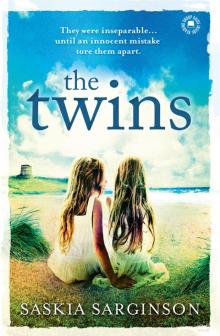
The twins, p.8
The Twins,
p.8


‘We must have been at a fair. I don’t remember.’ Hettie takes her glasses off and gives the photo back to me. ‘We didn’t spend much time together. I was at boarding school while she was little, and when she was packed off to school I’d already made the ghastly mistake of getting married.’
I make myself comfortable in the hollows and dips of the old sofa. Even at midday the room is gloomy with shadows, weighed down with heavy antiques and thickly woven tapestries; the grandfather clock in the corner ticks as loudly as a metronome. It is a place that invites confidences. One of the spaniels jumps up and curls itself against my leg. Hettie is in a talking mood. All I have to do is open an inviting silence.
‘Mother died while Rose was still at school.’ Hettie sits on the arm of the sofa, pushes at the sleeves of her bobbled cardigan with stubby fingers. ‘After that, Rose ran away a couple of times. Always brought back in disgrace for Daddy’s interminable lectures.’
‘So she was a bit of a rebel then?’ I ask, fiddling with a strand of my blue hair.
‘Well, she certainly didn’t like institutions or rules.’ Hettie smiles to herself as if remembering a private joke. Looks at me, and nods. ‘She wasn’t exactly academic, dear Rose. But she had plenty of ideas about how the world should work and what was wrong with it.’ Hettie crosses her legs, adjusting her skirt. ‘After she left school she started seeing this writer chap–I forget his name. Very Beat Generation with his dark-rimmed glasses and narrow trousers. Daddy took an instant dislike.’ She clears her throat. ‘Rose went off to America with him. Sent me postcards. Told me she was going to be an actress. I thought I’d see her up in lights.’ Hettie shakes her head. ‘She was so pretty.’
‘But then what happened?’
The dog sits up and scratches earnestly, ears back and eyes closed.
‘I hope that creature doesn’t have fleas…’ Hettie gives her large bosoms an absent-minded pat and leans forward to inspect the dog’s ears.
‘Hettie?’ Isolte calls in her London voice. ‘I did tell you, didn’t I? I’m going to a party tonight. That OK with you?’
She comes clattering down the stairs in red platform shoes, bringing all her demands and bright plans for the evening; she stands at the other side of the room, dressed in a glittery skirt that swishes around her knees, and the distance between us is so much greater than a stretch of worn carpet. Her happiness makes me feel ashamed. Why can’t I follow her example? Why can’t I ‘make the most of it’, as she puts it?
Holding the heavy frame, I stare at the child in the photo: my mother, preserved in black and white. She stares back. She is radiant, her nose wrinkling above that wide smile. Issy seems to look out at me through my mother’s features, sharing the joke. But I am not there. I can’t find a reflection of myself in my mother, or my sister any more. Not even in my aunt. I hunch up on the sofa, lost in shadows, my stomach clenched, cold and empty. I don’t know who I am.
11
‘Can you spare a moment?’
Sam calls Isolte, beckoning from the other side of the room, cigarette in hand. She leads the way to the meeting room–the one place that’s separated from the rest of the open-plan office–and Isolte follows, feeling irritated, thinking of the list of things she has to get through.
Sam has chosen a chair that’s larger and higher than the low, squashy one she’s left for Isolte to occupy. Isolte tries to sink into it gracefully, but her knees are up by her chin and she has no idea how she’s going to get out again. Sam crosses her legs and clasps her hands together as if about to pray. Her fingernails, Isolte notices, are short and masculine, her fingers weighed down with chunky silver rings. The cigarette burns in the ashtray, smoke rising in an acrid curl.
‘As you know,’ she tells Isolte, ‘I have a new vision for the magazine and change is essential. I’ve been trusted with the job of taking this magazine on to the next level.’ She frowns. ‘We’ve really got to get it noticed, push up the readership, pull in new advertisers. It’s a big task and, quite frankly, sacrifices will have to be made.’ She leans back and sighs. ‘What I’m saying is, it’s time for you to move on, Isolte. You should take a holiday, move into the next phase of your career.’
The next phase of her career? It takes a few moments for her to work it out. ‘You’re firing me?’
‘No,’ Sam gives her a pasted-on grin, ‘of course not. We’re offering you redundancy. There’ll be a payment. Think of it as a chance for better things.’
Isolte looks at the cup of coffee in front of her. The liquid is gathering a skin on top, puckered and pale as scum.
‘What if I don’t want to take that chance?’
‘I think you’ll find that option isn’t available.’
How clever Sam is at saying something with words that mean nothing. Isolte is almost impressed. She stands up and finds that she is defenceless. Words rise from somewhere inside her numb brain, forming sentences of protest and self-pity. Isolte opens and closes her mouth soundlessly. It can’t be right, she thinks. They can’t make her redundant if they’re going to replace her. Can they? She swallows and stands up straighter, scrabbles around for some dignity. ‘I’ll have to speak to my solicitor, of course.’
‘Of course,’ Sam agrees sweetly.
Isolte wonders if she’s in shock. She feels as though she’s floating. The magazine has been more than her place of work–it’s been her identity, her home. She’s been here for five years. Her fingers move automatically, flying over her desk, gathering a green bottle of scent labelled Poison, her leather Filofax and her work address book. She picks up an inscrutable marble sphinx small enough to sit on her palm, brought back from a shoot in Egypt. What else really belongs to her? What else does she want? She looks at the pictures and cards pinned to the noticeboard–all those hopeful models and jaunty advertising strategies–and takes down the photograph of the horse, slipping it into her bag.
Lucy is sitting at her desk. She is crying.
‘It’ll be OK,’ Isolte says brightly. ‘It’ll all be all right, Lucy. I’ll be fine. And you’ve still got your job. Sam won’t get rid of you.’
She pulls on her jacket, slings her bag over her shoulder, looks round just one more time and walks out, head held high. There is a quiet, shocked whispering coming from the subs’ desk. Isolte feels the news travelling through the room behind her like a bush fire: the bright consuming flames of gossip.
She’d been so naive. She hadn’t suspected a thing. Stevie had hinted at something like this. But still she hadn’t suspected. Not when Sam called her into the meeting room, or when she offered her a coffee, not even when she began her little speech. So much for loyalty, Isolte thinks. She had been only a little cog after all.
The daylight of the street is shockingly bright. She takes big gulps of dirty air. She is disorientated. Looking right and left, she has no idea which direction to take. A siren starts up in the fire station opposite. A big red truck cruises out of the double doors and on to the street, heading for Piccadilly Circus with lights blazing and the siren shrieking.
There’s a homeless girl huddled on cardboard against the wall of a theatre; she gazes at the firetruck listlessly. Isolte walks over to her and riffles through her purse for change. The girl looks up hopefully and Isolte stares into her face: she guesses that the girl’s in her teens; she has bruises under her eyes and puffy skin, her matted hair sticks to her small skull like clumps of weed. Isolte’s fingers fumble inside her purse; she ignores the coins, digs out a five-pound note.
The girl looks surprised. She folds the note inside her hand, conceals it within her old coat with furtive speed. ‘Fanks,’ she murmurs. Her eyes are the palest blue, Isolte notices, like fragments of ice.
They don’t have strict visiting hours at the hospital. The nurse at the front desk tells her that she can go through. There is a smell of overcooked vegetables. Viola is propped up on her pillows with a book in her hands that she’s not reading. When she sees Isolte she raises her eyebrows. ‘This is a surprise,’ she says. ‘Why aren’t you at work?’
‘Long story. I’ll tell you later.’ Isolte sits next to the bed and nods at the tray with a glass on the side table. ‘Have you had lunch?’
‘I’ve had some of my drink,’ Viola’s voice becomes guarded, ‘the stuff that goes down my tube. They wanted me to try taking it by mouth.’
‘Was it OK?’ Isolte crosses her legs, sits back in the chair. Mustn’t talk about food any more. She always says the wrong thing.
‘Issy, this is a concoction of fat and liquid with some vitamins mixed in.’ Viola gives a shadow of a smile. ‘What do you think?’
‘Point taken.’ She reaches across. ‘I’m parched. Can I steal some of your water?’
Viola’s gaze is unwavering. ‘What’s wrong?’
Isolte takes a long sip of tepid water and frowns. ‘What do you mean?’
‘Come on,’ Viola moves painfully on the bed, shifting to one side, ‘something is going on.’
‘I’ve been sacked.’ It’s a relief to say it. ‘Well, they’re calling it redundancy. But they’ll replace me with another version of myself. Someone younger, more to the new editor’s liking. She’ll already have someone picked out.’
‘Can they do that?’
‘Seems they have.’
‘What will you do?’
‘I don’t know,’ Isolte shrugs, ‘I really have no idea. Get another job, I suppose.’
‘Why don’t you go away–do something different? You haven’t been happy for ages.’
Isolte is startled. She opens her mouth to protest. Up until today, she’s had a great job; she owns her own flat and has a handsome, successful boyfriend. Why wouldn’t she be happy?
‘But I am, I have been—’ she begins to argue.
Viola shakes her head dismissively. ‘Not properly happy. You know you haven’t. Neither of us has, have we? Not for a long time.’
Isolte sets her mouth in a stubborn line. But Viola’s words have burrowed through the surface of things, stirring up an old darkness. Isolte looks at the floor and frowns. ‘Well, I don’t know…’ she says, ‘perhaps not.’
Viola makes an effort to sit up straighter, and Isolte leans across to help, holding her frail shoulders, plumping the pillow behind her.
‘I think in a way it’s positive–this, this redundancy. That job wasn’t good for you. It made you, I don’t know, hard or something.’ Viola looks at her earnestly. ‘Think of this as an opportunity.’
‘Funny,’ Isolte says bleakly. ‘That was what my editor–ex-editor–said.’
‘I just mean maybe you can be yourself again, Issy.’
A small plump nurse arrives at the bedside and looks inside the cup on the tray. Seeing that some of the liquid has gone, she says briskly, ‘Good girl,’ and takes Viola’s wrist in her doughy hand. ‘Time for you to have a rest. I’m just going to take your pulse and blood pressure. Maybe your sister can come back later?’
The nurse, placid and smooth-faced as a doll, gives Isolte a pointed stare. Viola does look tired. Her eyes ringed with purple, lips bloodless and cracked. The tube is still in place, like a transparent vein weaving across the outside of her skin.
From the street there is the yelp of an ambulance siren, muffled by the closed window. Isolte remembers the homeless girl slumped on her cardboard. She has a need to hold Viola–to hug her tightly and press her own face against the face of her twin, to spread her warmth into the cold blue lake of Viola’s body. She touches the back of Viola’s hand. The skin is thin as paper. The knuckles pressing through are too big. She stands up. ‘See you tomorrow.’
Viola nods, her head heavy on the stalk of her neck. She lies back, exhausted. The nurse is already holding Viola’s arm, wrapping it in black, her fingers busy with a small pump.
At the flat she wanders around empty rooms, switching on all the lights. She’s hardly ever at home–not on her own, never during the day. When she first moved, she was excited, spending every weekend at markets and rooting through thrift shops to find interesting bits of furniture and pictures. She spends most of her time at Ben’s now. Her place smells unlived-in. An open book pressed face down on the sofa has been in the same position for days. It reminds her of a dead bird, the pages splayed out like limp wings. The cactus plant is rotting; brown-fleshed, it leans to one side drunkenly. Isolte shivers. She wonders if she’s catching flu. The muscles in her shoulders ache.
She has a hot shower, using generous handfuls of body wash, filling the space with steam and Moroccan Rose. She stays under the jet of water until it begins to go cold. She scrubs every inch of her skin and washes her hair. Wrapped in a towel, she phones Ben and asks him to come over to her place on his way back from work. She makes herself some pasta and forces herself to eat a little.
The thought of explaining it again to Ben makes her feel exhausted. She doesn’t want to think about the redundancy. She doesn’t want to think about anything. What Viola said in the hospital has stayed with her. She never considered whether she was happy or not. It had been enough that her days were full. She felt the comfort of belonging to a particular world and the relief of being good at her job. She tried to be busy, to be necessary. But she didn’t have the ache of ambition in her. Otherwise she would have jumped ship before, taken a step up into a more prestigious magazine. This job suited her perfectly. Had shaped her life. Now she has no idea what to do. A void is opening–and she’s stepping into it: a calendar of empty days.
She can’t tell Ben. Not just yet. She feels the failure of it dismantling her, exposing her. The job had been an identity. And that identity had been a shield. She’s not sure who she is without it. She feels humiliation smeared across her like something embarrassing. She doesn’t want him to see her like that.
She needs Ben to make her forget. Sex is something that demands complete focus. She is always hungry for him. He’s completely different from the kind of men she normally finds attractive. The maleness of him is irresistible–there’s something almost vulgar about his broad hands with rope-like veins over the back of them. The thickness of his skin makes her want to bite it. One day, she thinks, perhaps it will burn out, this desire they have for each other, and then she’ll be released. She’ll be safe from needing him.
Isolte opens the door to him. He puts his bags on the floor, shrugs off his leather jacket. His chin is scratchy with stubble; his eyes close as he leans in for a kiss. She knocks her foot against the bags in her hurry. A camera edge bruises her shin, as she stumbles awkwardly into his arms.
12
The boys were at a different school from us. They were in the second year at the comprehensive in town: a sprawl of concrete blocks and Portakabins arranged beside a windswept playing field. All of it fenced around with wire. Luckily for us they were experts at bunking off, so we saw them nearly every day. Sometimes they turned up at our back door with black eyes or split lips. We never mentioned their injuries–the damage was a part of them, like their red hair. The bruises their father inflicted on them blended with their own, the boys’ hot-headed scrapping disguising his abuse from anyone who might have cared. Our hair-pulling and squabbling seemed tame in comparison–the worst we’d done to each other had been accidental; Issy caught my eyeball with her fingernail, and a flame seared across the wet flesh.
The doctor said I had a scratched cornea. He gave me an eye patch to wear. It made me look rakish and dangerous, like a pirate. I had constant sight of the glowing ridge of my nose, and the world seemed lop-sided. My eye healed quickly so I didn’t have to wear the patch for more than a couple of days. I was loath to give it up, even though I’d been teased for it at school. The class joker, Henry Green, his face split by a leering grin, had stuck out his foot to trip me up: ‘Not much of a treasure chest on you, is there?’
Mummy’s experiment in home-schooling while we lived in Wales meant us lagging behind in all things academic. The result was that we were put down a year and had to go to the village primary, a squat Victorian building next to the church. The day after the patch came off, we were back at school chanting times tables and writing out pointless spelling lists. Girls in white socks with their hair in bunches ignored us. ‘Hoist the Jolly Roger!’ the boys sniggered, saluting both of us, not knowing which one had worn the patch.
We played on our own at break, escaping through the hedge into the out-of-bounds churchyard, loitering among the listing, mottled gravestones marooned in the long grass. ‘Twinnies,’ they called us. ‘Dirty hippies.’ ‘Home-schooled.’ ‘Mental.’ We were sick of being outsiders, the others whispering about us behind their hands, scrutinising our straggly hair and weird shoes, our homemade dresses. Mummy never got seams straight. She favoured the easiest patterns–no gathers, no sleeves, no collars–making everything out of utilitarian cotton gingham or, worse, she cut down her own clothes and then we got stuck with printed velvet and embroidered cheesecloth. Mummy liked us in navy knee socks, and best with bare legs. All the other girls had full gathered skirts with ribbons tied in bows at their waists. They wore ankle socks with lace trimming.
John and Michael must have had a sudden passion for school, or else they were ill, because we hadn’t seen them for a whole week. They hadn’t even come over in the evenings. They’d missed seeing the eye patch–I was disappointed. I’d hoped to impress them with my jaunty Blackbeard look and the state of my gory iris. We were hungry for their company, Issy and I. We had a plan for a den in the forest, a longing to trespass on the Malletts’ farm. We decided not to go home when school ended but walk to their house instead.