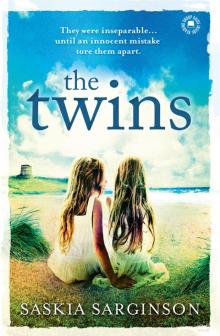
The twins, p.3
The Twins,
p.3


‘No cure then?’ Issy put her chin up.
The boy shook his head.
‘What’s your name?’ Issy swallowed. She was trying to take it in. Trying to work out what to do.
‘Michael,’ he said.
‘John,’ the other one said. The one with the eye.
‘I’m Viola,’ I offered, feeling brave, ‘and that’s Isolte.’
‘Funny names,’ Michael shrugged.
We didn’t think they were funny. They were just our names. Mummy said that Viola and Isolte were names of characters in plays. She chose them for us because they were beautiful and belonged to strong women who’d both known true love. I opened my mouth and closed it again. I was doubtful that these boys would be interested in this information. They might even laugh.
Issy was already explaining that, actually, people usually called her Issy, but Michael wasn’t listening. He was frowning as if in concentration. He gestured to the slingshot in his brother’s fist. ‘We could finish it off.’
It took a moment for me to understand that he meant the rabbit. I felt the air leave my body. I slumped forward, my fingers moving towards the basket.
John and Michael looked at each other. ‘Fairest thing,’ John said.
I touched the rabbit’s ears. They were silk, ribbons of silk, specked brown and silver. Then I looked at the tight stretch of the eyelids, stuck down over swollen mounds of pus. I bit my lip, glanced up at Isolte. She nodded.
‘Will it be quick?’ I asked.
Michael was kicking at the stones on the track, as if he was searching for something. He picked up a flinty rock and weighed it in his cupped palm. ‘Best do it by hand,’ he said to his brother. He rubbed a grubby finger over the flint, feeling the edges.
We put the rabbit down on the verge gently. Its long protesting nails, like splayed hooks, dragged trailing bits of grass and bracken from the basket. It stayed where we’d put it, sides pulsing in and out. I let out a sob and clamped my hand over my mouth. Issy kept her gaze fixed on the rabbit, but I shut my eyes as one of the boys, I can’t remember which, brought the rock down hard. I felt the movement, the deft speed of it.
There was a soft thump. A muted noise, not the firm thwack of ball against racket, not metallic like a stone against a road. Something smaller and quieter. A caving in of thin bone and flesh. I was afraid that the rabbit would scream. But it made no noise.
‘It’s done.’
I sniffed and swallowed, scrubbing at my face with the back of my hand, wiping away the wet.
Afterwards Isolte said, ‘They’re all right, aren’t they? Those boys.’
1974
John,
I keep writing these letters and then tearing them up. I’ll probably do the same with this one. I’m not even sure what I want to say. Except I miss you. I miss you so much. It’s been two years, one month and three days of not seeing you. I don’t belong here. Never will. I long for the forest–the smell of pine and mist on the ground–the herds of deer grazing. Do you remember that adder that went across the path under our feet–I don’t think I’ve ever jumped so high! You put your hand on my chest, feeling my heart to tease me. But I think you were scared too. Only you would never admit it, would you? You always thought you had to be brave. I think of you all the time, John; and I go over everything, driving myself mad with the ‘what if’s’. Can you sense me at your shoulder; feel me missing you, wanting you? I’m sorry for everything, for the way things ended. I wish I could go back in time and make it right. But we all do, don’t we?
Viola
4
Ben is on the phone. He makes a pleased-to-see-her face, but doesn’t stop talking. Isolte shrugs off her coat and reaches around his waist for a hug, smelling traces of his peppery aftershave and the oil in his jumper. He pulls her to him absently, nodding and saying, ‘Sure. Yes, fine. Yeah,’ into the receiver. She feels the vibration of his voice through his ribcage. She can’t hear who’s on the end of the line. She lets go of him and wanders next door.
The television is on in the living room. Sound turned up loud. There is a picture of a ferry on its side, wallowing in grey water. Isolte reads the caption: Herald of Free Enterprise salvage operation. The newsreader looks up under a peroxide helmet and tells Isolte that of the 539 on board, 193 people perished in total.
‘Shit.’ Isolte turns it off.
She’s familiar with the North Sea. An expanse of muscular waves thickened with grit. She’s swallowed mouthfuls of its brown water, felt its insistent currents tugging at her legs, persuading her away from the beach. It would have been freezing. How long could they have survived in the water–seconds, minutes? Sucked down by the sinking ship. The cold and the currents would have got them. Children too, probably. Babies in their pushchairs. The weight of all that water. They wouldn’t have had a chance. She doesn’t want to think about it.
She goes over to the record player and starts to flip through Ben’s albums. She can hear his voice in the other room: his telephone voice. It’s rude not to finish the call and come and say hello to her properly. Indignation makes her throat tight, almost tearful. She feels an airy fizzing in her fingers and toes; little bubbles of frustration snapping in her blood.
She slips Bowie’s Let’s Dance out of its cover and puts it on the turntable. It would serve him right if she went home. And then he’s behind her, burying his scratchy chin in her neck, biting at her earlobes.
‘Sorry, sweetheart. Business. You know how it is.’ He breathes in heavily. ‘God, you smell good.’
Sweetheart. His name for everyone. Not just her. He says it with an urban growl, a slight South London twang. Ben went to public school and his parents live in a six-bedroom house in Kent. But you’d never know. He’s invented a new persona: a streetwise swagger, battered leather jacket, lazy vowels and the careless way he moves–bouncing on his toes, long loose strides, more of a prowl than a walk. She wonders how long it took him to perfect. She thinks about the little boy in the stripy blazer and the grey shorts. The one she’s seen in photographs looking out at the world with a grin; the one who wore a straw boater in the summer and played cricket for his house team. Did he know then that he wanted to shrug off all that privileged history and reinvent himself?
Her back is still pressed into his chest; she resists him, her mouth tight. She can feel the muscles in his arms flexing; his biceps harden and tense. Ben works out every morning. He keeps silver dumb-bells under his bed. Straight after their first night together, he’d flung himself out of bed to perform his fitness routine. Isolte, sprawled naked and lazy in the crumpled sheets, had watched him in amazement. She’d buried her face in the pillow it made her laugh so much–the vanity of it. But now she admires his discipline; she likes the clenched power she feels inside him.
As if he can sense her resistance weakening, he curls tighter, his hands wrapping around her breasts, finding her nipples. Her stomach does a little somersault. She forgives Ben. He can’t help himself; he wants to please everyone. It’s his failing and his saving. She reaches up and tangles her fingers in the curls at the nape of his neck, searching for his mouth. He slides her closer, obliges her with opened lips and probing tongue. And then the phone rings. She feels him tense, the muscles in his shoulders bunching under her touch. He can never resist. He follows the pull of it.
‘Sorry.’ He breaks away.
‘Ben.’ She holds handfuls of his jumper. ‘Not now.’
But he’s already cradling the mouthpiece and talking quickly, the cable curling in his other hand.
‘Sure.’ He nods. ‘No problem, mate. Be good to see you.’
He gives her his best confused look, rumpling his hair with his long hand, shrugging. ‘It’s Stevie. He’s in the area.’ Appealing to reason with raised eyebrows. ‘You know I’m getting in with that crowd. Harpers is a good gig. He’ll only stay for a moment.’
People are always in the area. Bloomsbury is just round the corner from the British Museum, only a short walk from Oxford Street, an easy stroll from all the darkrooms and magazine houses in Soho. There is always someone calling, someone ringing the doorbell. It makes Isolte want to run away. She can’t bear the exposure–the feeling of being hunted.
Stevie, art director of Harpers & Queen, is sallow and thin with a dominating nose. He reminds Isolte of Venetian princes in Renaissance portraits. He sweeps in, flicking a trailing black shawl over his shoulder, taking his trilby off with a flourish.
‘My dears, what a filthy evening.’ He unbuttons his coat slowly, revealing a fuchsia shirt. ‘Why do we put up with it? Why don’t we all just emigrate?’
Stevie has come, not just for a drink, but to take a look at the transparencies from the shoot he and Ben worked on earlier in the week. He reaches for the shiny stack of plastic sheets with eager, manicured hands. Soon both men are bent over the light box in the kitchen, taking it in turns to peer through a magnifying glass.
‘This is cover material,’ Ben is saying eagerly. ‘Take a look. Do you want to chalk it up?’
Isolte leans against the doorframe watching them. She’s made herself a sandwich and she eats it standing up, slivers of ham and cheese between her teeth. Her plan for an Indian takeaway is ruined. This evening is not working out as she’d hoped. She feels strangely numb. It’s too late to go home. The thought of calling a cab, letting herself into an empty flat, gives her a defeated, hollow feeling. She shivers, pulling her cardigan tighter around her. When will Stevie leave? How many drinks will it take?
‘So, Isolte, dear-heart,’ Stevie straightens, and looks at her over his shoulder, ‘guess who I saw in Groucho’s?’
She can’t be bothered with this game. She shrugs.
‘Your new editor.’ He watches her carefully.
‘Really?’ Isolte keeps her voice level, lets a hint of boredom creep in.
‘She’s quite a little firecracker, isn’t she? Not afraid she’s going to shake things up?’
Isolte sighs. ‘Really, Stevie, you are such a troublemaker. Why would I worry? She’s already said she loves the fashion pages.’
Ben grins at her. ‘Isolte will have her eating out of her hand in no time.’
He picks up the bottle of wine from the table, sees that it’s empty and gives a start of surprise. ‘Another?’ He’s already reaching into the cupboard to pull out a burgundy.
Isolte looks out of the window; through the glassy reflections of the kitchen she sees the lights of the city blinking. Feels the faint rumble of a tube train passing deep underground. Hears a high-pitched shriek from the street. She can’t tell if the shriek is one of pleasure or fear. Stevie is talking about an underwear advert. ‘I don’t know why they gave the campaign to Josh Anderson. Your book’s never looked better.’
Ben leans forward, nodding, his lips wine-stained. ‘I’m thinking of changing my agent. Amanda’s made too many mistakes. She’s lost her hold in New York.’
Isolte’s back is aching. She’s been standing up all day. She swallows her last mouthful and puts the plate on the granite counter. The men don’t notice when she slips away. Locked inside the humming space of Ben’s white-tiled bathroom, she takes off her make-up, dragging pads of cotton wool across her skin, smearing away streaks of black and red.
Isolte shivers in Ben’s king-size bed. She’s put on one of Ben’s T-shirts but it hasn’t helped. She lies in one place to avoid the icy sheet. She can hear Ben’s voice, the tumbling slur of his words and then Stevie’s short, hard laugh. She hugs herself, trying to get warm, trying not to be self-pitying. She’s past the point of anger. There is the clink of glass against glass. Ben won’t be coming to bed for hours.
She thinks about Viola, lying alone in her hospital bed. What will she hear? Isolte imagines the squeaky footsteps of nurses, the movement of equipment, phlegmy coughing, retching, and whimpering patients. Noises that go on all night. It would drive her mad. But she doesn’t know how much Viola takes in. Like a diver, Viola is swimming away from the surface, kicking and paddling into some clouded, dreaming place. Of course, Isolte knows what Viola is doing. She is escaping from their past, hiding from guilt, from the memories.
Viola is fading away, little by little. She will have succeeded when she’s disappeared completely. ‘Stay with me,’ Isolte whispers into the darkness. I can’t do this on my own. Viola, don’t go. I need you. You know I do. Isolte clenches her fingers into fists, nails digging into her palms. If only it was as simple as holding on physically. If only she could restrain Viola with touch, haul her back into a safe place.
She turns over in bed, pressing her face into the pillow, trying to muffle the sounds from the kitchen: the clinking of glass, indistinct snatches of conversation and irritating bursts of laughter. Without wanting to, she sees her mother’s hand curled round a glass of wine: more glasses drunk alone at the kitchen table at night when they were in bed. Dark bottles lined up in the morning, green-lipped and empty. ‘Come and give me a hug,’ Rose had called, still in bed although it was nearly lunchtime. Her eyes pink-rimmed. Isolte always hung back, letting Viola be the first to clamber into the crumpled sheets and taste their mother’s foul breath.
It wasn’t always like that. When they’d first moved to the forest, Rose wasn’t drinking, and more often than not she got out of bed before them, going downstairs to make porridge. ‘This is our fresh start, my angels,’ she sang out. ‘Isn’t it exciting! Just the three of us. No Welsh drizzle and selfish men.’ Humming, she’d take the washing out into the garden; her fingers steady as she pegged socks and vests on the line, the flapping washing a tangible promise that everything could be rinsed clean.
One school morning, when the air was dense with gathering energy, Rose stood barefoot, pegging out clothes. A sudden shadow snuffed out the sun, and the sky cracked open with a sound like an axe splitting a tree. The downpour was fierce. Rose dropped the washing, calling them into the rain. ‘Look!’ She stretched out her arms and tipped her head back. ‘Come and feel. It’s lovely! Such lovely, wet rain!’ They raced each other round the sodden lawn, still in their socks and no shoes. Hair plastered to their skin, water flooding mouths and eyes. Rose grabbed their hands and danced with them, singing and skipping. Their legs were splashed with mud, their hearts a wild thundering. And they laughed; they couldn’t stop. It made their faces hurt and their chests ache.
In the kitchen, their mother pulled them to her in a damp huddle, clothes dripping on to the linoleum, and whispered, ‘My darling girls. We’re going to be all right, aren’t we?’ Isolte felt the chilled skin of her mother on one side, shoulder blades curved like a flightless bird’s, and on the other, Viola, as insubstantial as Isolte’s own reflection. In that moment she was afraid that their circle of three was too fragile. The dark mouth of the forest and the wet tongue of the rain would swallow them up. It made her shiver.
Rose chased away the thundery dark. There was a pile of shillings waiting to go into the meter. Even though it was morning, she put on the kitchen lights and the electric fire to dry their clothes, three bars glowing orange. The smell of damp, hot cotton filled the air. The radio was playing ‘Here Comes The Sun’, and their mother turned it up loud and sang along, standing at the stove making hot chocolate. Isolte got out the tin of golden syrup for their porridge and dipped her finger in, sucking globs of it, letting strands of sticky sweetness loop across her chin. Viola sat on the floor peeling off her muddy socks. The rain falling outside, steaming up the kitchen windows, the cat weaving herself around their mother’s legs asking for milk.
My darling girls.
5
Luke and Abby arrived from Wales in a purple VW camper van decorated with stars, moons and flowers. The paint was cracked and peeling around the petals and there were dribbles running down from the points of the stars. They parked the van in the drive next to Mummy’s Vespa with the egg-shaped sidecar.
Abby tumbled out of the van straight into Mummy’s arms. They stood on the sandy path with their arms wrapped around each other, while Luke, a bony man with hair in a bowl cut, yawned, scratched his stomach and stretched, showing dark patches under the arms of his shirt. Luke didn’t seem to mind that Mummy and Abby were making a spectacle of themselves. He smiled at us vaguely and cracked his long fingers, one by one.
‘Oh, it’s so lovely to see you. I’ve missed you!’ Mummy sighed. Mummy had told us only the other day that one of the reasons we’d left the commune was that none of that lot had any manners or true generosity of spirit. Yet here she was inviting them to stay, behaving as if they were long-lost relatives. These two came with the smells of the commune wafting behind them. Our noses recognised the mouldy damp, overcooked rice, patchouli and sandalwood–that clinging smell, how it got into all our things, even our hair. We liked living without other people’s rules, constant rows, rotting clothes and muddy shoes, without having to share everything. We liked not having to call Mummy ‘Rose’. Most of all we liked having her all to ourselves.
‘Sleep in the house,’ Mummy told them, ‘we’ve got a spare room.’ (She’d spent all morning cleaning it, hair in a scarf, dusting, even pushing the ancient vacuum around, risking electrocuting herself with the dodgy switch. She’d put a new bulb into the lamp with the hessian shade and hung a rag rug over the damp patch on the wall.) But Luke and Abby had said they didn’t want to put anyone to any trouble and had gone out to the van later that night and shut themselves in.
The next morning the windows of the van were foggy with condensation. The couple emerged barefoot and fusty. Abby and Mummy sat at the kitchen table sipping tea and talking in low voices. They ignored us. ‘Gossip,’ Luke nodded over at the women, ‘so tasty.’ He winked. ‘Watch how those two love to swallow it.’ And he grinned, not moving from his position on a stool by the wood burner, a guitar on his lap and his fingers clasped round a cup of coffee. He put a rolled-up cigarette between his lips and inhaled deeply, eyes slow as a cat’s. His feet were up on a chair and I saw that the soles were grey, toenails thick and yellow, curling at the edges. I looked away quickly.